Introduction
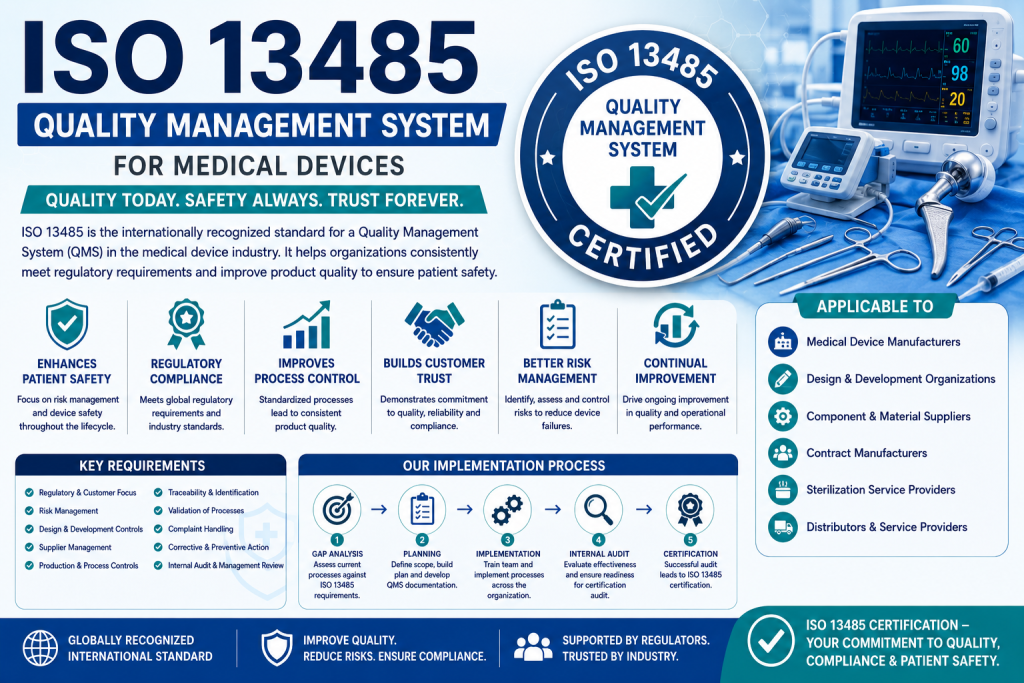
Medical devices are directly connected with patient safety, clinical performance, healthcare trust, and regulatory responsibility. Whether a company manufactures surgical instruments, diagnostic equipment, implants, hospital devices, software as a medical device, medical accessories, or components supplied to medical device manufacturers, quality cannot be treated as a simple production activity. Every process must be controlled, documented, verified, and improved. This is where ISO 13485 becomes important. ISO 13485 is a quality management system standard specifically designed for medical device organizations. It helps companies build a structured system to design, manufacture, install, service, store, distribute, and support medical devices in a controlled and regulatory-focused way.
What Is ISO 13485?
ISO 13485 is an international quality management system standard for medical devices. It defines requirements for organizations that need to demonstrate their ability to provide medical devices and related services that consistently meet customer and regulatory requirements.
In simple words, ISO 13485 helps medical device businesses manage quality in a systematic and controlled way.
It helps answer important questions such as:
- Are medical device processes properly controlled?
- Are regulatory requirements identified and followed?
- Are risks managed throughout the product lifecycle?
- Are suppliers properly evaluated?
- Are products traceable?
- Are design and development activities documented?
- Are production processes validated where required?
- Are complaints handled properly?
- Are corrective actions taken when problems occur?
- Are records maintained as evidence of compliance?
ISO 13485 is not just about producing a good product once. It is about proving that the organization has a reliable system to produce safe and effective medical devices consistently.
Why ISO 13485 Is Important
ISO 13485 is important because medical devices affect human health. A defect in a medical device can create serious consequences for patients, doctors, hospitals, manufacturers, and regulators. Unlike ordinary products, medical devices must be designed, manufactured, controlled, and monitored with a strong focus on safety, performance, and regulatory compliance.
ISO 13485 helps organizations:
- Improve medical device quality
- Strengthen regulatory compliance
- Improve patient safety focus
- Build customer and stakeholder trust
- Create controlled production processes
- Improve supplier management
- Support product traceability
- Improve complaint handling
- Strengthen corrective and preventive actions
- Support market access in regulated regions
- Improve audit readiness
- Reduce quality failures and recalls
For medical device companies, ISO 13485 certification can also support customer approval, tender participation, export readiness, distributor confidence, and regulatory submissions in several markets.
ISO 13485 Is Not a General Quality Standard
Many people confuse ISO 13485 with ISO 9001. ISO 9001 is a general quality management system standard for many types of organizations. ISO 13485 is specifically designed for the medical device industry.
The main difference is that ISO 13485 focuses heavily on regulatory requirements, risk control, documentation, traceability, process validation, sterile product controls, complaint handling, and medical device lifecycle management.
For example, a company making furniture may use ISO 9001. A company making surgical instruments, diagnostic devices, or medical equipment should consider ISO 13485 because medical devices need stronger regulatory and safety controls.
Who Should Implement ISO 13485?
ISO 13485 can be used by organizations involved in one or more stages of the medical device lifecycle.
It is useful for:
- Medical device manufacturers
- Medical device designers
- Component suppliers
- Contract manufacturers
- Sterilization service providers
- Packaging suppliers
- Importers and distributors
- Installation service providers
- Maintenance and servicing companies
- Medical device software companies
- Diagnostic equipment manufacturers
- Hospital equipment manufacturers
- Surgical instrument manufacturers
- Quality and regulatory service providers
- Companies supporting medical device supply chains
Even if an organization does not manufacture the final device, it may still need ISO 13485 if it supplies critical components, outsourced processes, design services, sterilization, packaging, or distribution support to medical device companies.
Main Objective of ISO 13485
The main objective of ISO 13485 is to help organizations consistently meet customer and regulatory requirements for medical devices and related services.
The standard focuses on:
- Product safety
- Product effectiveness
- Process control
- Regulatory compliance
- Risk-based quality management
- Documented evidence
- Customer satisfaction
- Supplier control
- Traceability
- Continual suitability of the QMS
Unlike some other management system standards, ISO 13485 is strongly compliance-driven. It expects organizations to maintain proper records, follow defined processes, and control changes carefully.
What Is a Medical Device Quality Management System?
A medical device Quality Management System, or QMS, is a structured system of policies, procedures, processes, records, responsibilities, controls, and improvement activities used to manage medical device quality.
A QMS helps control the full lifecycle of a medical device, including:
- Design and development
- Purchasing
- Supplier management
- Production
- Process validation
- Inspection and testing
- Sterilization control where applicable
- Storage and distribution
- Installation
- Servicing
- Complaint handling
- Nonconforming product control
- Corrective action
- Regulatory communication
- Post-market monitoring
The QMS ensures that quality is not dependent on individual memory or informal practices. It creates a repeatable and auditable system.
Key Principles of ISO 13485
1. Regulatory Focus
ISO 13485 gives strong importance to applicable regulatory requirements. Medical device organizations must identify and follow the legal and regulatory rules that apply to their products and markets.
Regulatory requirements may relate to:
- Device classification
- Product registration
- Labeling
- Clinical evaluation
- Risk management
- Manufacturing controls
- Sterilization
- Post-market surveillance
- Complaint reporting
- Adverse event reporting
- Import and distribution controls
A company selling in multiple countries may need to manage different regulatory requirements for each market.
2. Risk-Based Thinking
Risk management is central to medical device quality. ISO 13485 expects organizations to apply risk-based thinking across product realization and QMS processes.
Risk may relate to:
- Patient safety
- Product performance
- Manufacturing process failure
- Supplier failure
- Sterilization failure
- Software malfunction
- Labeling errors
- Storage damage
- Distribution failure
- Complaint trends
- Regulatory noncompliance
Risk control should begin during design and continue through production, distribution, use, servicing, and post-market activities.
3. Strong Documentation Control
Medical device organizations must maintain strong document and record control. Documentation is important because regulators, auditors, customers, and notified bodies often need evidence that processes are controlled.
Documents may include:
- Quality manual
- Procedures
- Work instructions
- Specifications
- Design records
- Risk management records
- Production records
- Inspection records
- Validation reports
- Supplier records
- Complaint records
- Corrective action records
In ISO 13485, “if it is not documented, it is difficult to prove.”
4. Product Lifecycle Control
ISO 13485 covers the full product lifecycle. This means quality must be managed from initial concept to post-market monitoring.
Lifecycle stages include:
- Product planning
- Design and development
- Design verification
- Design validation
- Purchasing
- Production
- Packaging
- Sterilization where applicable
- Storage
- Distribution
- Installation
- Servicing
- Complaint handling
- Post-market feedback
This lifecycle approach helps prevent quality failures at every stage.
5. Supplier and Outsourced Process Control
Many medical device companies depend on suppliers and outsourced partners. ISO 13485 requires organizations to control suppliers based on their impact on product quality and regulatory compliance.
Supplier controls may include:
- Supplier evaluation
- Supplier qualification
- Purchase specifications
- Quality agreements
- Incoming inspection
- Supplier audits
- Performance monitoring
- Corrective actions
- Change notification requirements
A weak supplier can create serious quality and compliance problems for the final device manufacturer.
6. Traceability
Traceability means the organization can track materials, components, production batches, inspection records, distribution details, and sometimes individual devices.
Traceability is especially important for:
- Implants
- Sterile devices
- High-risk devices
- Devices requiring recalls
- Critical components
- Products with batch-controlled materials
Traceability helps organizations respond quickly if a defect, complaint, recall, or safety issue occurs.
7. Corrective Action and Continual Control
ISO 13485 expects organizations to identify nonconformities, investigate root causes, take corrective actions, verify effectiveness, and prevent recurrence.
Corrective action should not be treated as a simple form. It should be a structured investigation and improvement process.
Main Clauses of ISO 13485 Explained
ISO 13485 has several important clauses that define how the medical device QMS should work.
Clause 4: Quality Management System
This clause requires the organization to establish, document, implement, and maintain a quality management system.
It includes requirements for:
- QMS processes
- Process interactions
- Documentation
- Quality manual
- Medical device file
- Document control
- Record control
The medical device file is especially important because it contains or references key documents needed to demonstrate conformity for each device or device family.
Clause 5: Management Responsibility
Top management must show commitment to the QMS. Quality cannot be treated as only the responsibility of the quality department.
Management responsibilities include:
- Quality policy
- Quality objectives
- Customer focus
- Regulatory focus
- Role assignment
- Management representative
- Internal communication
- Management review
Leadership must ensure that the QMS is suitable, effective, and aligned with regulatory requirements.
Clause 6: Resource Management
The organization must provide adequate resources for QMS implementation and product quality.
This includes:
- Competent personnel
- Training
- Infrastructure
- Work environment
- Contamination control where applicable
For medical devices, work environment can be very important. Cleanliness, contamination prevention, environmental monitoring, personnel hygiene, and controlled areas may be required depending on the product.
Clause 7: Product Realization
This is one of the most important clauses of ISO 13485. It covers how the medical device is planned, designed, purchased, produced, installed, serviced, and controlled.
It includes:
- Planning of product realization
- Customer-related processes
- Design and development
- Purchasing
- Production and service provision
- Process validation
- Identification and traceability
- Customer property
- Preservation of product
- Control of monitoring and measuring equipment
This clause connects directly with product quality and regulatory expectations.
Clause 8: Measurement, Analysis, and Improvement
This clause focuses on monitoring, measurement, complaint handling, internal audit, nonconforming product, data analysis, corrective action, and preventive action.
It helps the organization understand whether the QMS is working and where improvement is needed.
ISO 13485 Certification Process
ISO 13485 certification is usually performed by an independent certification body. The certification body audits the organization’s QMS and checks whether it meets the requirements of ISO 13485.
Step 1: Understand ISO 13485 Requirements
The organization should first understand how ISO 13485 applies to its products, services, processes, and markets.
Step 2: Define QMS Scope
The scope should clearly define what the QMS covers.
The scope may include:
- Design and development
- Manufacturing
- Packaging
- Sterilization
- Installation
- Servicing
- Distribution
- Specific device families
- Specific locations
A clear scope helps avoid audit confusion.
Step 3: Conduct Gap Analysis
Gap analysis compares the current system with ISO 13485 requirements.
It helps identify missing areas such as:
- Weak document control
- No medical device file
- Poor supplier controls
- Missing risk management records
- No design validation evidence
- Weak complaint process
- No internal audit program
- Poor CAPA process
Step 4: Prepare Implementation Plan
The organization should create an action plan with responsibilities, deadlines, resources, and priorities.
Step 5: Develop QMS Documentation
The company prepares or updates required documents such as quality manual, procedures, work instructions, forms, specifications, risk records, and validation plans.
Step 6: Implement Processes
The QMS must be applied in real operations. Employees should follow approved procedures and maintain records as evidence.
Step 7: Train Employees
Employees must understand their roles, procedures, quality responsibilities, regulatory expectations, and documentation requirements.
Step 8: Conduct Internal Audit
Internal audit checks whether the QMS meets ISO 13485 and whether processes are implemented effectively.
Step 9: Conduct Management Review
Top management reviews audit findings, quality objectives, customer feedback, complaints, process performance, supplier performance, regulatory changes, CAPA status, and improvement needs.
Step 10: Certification Audit Stage 1
The certification body reviews documentation, scope, readiness, and basic QMS structure.
Step 11: Certification Audit Stage 2
The auditor checks actual implementation through interviews, records, process review, production evidence, design records, supplier files, complaint records, and CAPA evidence.
Step 12: Corrective Actions
If nonconformities are found, the organization must correct them and provide evidence.
Step 13: Certificate Issuance
After successful audit closure, the certification body issues the ISO 13485 certificate.
Step 14: Surveillance Audits
Certification is maintained through periodic surveillance audits. The organization must continue following and improving the QMS.
ISO 13485 Implementation Roadmap
| Phase | Key Action | Expected Output |
|---|---|---|
| Phase 1 | Understand ISO 13485 requirements | Management and team awareness |
| Phase 2 | Define QMS scope | Clear certification boundary |
| Phase 3 | Conduct gap analysis | List of missing controls |
| Phase 4 | Identify regulatory requirements | Regulatory requirement register |
| Phase 5 | Create QMS documentation | Controlled procedures and forms |
| Phase 6 | Build medical device file | Product-specific evidence file |
| Phase 7 | Implement risk management | Risk records and controls |
| Phase 8 | Qualify suppliers | Approved supplier list |
| Phase 9 | Validate processes where needed | Validation records |
| Phase 10 | Train employees | Competent workforce |
| Phase 11 | Conduct internal audit | Audit findings |
| Phase 12 | Conduct management review | Leadership evaluation |
| Phase 13 | Complete certification audit | External assessment |
| Phase 14 | Maintain and improve QMS | Ongoing compliance |
Documents Commonly Required for ISO 13485
The exact documents depend on the organization’s activities, product type, device class, and regulatory markets. Common documents include:
- Quality manual
- QMS scope
- Quality policy
- Quality objectives
- Document control procedure
- Record control procedure
- Regulatory requirement register
- Medical device file
- Risk management file
- Design and development procedure
- Design planning records
- Design input records
- Design output records
- Design verification records
- Design validation records
- Design transfer records
- Supplier evaluation procedure
- Approved supplier list
- Purchasing records
- Incoming inspection records
- Production procedure
- Work instructions
- Equipment maintenance records
- Process validation records
- Sterilization validation records where applicable
- Cleanroom monitoring records where applicable
- Traceability records
- Batch production records
- Final inspection records
- Nonconforming product records
- Complaint handling procedure
- Complaint records
- Corrective action procedure
- CAPA records
- Internal audit reports
- Management review records
- Training records
- Servicing records where applicable
- Installation records where applicable
Documentation should be practical, controlled, and accurate. Copy-paste documents that do not match real operations can create serious audit problems.
What Is a Medical Device File?
A medical device file contains or references documents that show how a specific medical device or device family is controlled.
It may include:
- Device description
- Intended use
- Product specifications
- Manufacturing process
- Packaging specifications
- Labeling and instructions for use
- Installation requirements
- Servicing procedures
- Acceptance criteria
- Risk management references
- Regulatory requirements
- Traceability requirements
The medical device file helps auditors and regulators understand how the organization controls each device.
Design and Development Controls
Design control is one of the most important parts of ISO 13485 for organizations that design medical devices.
Design and development usually includes:
- Design planning
- Design inputs
- Design outputs
- Design review
- Design verification
- Design validation
- Design transfer
- Design changes
- Design records
Design Input
Design input defines what the device must do. It may include customer needs, regulatory requirements, safety requirements, performance needs, usability, materials, labeling, and risk controls.
Design Output
Design output includes drawings, specifications, software code, manufacturing instructions, materials, acceptance criteria, and product documentation.
Design Verification
Verification checks whether design outputs meet design inputs. In simple words, “Did we design it correctly?”
Design Validation
Validation checks whether the final device meets user needs and intended use. In simple words, “Did we design the right device?”
Design Transfer
Design transfer ensures that the approved design can be correctly manufactured under controlled production conditions.
Risk Management in ISO 13485
Risk management is essential in medical devices because device failure may harm patients or users.
Risk management may include:
- Hazard identification
- Risk estimation
- Risk evaluation
- Risk control
- Residual risk review
- Benefit-risk analysis where needed
- Production and post-production risk monitoring
Common medical device risks include:
- Electrical safety failure
- Software malfunction
- Biocompatibility issue
- Sterility failure
- Incorrect labeling
- Mechanical failure
- Usability error
- Packaging damage
- Wrong measurement output
- Material incompatibility
Risk management should not be a one-time activity. It should continue throughout the product lifecycle.
Supplier Management in ISO 13485
Suppliers can directly affect medical device safety and performance. ISO 13485 requires strong purchasing controls.
Supplier control should include:
- Supplier evaluation
- Supplier selection criteria
- Supplier approval
- Purchase requirements
- Supplier quality agreements
- Incoming inspection
- Supplier performance monitoring
- Supplier corrective actions
- Supplier re-evaluation
- Change notification control
Critical suppliers may need stronger controls than low-risk suppliers. For example, a supplier providing sterile packaging or implant material may require more detailed evaluation than an office stationery supplier.
Process Validation
Some production processes cannot be fully verified by final inspection. In such cases, process validation is required.
Examples may include:
- Sterilization
- Welding
- Bonding
- Cleanroom processes
- Software-controlled production
- Coating processes
- Heat treatment
- Sealing processes
- Molding processes
Process validation proves that a process can consistently produce expected results under defined conditions.
Validation records may include:
- Validation plan
- Acceptance criteria
- Installation qualification
- Operational qualification
- Performance qualification
- Test results
- Deviations
- Approval records
- Revalidation requirements
Complaint Handling
Complaint handling is a critical ISO 13485 requirement. Medical device companies must have a process to receive, record, evaluate, investigate, and respond to complaints.
Complaint handling should include:
- Complaint receipt
- Complaint classification
- Product identification
- Investigation
- Risk evaluation
- Regulatory reporting decision
- Corrective action if needed
- Customer response
- Trend analysis
- Record retention
Complaints can reveal product defects, usability issues, labeling problems, supplier failures, or process weaknesses.
CAPA in ISO 13485
CAPA stands for Corrective and Preventive Action. It is one of the most important quality processes in medical device QMS.
A strong CAPA process includes:
- Problem identification
- Root cause analysis
- Risk evaluation
- Action planning
- Implementation
- Effectiveness verification
- Record closure
- Trend monitoring
CAPA should be used for significant quality issues, repeated problems, audit findings, complaint trends, supplier issues, process failures, and regulatory concerns.
A weak CAPA system is one of the most common reasons for audit findings.
Traceability and Product Identification
ISO 13485 requires organizations to identify products throughout production, storage, distribution, and servicing where applicable.
Traceability may include:
- Raw material batch
- Component lot
- Production batch
- Serial number
- Inspection status
- Sterilization batch
- Packaging batch
- Distribution record
- Customer or hospital shipment record
Traceability supports recall management, complaint investigation, field safety corrective actions, and regulatory reporting.
ISO 13485 vs ISO 9001
| Point | ISO 9001 | ISO 13485 |
|---|---|---|
| Main Focus | General quality management | Medical device quality management |
| Industry | Any industry | Medical device industry |
| Regulatory Focus | General | Strong regulatory focus |
| Risk Management | Broad business risk | Medical device safety and regulatory risk |
| Documentation | Flexible | More documentation-focused |
| Design Control | General | Medical device lifecycle-focused |
| Complaint Handling | General customer feedback | Medical device complaint and regulatory focus |
| Certification Use | General business credibility | Medical device compliance and market access support |
ISO 13485 is more suitable for medical device companies because it addresses the regulatory nature of the industry.
ISO 13485 and Regulatory Compliance
ISO 13485 certification does not automatically approve a medical device for sale in every country. Medical device market approval depends on local regulations.
However, ISO 13485 supports regulatory compliance by creating a strong quality system.
It may support:
- Regulatory submissions
- Customer audits
- Notified body audits
- Supplier qualification
- Export readiness
- Medical device registration
- Post-market surveillance
- Complaint and vigilance processes
Organizations should always check the specific regulatory requirements of their target market.
Benefits of ISO 13485 Certification
1. Better Medical Device Quality
ISO 13485 helps organizations control processes and reduce quality failures.
2. Stronger Regulatory Readiness
The standard supports documentation, traceability, risk management, and regulatory compliance.
3. Improved Customer Trust
Hospitals, distributors, regulators, and medical device manufacturers prefer working with controlled and certified suppliers.
4. Better Supplier Control
Supplier evaluation and monitoring reduce the risk of defective components or materials.
5. Improved Product Traceability
Traceability helps organizations respond quickly to complaints, recalls, and quality issues.
6. Stronger Audit Preparedness
ISO 13485 creates a structured system for audits by customers, certification bodies, and regulators.
7. Better Complaint and CAPA Management
The standard improves how organizations investigate complaints and prevent repeat problems.
8. Support for Market Access
Certification can support entry into regulated medical device supply chains and international markets.
9. More Consistent Production
Controlled procedures markets.
9. More Consistent Production
Controlled procedures, validation, inspection, and training improve production consistency.
10. Improved Business Credibility
ISO 13485 certification shows commitment to medical device quality and regulatory responsibility.
Common Mistakes During ISO 13485 Implementation
1. Treating ISO 13485 Like ISO 9001
ISO 13485 is more regulatory-focused and documentation-heavy than ISO 9001. Medical device companies must address specific device lifecycle requirements.
2. Weak Regulatory Requirement Identification
Organizations must know which regulatory requirements apply to their products and markets.
3. Poor Risk Management
Risk management should be linked with design, production, complaints, suppliers, and post-market feedback.
4. Incomplete Medical Device File
A missing or weak medical device file can create major audit findings.
5. Weak Supplier Controls
Suppliers must be evaluated based on their impact on product quality and regulatory compliance.
6. Poor Process Validation
Processes that cannot be fully verified later must be validated properly.
7. Inadequate Complaint Investigation
Complaints should not be closed without proper evaluation, investigation, and regulatory review.
8. Weak CAPA Root Cause Analysis
CAPA actions should address root causes, not just symptoms.
9. Poor Training Records
Employees must be trained and competent for assigned tasks.
10. Uncontrolled Documents
Using outdated drawings, procedures, or specifications can create serious product quality problems.
ISO 13485 Audit Preparation Checklist
Use this checklist before certification audit:
- Is the QMS scope clearly defined?
- Is the quality manual available?
- Are quality policy and objectives approved?
- Are regulatory requirements identified?
- Is the medical device file maintained?
- Are documents controlled?
- Are records controlled?
- Are roles and responsibilities defined?
- Are employees trained?
- Are design records complete where applicable?
- Is risk management implemented?
- Are suppliers evaluated and approved?
- Are purchasing records controlled?
- Are production processes documented?
- Are process validations completed where required?
- Is traceability maintained?
- Are inspection and test records available?
- Are nonconforming products controlled?
- Are complaints recorded and investigated?
- Are CAPA records complete?
- Are internal audits conducted?
- Is management review completed?
- Are customer and regulatory feedback reviewed?
- Are equipment calibration records available?
- Are storage and distribution controls defined?
Best Practices for ISO 13485 Implementation
Start With Regulatory Requirements
Before writing procedures, identify the regulatory requirements for your product and target markets.
Build a Real Medical Device File
Create a product-specific file that clearly references specifications, manufacturing controls, labeling, risk records, and quality evidence.
Connect Risk Management With QMS Processes
Risk management should not be limited to design. It should connect with suppliers, production, complaints, CAPA, and post-market feedback.
Keep Documents Practical
Documents should reflect real work practices. Avoid generic procedures that employees cannot follow.
Train Employees by Role
Production, quality, regulatory, design, purchasing, warehouse, and servicing teams need role-specific training.
Control Suppliers Carefully
Critical suppliers should be monitored more closely than low-risk suppliers.
Validate Special Processes
Any process that cannot be fully verified by later inspection should be validated.
Review Complaints Seriously
Complaints are important quality signals. They should be investigated and trended.
Use CAPA for Real Improvement
CAPA should identify root causes and verify whether actions are effective.
Prepare for Audits Continuously
Audit readiness should be part of daily operations, not a last-minute activity.
Practical Examples of ISO 13485 in Action
Example 1: Surgical Instrument Manufacturer
A surgical instrument manufacturer uses ISO 13485 to control raw materials, machining, polishing, passivation, inspection, labeling, and traceability. Supplier quality and final inspection records help prove product conformity.
Example 2: Diagnostic Device Company
A diagnostic device company applies design controls, verification, validation, software documentation, risk management, and complaint handling to ensure the device performs reliably.
Example 3: Sterile Packaging Supplier
A packaging supplier serving medical device manufacturers uses ISO 13485 to control cleanroom conditions, sealing validation, material traceability, and customer specifications.
Example 4: Medical Device Distributor
A distributor uses ISO 13485 principles to manage storage conditions, product traceability, customer complaints, recalls, and supplier communication.
Example 5: Software as a Medical Device Company
A medical software company uses design control, risk management, cybersecurity considerations, validation, change control, and complaint monitoring to manage product quality.
Cost Factors for ISO 13485 Certification
The cost of ISO 13485 certification depends on many factors:
- Organization size
- Number of employees
- Number of sites
- Product complexity
- Device risk class
- Design responsibility
- Manufacturing complexity
- Sterilization requirements
- Supplier network
- Current documentation maturity
- Consultant involvement
- Certification body fees
- Training requirements
- Internal audit effort
- Corrective action effort
A simple distributor may need less effort than a manufacturer designing and producing high-risk medical devices.
How Long Does ISO 13485 Implementation Take?
The timeline depends on the organization’s current quality maturity, product complexity, documentation readiness, regulatory requirements, and resource availability.
Important timeline factors include:
- Existing QMS maturity
- Design control requirements
- Risk management readiness
- Supplier documentation availability
- Process validation needs
- Training requirements
- Internal audit findings
- Management commitment
- Certification body availability
The goal should not be fast certification only. The goal should be a working QMS that supports medical device safety, compliance, and business credibility.
Frequently Asked Questions
1. What is ISO 13485?
ISO 13485 is an international quality management system standard for organizations involved in medical devices and related services.
2. Is ISO 13485 only for manufacturers?
No. It can also apply to designers, suppliers, contract manufacturers, distributors, service providers, installers, and other organizations involved in the medical device lifecycle.
3. Is ISO 13485 certification mandatory?
It depends on the country, product type, customer requirement, and regulatory pathway. In many cases, it is strongly expected or required by customers, regulators, or market access programs.
4. What is the difference between ISO 13485 and ISO 9001?
ISO 9001 is a general quality standard. ISO 13485 is specifically designed for medical devices and has stronger regulatory, documentation, risk, and traceability requirements.
5. Who issues ISO 13485 certificates?
ISO 13485 certificates are issued by independent certification bodies after successful audits. ISO itself does not issue certificates.
6. What is a medical device file?
A medical device file contains or references key documents that define and control a medical device or device family.
7. What documents are needed for ISO 13485?
Common documents include quality manual, procedures, medical device file, risk management records, design records, supplier records, production records, validation records, complaint records, CAPA records, internal audit reports, and management review records.
8. Does ISO 13485 guarantee regulatory approval?
No. ISO 13485 supports regulatory compliance, but device approval depends on specific laws and regulatory requirements in the target market.
9. Can small medical device companies implement ISO 13485?
Yes. Small companies can implement ISO 13485 in a practical way based on their product scope, risk level, and regulatory requirements.
10. What is the main benefit of ISO 13485?
The main benefit is a structured medical device quality system that improves product control, regulatory readiness, traceability, customer confidence, and patient safety focus.
Conclusion
ISO 13485 is a critical quality management system standard for medical device organizations. It helps companies build controlled, documented, and regulatory-focused processes for designing, manufacturing, supplying, installing, servicing, and supporting medical devices. The standard is especially important because medical devices directly affect patient safety and healthcare outcomes. A strong ISO 13485 QMS improves supplier control, risk management, traceability, complaint handling, CAPA, production control, and audit readiness. However, the real value of ISO 13485 is not only certification. Its real value is creating a disciplined quality culture where every prcess supports safe, effective, and compliant medical devices.