Introduction
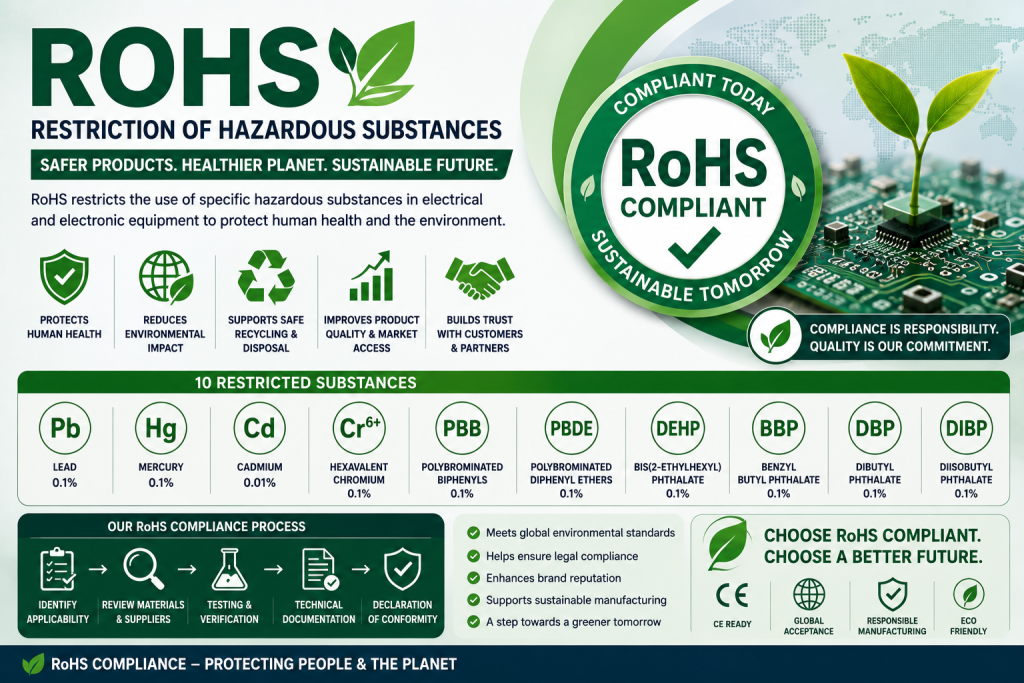
RoHS, also known as Restriction of Hazardous Substances, is one of the most important compliance requirements for businesses that manufacture, import, export, or sell electrical and electronic products. Modern electronics often contain metals, plastics, flame retardants, soldering materials, cables, batteries, circuit boards, sensors, and many small components. Some of these materials may contain hazardous substances that can harm human health and the environment if they are not controlled properly. RoHS helps reduce the use of such hazardous substances in electrical and electronic equipment. For businesses, RoHS compliance is not only a legal requirement in many markets; it is also a sign of responsible manufacturing, safer products, better supply-chain control, and environmental awareness.
What Is RoHS?
RoHS stands for Restriction of Hazardous Substances. It is a regulatory framework that restricts the use of certain harmful substances in electrical and electronic equipment.
In simple words, RoHS means that certain hazardous materials should not be present above permitted limits in electrical and electronic products.
RoHS mainly focuses on substances such as:
- Lead
- Mercury
- Cadmium
- Hexavalent chromium
- Certain flame retardants
- Certain phthalates
These substances may be used in solder, cables, plastics, coatings, paints, circuit boards, connectors, switches, batteries, and other electronic components. If not controlled, they may create health and environmental risks during manufacturing, use, recycling, or disposal.
Why RoHS Is Important
RoHS is important because electrical and electronic waste is a major environmental concern. Electronic products are used everywhere: homes, offices, factories, hospitals, schools, vehicles, communication systems, consumer gadgets, industrial machines, and smart devices. When these products become waste, hazardous substances can enter soil, water, air, and recycling systems.
RoHS helps reduce these risks by encouraging safer materials and better product design.
Key Reasons RoHS Matters
- It reduces hazardous substances in electronic products.
- It supports safer recycling and disposal.
- It protects workers involved in manufacturing and waste handling.
- It helps reduce environmental pollution.
- It improves product responsibility.
- It supports market access in regulated regions.
- It improves customer and buyer confidence.
- It strengthens supplier and material control.
- It supports sustainable manufacturing.
For manufacturers and exporters, RoHS compliance can be essential for selling products in the European market and other regions that follow similar hazardous substance restrictions.
RoHS Is Not Just a Label
Many businesses think RoHS compliance is simply a label or declaration printed on a product brochure. This is incorrect. RoHS compliance must be supported by evidence.
A product should be called RoHS compliant only when the company can prove that the restricted substances are within permitted limits in the relevant materials and components.
This proof may include:
- Supplier declarations
- Material declarations
- Test reports
- Bill of materials review
- Technical documentation
- Risk assessment
- Component certificates
- RoHS Declaration of Conformity
- Internal compliance records
A simple supplier statement without verification may not be enough for high-risk products or serious buyers.
Products Commonly Covered Under RoHS
RoHS generally applies to electrical and electronic equipment. This means products that depend on electric current or electromagnetic fields to work properly.
Common product categories may include:
- Consumer electronics
- Home appliances
- IT equipment
- Telecom equipment
- Lighting products
- Electrical tools
- Toys with electronic parts
- Medical devices
- Monitoring and control instruments
- Automatic dispensers
- Cables
- Circuit boards
- Control panels
- Industrial electronic devices
- Smart devices
- Sensors and electronic modules
Examples include mobile chargers, laptops, printers, LED lights, washing machines, electronic toys, routers, power adapters, control units, cables, switches, circuit boards, and electronic measuring instruments.
Products That May Be Outside RoHS Scope
Not every product automatically falls under RoHS. Some products may be excluded or handled under different rules depending on market, product category, application, and legal framework.
Examples may include some large-scale fixed installations, certain military equipment, some transport-related equipment, or specific exempted applications. The exact treatment depends on the applicable regulation and product use.
Businesses should not assume that a product is outside scope without checking the relevant legal requirements.
Restricted Substances Under RoHS
RoHS currently focuses on 10 major restricted substances in electrical and electronic equipment.
| Restricted Substance | Common Use or Risk Area | Typical Limit in Homogeneous Material |
|---|---|---|
| Lead | Solder, glass, pigments, metal alloys | 0.1% |
| Mercury | Switches, lamps, sensors | 0.1% |
| Cadmium | Batteries, pigments, coatings | 0.01% |
| Hexavalent Chromium | Anti-corrosion coatings, surface treatment | 0.1% |
| PBB | Flame retardants in plastics | 0.1% |
| PBDE | Flame retardants in plastics | 0.1% |
| DEHP | Plasticizer in cables and plastics | 0.1% |
| BBP | Plasticizer in flexible materials | 0.1% |
| DBP | Plasticizer in plastics and polymers | 0.1% |
| DIBP | Plasticizer in plastics and polymers | 0.1% |
The limits are generally measured in homogeneous material. This means the smallest material part that cannot be mechanically separated into different materials.
What Is Homogeneous Material?
Homogeneous material is an important concept in RoHS compliance. It means a material that has a uniform composition throughout and cannot be mechanically separated into different materials.
For example:
- Plastic insulation on a wire may be one homogeneous material.
- Copper conductor inside the wire may be another homogeneous material.
- Solder on a circuit board may be another homogeneous material.
- Coating on a metal part may be another homogeneous material.
- A plastic housing may be another homogeneous material.
RoHS limits do not apply only to the total weight of the complete product. They apply to each homogeneous material. This is why a small component can create non-compliance even if the full product looks safe.
RoHS Compliance vs RoHS Certification
Many businesses use the term “RoHS certification,” but the more accurate term is usually “RoHS compliance.”
RoHS compliance means the product meets applicable RoHS requirements and the company has evidence to support the claim.
RoHS certification may refer to a third-party test report, compliance certificate, or declaration issued by a testing laboratory or certification body. However, the legal responsibility usually remains with the manufacturer, importer, or economic operator placing the product on the market.
In simple words:
- RoHS compliance is the legal and technical requirement.
- RoHS testing provides evidence.
- RoHS declaration communicates responsibility.
- RoHS certificate may support buyer confidence but does not replace compliance responsibility.
Who Is Responsible for RoHS Compliance?
RoHS responsibility depends on the role of the business in the supply chain.
Manufacturer
The manufacturer is mainly responsible for designing and producing RoHS-compliant products. The manufacturer must ensure components, materials, documentation, and declarations are properly controlled.
Importer
The importer must ensure that products brought into the market comply with applicable requirements. Importers should verify documentation, supplier declarations, technical files, and product labeling.
Distributor
Distributors must act responsibly and should not sell products they know or suspect are non-compliant.
Private Label Brand
If a company sells a product under its own brand name, it may take responsibility similar to a manufacturer, even if another factory actually made the product.
Supplier
Suppliers provide materials, components, assemblies, or finished goods. They must provide accurate material information, declarations, and test evidence where required.
Why Businesses Need RoHS Compliance
RoHS compliance is important for both legal and business reasons.
1. Market Access
Products that fall under RoHS rules may need compliance before they can be sold in regulated markets.
2. Customer Trust
Buyers, distributors, and enterprise customers often request RoHS declarations before approving products.
3. Environmental Responsibility
RoHS supports cleaner product design and safer end-of-life recycling.
4. Reduced Legal Risk
Non-compliant products may face rejection, recall, penalties, or sales restrictions.
5. Better Supply-Chain Control
RoHS forces businesses to verify materials, suppliers, and component sources.
6. Competitive Advantage
A RoHS-compliant product can be more acceptable to global buyers and regulated industries.
Step-by-Step RoHS Compliance Process
Step 1: Identify Whether the Product Is in Scope
The first step is to check whether your product falls under RoHS requirements. Ask:
- Is it electrical or electronic equipment?
- Does it need electricity or electromagnetic fields to work?
- Is it being sold in a market where RoHS applies?
- Does it fall under any exemption?
- Is it part of another regulated product?
This step prevents unnecessary testing and avoids false compliance claims.
Step 2: Create a Bill of Materials
A Bill of Materials, or BOM, lists all parts, components, materials, and assemblies used in the product.
A BOM may include:
- Printed circuit boards
- Resistors
- Capacitors
- Cables
- Connectors
- Plastic housing
- Screws
- Coatings
- Displays
- Batteries
- Sensors
- Switches
- Packaging components where relevant
The BOM is the foundation of RoHS compliance because every material risk must be traced.
Step 3: Identify High-Risk Materials
Not all materials have the same RoHS risk. Some materials are more likely to contain restricted substances.
High-risk areas may include:
- Solder joints
- PVC cables
- Plasticizers
- Flame-retardant plastics
- Metal coatings
- Painted surfaces
- Batteries
- Connectors
- Switches
- Older components
- Low-cost unknown suppliers
- Recycled materials
A proper risk review helps decide where testing or stronger supplier evidence is needed.
Step 4: Collect Supplier Declarations
Suppliers should provide declarations confirming that their components or materials meet RoHS requirements.
Supplier declarations should ideally include:
- Supplier name
- Product or part number
- RoHS compliance statement
- Restricted substance status
- Reference to applicable regulation
- Date of issue
- Authorized signature
- Contact details
- Validity or revision control
Old, vague, unsigned, or generic declarations should be reviewed carefully.
Step 5: Review Material and Component Data
The company should review material declarations, product specifications, certificates, and test reports to confirm compliance.
Useful documents may include:
- Full material declarations
- Supplier RoHS declarations
- Test reports
- Safety data sheets
- Material specifications
- Component drawings
- Compliance certificates
- Manufacturing process information
The goal is to verify that restricted substances are controlled at the material level.
Step 6: Conduct RoHS Testing Where Needed
Testing may be required when supplier evidence is weak, materials are high risk, or customers request laboratory proof.
Common RoHS testing methods include:
- XRF screening
- Wet chemical testing
- ICP analysis
- GC-MS for phthalates
- UV-Vis testing for certain chromium analysis
Testing should be done by a competent laboratory, especially for products entering regulated markets or large buyer supply chains.
Step 7: Prepare Technical Documentation
Technical documentation is the evidence package that supports RoHS compliance.
It may include:
- Product description
- Bill of materials
- Supplier declarations
- Material declarations
- Risk assessment
- Test reports
- Product drawings
- Component specifications
- Manufacturing controls
- Change control records
- RoHS compliance statement
- Declaration of Conformity where required
Documentation should be organized and available when customers, auditors, importers, or authorities request it.
Step 8: Issue RoHS Declaration
After confirming compliance, the manufacturer may issue a RoHS Declaration of Conformity or RoHS compliance statement.
The declaration should include:
- Manufacturer name and address
- Product name and model
- Applicable RoHS requirement
- Statement of compliance
- Responsible person
- Date of issue
- Signature
- Supporting document reference
A declaration should not be issued unless the business has sufficient evidence.
Step 9: Apply CE Marking Where Applicable
For many electrical and electronic products sold in the European market, RoHS is linked with CE marking. If the product falls under CE marking requirements, RoHS compliance must be considered as part of the overall conformity assessment.
This means the manufacturer may need:
- Technical documentation
- EU Declaration of Conformity
- CE marking on the product
- Compliance with all other applicable EU product rules
RoHS compliance alone may not be enough if the product also falls under other rules such as electrical safety, EMC, radio equipment, machinery, or battery regulations.
Step 10: Maintain Ongoing Compliance
RoHS compliance is not a one-time activity. Products, suppliers, components, materials, and laws may change.
A business should review RoHS compliance when:
- A supplier changes
- A component changes
- A material changes
- A product design changes
- A manufacturing process changes
- A regulation changes
- A customer requests updated evidence
- A test report becomes outdated
- A product complaint occurs
Ongoing compliance is essential for long-term market trust.
RoHS Compliance Process Summary
| Step | Action | Expected Output |
|---|---|---|
| 1 | Check product scope | RoHS applicability decision |
| 2 | Prepare Bill of Materials | Complete material and component list |
| 3 | Identify high-risk materials | Risk-based compliance plan |
| 4 | Collect supplier declarations | Supplier compliance evidence |
| 5 | Review material data | Verified documentation |
| 6 | Conduct testing where required | Test reports |
| 7 | Prepare technical documentation | RoHS technical file |
| 8 | Issue declaration | RoHS compliance statement |
| 9 | Apply CE marking if applicable | Product market readiness |
| 10 | Monitor changes | Ongoing compliance control |
Documents Required for RoHS Compliance
Common documents may include:
- Product description
- Product model list
- Bill of Materials
- Supplier declarations
- Material declarations
- RoHS test reports
- Technical drawings
- Component specifications
- Manufacturing process details
- Risk assessment
- Quality control records
- Change control records
- EU Declaration of Conformity where applicable
- CE marking documentation where applicable
- Customer compliance declarations
- Laboratory certificates
- Internal audit records
- Corrective action records
The exact documents depend on the product, market, supply chain complexity, and buyer requirements.
RoHS Testing Explained
RoHS testing checks whether restricted substances are present above permitted levels in product materials.
XRF Screening
XRF screening is commonly used for fast material screening. It can detect elements such as lead, mercury, cadmium, chromium, and bromine. However, it may not always confirm exact chemical forms, such as hexavalent chromium, and may need further testing.
Wet Chemical Testing
Wet chemical testing is more detailed and can confirm certain substances more accurately.
Phthalate Testing
For substances like DEHP, BBP, DBP, and DIBP, specialized testing such as GC-MS may be used.
Testing should be based on risk. A complex electronic product may require testing of selected high-risk components rather than every single part, depending on compliance strategy and evidence quality.
RoHS and CE Marking
RoHS is closely connected with CE marking for many products sold in the European market. If RoHS applies to a product, the manufacturer must include RoHS compliance in the EU Declaration of Conformity.
This means a CE-marked electrical or electronic product may need to comply with RoHS along with other applicable requirements.
For example, an LED light may need to consider:
- RoHS
- Low voltage safety
- Electromagnetic compatibility
- Ecodesign rules
- Energy labeling rules
- WEEE obligations
- Packaging requirements
CE marking should not be treated as only a logo. It must be supported by proper documentation.
RoHS vs REACH
RoHS and REACH are both chemical-related regulations, but they are different.
RoHS
RoHS restricts specific hazardous substances in electrical and electronic equipment.
REACH
REACH deals with chemical registration, evaluation, authorization, and restriction across a broader range of products and substances.
A product may need to comply with both RoHS and REACH. For example, an electronic device may meet RoHS limits but still need REACH substance communication if it contains certain substances of very high concern.
Businesses should not assume that RoHS compliance automatically means REACH compliance.
RoHS vs WEEE
RoHS and WEEE are connected but different.
RoHS
RoHS focuses on restricting hazardous substances inside electrical and electronic equipment.
WEEE
WEEE focuses on collection, recycling, and proper disposal of waste electrical and electronic equipment.
RoHS helps make electronic waste safer to recycle, while WEEE manages the end-of-life responsibility of electronic products.
RoHS for Manufacturers
Manufacturers should build RoHS compliance into product design and sourcing.
Key actions include:
- Choose compliant components
- Avoid restricted substances during design
- Approve reliable suppliers
- Maintain material declarations
- Test high-risk materials
- Keep technical documentation
- Control product changes
- Train purchasing and engineering teams
- Review supplier performance
- Prepare declarations accurately
Manufacturers should not wait until production is complete. RoHS should be considered during design and procurement.
RoHS for Importers
Importers must verify that products they bring into a regulated market are compliant.
Importers should check:
- Product scope
- Supplier declaration
- Test reports
- Technical documentation availability
- Product labeling
- CE documentation where applicable
- Manufacturer details
- Traceability records
- Component change history
Importers should not depend only on a supplier’s verbal assurance.
RoHS for Exporters
Exporters selling electrical and electronic products to Europe or other RoHS-regulated markets should prepare compliance documentation before shipment.
Exporters should ensure:
- Product is in scope
- Restricted substances are controlled
- Supplier documents are valid
- Test reports match the actual product
- Declaration is accurate
- Buyer requirements are understood
- Labeling and documentation are correct
Non-compliant shipments may face delays, rejection, or customer claims.
Common Mistakes in RoHS Compliance
1. Thinking RoHS Applies Only to Finished Products
RoHS applies at the homogeneous material level. Small parts and coatings can create non-compliance.
2. Relying Only on Supplier Claims
Supplier claims should be supported by declarations, test reports, or material data.
3. Ignoring Phthalates
Some businesses focus only on heavy metals and forget the four restricted phthalates.
4. Using Old Test Reports
Test reports should match the current product design, supplier, material, and production version.
5. Not Controlling Component Changes
A supplier may change materials without notice. Change control is essential.
6. Confusing RoHS With REACH
RoHS and REACH are different requirements. Compliance with one does not automatically prove compliance with the other.
7. No Technical File
Without documentation, it becomes difficult to prove compliance during audits or authority checks.
8. Testing Only the Final Product
Testing a final product may not identify all material-level risks. BOM review and material-level control are important.
9. Ignoring Exemptions and Updates
Some exemptions may expire or change. Businesses must monitor updates.
10. Incorrect Declaration
A declaration must be accurate, product-specific, and supported by evidence.
RoHS Compliance Checklist
Use this checklist before claiming RoHS compliance:
- Is the product electrical or electronic equipment?
- Is RoHS applicable in the target market?
- Has the full Bill of Materials been prepared?
- Are all suppliers identified?
- Are high-risk components reviewed?
- Are supplier declarations collected?
- Are test reports available where needed?
- Are phthalates included in compliance review?
- Are material declarations available?
- Is homogeneous material risk considered?
- Is the technical file prepared?
- Is the declaration accurate?
- Are CE requirements checked where applicable?
- Are product changes controlled?
- Are supplier changes monitored?
- Are records updated regularly?
- Are exemptions reviewed if used?
- Are documents available for customers or authorities?
Benefits of RoHS Compliance
1. Safer Products
RoHS helps reduce harmful substances in electrical and electronic products.
2. Environmental Protection
It supports safer recycling and reduces hazardous waste risks.
3. Better Market Access
RoHS compliance is required for many electrical and electronic products in regulated markets.
4. Stronger Buyer Confidence
Customers and distributors often prefer compliant and well-documented products.
5. Better Supply-Chain Control
RoHS compliance improves supplier evaluation and material traceability.
6. Reduced Business Risk
Proper compliance reduces the risk of penalties, recalls, rejected shipments, and reputation damage.
7. Support for Sustainable Manufacturing
RoHS encourages safer material selection and cleaner product design.
Best Practices for Successful RoHS Compliance
Start During Product Design
Choose compliant materials and components from the beginning.
Maintain a Complete BOM
A complete Bill of Materials helps trace compliance across the product.
Use Approved Suppliers
Work with suppliers that understand RoHS and provide reliable documentation.
Test High-Risk Materials
Use testing where supplier evidence is weak or material risk is high.
Keep Records Organized
Maintain declarations, test reports, specifications, and technical files.
Review Changes Carefully
Any material, supplier, or component change can affect compliance.
Train Internal Teams
Engineering, purchase, quality, production, and sales teams should understand RoHS responsibilities.
Monitor Regulatory Updates
Restricted substances, exemptions, and documentation expectations can change.
Avoid Generic Declarations
Declarations should be product-specific and evidence-based.
Integrate RoHS With Quality Management
RoHS should be part of supplier approval, incoming inspection, product development, and change control.
Real-Life Examples
Example 1: LED Light Manufacturer
An LED light manufacturer reviews solder, wires, PCB, plastic housing, and coating materials. It collects supplier declarations and tests high-risk plastic parts before issuing a RoHS declaration.
Example 2: Cable Supplier
A cable supplier checks PVC insulation for lead stabilizers and phthalates. After testing, the supplier replaces risky materials with compliant alternatives.
Example 3: Electronics Importer
An importer receives a product with a RoHS logo but no test report. The importer requests the BOM, supplier declarations, and laboratory reports before selling it.
Example 4: Toy With Electronic Sound Module
A toy company checks both toy safety and RoHS requirements because the toy contains batteries, circuit boards, wires, and sound components.
Example 5: Industrial Control Panel
A control panel manufacturer reviews switches, circuit boards, wiring, coatings, terminals, and displays to ensure compliance before exporting.
Cost Factors for RoHS Compliance
The cost of RoHS compliance depends on many factors:
- Product complexity
- Number of components
- Number of suppliers
- Testing requirements
- Material risk level
- Laboratory charges
- Documentation readiness
- Consultant support
- Need for repeated testing
- Number of product models
- Change control maturity
- Buyer documentation requirements
A simple electronic accessory may need less effort than a complex industrial machine with hundreds of electronic components.
How Long Does RoHS Compliance Take?
The timeline depends on how ready the product and supply chain are.
Important factors include:
- Availability of BOM
- Supplier response time
- Test laboratory timeline
- Number of high-risk materials
- Documentation quality
- Product redesign needs
- Customer requirements
- Internal review process
Businesses should begin RoHS planning early instead of waiting until shipment or customer audit.
Frequently Asked Questions
1. What does RoHS mean?
RoHS means Restriction of Hazardous Substances. It restricts certain hazardous materials in electrical and electronic equipment.
2. Which products need RoHS compliance?
RoHS generally applies to electrical and electronic equipment, such as electronics, appliances, lighting, IT equipment, cables, and electronic tools.
3. What substances are restricted under RoHS?
RoHS restricts substances such as lead, mercury, cadmium, hexavalent chromium, PBB, PBDE, DEHP, BBP, DBP, and DIBP.
4. Is RoHS the same as CE marking?
No. RoHS is a hazardous substance restriction. CE marking is a broader conformity mark for certain products. Many electronic products may need both.
5. Is RoHS testing mandatory?
Testing depends on the product, risk level, supplier evidence, customer requirement, and compliance strategy. However, the company must have sufficient evidence to prove compliance.
6. What is a RoHS declaration?
A RoHS declaration is a statement by the manufacturer or supplier confirming that the product meets applicable RoHS requirements.
7. What is homogeneous material in RoHS?
Homogeneous material is a material with uniform composition that cannot be mechanically separated into different materials.
8. Can a product be RoHS compliant without a test report?
It may be possible if strong supplier and material evidence is available. However, testing is often used for high-risk materials or customer assurance.
9. Does RoHS apply outside Europe?
Many countries have their own RoHS-style rules. Businesses should check the target market requirements.
10. What happens if a product is not RoHS compliant?
The product may face sales restrictions, rejection, recall, penalties, customer claims, or market access problems.
Conclusion
RoHS Restriction of Hazardous Substances is a critical compliance requirement for electrical and electronic products. It helps reduce harmful substances, supports safer recycling, protects human health, and promotes environmentally responsible manufacturing. For businesses, RoHS compliance is more than a document or logo. It requires careful material selection, supplier control, testing where needed, technical documentation, accurate declarations, and ongoing change management. Manufacturers, importers, exporters, private-label sellers, and suppliers should treat RoHS as part of product quality and compliance management. A well-managed RoHS system not only supports legal market access but also builds stronger customer trust and long-term business credibility.