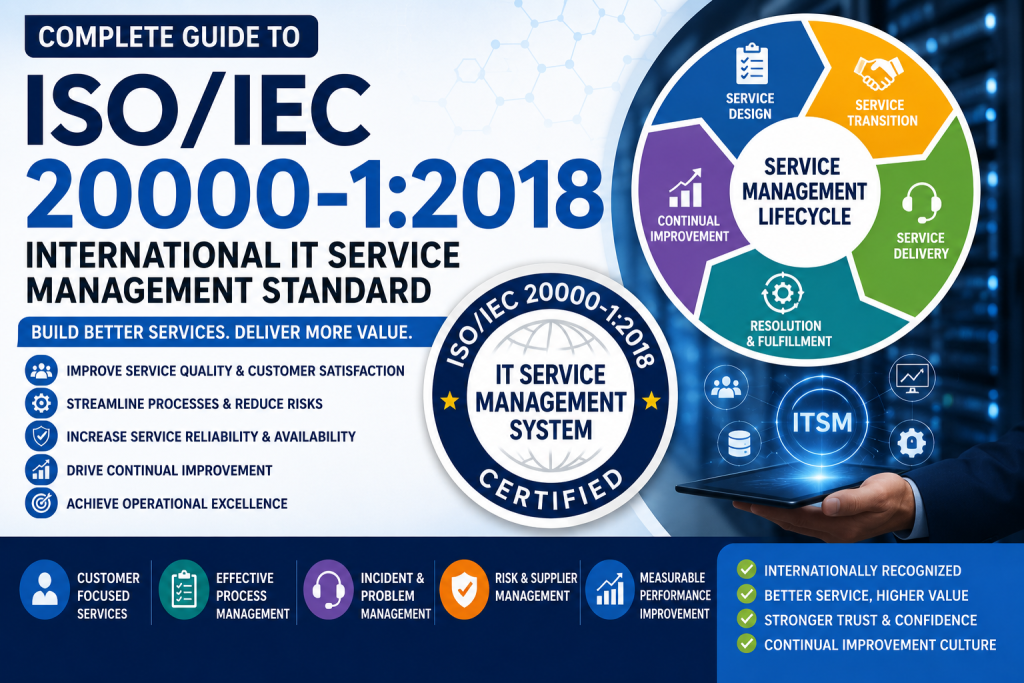
Introduction
In modern business, IT services are no longer only technical support functions. They are directly connected with customer experience, business continuity, productivity, security, revenue, and organizational growth. Whether a company provides cloud services, software support, helpdesk operations, managed IT services, data center services, internal IT support, or business technology operations, the quality of service delivery matters. Poor IT service management can lead to repeated incidents, slow response times, unclear responsibilities, weak change control, unhappy customers, and business disruption. This is where ISO/IEC 20000-1:2018 becomes important. It is an international standard that helps organizations build a structured Service Management System, commonly known as an SMS, to plan, deliver, monitor, and improve services in a professional and consistent way.
What Is ISO/IEC 20000-1:2018?
ISO/IEC 20000-1:2018 is an international standard for service management systems. It provides requirements for organizations that want to establish, implement, maintain, and continually improve a Service Management System.
In simple words, ISO/IEC 20000-1:2018 helps an organization manage services properly from planning to delivery and improvement.
It helps answer important questions such as:
- What services do we provide?
- Who are our customers and users?
- What service levels have been agreed?
- How are incidents handled?
- How are service requests fulfilled?
- How are changes controlled?
- How are suppliers managed?
- How are risks identified?
- How is service performance measured?
- How do we improve service quality over time?
Although it is commonly known as an IT service management standard, ISO/IEC 20000-1:2018 can also support other service-based operations. However, it is especially valuable for IT service providers and organizations that depend heavily on technology services.
What Is a Service Management System?
A Service Management System, or SMS, is a structured set of policies, processes, procedures, roles, responsibilities, tools, records, and improvement activities used to manage services.
An SMS helps ensure that services are:
- Planned properly
- Designed according to customer needs
- Delivered consistently
- Supported effectively
- Monitored regularly
- Improved continuously
For example, if a company provides IT support, the SMS defines how incidents are reported, how tickets are prioritized, how service requests are handled, how changes are approved, how suppliers are managed, and how service performance is reviewed.
Without an SMS, service delivery can become informal, inconsistent, and dependent on individual employees instead of controlled processes.
Why ISO/IEC 20000-1:2018 Is Important
ISO/IEC 20000-1:2018 is important because businesses now depend heavily on reliable IT and digital services. Even a short service failure can affect customers, employees, operations, payments, communication, and reputation.
The standard helps organizations move from reactive service support to structured service management.
Reactive service support means solving problems only after users complain. Structured service management means planning, monitoring, controlling, and improving services before problems become major disruptions.
ISO/IEC 20000-1:2018 is important because it helps organizations:
- Improve IT service quality
- Reduce repeated incidents
- Improve customer satisfaction
- Define clear service responsibilities
- Strengthen service-level management
- Improve incident and request handling
- Control changes better
- Manage suppliers more effectively
- Improve service reporting
- Build a culture of continual improvement
- Support business continuity and service reliability
- Demonstrate professional IT service management capability
For IT service providers, certification can also help build trust with clients, partners, auditors, and enterprise customers.
ISO/IEC 20000-1:2018 Is Not Only About Helpdesk
Many people think IT service management means only ticket handling or helpdesk support. That is a narrow view. ISO/IEC 20000-1:2018 covers the wider service lifecycle.
It includes areas such as:
- Service planning
- Service design
- Service transition
- Service delivery
- Incident management
- Service request management
- Problem management
- Change control
- Release and deployment
- Service level management
- Supplier management
- Capacity and availability
- Service continuity
- Information security management
- Configuration management
- Performance evaluation
- Continual improvement
This makes ISO/IEC 20000-1:2018 useful for organizations that want stable, reliable, and customer-focused service operations.
Who Should Use ISO/IEC 20000-1:2018?
ISO/IEC 20000-1:2018 can be used by any organization that provides services and wants to manage them professionally.
It is especially useful for:
- IT service providers
- Managed service providers
- Cloud service providers
- Data center companies
- SaaS companies
- Software support companies
- IT helpdesk teams
- Internal IT departments
- Business process outsourcing companies
- Telecom service providers
- Cybersecurity service providers
- Infrastructure support teams
- Government IT service units
- Banking and financial IT teams
- Healthcare IT departments
- Large enterprises with complex IT operations
Small organizations can also implement ISO/IEC 20000-1:2018 in a practical and proportionate way based on their service scope, risks, and customer expectations.
Main Objectives of ISO/IEC 20000-1:2018
The main objective of ISO/IEC 20000-1:2018 is to help organizations deliver services that meet agreed requirements and provide value.
Key objectives include:
- Improve service quality
The standard helps organizations define, monitor, and improve service delivery. - Create consistent service processes
It reduces dependency on informal practices and individual working styles. - Improve customer satisfaction
Clear service levels, better communication, and reliable support improve customer confidence. - Control service risks
The standard helps organizations identify and manage risks that can affect services. - Improve incident and request handling
It creates a structured approach for restoring services and fulfilling user needs. - Strengthen change management
Changes are assessed, approved, implemented, and reviewed in a controlled way. - Improve supplier management
Suppliers are monitored to ensure they support service commitments. - Support continual improvement
Service performance is reviewed and improved regularly.
Key Principles of ISO/IEC 20000-1:2018
1. Customer-Focused Service Delivery
The standard encourages organizations to understand customer needs and deliver services that meet agreed expectations. This includes clear service definitions, service level agreements, communication, reporting, and customer feedback.
2. Defined Roles and Responsibilities
Service quality suffers when responsibilities are unclear. ISO/IEC 20000-1:2018 helps define who owns services, who manages incidents, who approves changes, who communicates with customers, and who reviews performance.
3. Process-Based Management
The standard encourages structured processes instead of random or informal service handling. This helps improve repeatability, accountability, and control.
4. Risk-Based Thinking
Organizations must consider risks and opportunities that can affect service management. This includes operational risks, supplier risks, technology risks, capacity risks, continuity risks, and customer-related risks.
5. Continual Improvement
Service management is never complete. The organization must review performance, identify weaknesses, take corrective actions, and improve services over time.
6. Evidence-Based Decision Making
Service decisions should be based on data such as incident trends, SLA performance, customer complaints, audit findings, service availability, change success rate, and user feedback.
Main Clauses of ISO/IEC 20000-1:2018 Explained
ISO/IEC 20000-1:2018 follows a management-system structure similar to many other ISO standards. The main auditable clauses are usually Clause 4 to Clause 10.
Clause 4: Context of the Organization
The organization must understand internal and external issues that can affect the Service Management System. It must also understand the needs and expectations of interested parties.
Interested parties may include:
- Customers
- Users
- Employees
- Suppliers
- Regulators
- Business partners
- Internal departments
- Management
- Service owners
This clause also requires the organization to define the scope of the SMS. The scope should clearly state which services, locations, teams, and customers are covered.
Clause 5: Leadership
Top management must demonstrate leadership and commitment to the SMS. They must ensure that service management objectives align with business goals.
Leadership responsibilities include:
- Approving service management policy
- Assigning roles and responsibilities
- Providing resources
- Supporting process owners
- Reviewing service performance
- Promoting continual improvement
- Ensuring customer focus
Without leadership support, service management becomes a documentation exercise instead of a working system.
Clause 6: Planning
Planning focuses on risks, opportunities, objectives, and actions needed to achieve service management goals.
The organization should plan:
- How to manage service risks
- How to achieve service objectives
- How to handle changes to the SMS
- How to improve service performance
- How to meet customer and contractual requirements
Planning helps prevent confusion and creates a clear direction for service management.
Clause 7: Support
This clause covers resources, competence, awareness, communication, and documented information.
The organization must ensure that people involved in service management are competent and aware of their responsibilities.
Support areas include:
- Skilled employees
- Service management tools
- Knowledge management
- Communication methods
- Training records
- Document control
- Process documentation
- Service reports
If people are not trained or documents are not controlled, service quality can become inconsistent.
Clause 8: Operation of the Service Management System
Clause 8 is one of the most important sections because it covers the actual operation of service management processes.
It includes:
- Service portfolio
- Relationship and agreement management
- Supply and demand management
- Service design, build, and transition
- Resolution and fulfillment
- Service assurance
This is where the SMS becomes practical and visible in daily service delivery.
Clause 9: Performance Evaluation
The organization must monitor, measure, analyze, evaluate, audit, and review service management performance.
Performance evaluation may include:
- SLA achievement
- Incident resolution time
- Service availability
- Customer satisfaction
- Supplier performance
- Audit results
- Change success rate
- Service request fulfillment
- Problem management trends
- Corrective action status
This helps management understand whether the SMS is working effectively.
Clause 10: Improvement
The organization must handle nonconformities, corrective actions, and continual improvement.
Improvement may come from:
- Customer feedback
- Incident trends
- Problem analysis
- Internal audits
- Management reviews
- Supplier reviews
- Service reports
- Failed changes
- Complaints
- Lessons learned
The goal is to make services more reliable, efficient, and valuable over time.
Key ITSM Processes in ISO/IEC 20000-1:2018
1. Service Portfolio Management
Service portfolio management helps the organization define and manage all services. It ensures that services are documented, approved, reviewed, and aligned with customer needs.
A service portfolio may include:
- Current live services
- Planned services
- Retired services
- Service descriptions
- Service owners
- Customer groups
- Service dependencies
2. Service Level Management
Service level management ensures that service expectations are clearly agreed and monitored.
It may include:
- Service Level Agreements
- Operational Level Agreements
- Service targets
- Availability targets
- Response and resolution targets
- Reporting frequency
- Review meetings
A clear SLA reduces misunderstandings between service provider and customer.
3. Incident Management
Incident management focuses on restoring normal service as quickly as possible after disruption.
Examples of incidents include:
- Application outage
- Network failure
- Email service down
- Laptop not working
- Printer issue
- Database error
- User login failure
- Cloud service disruption
Incident management should define ticket logging, categorization, prioritization, escalation, resolution, closure, and communication.
4. Service Request Management
Service requests are standard user requests that are not usually incidents.
Examples include:
- Password reset
- New user account
- Software installation
- Access request
- Laptop request
- Email group addition
- Report generation
- Standard configuration change
A good service request process improves user experience and reduces confusion.
5. Problem Management
Problem management focuses on finding root causes and preventing repeated incidents.
For example, if users repeatedly face the same application error, incident management restores service each time, but problem management investigates why the error keeps happening.
Problem management may include:
- Root cause analysis
- Known error records
- Workarounds
- Permanent fixes
- Trend analysis
- Preventive actions
6. Change Management
Change management ensures that changes are assessed, approved, tested, implemented, and reviewed.
Examples of changes include:
- Server upgrade
- Software release
- Firewall rule change
- Database migration
- Cloud infrastructure modification
- Application patch
- Network configuration update
Poor change control can cause outages, security gaps, or business disruption. ISO/IEC 20000-1:2018 helps organizations control this risk.
7. Release and Deployment Management
Release and deployment management controls how new or changed services are moved into live environments.
It helps ensure that releases are:
- Planned
- Tested
- Approved
- Communicated
- Documented
- Implemented safely
- Reviewed after deployment
This is especially important for software, cloud, infrastructure, and application support teams.
8. Configuration Management
Configuration management helps organizations maintain information about service assets and configuration items.
Configuration items may include:
- Servers
- Applications
- Databases
- Network devices
- Cloud resources
- Laptops
- Licenses
- Documentation
- Service dependencies
Accurate configuration information helps with incident resolution, change assessment, risk analysis, and service planning.
9. Availability Management
Availability management ensures that services are available according to agreed requirements.
This may involve:
- Uptime monitoring
- Redundancy planning
- Capacity planning
- Backup systems
- Failover design
- Maintenance windows
- Service availability reporting
Availability is especially important for business-critical services.
10. Capacity and Performance Management
Capacity management ensures that services have enough resources to meet demand.
This includes monitoring:
- Server capacity
- Network bandwidth
- Storage usage
- Application performance
- User growth
- Transaction volume
- Cloud resource consumption
Capacity planning helps prevent slow systems, outages, and customer dissatisfaction.
11. Service Continuity Management
Service continuity management ensures that services can recover after major disruption.
This may include:
- Disaster recovery planning
- Backup and restoration
- Recovery time objectives
- Recovery point objectives
- Continuity testing
- Emergency communication
- Alternative service arrangements
It helps organizations stay prepared for serious incidents.
12. Information Security Management
ISO/IEC 20000-1:2018 includes information security management as part of service assurance. Services should protect confidentiality, integrity, and availability of information where applicable.
This may include:
- Access control
- Secure service operations
- Incident reporting
- Security awareness
- Supplier security
- Data protection
- Secure change control
Organizations may also integrate ISO/IEC 20000-1 with ISO/IEC 27001 for stronger information security governance.
13. Supplier Management
Many IT services depend on suppliers. These may include cloud providers, software vendors, telecom providers, hardware vendors, data centers, and outsourced support teams.
Supplier management should cover:
- Supplier selection
- Contract requirements
- Service performance monitoring
- Review meetings
- Escalation process
- Risk management
- Supplier responsibilities
- Service continuity expectations
If supplier performance is poor, the final customer experience suffers.
ISO/IEC 20000-1:2018 Certification Process
ISO/IEC 20000-1:2018 certification is usually performed by an independent certification body. The certification body audits the organization’s SMS and checks whether it meets the requirements of the standard.
Step 1: Understand the Standard
The organization should first understand what ISO/IEC 20000-1:2018 requires and how it applies to its services.
Step 2: Define the SMS Scope
The scope should clearly define which services, locations, teams, customers, and processes are covered.
A good scope is specific, realistic, and aligned with business needs.
Step 3: Conduct Gap Analysis
Gap analysis compares current ITSM practices with ISO/IEC 20000-1:2018 requirements.
It helps identify missing areas such as:
- Weak SLA process
- Poor incident records
- No formal change approval
- Missing service catalogue
- Incomplete supplier reviews
- No internal audit process
- Lack of management review
- Poor service reporting
Step 4: Create Implementation Plan
The organization should prepare an action plan with timelines, owners, resources, and priorities.
Step 5: Develop SMS Documentation
Documents should be created or updated based on service needs and standard requirements.
Step 6: Implement Processes
The organization applies service management processes in daily work. This includes incident handling, request fulfillment, change control, service reporting, supplier management, and continual improvement.
Step 7: Train Employees
Employees must understand their service management responsibilities. Training should be role-based and practical.
Step 8: Monitor Service Performance
The organization should collect data on service levels, incidents, changes, requests, availability, suppliers, and customer satisfaction.
Step 9: Conduct Internal Audit
Internal audit checks whether the SMS meets ISO/IEC 20000-1:2018 requirements and whether processes are followed.
Step 10: Conduct Management Review
Top management reviews SMS performance, risks, audit results, service objectives, customer feedback, and improvement opportunities.
Step 11: Certification Audit Stage 1
The certification body reviews documentation, readiness, scope, and basic SMS structure.
Step 12: Certification Audit Stage 2
The auditor checks actual implementation through records, interviews, service data, process evidence, and operational review.
Step 13: Corrective Actions
If nonconformities are found, the organization must fix them and provide evidence.
Step 14: Certificate Issuance
After successful audit closure, the certification body issues the ISO/IEC 20000-1:2018 certificate.
Step 15: Surveillance Audits
Certification does not end after approval. Surveillance audits are conducted periodically to ensure the SMS continues to operate effectively.
Documents Commonly Required for ISO/IEC 20000-1:2018
Documentation should be practical and useful. It should help employees deliver services consistently, not create unnecessary paperwork.
Common documents include:
- SMS scope
- Service management policy
- Service management objectives
- Service catalogue
- Service level agreements
- Incident management procedure
- Service request procedure
- Problem management procedure
- Change management procedure
- Release and deployment procedure
- Configuration management records
- Supplier management procedure
- Service continuity plan
- Availability and capacity plans
- Information security procedure
- Risk and opportunity register
- Internal audit reports
- Management review records
- Corrective action records
- Service performance reports
- Customer feedback records
- Training records
- Communication records
- Continual improvement register
The exact documents depend on the service scope, organization size, complexity, and certification body expectations.
ISO/IEC 20000-1:2018 Implementation Roadmap
| Phase | Key Action | Expected Output |
|---|---|---|
| Phase 1 | Understand service requirements | Clear business case |
| Phase 2 | Define SMS scope | Approved scope statement |
| Phase 3 | Conduct gap analysis | List of missing areas |
| Phase 4 | Prepare implementation plan | Action plan with owners |
| Phase 5 | Create service catalogue | Defined services |
| Phase 6 | Define SLAs and service targets | Agreed service expectations |
| Phase 7 | Implement ITSM processes | Controlled service operations |
| Phase 8 | Train employees | Competent service teams |
| Phase 9 | Monitor performance | Service reports and metrics |
| Phase 10 | Conduct internal audit | Audit findings |
| Phase 11 | Conduct management review | Leadership evaluation |
| Phase 12 | Complete certification audit | External assessment |
| Phase 13 | Improve continually | Stronger service management |
Benefits of ISO/IEC 20000-1:2018 Certification
1. Better Service Quality
The standard helps organizations define, control, monitor, and improve service delivery.
2. Improved Customer Satisfaction
Clear SLAs, faster incident resolution, better communication, and reliable service reporting improve customer trust.
3. Stronger IT Governance
ISO/IEC 20000-1:2018 connects IT services with business goals, management review, and continual improvement.
4. Better Incident and Problem Handling
The standard improves how incidents are restored and how repeated problems are prevented.
5. Improved Change Control
Controlled changes reduce service outages, failed deployments, and operational disruption.
6. Stronger Supplier Management
Suppliers are monitored and managed based on service commitments.
7. Better Audit Readiness
Documented processes, records, and reports help the organization prove service management maturity.
8. Competitive Advantage
Certification can support tenders, client onboarding, outsourcing contracts, and enterprise customer confidence.
9. Improved Internal Discipline
The organization becomes more structured in ticket management, service reporting, roles, responsibilities, and improvement actions.
10. Continual Improvement
The SMS helps teams regularly review service performance and improve weak areas.
ISO/IEC 20000-1:2018 and ITIL
ISO/IEC 20000-1:2018 and ITIL are closely related but not the same.
ITIL provides best-practice guidance for IT service management. ISO/IEC 20000-1:2018 provides requirements for a certifiable Service Management System.
In simple words:
- ITIL gives guidance on how ITSM can be practiced.
- ISO/IEC 20000-1:2018 defines requirements that can be audited for certification.
Many organizations use ITIL practices to help implement ISO/IEC 20000-1:2018, but ISO certification is based on meeting the ISO/IEC 20000-1 requirements.
ISO/IEC 20000-1:2018 vs ISO 9001
ISO 9001 focuses on quality management systems across many types of organizations. ISO/IEC 20000-1:2018 focuses specifically on service management systems.
| Standard | Main Focus | Best For |
|---|---|---|
| ISO 9001 | Quality management | General business quality processes |
| ISO/IEC 20000-1:2018 | Service management | IT service providers and service-based organizations |
Some organizations use both standards together. ISO 9001 can support overall quality management, while ISO/IEC 20000-1:2018 strengthens service delivery and ITSM.
ISO/IEC 20000-1:2018 vs ISO/IEC 27001
ISO/IEC 27001 focuses on information security management. ISO/IEC 20000-1:2018 focuses on service management.
| Standard | Main Focus | Purpose |
|---|---|---|
| ISO/IEC 20000-1:2018 | Service Management System | Deliver and improve services |
| ISO/IEC 27001 | Information Security Management System | Protect information assets |
Both standards can work together. For example, an IT service provider may use ISO/IEC 20000-1 to manage service delivery and ISO/IEC 27001 to manage information security risks.
Practical Examples of ISO/IEC 20000-1:2018 in Action
Example 1: Managed IT Service Provider
A managed service provider supports multiple business clients. It implements service catalogue, SLA monitoring, incident management, change control, supplier management, and monthly service reviews. This improves customer trust and reduces repeated service complaints.
Example 2: Internal IT Department
A company’s internal IT team receives many informal requests through phone calls and messages. After implementing ISO/IEC 20000-1:2018, all requests are logged, categorized, prioritized, tracked, and reviewed. This improves transparency and user satisfaction.
Example 3: Cloud Service Provider
A cloud service provider uses the standard to manage availability, capacity, service continuity, incident communication, supplier dependencies, and change deployment. This helps improve service reliability.
Example 4: Software Support Team
A software company provides application support to enterprise customers. It implements incident management, problem management, release control, and service reporting. Repeated errors reduce because root causes are tracked properly.
Example 5: Data Center Service Company
A data center company uses ISO/IEC 20000-1:2018 to formalize service continuity, supplier management, capacity planning, physical infrastructure support, service reporting, and customer communication.
Common Mistakes During ISO/IEC 20000-1:2018 Implementation
1. Treating Certification as Only Paperwork
A paper-based SMS may pass some document checks but will not improve real service quality. Processes must work in daily operations.
2. Poor Scope Definition
If the scope is unclear, teams may not know which services, customers, locations, and processes are covered.
3. Weak Service Catalogue
Without a clear service catalogue, customers and users may not understand what services are available.
4. Missing Service Level Agreements
SLAs help define expectations. Without them, service performance becomes difficult to measure.
5. Informal Change Management
Uncontrolled changes can create outages and customer dissatisfaction.
6. No Problem Management
If repeated incidents are not analyzed, the same issues keep returning.
7. Poor Supplier Monitoring
Service providers often depend on suppliers. If suppliers are not monitored, service quality can suffer.
8. Lack of Service Metrics
Without metrics, management cannot evaluate performance or improvement.
9. Weak Internal Audit
Internal audits should check real implementation, not just document availability.
10. No Continual Improvement Culture
If improvement actions are not tracked, the SMS becomes static and ineffective.
ISO/IEC 20000-1:2018 Audit Preparation Checklist
Use this checklist before certification audit:
- Is the SMS scope clearly defined?
- Is the service management policy approved?
- Are service management objectives documented?
- Is the service catalogue available?
- Are SLAs defined and reviewed?
- Are incidents logged and managed?
- Are service requests tracked?
- Is problem management implemented?
- Are changes assessed and approved?
- Are releases controlled?
- Is configuration information maintained?
- Are suppliers monitored?
- Is service continuity planned?
- Is availability and capacity reviewed?
- Is service performance measured?
- Are customer complaints recorded?
- Are internal audits completed?
- Is management review conducted?
- Are corrective actions tracked?
- Are improvement actions recorded?
- Are employees trained?
- Are service reports available?
Best Practices for Successful Implementation
Start With Clear Services
Before writing policies, define your services clearly. Know what you deliver, to whom, and under what expectations.
Keep Processes Practical
Processes should support daily work. Avoid complex documents that employees cannot follow.
Use a Ticketing Tool Properly
A ticketing tool helps track incidents, requests, changes, problems, and service data. However, the tool must support the process, not replace process discipline.
Train Service Teams
Employees must understand incident priority, escalation rules, SLA targets, change approval, customer communication, and documentation requirements.
Review SLAs Regularly
Service levels should reflect real business needs. Unrealistic SLAs create pressure and dissatisfaction.
Control Changes Carefully
Every major change should be assessed for risk, impact, approval, communication, testing, and rollback.
Use Data for Improvement
Service reports should not be prepared only for audit. They should help managers identify trends and improve service quality.
Involve Customers
Customer feedback helps organizations understand whether services are meeting expectations.
Monitor Suppliers
Supplier failures can affect your SLA. Supplier performance must be reviewed regularly.
Keep Improving
ISO/IEC 20000-1:2018 should become part of the organization’s service culture, not a one-time project.
Cost Factors for ISO/IEC 20000-1:2018 Certification
The cost of ISO/IEC 20000-1:2018 certification depends on several factors:
- Organization size
- Number of employees
- Number of locations
- Number of services in scope
- Service complexity
- Existing ITSM maturity
- Documentation readiness
- Certification body fees
- Consultant support
- Training needs
- Tooling requirements
- Internal audit effort
- Corrective action effort
A small IT support company with mature processes may need less effort than a large service provider with multiple customers, suppliers, locations, and complex service dependencies.
How Long Does ISO/IEC 20000-1:2018 Implementation Take?
The implementation timeline depends on the organization’s current service management maturity.
Important factors include:
- Current process maturity
- Availability of service records
- SLA readiness
- Tooling readiness
- Staff competence
- Number of services
- Number of suppliers
- Complexity of service delivery
- Management involvement
- Audit preparation quality
The goal should not be fast certification only. The goal should be a working Service Management System that improves service quality and customer satisfaction.
Frequently Asked Questions
1. What is ISO/IEC 20000-1:2018?
ISO/IEC 20000-1:2018 is an international standard that specifies requirements for a Service Management System. It helps organizations plan, deliver, monitor, and improve services.
2. Is ISO/IEC 20000-1:2018 only for IT companies?
It is mainly used for IT service management, but it can also support other service-based organizations. It is especially useful for IT service providers, internal IT departments, cloud providers, and managed service companies.
3. What is an SMS in ISO/IEC 20000-1?
SMS means Service Management System. It is a structured system of policies, processes, roles, records, and improvement activities used to manage services.
4. Who issues ISO/IEC 20000-1 certification?
Certification is issued by independent certification bodies after successful external audit. ISO itself does not issue certificates.
5. Is ISO/IEC 20000-1 certification mandatory?
In most cases, certification is voluntary. However, some clients, contracts, tenders, or outsourcing agreements may require it.
6. What is the difference between ISO/IEC 20000-1 and ITIL?
ITIL provides best-practice guidance for IT service management. ISO/IEC 20000-1 provides certifiable requirements for a Service Management System.
7. What documents are needed for ISO/IEC 20000-1?
Common documents include SMS scope, service management policy, service catalogue, SLAs, incident procedure, change procedure, supplier records, audit reports, management review records, and improvement records.
8. Can small businesses implement ISO/IEC 20000-1?
Yes. Small businesses can implement the standard in a practical way based on their service scope and risks.
9. What is the main benefit of ISO/IEC 20000-1?
The main benefit is improved service quality through structured service planning, delivery, monitoring, and continual improvement.
10. Does ISO/IEC 20000-1 improve customer satisfaction?
Yes. Clear service levels, better incident handling, improved communication, and regular performance review can improve customer satisfaction.
Conclusion
ISO/IEC 20000-1:2018 is a powerful international standard for organizations that want to manage IT services professionally and consistently. It helps businesses move beyond informal support and build a structured Service Management System focused on planning, delivery, monitoring, control, and continual improvement. The standard supports better service quality, clearer responsibilities, stronger customer communication, improved incident handling, controlled changes, supplier accountability, and reliable service performance. For IT service providers, cloud companies, internal IT teams, managed service providers, and service-based organizations, ISO/IEC 20000-1:2018 can become a strong foundation for operational excellence and customer trust. The real value of certification is not only the certificate, but the disciplined service culture it creates inside the organization.