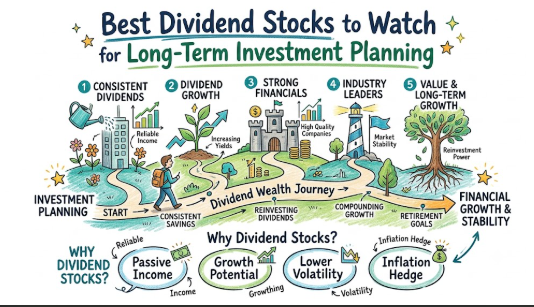
Introduction
Many beginners enter the stock market hoping to earn regular income from shares, but they often feel confused when they hear words like dividend yield, payout ratio, record date, ex-dividend date, and long-term compounding. Dividend stocks look simple because companies share part of their profit with shareholders, but choosing them without research can lead to poor decisions. A high dividend yield may look attractive, yet it can sometimes hide weak business performance, falling stock prices, or unsustainable payouts. This blog on Best Dividend Stocks to Watch is written for beginners, salaried people, new investors, traders, and finance learners who want to understand dividend investing practically. Instead of chasing random tips or social media claims, readers will learn how dividend stocks work, what factors matter, what mistakes to avoid, and how to build a disciplined watchlist with risk awareness.
Understanding Best Dividend Stocks to Watch in Simple Words
Best Dividend Stocks to Watch means identifying companies that may be worth researching because they have a history of sharing profits with shareholders through dividends. It does not mean every dividend-paying company is automatically safe or suitable for investment.
A dividend is a portion of company profit distributed to shareholders. When a company earns profit, it may use that money for business expansion, debt repayment, reserves, or dividend distribution. Some mature and stable companies pay regular dividends because they generate steady cash flow. Growth companies may pay lower dividends because they reinvest more money into expansion.
People search for dividend stocks because they want:
- Regular passive income
- Long-term wealth creation
- Lower emotional stress compared to frequent trading
- Portfolio stability
- Exposure to established businesses
In real life, dividend stocks are often used by long-term investors, retirees, salaried employees, and conservative investors who prefer income along with possible capital growth.
A beginner-friendly example is simple. Suppose an investor owns shares of a company that declares a dividend. If the investor holds the shares before the required record date, the dividend may be credited to their bank account linked with the demat account. However, the stock price may also move after the ex-dividend date, and dividends are not guaranteed every year.
A common misunderstanding is that a high dividend yield always means a good stock. This is not true. A dividend yield can become high simply because the stock price has fallen sharply.
Practical takeaway: Dividend investing should focus on business quality, consistency, cash flow, debt level, and sustainability—not only on the dividend amount.
Why Best Dividend Stocks to Watch Is Important
Dividend stocks are important because they connect investing with real cash flow. For beginners, this makes the stock market easier to understand because dividends show that companies can share profits with shareholders. However, dividend investing also requires patience and proper analysis.
For savings, dividend income can support long-term financial goals if reinvested wisely. For investing, dividend stocks may add stability to a portfolio. For trading, dividend dates can influence short-term price movement, but beginners should avoid trading only for dividends without understanding risk. For tax planning, dividend income may have tax implications depending on the investor’s situation. For emotional decision-making, dividend stocks can help beginners focus on business quality rather than daily price movement.
A practical scenario: A salaried person wants to invest for long-term wealth but does not want to check stock prices every hour. Instead of buying random trending stocks, they create a dividend watchlist, compare company fundamentals, check dividend history, and invest gradually based on their risk profile. This approach is more disciplined than chasing quick gains.
Dividend stocks matter because they teach three important lessons:
- A company’s profit quality matters.
- Cash flow is more important than market noise.
- Long-term discipline is stronger than emotional buying.
The better approach is to treat dividend investing as a research-based strategy, not as a shortcut to fixed income.
The Real Problem Readers Face With Best Dividend Stocks to Watch
Most beginners face confusion because dividend investing appears simple from the outside but becomes complex when they start comparing actual stocks. Online advice often highlights dividend yield without explaining why the yield is high, whether the company can continue paying dividends, or whether the business itself is healthy.
The real problems include:
- Lack of awareness about how dividends work
- Too much confusing advice online
- Emotional decisions based on high dividend yield
- Poor planning before buying stocks
- Weak comparison between companies
- Unrealistic expectations of regular income
- Ignoring market risk
- Depending only on social media stock tips
- Not understanding record date and ex-dividend date
- Not knowing how taxation may apply
- Not reviewing portfolio performance
Many beginners also assume that dividend stocks cannot fall in price. This is a dangerous misunderstanding. A dividend-paying stock is still an equity investment, and its price can rise or fall based on company performance, market conditions, interest rates, sector trends, and investor sentiment.
Another common issue is that beginners compare dividend stocks like bank fixed deposits. A fixed deposit gives a predefined interest rate, but dividends depend on company decisions and business performance. Companies can reduce, skip, or stop dividends when profits fall or cash flow weakens.
The better approach is to understand dividend stocks as part of a broader investment plan. Investors should compare quality, valuation, debt, earnings, payout ratio, and long-term business strength before making any decision.
How Best Dividend Stocks to Watch Works Step by Step
Step 1: Understand What Dividend Stocks Are
Dividend stocks are shares of companies that distribute part of their profits to shareholders.
Why it matters: Beginners must first understand that dividends are not guaranteed income. They depend on company profitability and board approval.
How to apply it: Learn the basic terms such as dividend yield, payout ratio, ex-dividend date, and record date.
Practical example: A company may announce a dividend per share, but only eligible shareholders receive it based on the record date.
Common mistake: Buying only because a company announced a dividend.
Better approach: Check whether the business is strong enough to keep paying dividends in future.
Step 2: Check Dividend History
Dividend history shows whether a company has paid dividends consistently over several years.
Why it matters: Consistency can indicate financial discipline, but it should not be the only reason to invest.
How to apply it: Review past dividend payments, skipped years, and whether dividends increased or reduced.
Practical example: A company with stable dividends over time may be more reliable than one that paid a one-time special dividend.
Common mistake: Assuming one large dividend means the company is a great dividend stock.
Better approach: Focus on consistency and sustainability.
Step 3: Study the Dividend Yield Carefully
Dividend yield shows the dividend amount compared to the stock price.
Why it matters: A very high yield may look attractive but can sometimes indicate a falling stock price or weak market confidence.
How to apply it: Compare yield with company fundamentals, sector average, and payout ratio.
Practical example: If a stock price falls sharply while the dividend remains the same, the yield may look unusually high.
Common mistake: Selecting stocks only with the highest dividend yield.
Better approach: Prefer reasonable yield backed by strong earnings and cash flow.
Step 4: Review Company Fundamentals
Fundamentals include revenue, profit, debt, cash flow, return ratios, and business strength.
Why it matters: Dividends are paid from real business performance. Weak fundamentals can make dividends risky.
How to apply it: Check whether the company earns stable profits and has manageable debt.
Practical example: A company with strong cash flow and low debt may have better dividend sustainability.
Common mistake: Ignoring balance sheet quality.
Better approach: Treat dividends as one part of business analysis, not the full story.
Step 5: Understand the Payout Ratio
The payout ratio shows how much of the company’s profit is paid as dividend.
Why it matters: If a company pays too much of its profit as dividend, it may not have enough money left for growth, debt repayment, or future needs.
How to apply it: Compare payout ratio with sector norms and company growth plans.
Practical example: A mature utility company may have a higher payout ratio than a fast-growing technology company.
Common mistake: Thinking higher payout is always better.
Better approach: Look for a balanced payout that supports both shareholders and business growth.
Step 6: Compare Dividend Stocks Across Sectors
Different sectors have different dividend patterns. Some sectors may pay regular dividends, while others may focus on growth.
Why it matters: Sector comparison helps avoid unfair judgment.
How to apply it: Compare banks with banks, FMCG with FMCG, energy with energy, and IT with IT.
Practical example: A mature public sector company and a fast-growing startup-style business should not be compared only on dividend yield.
Common mistake: Comparing companies from unrelated sectors without context.
Better approach: Understand sector maturity, business model, and cash flow behavior.
Step 7: Add Stocks to a Watchlist Before Investing
A watchlist helps investors track good companies without rushing into buying.
Why it matters: It reduces emotional decisions and allows better timing and research.
How to apply it: Create a list with dividend yield, payout ratio, debt, profit growth, valuation, and risk notes.
Practical example: A beginner can track 10–15 dividend-paying companies and review them monthly.
Common mistake: Buying immediately after reading one article or social media post.
Better approach: Watch, compare, study, and then decide carefully.
Step 8: Review Your Portfolio Regularly
Dividend investing is not a one-time decision. Companies and markets change.
Why it matters: A stock that looked strong earlier may become risky if profits fall or debt increases.
How to apply it: Review quarterly results, annual reports, dividend announcements, and sector news.
Practical example: If a company cuts dividends because of weak earnings, investors should review their investment reason.
Common mistake: Holding forever without checking business quality.
Better approach: Stay long-term, but not careless.
Key Factors That Influence Best Dividend Stocks to Watch
Risk and Return
Dividend stocks can provide income, but they still carry market risk. A stock may pay dividends and still fall in price. Beginners should compare possible dividend income with possible capital loss.
Common mistake: Thinking dividend stocks are risk-free.
Better approach: Review both dividend income and stock price risk.
Time Horizon
Dividend investing works better with patience. Investors who expect quick returns may become disappointed.
Common mistake: Buying dividend stocks for short-term excitement.
Better approach: Use dividend stocks for long-term portfolio planning.
Market Volatility
Stock prices can move due to market news, interest rates, sector changes, global events, and company results. Dividend stocks are not immune to volatility.
Common mistake: Selling in panic when prices fall temporarily.
Better approach: Check whether the business reason for investing is still valid.
Research Quality
Good research separates dividend investors from yield chasers. Research should include profit, cash flow, debt, valuation, dividend history, and management quality.
Common mistake: Depending only on tips.
Better approach: Build your own checklist.
Diversification
Putting all money into one dividend stock is risky. Even strong companies can face business problems.
Common mistake: Investing heavily in one high-yield stock.
Better approach: Spread investments across sectors and asset classes.
Emotional Control
Dividend investing requires calm thinking. Greed can push beginners toward risky high-yield stocks, while fear can make them sell good companies too early.
Common mistake: Acting in panic or excitement.
Better approach: Use written rules before buying or selling.
Portfolio Review
A portfolio should be reviewed regularly, not daily. Review helps identify weak companies, overexposure, and changing dividend quality.
Common mistake: Ignoring portfolio health after buying.
Better approach: Review quarterly or half-yearly.
Long-Term Discipline
Dividend investing rewards consistency, patience, and reinvestment habits. Long-term discipline can be more useful than frequent buying and selling.
Common mistake: Switching stocks constantly.
Better approach: Focus on quality and clear investment logic.
Detailed Breakdown of Best Dividend Stocks to Watch
Stock Market Basics
The stock market allows investors to buy ownership in listed companies. When you buy a share, you become a small shareholder of that company. Your return may come from price appreciation, dividends, or both.
Dividend stocks are different from pure growth stocks because they focus more on income distribution. However, the best dividend stocks are usually not just high dividend payers. They are companies with strong businesses, stable earnings, and responsible capital allocation.
How Stocks Work
A stock price changes based on demand, supply, company results, investor expectations, economic conditions, and market sentiment. A dividend announcement may attract investors, but price movement after dividend dates can confuse beginners.
A stock can give dividends and still decline in price. Similarly, a stock may pay a low dividend but grow strongly over time. This is why investors must evaluate total return, not only dividend income.
Investing vs Trading
Investing means buying shares with a long-term view based on business quality and valuation. Trading means buying and selling for short-term price movements.
Dividend investing is closer to long-term investing than short-term trading. Some traders try to buy before dividend dates, but this strategy can be risky because the stock price may adjust after the ex-dividend date.
Better approach: Beginners should first learn investing basics before trying dividend-based trading strategies.
Risk and Return
Dividend stocks may reduce emotional pressure because they provide periodic income, but they do not remove risk. Business decline, debt pressure, weak demand, poor management, or regulatory issues can affect dividend payments.
A smart investor looks for balanced return: dividend income plus possible long-term capital growth.
Market Volatility
Dividend stocks may sometimes perform better than highly speculative stocks during uncertain markets, but this does not mean they always protect capital. Market volatility can affect all equity investments.
Beginners should avoid checking daily price changes too frequently. Instead, they should focus on company performance, dividend sustainability, and portfolio balance.
Long-Term vs Short-Term Approach
Dividend investing usually suits long-term investors who want steady wealth-building habits. A short-term investor may become impatient because dividend income alone may look small in the beginning.
The power of dividend investing improves when investors reinvest dividends, keep adding capital regularly, and allow time to work.
Research Basics
Before adding any company to a dividend stock watchlist, check:
- Business model
- Revenue trend
- Profit trend
- Cash flow
- Debt level
- Dividend history
- Payout ratio
- Valuation
- Sector outlook
- Management quality
This does not guarantee success, but it improves decision quality.
Fundamental Understanding
Fundamental analysis helps investors understand whether a company is financially healthy. For dividend stocks, fundamentals are very important because dividends must be supported by real earnings and cash flow.
A company with weak profits but high dividend payout may not sustain dividends for long. A company with strong cash generation may be better positioned to reward shareholders.
Technical Understanding
Technical analysis studies price charts, support, resistance, volume, and trends. For dividend investors, technical analysis is not the main tool, but it can help avoid buying at extremely overvalued or emotionally heated levels.
Beginners should not depend only on charts. A dividend stock should first pass fundamental quality checks.
Diversification
A dividend portfolio should not depend on one company or one sector. For example, if all dividend stocks are from the same sector, one industry problem can hurt the entire portfolio.
A balanced dividend watchlist may include companies from different sectors such as consumer goods, banking, energy, utilities, IT services, healthcare, and manufacturing, depending on research quality and suitability.
Portfolio Thinking
Dividend investing should be part of a larger portfolio. Investors may also hold growth stocks, mutual funds, debt instruments, emergency funds, and other assets based on goals and risk profile.
The goal is not to collect the highest number of dividend stocks. The goal is to build a portfolio that matches income needs, risk tolerance, and long-term objectives.
Emotional Control
Beginners often buy dividend stocks when everyone is talking about them. They may also sell quickly when prices fall. Both actions can damage long-term discipline.
A written investment journal can help. Before buying, write why you selected the stock. During market volatility, review that reason instead of reacting emotionally.
Beginner Mistakes
The biggest beginner mistake is chasing yield without understanding business health. Other mistakes include ignoring debt, not checking cash flow, buying before dividend date without research, and assuming dividend income is fixed.
Importance of Patience and Discipline
Dividend investing is a slow and steady approach. It is not designed for quick profits. Patience helps investors allow dividends, reinvestment, and business growth to work together.
Why Following Random Tips Is Risky
Random tips rarely explain risk, valuation, debt, cash flow, or suitability. A stock that suits one investor may not suit another. Blindly copying someone else can lead to losses.
Better approach: Use public information, company reports, financial statements, and professional advice when needed.
Common Mistakes Beginners Make With Best Dividend Stocks to Watch
1. Following Random Advice
Beginners often follow social media posts, WhatsApp messages, or short videos without checking facts.
Why it is risky: The advice may be biased, incomplete, or misleading.
What can go wrong: Investors may buy weak companies at high prices.
What to do instead: Verify information and build your own research checklist.
2. Ignoring Risk
Some investors assume dividend stocks are safe because they pay income.
Why it is risky: Equity risk remains.
What can go wrong: Stock price loss may be larger than dividend income.
What to do instead: Review business, valuation, and market risk.
3. Chasing High Dividend Yield
High yield can be attractive, but it may be a warning sign.
Why it is risky: Yield may rise because the stock price has fallen.
What can go wrong: The company may cut dividends later.
What to do instead: Check earnings, payout ratio, and cash flow.
4. Not Comparing Options
Buying the first dividend stock you find can limit decision quality.
Why it is risky: Better-quality alternatives may exist.
What can go wrong: Investors may choose weak companies.
What to do instead: Compare multiple companies in the same sector.
5. Trusting Fake Profit Claims
No stock can guarantee returns.
Why it is risky: Fake claims create unrealistic expectations.
What can go wrong: Investors may lose money in poor-quality stocks.
What to do instead: Avoid anyone promising fixed stock market profits.
6. Making Emotional Decisions
Greed and fear are common in investing.
Why it is risky: Emotional decisions ignore logic.
What can go wrong: Investors buy high and sell low.
What to do instead: Use written rules and review calmly.
7. Using Emergency Money for Stocks
Emergency money should remain safe and liquid.
Why it is risky: Stock prices can fall when money is urgently needed.
What can go wrong: Investors may sell at a loss during emergencies.
What to do instead: Keep emergency funds separate.
8. Ignoring Tax and Compliance
Dividend income may have tax implications.
Why it is risky: Poor tax awareness can create problems later.
What can go wrong: Investors may underreport income.
What to do instead: Maintain records and consult a tax professional if required.
9. Not Reading Company Announcements
Dividend dates and terms matter.
Why it is risky: Investors may misunderstand eligibility.
What can go wrong: They may buy too late and miss dividends.
What to do instead: Check official company announcements.
10. Sharing Sensitive Information
Fraudsters may target investors with fake dividend schemes.
Why it is risky: Personal and financial data can be misused.
What can go wrong: Financial fraud or identity misuse.
What to do instead: Use only verified platforms and never share passwords or OTPs.
Don’t Do This Checklist
- Do not buy only because dividend yield is high.
- Do not trust guaranteed return claims.
- Do not invest emergency money in stocks.
- Do not copy social media tips blindly.
- Do not ignore company debt.
- Do not forget tax responsibility.
- Do not invest without understanding the business.
- Do not put all money into one stock.
- Do not panic-sell without reviewing fundamentals.
- Do not share OTPs, passwords, or demat details.
Practical Real-Life Examples of Best Dividend Stocks to Watch
Example 1: Salaried Person Building Passive Income
A salaried employee wants extra income from investments. The mistake is buying the highest-yielding stock without checking the company’s financial health. A better action is to create a dividend watchlist, compare payout ratio and debt, and invest slowly. The learning is that dividend income should come from quality, not excitement.
Example 2: Beginner Investor Avoiding Random Tips
A beginner sees a social media post claiming one stock will give huge dividend income. The challenge is emotional pressure to buy quickly. A better action is to verify the company’s dividend history, earnings, and valuation. The learning is that research protects investors from misleading advice.
Example 3: Small Business Owner Managing Extra Cash
A small business owner wants to invest surplus money in dividend stocks. The mistake is investing money that may be needed for business operations. A better action is to keep working capital separate and invest only long-term surplus. The learning is that liquidity planning matters before investing.
Example 4: Retired Investor Seeking Income
A retired investor wants regular income and chooses only high-yield stocks. The challenge is capital protection. A better action is to diversify across dividend stocks, debt instruments, and safer income options. The learning is that dividend stocks should not be the only income source.
Example 5: Trader Learning Dividend Dates
A trader buys a stock just before the ex-dividend date expecting easy profit. The stock price adjusts after the dividend event, creating confusion. A better action is to understand ex-dividend price behavior before trading. The learning is that dividend announcements do not guarantee short-term gains.
Two Useful Tables for Better Understanding
Table 1: Dividend Stock Selection Checklist
| Factor | What to Check | Why It Matters |
|---|---|---|
| Dividend History | Regularity of past dividends | Shows consistency but does not guarantee future payouts |
| Dividend Yield | Dividend compared to stock price | Helps compare income potential |
| Payout Ratio | Portion of profit paid as dividend | Shows sustainability of dividend payments |
| Cash Flow | Real cash generated by business | Supports dividend strength |
| Debt Level | Borrowings and repayment pressure | High debt can reduce future dividend ability |
| Profit Trend | Stability of earnings | Weak profits can affect dividends |
| Valuation | Whether stock is expensive or reasonable | Prevents overpaying for income |
| Sector Stability | Business cycle and demand | Helps judge long-term reliability |
Table 2: Beginner Mistake vs Better Approach
| Beginner Mistake | Why It Is Risky | Better Approach |
|---|---|---|
| Buying highest-yield stock | High yield may indicate falling price | Check business quality and payout ratio |
| Ignoring debt | Debt can reduce dividend safety | Review balance sheet strength |
| Following social media tips | Advice may be biased or incomplete | Verify with your own research |
| Investing emergency funds | Stocks can fall when money is needed | Keep emergency money separate |
| Not reviewing portfolio | Company quality can change | Review results and announcements regularly |
| Ignoring tax impact | Income reporting may be required | Keep records and seek tax advice |
| Buying without comparison | Better options may exist | Compare companies sector-wise |
| Expecting fixed income | Dividends are not guaranteed | Treat dividends as variable income |
Tools, Methods, and Frameworks Readers Can Use
1. Stock Watchlist
A stock watchlist is a simple list of companies you want to study before investing. It helps beginners avoid impulsive buying.
Use columns like company name, sector, dividend yield, payout ratio, debt level, profit trend, valuation, and notes. This method helps avoid the mistake of buying based on excitement.
2. Fundamental Analysis Checklist
This checklist helps investors study the company behind the stock. It includes revenue, profit, cash flow, debt, return ratios, and management quality.
Beginners can use it before adding any company to their dividend portfolio. It helps avoid weak business selection.
3. Dividend History Tracker
A dividend history tracker records past dividends, skipped years, and dividend growth or decline.
This helps investors separate consistent dividend payers from one-time dividend payers. The mistake it avoids is assuming one large dividend means long-term quality.
4. Portfolio Review Method
A portfolio review method helps investors check whether their holdings still match their goals.
Beginners can review quarterly results, annual reports, dividend announcements, and sector changes. This avoids the mistake of holding poor-quality stocks blindly.
5. Risk Allocation Method
Risk allocation means deciding how much money to invest in each stock or sector.
For beginners, this prevents overexposure. It helps avoid putting too much money into one attractive-looking dividend stock.
6. Investment Journal
An investment journal records why you bought a stock, what risks you noticed, and when you will review it.
This helps control emotions. When prices fall, you can review your original reason instead of reacting in panic.
7. Dividend Reinvestment Plan
Dividend reinvestment means using received dividends to buy more quality investments instead of spending the money immediately.
This supports long-term compounding. It helps avoid the mistake of treating small dividends as disposable income too early.
8. Tax Record Sheet
A tax record sheet helps track dividend income, capital gains, and transaction details.
This is useful during tax filing and financial planning. It helps avoid confusion and missed reporting.
Expert Tips to Make Better Decisions
1. Learn Before Taking Action
Understanding dividends, payout ratio, and business quality is more important than rushing to invest. Beginners should spend time learning basic stock market terms before buying shares.
2. Compare Multiple Options
Never select a dividend stock in isolation. Compare companies in the same sector to understand which business has better earnings, debt control, and dividend sustainability.
3. Check Risk Before Expected Return
Before asking how much dividend income you may receive, ask how much capital risk you are taking. This habit protects beginners from chasing unsafe yields.
4. Avoid Extremely High Yield Traps
A very high dividend yield may not always be attractive. It may happen because the stock price has fallen due to business problems. Always check why the yield is high.
5. Study Cash Flow
Profit shown in reports is important, but cash flow shows whether the company actually generates enough cash. Dividends are stronger when supported by real cash generation.
6. Keep Emergency Money Separate
Do not invest money required for rent, medical needs, school fees, business expenses, or emergencies. Dividend stocks can fall in value, and forced selling can cause losses.
7. Diversify Across Sectors
A dividend portfolio should not depend on one company or one sector. Diversification reduces the impact of one business or industry problem.
8. Review Dividend Sustainability
A company may pay dividends today but reduce them later. Check profit trend, debt, payout ratio, and management commentary to judge sustainability.
9. Avoid Emotional Buying
Do not buy only because everyone is discussing a stock. Emotional buying often happens near expensive valuations.
10. Reinvest Dividends Wisely
For long-term investors, reinvesting dividends can support wealth creation. Spending dividends too early may reduce compounding benefits.
11. Understand Tax Impact
Dividend income may be taxable depending on applicable rules and investor profile. Keep records and consult a qualified tax professional when needed.
12. Do Not Blindly Copy Others
A stock suitable for a retired investor may not suit a young growth-focused investor. Your investment choices should match your goals, income, age, and risk tolerance.
13. Use Valuation Discipline
A good dividend stock bought at an expensive price may still deliver poor returns. Check valuation before investing.
14. Track Mistakes and Improve
Every investor makes mistakes. The important step is to record them, understand them, and improve future decisions.
15. Focus on Long-Term Discipline
Dividend investing works best when combined with patience, regular review, and realistic expectations. Avoid treating it as a shortcut to quick income.
Case Studies: How Better Understanding Changes Decisions
Case Study 1: The High-Yield Trap
Profile: Rahul, a beginner investor and salaried employee.
Situation: Rahul wanted monthly passive income from dividend stocks.
Problem: He selected a stock only because it showed a very high dividend yield.
Wrong approach: He did not check why the stock price had fallen, whether profits were stable, or whether the dividend was sustainable.
Better approach: Rahul later learned to check payout ratio, debt, cash flow, and business performance before choosing dividend stocks.
Result or learning: He realized that high yield without business quality can be risky.
Key takeaway: Dividend yield should be studied with fundamentals, not alone.
Case Study 2: The Disciplined Watchlist Investor
Profile: Meena, a working professional with a long-term investment goal.
Situation: She wanted to build a dividend portfolio but was unsure where to start.
Problem: Too many online opinions confused her.
Wrong approach: Initially, she considered buying stocks recommended in online comments.
Better approach: She created a watchlist, tracked dividend history, compared companies sector-wise, and invested gradually after research.
Result or learning: Her decisions became calmer and more structured.
Key takeaway: A watchlist can reduce emotional investing and improve research quality.
Case Study 3: The Retired Investor’s Income Plan
Profile: Mr. Sharma, a retired investor seeking regular income.
Situation: He wanted to depend only on dividend stocks for income.
Problem: He did not consider that dividends can change and stock prices can fall.
Wrong approach: He planned to put most of his money into a few high-yield stocks.
Better approach: He diversified across dividend stocks, safer debt options, emergency funds, and professional guidance.
Result or learning: His income plan became more balanced and risk-aware.
Key takeaway: Dividend stocks can support income, but they should not replace complete financial planning.
Risk Awareness: What Readers Must Check First
Market Risk
Market risk means the stock price can move up or down due to market conditions. Dividend stocks are also affected by market risk.
How to reduce it: Invest for the long term, diversify, and avoid using emergency money.
Dividend Cut Risk
A company can reduce or stop dividends if profits fall or cash flow becomes weak.
How to reduce it: Check dividend history, payout ratio, profit trend, and debt.
Valuation Risk
Even a good company can be a poor investment if bought at an expensive price.
How to reduce it: Compare valuation with earnings, growth, sector averages, and historical levels.
Business Risk
A company may face weak demand, poor management decisions, regulatory pressure, or competition.
How to reduce it: Understand the business model and review company updates regularly.
Liquidity Risk
Some stocks may be difficult to sell quickly without price impact.
How to reduce it: Prefer well-traded companies and avoid unknown low-liquidity stocks.
Interest Rate Risk
When interest rates change, investor preference between fixed income and dividend stocks may also change.
How to reduce it: Balance equity investments with other suitable asset classes.
Emotional Risk
Fear and greed can damage investment decisions.
How to reduce it: Use written rules, review calmly, and avoid panic decisions.
Misinformation Risk
Fake tips and misleading claims can influence beginners.
How to reduce it: Verify information from reliable sources and avoid guaranteed return promises.
Tax-Related Risk
Dividend income and capital gains may have tax implications.
How to reduce it: Maintain records and consult a qualified tax professional where needed.
Concentration Risk
Putting too much money in one stock or sector can increase portfolio risk.
How to reduce it: Diversify across companies, sectors, and asset classes.
Readers should verify all details before investing and consult a qualified financial advisor where required.
Checklist Before Taking Action
Before selecting any dividend stock, check the following:
- Do I clearly understand how dividends work?
- Have I checked the company’s dividend history?
- Have I reviewed the dividend yield carefully?
- Have I checked the payout ratio?
- Have I reviewed profit and cash flow?
- Have I checked company debt?
- Have I compared the stock with similar companies?
- Have I reviewed valuation?
- Have I avoided guaranteed return claims?
- Have I kept emergency funds separate?
- Have I checked tax impact?
- Have I protected my personal and financial data?
- Have I avoided emotional buying?
- Have I written down my investment reason?
- Have I considered professional advice if needed?
- Have I planned regular portfolio review?
Use this checklist before investing, not after buying. A checklist does not remove risk, but it improves discipline and reduces avoidable mistakes.
Strategic Insights for Better Decision-Making
Position Sizing
Position sizing means deciding how much money to invest in one stock. Even if a dividend stock looks attractive, beginners should avoid putting a large portion of money into one company.
A practical approach is to start small, track performance, and increase exposure only after gaining confidence and reviewing fundamentals.
Portfolio Review
Dividend investing requires regular review. Investors should check whether a company’s dividend remains supported by profits and cash flow.
A quarterly or half-yearly review is better than daily panic checking.
Diversification
Diversification protects investors from depending too much on one company or sector. A dividend portfolio can include different industries, but every stock should be selected carefully.
The goal is not to own many stocks randomly. The goal is to reduce risk through thoughtful selection.
Risk Allocation
Different stocks carry different levels of risk. A mature large company may carry different risk compared to a cyclical company.
Beginners should decide how much risk they can handle before investing.
Long-Term Mindset
Dividend investing works best when investors think in years, not days. Short-term price movement should not dominate long-term decision-making.
A long-term mindset helps investors focus on business quality and income growth.
Avoiding Herd Mentality
Herd mentality means buying because many others are buying. This can lead to overvalued purchases.
Investors should ask: “Does this company fit my goals, risk profile, and research checklist?”
Investment Discipline
Discipline means following a clear process. It includes research, comparison, allocation, review, and patience.
Dividend investors who stay disciplined are less likely to chase hype or panic during volatility.
Key Terms Explained for Beginners
- Dividend: Dividend is a portion of company profit distributed to shareholders. It can provide income, but it is not guaranteed.
- Dividend Yield: Dividend yield compares annual dividend with stock price. It helps estimate income potential but should not be used alone.
- Payout Ratio: Payout ratio shows how much of a company’s profit is paid as dividend. A very high payout may be difficult to sustain.
- Ex-Dividend Date: This is the date from which new buyers may not be eligible for the announced dividend.
- Record Date: Record date is the date on which the company checks shareholder records for dividend eligibility.
- Cash Flow: Cash flow shows how much cash a business generates. Strong cash flow supports dividend sustainability.
- Earnings Per Share: Earnings per share shows company profit divided by outstanding shares. It helps investors understand profitability.
- Valuation: Valuation tells whether a stock is expensive, reasonable, or cheap compared to earnings and growth.
- Debt-to-Equity Ratio: This ratio shows how much debt a company uses compared to shareholder equity. High debt can increase risk.
- Capital Appreciation: Capital appreciation means increase in stock price over time. Dividend investors should consider both dividends and price growth.
- Dividend Reinvestment: Dividend reinvestment means using dividend income to buy more investments. It can support long-term compounding.
- Portfolio: A portfolio is a collection of investments. A good portfolio balances risk, return, liquidity, and goals.
- Volatility: Volatility means price movement. Dividend stocks can also be volatile during market changes.
- Diversification: Diversification means spreading investments across different stocks or assets to reduce concentration risk.
- Total Return: Total return includes dividend income and price appreciation or loss. It gives a fuller picture than dividend yield alone.
Who Should Read This Blog
Beginners
Beginners can use this blog to understand dividend investing in simple words without getting confused by market jargon.
Students
Students learning finance can understand how companies reward shareholders and why research matters.
Salaried Employees
Salaried people looking for long-term wealth-building can learn how dividend stocks may fit into a disciplined investment plan.
Small Business Owners
Business owners can understand how to invest surplus money carefully without mixing business cash flow with stock market risk.
New Investors
New investors can learn how to create a watchlist, compare companies, and avoid high-yield traps.
Traders
Traders can understand why dividend dates may affect stock prices and why short-term dividend strategies are risky.
Loan Seekers
Loan seekers can learn why borrowed money should not be used carelessly for stock investing.
Crypto Learners
Crypto learners can compare risk awareness across volatile assets and understand why guaranteed return thinking is dangerous.
Casino Content Creators
Casino content creators can learn responsible financial language and avoid misleading income claims in finance-related content.
Finance Bloggers
Finance bloggers can use this structure to write responsible, beginner-friendly, and risk-aware dividend content.
People Improving Money Awareness
Anyone trying to improve financial discipline can learn how research, patience, and planning reduce avoidable mistakes.
Frequently Asked Questions
1. What are Best Dividend Stocks to Watch?
Best Dividend Stocks to Watch are companies that investors may research because they have dividend-paying history, stable business quality, and possible income potential. They are not automatic buy recommendations. Investors should check fundamentals, risk, valuation, and suitability before investing.
2. Are dividend stocks safe for beginners?
Dividend stocks can be useful for beginners, but they are not risk-free. Their prices can fall, and companies can reduce or stop dividends. Beginners should start with education, proper research, and small exposure.
3. What is dividend yield?
Dividend yield shows the dividend amount compared to the stock price. It helps investors understand income potential. However, a high yield can sometimes indicate a falling stock price, so it should be checked carefully.
4. Why is payout ratio important?
Payout ratio shows how much profit a company pays as dividend. If the payout is too high, the company may struggle to maintain dividends. A balanced payout is usually healthier than an unrealistic payout.
5. Can dividend income replace salary?
Dividend income can support financial goals, but replacing salary requires large capital, diversification, and careful planning. Dividends are not guaranteed, so depending fully on them without a backup plan can be risky.
6. How can beginners start dividend investing safely?
Beginners can start by learning key terms, creating a watchlist, checking dividend history, reviewing fundamentals, and investing gradually. They should avoid borrowed money, emergency funds, and random tips.
7. What is the biggest mistake in dividend investing?
The biggest mistake is chasing high dividend yield without checking business quality. A high yield may hide weak fundamentals or falling stock prices. Investors should focus on sustainability.
8. How often should I review dividend stocks?
A practical review can be done quarterly or half-yearly. Investors should check company results, dividend announcements, debt levels, profit trends, and sector changes during review.
9. Are Best Dividend Stocks to Watch good for salaried people?
Yes, Best Dividend Stocks to Watch can help salaried people learn long-term income investing. However, salaried investors should first maintain emergency funds and invest only money they can keep for the long term.
10. Should I invest before the dividend record date?
Buying only before the record date is not always wise. Stock prices may adjust after the ex-dividend date. Investors should buy only if the company fits their long-term investment plan.
11. Do dividend stocks have tax impact?
Dividend income may have tax implications depending on applicable rules and investor profile. Investors should keep records and consult a qualified tax professional when required.
12. What is the best next step after reading this blog?
The best next step is to create a dividend stock watchlist and study each company carefully. Use dividend yield, payout ratio, cash flow, debt, valuation, and risk checklist before making any decision.
Conclusion and Next Steps
Best Dividend Stocks to Watch is an important topic for beginners because dividend investing teaches discipline, patience, business understanding, and risk awareness. Dividend stocks can help investors build long-term income habits, but they should never be treated as guaranteed income or a shortcut to wealth. A good dividend investor does not simply chase the highest yield. Instead, they studies company fundamentals, dividend history, payout ratio, cash flow, debt, valuation, and long-term business strength. Beginners should remember that every stock investment carries market risk, and even strong companies can face difficult periods. The next step is to build a simple watchlist, compare companies sector-wise, keep emergency money separate, avoid social media tips, maintain records, and review the portfolio regularly. Dividend investing becomes more meaningful when it is connected with financial goals, tax awareness, diversification, and professional guidance where required. With the right approach, readers can move from confusion to clarity and make more informed investment decisions with confidence, patience, and responsibility.