Introduction
When you open a demat account or look at the stock market for the first time, the terms “trading” and “investing” are often thrown around like they mean the exact same thing. You might see news headlines talking about a “day trader making massive gains” right next to an article about a “long-term investor building massive wealth.” This creates a lot of confusion for beginners who are just trying to figure out where to put their hard-earned money.
Understanding the difference between trading and investing is the absolute first step toward building a successful journey in the financial markets. If you enter the market without knowing whether you are a trader or an investor, you might end up treating a long-term investment like a short-term gamble, or vice versa, which often leads to unnecessary financial losses.
This comprehensive guide is designed to remove that confusion. We will break down the fundamental concepts, analyze the specific risk profiles, and look at how human psychology drives both activities. By the end of this deep dive, you will have a clear understanding of which path aligns best with your financial goals, time availability, and risk tolerance.
What Is Trading?
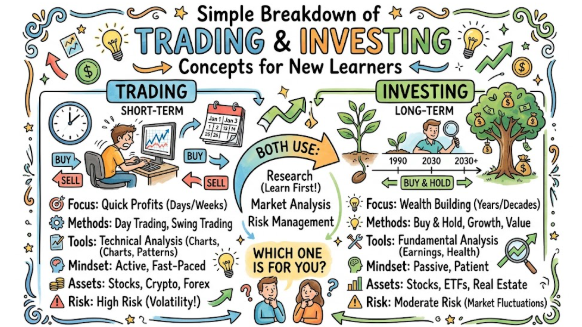
Trading in the stock market refers to the frequent buying and selling of financial instruments like shares, commodities, or currencies with the primary goal of generating short-term profits. Traders do not focus on holding an asset for years to see a company grow. Instead, they try to capitalize on the daily, hourly, or weekly price fluctuations of stocks.
Because trading relies heavily on price movements, a trader’s success depends on timing the market correctly. It is an active approach to the stock market that requires constant attention, quick execution, and a high degree of emotional discipline.
Core Pillars of Stock Trading for Beginners
- Short-Term Horizon: Positions can last for just a few minutes (scalping), a single day (intraday trading), or a few weeks (swing trading).
- Technical Analysis: Traders rely extensively on stock charts, historical price volume patterns, and indicators to predict where the price will move next.
- Leverage and Margin: Many traders use borrowed funds provided by brokers to trade larger positions, which can amplify both profits and losses.
- Strict Risk Management: Because short-term market movements are highly volatile, successful trading depends on using defensive tools like stop-loss orders to limit capital damage.
What Is Investing?
Investing is the process of buying financial assets, such as shares of a company, mutual funds, or ETFs, and holding them for an extended period. The core philosophy of investing is to buy a piece of a fundamentally strong business and participate in its long-term growth and wealth creation.
Investors are less concerned with daily price ups and downs. They understand that while a stock price might fluctuate wildly in the short term, the market eventually rewards businesses that consistently increase their revenues, profits, and market share.
Core Pillars of Stock Investing for Beginners
- Long-Term Horizon: Investors buy assets with the intention of holding them for months, years, or even decades to achieve financial goals like retirement or children’s education.
- Fundamental Analysis: This involves studying a company’s financial statements, management quality, competitive advantages, balance sheet health, and sector growth potential.
- The Power of Compounding: Long-term investing allows you to earn returns on your previous returns. Reinvesting dividends and letting your capital grow over time can significantly accelerate wealth accumulation.
- Patience and Low Maintenance: Unlike trading, investing does not require you to sit in front of a screen all day. It requires periodic reviews, usually once a quarter or once a year, making it highly suitable for salaried professionals.
Trading vs Investing Comparison
To help you visualize how these two approaches operate side-by-side, look at the structural breakdown below. This highlights the operational differences across various key parameters.
| Point of Difference | Trading | Investing |
| Time Horizon | Short-term (minutes to weeks) | Long-term (months to years) |
| Main Focus | Price movement and timing | Business value and growth |
| Analysis Style | Technical analysis, charts, patterns | Fundamental analysis, financial strength |
| Risk Level | Higher due to short-term volatility | Moderate; risk reduced with diversification |
| Skill Needed | Fast decision-making, discipline, risk control | Patience, research, goal-based planning |
| Monitoring | Requires frequent tracking | Requires periodic review |
| Suitable For | Active market participants | Long-term wealth builders |
Key Differences Explained Simply
Let us expand on these structural differences to see how they impact your day-to-day capital management and decision-making.
1. Time Horizon and Frequency
Traders operate in a fast-paced environment. They perform a high frequency of transactions, sometimes buying and selling multiple times in a single trading session. However, investors follow a “buy and hold” approach. Their transaction frequency is low, often buying assets through regular monthly routes like Systematic Investment Plans (SIPs) and holding them through market cycles.
2. Analytical Approach and Strategy
The underlying strategy differs completely. Trading is primarily driven by psychology and supply-and-demand dynamics, which reflect on technical price charts. Investing focuses heavily on intrinsic value. An investor wants to know if a company has stable cash flows and whether the current stock price is cheap or expensive relative to its actual earnings capacity.
3. Capital Commitment and Transaction Costs
Trading can require a significant amount of active capital to make short-term price movements meaningful, and it incurs high transaction costs due to frequent brokerage charges, government taxes, and regulatory fees. Investing can be started with very small amounts, and because transactions are rare, the impact of brokerage fees on long-term returns remains minimal.
4. Emotional Control and Daily Stress
A trader must be comfortable with taking quick, minor losses and moving on without emotional attachment. The fast pace can cause high stress if not managed properly. An investor needs a different kind of emotional control: the patience to do nothing when the overall market drops during a temporary economic slowdown.
How Traders Make Decisions
Traders view the stock market as an ocean of waves, and their goal is to ride those waves for quick gains. They utilize structured technical tools to remove guesswork from their daily operations.
Key Tools and Methods Used in Short-Term Trading
- Price Charts: Analyzing candlestick charts to identify support levels (where prices stop falling) and resistance levels (where prices struggle to rise).
- Volume Analysis: Checking the total number of shares traded to confirm if a specific price movement has strong institutional backup or is just a minor glitch.
- Technical Indicators: Using mathematical calculations based on price and volume, such as the Relative Strength Index (RSI) or Moving Averages, to identify overbought or oversold conditions.
- The Trading Plan: Before entering a trade, a disciplined trader always calculates their entry price, target price, and stop-loss price. This mathematical approach ensures they know exactly how much capital is at risk before the trade even begins.
How Investors Make Decisions
Investors look at the stock market as a marketplace where they can buy fractional ownership in real businesses. Their decision-making process is rooted in assessing business durability and corporate governance.
Key Tools and Methods Used in Long-Term Investing
- Financial Statements: Examining the annual profit and loss statements, balance sheets, and cash flow reports to evaluate a company’s financial health.
- Debt-to-Equity Ratio: Checking whether a company is operating on massive borrowed capital or if it is generating its own funds to fuel expansion.
- Management Quality: Reviewing the track record, transparency, and integrity of the promoters leading the corporate decisions.
- Diversification Matrix: Spreading investment capital across multiple companies, sectors, and asset classes to protect the overall portfolio from a single business failure.
Which Is Better for Beginners?
For an individual step-entering the stock market for the first time, long-term investing is generally considered a more practical and less risky starting point.
The primary reason is that stock investing for beginners allows for a wider margin of error. If you buy a fundamentally strong company and its price drops by 5% the next week due to global events, your investment remains intact because the business operations haven’t changed. Over time, the market tends to correct itself, and the price can bounce back.
On the flip side, stock trading for beginners requires an intermediate to advanced understanding of chart structures, risk-to-reward dynamics, and immediate psychological control. A beginner trying to day-trade without this specialized training may suffer rapid capital depletion within a few weeks due to high volatility and emotional decision-making.
Therefore, starting with goal-based investing through mutual funds, index ETFs, or large-cap blue-chip stocks helps beginners understand market behavior safely while accumulating wealth in a stable manner. Once you build solid market literacy, you can allocate a tiny, separate portion of your capital to learn the ropes of active trading.
Real-Life Example: Trader vs Investor Mindset
To understand how these concepts function under pressure, let us look at a simple hypothetical scenario involving a manufacturing company called “Company X.”
Imagine Company X announces its quarterly financial results. The company reports a minor dip in short-term net profit because they invested heavily in building a new, advanced manufacturing plant that will operationalize in two years. Due to this short-term profit dip, panic selling hits the market, and the stock price drops by 10% in a single day.
- The Trader’s Reaction: A short-term swing trader sees the sharp price drop breach a critical support level on the daily chart. To protect their remaining capital from further downward momentum, the trader executes their stop-loss order and exits the position immediately. For the trader, the asset’s price trajectory is broken, making it an unviable short-term trade.
- The Investor’s Reaction: A long-term investor views this exact same 10% price drop as an excellent buying opportunity. They know the company’s core business model is healthy and that the new manufacturing plant will increase company earnings substantially over the next few years. They use the price drop to accumulate more shares at a discounted valuation, confident that the long-term growth story remains intact.
This simple example highlights how the exact same market event can trigger two entirely opposite, yet completely logical actions, depending on whether your framework is trading or investing.
Risks in Trading
While active trading offers the potential for quick returns, it comes accompanied by structural risks that every beginner must understand clearly.
Why Short-Term Trading Requires Caution
- Market Volatility: Sudden economic announcements, geopolitical news, or global market shifts can cause prices to gapping up or down violently, bypassing planned exit points.
- Psychological Traps: Short-term fluctuations frequently trigger the twin emotions of greed and fear, leading to overtrading or refusing to cut losses when a trade goes wrong.
- The Impact of Leverage: Using leverage or margin allowed by brokers means you are trading with borrowed money. While this can increase your profits when you are right, it can wipe out your entire trading account capital in minutes if the trade goes against you.
- Sustained Transaction Overheads: Frequent trading incurs regular statutory costs like Securities Transaction Tax (STT), exchange turnover charges, GST, and brokerage fees, which can slowly erode your net earnings over time.
Risks in Investing
Long-term investing is a great path for wealth building, but it is not entirely risk-free. It requires a disciplined approach to manage specific systemic and non-systemic risks.
What to Watch Out For as an Investor
- Market and Economic Risk: Prolonged structural recessions or bear markets can suppress asset valuations across the entire stock market for months or years at a time.
- Company-Specific Vulnerabilities: A company you invest in might suffer from poor management decisions, disruptive technological updates from competitors, or shifting consumer habits that permanently impact its profitability.
- Liquidity and Opportunity Cost: When you lock your capital into long-term investments, that money may not be immediately available for unexpected personal emergencies without disrupting your compound interest timeline.
- Inflation and Underperformance Risks: If you pick underperforming mutual funds or stagnant companies, your portfolio returns might fail to beat the prevailing inflation rate, resulting in a loss of real purchasing power over the long run.
Beginner Decision Checklist
Before allocating any capital to the live markets, use this structured checklist to evaluate your operational readiness and find the path that naturally aligns with your current life situation.
| Checklist Question | If Your Answer Is Yes | What It May Indicate |
| Do you have time to monitor markets daily? | Yes/No | Trading needs active tracking |
| Can you handle short-term losses calmly? | Yes/No | Trading requires emotional control |
| Do you prefer long-term wealth building? | Yes/No | Investing may suit goal-based planning |
| Do you understand risk management? | Yes/No | Important for trading or investing |
| Do you have an emergency fund? | Yes/No | Avoid using emergency funds in markets |
| Can you research companies patiently? | Yes/No | Useful for long-term investing |
| Are you following tips without learning? | Yes/No | This is risky for both |
Common Mistakes Beginners Make
Many newcomers enter the capital markets with enthusiasm but fall into predictable behavioral traps. Being aware of these errors can help you protect your hard-earned capital.
- Confusing Trading with Investing: Buying a speculative stock for a short-term trade, watching it drop in value, and then choosing to hold it for years while calling it a “long-term investment” out of pure denial.
- Following Tips Blindly: Acting on unverified multi-bagger tips from social media groups, messaging channels, or family friends without conducting basic personal research or background checks.
- Overtrading Due to Boredom: Believing that you must buy or sell something every day to be a real participant in the market, which simply racks up heavy transaction fees.
- Emotional Revenge Trading: Attempting to recover a trading loss immediately by taking larger, riskier positions out of anger, which typically compounds the initial loss.
- Deploying Emergency Funds: Investing or trading with money required for basic living expenses, rent, or medical emergencies over the next six months.
- Expecting Quick, Effortless Profit: Entering the stock market with the illusion that it acts as a quick get-rich scheme, rather than viewing it as a serious professional skill that takes time to learn.
Practical Tips for Beginners
To build a sustainable, responsible financial journey, adopt these foundational execution habits right from day one.
Actionable Guidance for Your Market Journey
- Learn the Basics First: Dedicate time to understanding basic financial jargon, how order execution works, how to read standard financial tables, and the basics of risk management.
- Define Your Financial Goals: Clearly establish what you are accumulating capital for—whether it is a home down payment in 5 years, higher education, or building long-term retirement security.
- Start with Small Capital: Begin your journey with small, manageable sums of money that will not impact your daily lifestyle if you experience a temporary market downturn during your initial learning phase.
- Avoid Borrowed Money: Never trade or invest using personal loans, credit card debt, or funds borrowed from acquaintances. Only commit capital that belongs entirely to you.
- Maintain Separate Capital Buckets: If you decide to explore both paths, create distinct demat accounts—one dedicated exclusively to your core long-term investments and another small account for short-term practice trading.
Can You Do Both Trading and Investing?
Yes, it is entirely possible to do both trading and investing simultaneously, provided you maintain a strict, absolute separation between the two activities. Many seasoned market participants utilize a dual approach to manage their personal balance sheets effectively.
The key to successfully managing both is structural isolation. Your core wealth-building activities should happen in your investment portfolio, where you buy quality mutual funds, stable index ETFs, and blue-chip stocks. This capital is completely insulated from short-term market noise and is left alone to benefit from long-term economic growth.
Meanwhile, you can maintain a completely independent capital bucket for short-term trading. This trading capital should represent a minor percentage of your total net worth—an amount that you can comfortably manage without emotional stress.
By keeping separate bank accounts, separate brokerage accounts, and entirely separate analytical rules, you ensure that a bad week in short-term trading never damages your primary long-term financial safety net.
When Should You Take Professional Help?
Navigating the financial markets can become overwhelming as your responsibilities grow or your income increases. Recognizing when to consult an expert can save you from costly strategic errors.
Signs That Point Toward Seeking Professional Assistance
- Lack of Core Learning Time: If your primary professional career or family commitments leave you with zero time to research individual corporate balance sheets or monitor daily asset paths.
- Managing Large Sums of Capital: When you accumulate a substantial life corpus, such as an inheritance or sudden retirement payout, where capital preservation becomes your number one priority.
- Persistent Confusion and Stress: If you find yourself consistently anxious about market movements, unable to determine your personal risk tolerance, or making impulsive financial moves.
- Complex Family Tax and Estate Planning: When your investments involve navigating intricate tax brackets, capital gains liabilities, or structuring legacy wealth distribution for your children.
In such situations, partnering with a qualified, registered financial advisor can help you design a customized financial roadmap tailored directly to your unique life targets.
Frequently Asked Questions
1. Is trading riskier than investing?
Yes, short-term trading generally carries higher immediate risk than long-term investing because short-term price movements are highly volatile and heavily influenced by market sentiment and unexpected news events. Investing allows you to average out this short-term volatility over a longer time horizon.
2. Can a beginner start with intraday trading?
While it is legally permissible, starting with intraday trading is highly challenging for absolute beginners. It requires real-time emotional discipline, instantaneous decision-making, and deep chart-reading expertise, which takes significant practice to develop.
3. How much money do I need to start investing in India?
You can start investing in India with as little as ₹100 or ₹500 per month through a Systematic Investment Plan (SIP) in mutual funds. This low entry barrier makes it highly accessible for students and young salaried professionals.
4. Do investors care about daily stock market drops?
No, long-term investors generally view daily or weekly stock market drops as noise. As long as the company’s underlying business performance, management quality, and industry growth remain strong, temporary drops are often treated as buying opportunities.
5. What is fundamental analysis?
Fundamental analysis is a method used primarily by long-term investors to evaluate a stock’s intrinsic value. It involves studying financial statements, net profits, profit margins, company debt levels, and the overall economic landscape of the industry.
6. What is technical analysis?
Technical analysis is a methodology used mostly by short-term traders to predict future price movements. It relies heavily on analyzing historical price trends, chart setups, candlestick patterns, and trade volume data rather than business financial health.
7. Can I lose all my money in long-term investing?
While complete capital loss is rare if your funds are diversified across multiple sector leaders or broad-market index ETFs, you can experience sharp temporary drops during severe economic recessions. Complete loss typically only occurs if you concentrate your entire capital into a single fraudulent or failing company.
8. What are mutual funds and ETFs?
Mutual funds and Exchange-Traded Funds (ETFs) are professional investment vehicles that pool money from multiple investors to buy a diversified basket of stocks or bonds. They are highly recommended for beginners because they provide automatic diversification under professional management.
9. What is a stop-loss order in trading?
A stop-loss is an automated instruction given to your stockbroker to sell a share automatically once it hits a specific, predetermined lower price point. This tool is critical for traders to cut losses early and prevent major capital damage when a trade goes wrong.
10. How do taxes differ between trading and investing in India?
In India, investments held for over a year are subject to Long-Term Capital Gains (LTCG) tax, which usually enjoys lower tax rates. Short-term investments and trading profits are classified under Short-Term Capital Gains (STCG) or speculative business income, which typically attract a higher tax percentage depending on your holding duration and regular income tax slab.
Conclusion
At the end of the day, neither trading nor investing can be declared universally “better” than the other. Both are legitimate financial pathways that serve completely different purposes, require different skill sets, and appeal to different human temperaments.
Trading can suit individuals who possess the technical skill, daily time availability, and strict emotional control required to handle high-speed market fluctuations. Investing can suit long-term wealth builders, salaried professionals, and beginners who want their capital to grow steadily alongside the expanding economy without requiring constant daily supervision.
The most responsible approach is to take an honest look at your personal schedule, your psychological comfort with risk, and your long-term life objectives. Never rush into the markets based on hype or the promise of effortless profits. Invest your time in learning the core mechanics of the market first, start small, and build a solid foundation of financial literacy as you grow your wealth step by step.