Introduction
Human-in-the-Loop Labeling Tools help organizations combine human judgment with machine learning automation to create, review, correct, and improve training data for AI models. These tools are used when automated labeling alone is not accurate enough and human reviewers are needed to validate labels, resolve edge cases, improve data quality, and guide model learning.
In AI workflows, human-in-the-loop labeling is especially important for computer vision, natural language processing, document AI, speech recognition, healthcare AI, autonomous systems, fraud detection, customer support automation, and generative AI evaluation. These tools help teams build reliable datasets while reducing manual workload through active learning, model-assisted labeling, review queues, quality checks, and feedback loops.
Real-world use cases include:
- Reviewing AI-generated labels before model training
- Correcting object detection labels in image datasets
- Validating extracted fields from documents and invoices
- Evaluating chatbot responses and generative AI outputs
- Improving model predictions through active learning feedback
Buyers evaluating Human-in-the-Loop Labeling Tools should consider:
- Supported data types
- Model-assisted labeling capabilities
- Human review and approval workflows
- Quality assurance and consensus controls
- Workforce management options
- Dataset versioning and auditability
- Integration with ML and MLOps pipelines
- Security and access controls
- Automation and active learning support
- Scalability and pricing model
Best for: AI teams, machine learning engineers, data scientists, computer vision teams, NLP teams, document AI teams, healthcare AI teams, autonomous systems teams, robotics companies, and enterprises that need accurate, reviewed, and production-ready training data.
Not ideal for: Very small projects with simple manual labeling needs, teams without an AI model training pipeline, or organizations that only need one-time basic annotation without review, feedback, or quality control workflows.
Key Trends in Human-in-the-Loop Labeling Tools
- Model-assisted labeling is reducing manual annotation effort while keeping humans involved for validation.
- Active learning is helping teams prioritize the most valuable samples for human review.
- Human review workflows are becoming essential for generative AI evaluation and safety testing.
- Multimodal labeling across text, image, video, audio, and documents is becoming more common.
- Quality assurance workflows now include consensus labeling, reviewer scoring, and audit trails.
- Sensitive industries are prioritizing secure annotation environments and role-based access.
- AI data platforms are merging labeling, evaluation, dataset management, and MLOps workflows.
- Workforce management is becoming more structured for large-scale annotation programs.
- Human feedback is increasingly used to improve AI assistants, search systems, and recommendation models.
- Dataset governance, versioning, and traceability are becoming important for responsible AI programs.
How We Selected These Tools
The tools in this list were selected based on human review depth, labeling flexibility, AI-assisted workflows, enterprise adoption, quality control features, workforce support, and integration with machine learning pipelines.
Selection criteria included:
- Support for human-in-the-loop annotation workflows
- Model-assisted labeling and automation capabilities
- Quality assurance, review, and consensus features
- Image, video, text, audio, and document support
- Workforce management and collaboration options
- Security, governance, and audit controls
- Integration with MLOps and AI development workflows
- Dataset versioning and export capabilities
- Scalability for enterprise and high-volume projects
- Practical fit for computer vision, NLP, document AI, and generative AI workflows
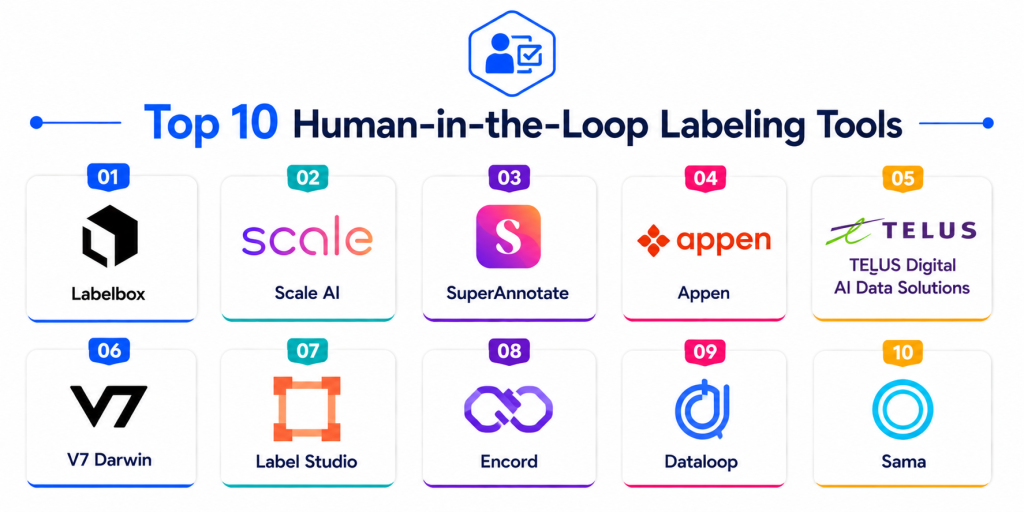
Top 10 Human-in-the-Loop Labeling Tools
1- Labelbox
Short description: Labelbox is an AI data platform that supports human-in-the-loop labeling, model-assisted annotation, data curation, quality review, and dataset management. It is designed for teams that need structured annotation workflows across image, video, text, documents, and multimodal AI projects.
Key Features
- Human-in-the-loop annotation workflows
- Model-assisted labeling
- Data curation and dataset management
- Review queues and quality control
- Consensus and approval workflows
- API and ML pipeline integration
- Collaboration and project management
Pros
- Strong enterprise AI data workflow support
- Good balance of automation and human review
- Useful for computer vision, NLP, and document AI teams
Cons
- Pricing may be high for smaller teams
- Advanced workflows require setup planning
- Best value comes with mature AI data operations
Platforms / Deployment
- Web / APIs
- Cloud / Hybrid options vary
Security & Compliance
- RBAC
- SSO support
- Encryption
- Audit logging
- Enterprise security controls
- Compliance details vary by plan
Integrations & Ecosystem
Labelbox integrates with cloud storage, ML pipelines, and AI development workflows. It is suitable for teams that need to connect labeling with training, evaluation, and dataset improvement processes.
- Cloud storage platforms
- Python SDKs
- Computer vision workflows
- NLP workflows
- MLOps environments
- Custom AI pipelines
Support & Community
Labelbox provides documentation, onboarding support, enterprise customer success, implementation resources, and AI data workflow guidance for production teams.
2- Scale AI
Short description: Scale AI provides managed data labeling, human review, AI data generation, and model evaluation services for enterprise AI teams. It is especially useful for complex human-in-the-loop projects that require high-quality annotation, managed workforces, and scalable review operations.
Key Features
- Managed human labeling services
- Human-in-the-loop review workflows
- Image, video, text, and document labeling
- AI model evaluation support
- Data quality workflows
- Workforce operations
- Enterprise project management
Pros
- Strong managed workforce capability
- Good for complex, large-scale labeling projects
- Useful for enterprise AI and autonomous system datasets
Cons
- Less ideal for teams wanting only self-service tooling
- Premium pricing model
- Project setup may require vendor coordination
Platforms / Deployment
- Web / APIs
- Cloud / Managed services
Security & Compliance
- RBAC
- Encryption
- Audit controls
- Enterprise security support
- Compliance details vary by project and contract
Integrations & Ecosystem
Scale AI supports AI data workflows across visual AI, language models, document AI, and model evaluation use cases. It works well when teams need labeling operations plus human review capacity.
- Cloud storage
- ML pipelines
- Computer vision workflows
- NLP workflows
- AI evaluation workflows
- Custom enterprise pipelines
Support & Community
Scale AI offers enterprise support, managed project operations, workforce coordination, and AI data expertise for teams that need scalable human-in-the-loop programs.
3- Appen
Short description: Appen provides data annotation, data collection, and human review services for AI teams that need large-scale labeled datasets. It is useful for language data, speech data, search relevance, text evaluation, image labeling, and global workforce-based AI training projects.
Key Features
- Human-in-the-loop data labeling
- Global workforce support
- Text, speech, image, video, and audio annotation
- Search relevance evaluation
- Data collection services
- Quality review workflows
- Multilingual labeling support
Pros
- Strong workforce-based annotation support
- Useful for language, speech, and search relevance projects
- Good for large-scale human review programs
Cons
- Managed services may cost more than self-service tools
- Project quality depends on clear instructions and review design
- Less suitable for teams needing full internal workflow control
Platforms / Deployment
- Web / Managed workforce platform
- Cloud / Managed services
Security & Compliance
- Access controls
- Workforce governance
- Data handling controls
- Compliance details vary by project and contract
Integrations & Ecosystem
Appen supports enterprise AI training data programs that require human judgment, linguistic knowledge, and scalable review workflows.
- NLP datasets
- Speech AI workflows
- Search relevance projects
- Computer vision datasets
- Enterprise AI teams
- Custom data pipelines
Support & Community
Appen provides project management support, workforce operations, quality assurance guidance, and labeling services for organizations running large AI data programs.
4- SuperAnnotate
Short description: SuperAnnotate is a data annotation and AI data platform focused on computer vision, multimodal annotation, dataset management, and human-in-the-loop review workflows. It helps teams label, review, automate, and manage AI datasets at scale.
Key Features
- Human review workflows
- AI-assisted annotation
- Image and video labeling
- Text and document annotation
- Quality assurance controls
- Dataset management
- Automation and workflow customization
Pros
- Strong visual annotation experience
- Good QA and review controls
- Useful for enterprise computer vision workflows
Cons
- Advanced workflows may require onboarding
- Pricing may not fit very small projects
- Complex projects need careful workflow design
Platforms / Deployment
- Web / APIs
- Cloud / Hybrid options vary
Security & Compliance
- RBAC
- Encryption
- SSO support
- Audit logging
- Enterprise security options
- Compliance details vary by plan
Integrations & Ecosystem
SuperAnnotate connects annotation workflows with AI model development, review operations, and data pipeline environments.
- Cloud storage
- Python workflows
- ML pipelines
- Computer vision workflows
- Review workflows
- APIs
Support & Community
SuperAnnotate provides product documentation, onboarding support, enterprise assistance, and workflow guidance for visual AI and multimodal labeling teams.
5- Label Studio
Short description: Label Studio is an open-source data labeling platform that supports human-in-the-loop workflows for text, image, audio, video, time series, and multimodal data. It is popular with teams that need flexible labeling templates and self-hosted control.
Key Features
- Multi-data-type labeling
- Human review workflows
- Custom labeling interfaces
- ML-assisted labeling support
- Text classification and NER
- Image, audio, and video labeling
- Self-hosted deployment support
Pros
- Flexible and open-source
- Supports many annotation formats
- Good fit for custom human-in-the-loop workflows
Cons
- Enterprise governance may require paid features or customization
- Large projects require workflow planning
- Advanced QA setup may need technical work
Platforms / Deployment
- Web / Docker / Python environments
- Cloud / Self-hosted / Hybrid
Security & Compliance
- Authentication support
- Role-based access options
- Deployment-based encryption and security controls
- Enterprise security varies by edition
Integrations & Ecosystem
Label Studio integrates with ML workflows, storage systems, and human review pipelines. It is useful for teams that need customizable annotation workflows without being locked into one data type.
- Python SDKs
- Cloud storage
- ML backends
- NLP workflows
- Computer vision workflows
- APIs
Support & Community
Label Studio has a strong open-source community, documentation, templates, and commercial support options for production labeling programs.
6- CVAT
Short description: CVAT is an open-source annotation tool widely used for computer vision labeling. It supports human-in-the-loop image and video annotation workflows, including object detection, segmentation, tracking, and dataset preparation.
Key Features
- Image annotation
- Video annotation
- Bounding boxes
- Polygons and segmentation masks
- Object tracking
- Review workflows
- Dataset export formats
Pros
- Strong open-source computer vision support
- Good deployment control
- Useful for technical teams building visual AI datasets
Cons
- Requires technical setup and maintenance
- Enterprise workflow features may need customization
- Less polished than commercial platforms
Platforms / Deployment
- Web / Docker / Linux
- Self-hosted / Hybrid
Security & Compliance
- Authentication support
- Role-based project access
- Deployment-based security controls
- Compliance depends on hosting environment
Integrations & Ecosystem
CVAT integrates well with computer vision pipelines and dataset export workflows.
- OpenCV workflows
- YOLO-style datasets
- COCO formats
- Pascal VOC formats
- Custom ML pipelines
- Self-hosted AI systems
Support & Community
CVAT has a strong open-source community, active developer adoption, documentation, and commercial ecosystem support options.
7- Dataloop
Short description: Dataloop is an AI data platform that supports annotation, data management, automation, human review, and model-assisted labeling. It is designed for production AI teams that need scalable dataset operations and integrated labeling workflows.
Key Features
- Human-in-the-loop annotation
- Data curation and dataset management
- Model-assisted labeling
- Workflow automation
- Quality assurance tools
- Dataset versioning
- API and pipeline integrations
Pros
- Strong AI data operations capabilities
- Good automation and dataset management
- Useful for production ML teams
Cons
- Requires workflow planning
- Advanced capabilities have a learning curve
- Pricing can vary by project scale
Platforms / Deployment
- Web / APIs
- Cloud / Hybrid options vary
Security & Compliance
- RBAC
- SSO support
- Encryption
- Audit logging
- Enterprise security controls
- Compliance details vary by deployment
Integrations & Ecosystem
Dataloop connects annotation, automation, model feedback, and dataset operations into one workflow.
- Cloud storage
- Python SDKs
- ML models
- Automation pipelines
- Computer vision workflows
- APIs
Support & Community
Dataloop provides documentation, onboarding, enterprise support, and guidance for teams operating AI data pipelines at scale.
8- Encord
Short description: Encord is a data annotation and AI data platform focused on visual AI, medical AI, computer vision, and model evaluation workflows. It supports human-in-the-loop review, model-assisted labeling, and data quality evaluation.
Key Features
- Image and video annotation
- Human review workflows
- Medical imaging annotation
- Model-assisted labeling
- Data quality evaluation
- Segmentation workflows
- Workflow review tools
Pros
- Strong visual AI labeling workflows
- Good fit for medical and computer vision datasets
- Useful model-assisted review features
Cons
- Best suited for visual data projects
- Advanced workflows may require onboarding
- Pricing may not fit small one-time labeling needs
Platforms / Deployment
- Web / APIs
- Cloud / Hybrid options vary
Security & Compliance
- RBAC
- Encryption
- Audit logging
- SSO support
- Enterprise security controls
- Healthcare-related compliance details vary by plan and deployment
Integrations & Ecosystem
Encord integrates with visual AI pipelines and model evaluation systems.
- Cloud storage
- Python SDKs
- Computer vision pipelines
- Medical imaging workflows
- Model evaluation systems
- APIs
Support & Community
Encord provides documentation, onboarding support, enterprise assistance, and domain-focused support for visual AI projects.
9- V7 Darwin
Short description: V7 Darwin is a visual data annotation platform for image, video, medical imaging, and computer vision workflows. It supports automated labeling, human review, dataset management, and collaborative AI training workflows.
Key Features
- Image and video annotation
- Human-in-the-loop review
- Automated labeling workflows
- Medical imaging annotation
- Dataset management
- Quality review
- Model training support
Pros
- Strong visual annotation interface
- Good automation and review workflows
- Useful for medical and computer vision projects
Cons
- Best suited for visual data use cases
- Advanced setup may require training
- Pricing may be high for small teams
Platforms / Deployment
- Web / APIs
- Cloud
Security & Compliance
- RBAC
- Encryption
- Access controls
- Audit features vary by plan
- Compliance details vary by deployment and use case
Integrations & Ecosystem
V7 Darwin connects visual annotation workflows with machine learning pipelines and dataset exports.
- Cloud storage
- ML pipelines
- Computer vision workflows
- Medical imaging data
- APIs
- Dataset exports
Support & Community
V7 provides customer support, onboarding resources, documentation, and AI data workflow guidance.
10- Amazon SageMaker Ground Truth
Short description: Amazon SageMaker Ground Truth is a data labeling service for machine learning teams using AWS. It supports human-in-the-loop labeling, managed workforce options, automated labeling, and integration with SageMaker workflows.
Key Features
- Human labeling workflows
- Managed workforce options
- Automated data labeling support
- Image, text, and video labeling
- Review and quality controls
- SageMaker integration
- Scalable labeling jobs
Pros
- Strong AWS ecosystem integration
- Good managed workforce options
- Useful for teams already using SageMaker
Cons
- Best suited for AWS environments
- Less flexible outside AWS workflows
- Cost and setup require planning
Platforms / Deployment
- AWS Cloud / Web / APIs
- Cloud
Security & Compliance
- IAM integration
- Encryption
- Audit logging through AWS services
- Access controls
- Compliance support depends on AWS configuration
Integrations & Ecosystem
SageMaker Ground Truth integrates deeply with AWS machine learning and cloud data workflows.
- Amazon S3
- SageMaker
- AWS IAM
- Lambda workflows
- ML pipelines
- AWS data services
Support & Community
AWS provides documentation, enterprise support plans, cloud training resources, and a large machine learning developer ecosystem.
Comparison Table
| Tool Name | Best For | Platforms Supported | Deployment | Standout Feature | Public Rating |
|---|---|---|---|---|---|
| Labelbox | Enterprise AI data workflows | Web / APIs | Cloud / Hybrid options vary | Model-assisted labeling and data curation | N/A |
| Scale AI | Managed enterprise labeling | Web / APIs | Cloud / Managed services | High-quality managed human review | N/A |
| Appen | Large-scale human data projects | Web / Managed workforce platform | Cloud / Managed services | Global workforce and multilingual review | N/A |
| SuperAnnotate | Visual and multimodal annotation | Web / APIs | Cloud / Hybrid options vary | Strong QA and review workflows | N/A |
| Label Studio | Flexible open-source labeling | Web / Docker / Python | Cloud / Self-hosted / Hybrid | Custom multimodal labeling templates | N/A |
| CVAT | Computer vision annotation | Web / Docker / Linux | Self-hosted / Hybrid | Open-source visual labeling | N/A |
| Dataloop | Production AI data operations | Web / APIs | Cloud / Hybrid options vary | Automation and dataset management | N/A |
| Encord | Visual and medical AI labeling | Web / APIs | Cloud / Hybrid options vary | Data quality and model-assisted review | N/A |
| V7 Darwin | Image and video AI labeling | Web / APIs | Cloud | Automated visual annotation workflows | N/A |
| SageMaker Ground Truth | AWS ML labeling workflows | AWS Cloud / Web / APIs | Cloud | AWS-native human labeling jobs | N/A |
Evaluation & Scoring of Human-in-the-Loop Labeling Tools
| Tool Name | Core 25% | Ease 15% | Integrations 15% | Security 10% | Performance 10% | Support 10% | Value 15% | Weighted Total |
|---|---|---|---|---|---|---|---|---|
| Labelbox | 9.3 | 8.4 | 9.0 | 9.0 | 8.9 | 8.8 | 8.0 | 8.80 |
| Scale AI | 9.2 | 8.0 | 8.8 | 9.0 | 8.9 | 9.0 | 7.7 | 8.68 |
| Appen | 8.8 | 7.9 | 8.3 | 8.6 | 8.5 | 8.8 | 7.9 | 8.39 |
| SuperAnnotate | 9.0 | 8.3 | 8.7 | 8.8 | 8.8 | 8.7 | 8.1 | 8.65 |
| Label Studio | 8.7 | 8.1 | 8.5 | 8.0 | 8.4 | 8.3 | 9.1 | 8.52 |
| CVAT | 8.5 | 7.4 | 8.2 | 7.8 | 8.5 | 8.2 | 9.3 | 8.34 |
| Dataloop | 8.9 | 8.0 | 8.8 | 8.8 | 8.7 | 8.6 | 8.1 | 8.58 |
| Encord | 8.8 | 8.3 | 8.5 | 8.8 | 8.7 | 8.6 | 8.0 | 8.54 |
| V7 Darwin | 8.7 | 8.5 | 8.3 | 8.5 | 8.6 | 8.5 | 8.0 | 8.46 |
| SageMaker Ground Truth | 8.8 | 8.0 | 9.0 | 9.1 | 8.7 | 8.8 | 8.0 | 8.65 |
These scores are comparative and intended to help buyers evaluate practical fit rather than identify one universal winner. Commercial tools usually score higher for collaboration, workflow design, governance, and support, while open-source platforms provide stronger flexibility and value for technical teams. The best choice depends on data type, review complexity, workforce needs, security requirements, and ML pipeline integration.
Which Human-in-the-Loop Labeling Tool Is Right for You?
Solo / Freelancer
Solo AI builders and independent data scientists often need affordable, flexible, and simple labeling environments. Label Studio and CVAT are strong choices because they support self-hosting, custom workflows, and hands-on review without heavy enterprise setup.
SMB
SMBs usually need collaboration, review workflows, and some automation without high operational complexity. Label Studio, CVAT, SuperAnnotate, and V7 Darwin can work well depending on whether the team prefers open-source flexibility or a managed visual annotation interface.
Mid-Market
Mid-sized AI teams often require stronger QA workflows, dataset versioning, project management, and model-assisted review. Labelbox, SuperAnnotate, Dataloop, Encord, and SageMaker Ground Truth are strong options for growing production AI pipelines.
Enterprise
Large enterprises usually require governance, auditability, secure workforce access, quality assurance, project tracking, and scalable human review. Labelbox, Scale AI, Appen, Dataloop, Encord, and SageMaker Ground Truth are strong enterprise-focused choices.
Budget vs Premium
Open-source tools like Label Studio and CVAT are good for budget-conscious technical teams. Premium platforms like Labelbox, Scale AI, SuperAnnotate, Dataloop, and Encord provide stronger workflow management, automation, workforce support, and enterprise security options.
Feature Depth vs Ease of Use
Labelbox and Dataloop provide deep AI data operations features, while SuperAnnotate, Encord, and V7 Darwin are strong for visual annotation workflows. Label Studio and CVAT are flexible but require more technical setup. Scale AI and Appen are better when managed human labeling is more important than software-only control.
Integrations & Scalability
Teams using AWS should evaluate SageMaker Ground Truth. Teams with custom ML workflows may prefer Labelbox, Dataloop, SuperAnnotate, Label Studio, or CVAT. Teams managing high-volume human review should prioritize workforce tools, review workflows, and quality assurance dashboards.
Security & Compliance Needs
Security-focused teams should prioritize RBAC, SSO, encryption, audit logs, private deployment options, workforce controls, data retention policies, and restricted annotator access. Sensitive use cases should validate how human reviewers access data and how every label decision is audited.
Frequently Asked Questions
1. What is a Human-in-the-Loop Labeling Tool?
A Human-in-the-Loop Labeling Tool combines human review with machine learning automation to create, validate, and improve labeled datasets. Humans review uncertain or important cases while automation speeds up repetitive labeling work.
2. Why is human-in-the-loop labeling important?
It improves training data quality by adding human judgment where automated labeling may fail. This is especially important for edge cases, regulated domains, complex images, nuanced text, and generative AI evaluation.
3. How is human-in-the-loop labeling different from normal annotation?
Normal annotation may be fully manual, while human-in-the-loop labeling combines automation, model predictions, active learning, and human review. The goal is to improve speed and accuracy together.
4. What is model-assisted labeling?
Model-assisted labeling uses AI predictions to pre-label data. Human reviewers then approve, correct, or reject those predictions, reducing manual effort while maintaining quality control.
5. What is active learning in labeling workflows?
Active learning helps identify the most useful or uncertain samples for human review. This allows teams to spend annotation effort on data that is likely to improve the model most.
6. What are common implementation mistakes?
Common mistakes include unclear labeling guidelines, weak review processes, poor sample selection, inconsistent human reviewers, no audit trail, and ignoring model feedback when improving future labeling cycles.
7. Can these tools support generative AI evaluation?
Yes. Human-in-the-loop tools can be used to review AI responses, score relevance, detect harmful outputs, validate summaries, compare answers, and improve AI assistant quality through structured feedback.
8. Should teams use internal reviewers or managed annotation workforces?
Internal reviewers are better for sensitive or domain-specific data, while managed workforces are better for scale and speed. Many organizations use a hybrid approach for quality and efficiency.
9. What integrations are most important?
Important integrations include cloud storage, ML pipelines, MLOps tools, model training systems, APIs, identity providers, dataset versioning tools, and quality evaluation workflows.
10. What should buyers evaluate before selecting a tool?
Buyers should evaluate supported data types, model-assisted labeling, review workflows, QA controls, workforce options, security features, export formats, scalability, integrations, and total project cost.
Conclusion
Human-in-the-Loop Labeling Tools are essential for building accurate, reliable, and production-ready AI systems because human judgment remains critical for validating complex, sensitive, and ambiguous data. The right platform can improve label quality, reduce manual effort, speed up dataset creation, support model-assisted review, and create feedback loops that improve AI performance over time. Labelbox, SuperAnnotate, Dataloop, Encord, and V7 Darwin are strong options for teams that need polished labeling workflows and dataset management. Scale AI and Appen are better suited for organizations that need managed human review at scale, while Label Studio and CVAT provide flexible open-source options for technical teams. SageMaker Ground Truth is a strong fit for AWS-based machine learning workflows. The best choice depends on data type, labeling complexity, human review needs, workforce model, security requirements, and ML pipeline integration. Shortlist two or three tools, test them with real sample data, measure label quality and reviewer efficiency, validate security controls, and confirm that the selected platform can scale with your long-term AI data strategy.