Introduction
Community Forum Software helps organizations create online discussion communities where users, customers, members, employees, or fans can interact, share knowledge, ask questions, and collaborate. These platforms support threaded discussions, moderation workflows, private messaging, gamification, integrations, and user engagement analytics. Community forums are widely used by SaaS companies, nonprofits, educational institutions, gaming communities, customer support teams, and professional organizations.
As digital communities become increasingly important for customer engagement and peer-to-peer support, organizations are moving beyond basic discussion boards toward integrated community ecosystems. Modern Community Forum Software now includes AI-powered moderation, automation, mobile accessibility, community analytics, event integration, and CRM connectivity. These platforms help organizations improve engagement, reduce support workloads, build brand loyalty, and centralize knowledge sharing.
Real-world use cases
- Building customer support communities
- Managing member discussion forums
- Hosting developer and technical communities
- Running online educational and alumni communities
- Enabling internal employee collaboration and knowledge sharing
What buyers should evaluate
- Discussion and moderation capabilities
- User engagement and gamification tools
- Scalability for growing communities
- Mobile accessibility and user experience
- Integration flexibility with CRM and support platforms
- Reporting and analytics dashboards
- Automation and moderation workflows
- Security and permissions management
- Branding and customization support
- API and ecosystem extensibility
Best for:
Community Forum Software is best for SaaS companies, nonprofits, educational institutions, online communities, customer support teams, gaming communities, and membership organizations.
Not ideal for:
Organizations with limited community interaction needs or those requiring only basic chat functionality may prefer lightweight collaboration tools instead of full forum platforms.
Key Trends in Community Forum Software
- AI-assisted moderation is helping reduce spam, abuse, and low-quality content.
- Integrated community engagement analytics are improving retention and participation tracking.
- Cloud-native community platforms are replacing self-hosted legacy forums.
- Gamification and reputation systems are becoming central to member engagement strategies.
- Mobile-first user experiences are improving accessibility and community participation.
- CRM and customer support integrations are helping organizations unify engagement workflows.
- Hybrid event and webinar integrations are becoming more common within community platforms.
- Automation-driven moderation and onboarding workflows are reducing administrative workload.
- API-first architectures are improving customization and extensibility.
- Community-led support strategies are helping organizations reduce customer service costs.
How We Selected These Tools
- Evaluated platforms with strong adoption across online communities and organizations
- Prioritized tools with scalable discussion and moderation capabilities
- Included enterprise-grade and SMB-friendly platforms
- Assessed usability for administrators and community members
- Evaluated engagement, gamification, and automation features
- Reviewed reporting and analytics capabilities
- Considered API flexibility and integration ecosystems
- Assessed scalability for large and active communities
- Reviewed onboarding, documentation, and support quality
- Balanced traditional forum systems with modern community platforms
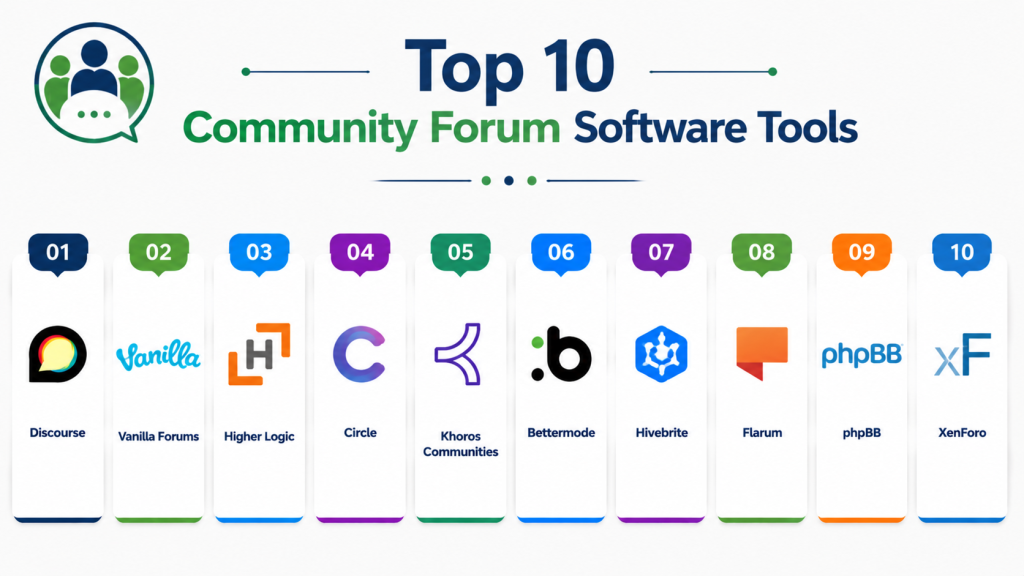
Top 10 Community Forum Software Tools
#1 — Discourse
Short description:
Discourse is a modern open-source community forum platform widely used for customer communities, developer forums, educational groups, and online discussion communities. It provides advanced moderation, gamification, real-time discussions, and mobile-friendly experiences. The platform is highly customizable and scalable. It is best suited for organizations requiring flexible and community-driven engagement.
Key Features
- Real-time discussion support
- Advanced moderation workflows
- Gamification and trust systems
- Mobile-responsive design
- Plugin and API ecosystem
- AI-assisted moderation capabilities
- Community analytics and reporting
Pros
- Highly customizable platform
- Strong moderation and engagement tools
- Active open-source ecosystem
Cons
- Self-hosted deployments require technical management
- Advanced customization may require developer resources
- Enterprise onboarding may vary by deployment model
Platforms / Deployment
Web / Cloud / Self-hosted
Security & Compliance
Supports role-based access controls, secure authentication, and moderation permissions.
Integrations & Ecosystem
Discourse integrates with operational and engagement ecosystems.
- SSO providers
- CRM systems
- Slack integrations
- Email systems
- Analytics platforms
Support & Community
Strong documentation, open-source community support, and managed hosting options are available.
#2 — Vanilla Forums
Short description:
Vanilla Forums is a cloud-based community platform designed for customer communities, branded discussion forums, and enterprise engagement environments. The platform combines forum functionality with knowledge sharing, gamification, and analytics capabilities. It is widely used by brands seeking scalable customer engagement communities. It is best suited for enterprise and customer-facing communities.
Key Features
- Branded community forums
- Gamification and engagement tools
- Knowledge base integration
- Moderation workflows
- Analytics dashboards
- Community automation capabilities
- Mobile-friendly experiences
Pros
- Strong enterprise branding support
- Good customer engagement workflows
- Scalable cloud infrastructure
Cons
- Premium features may increase costs
- Customization depth varies by plan
- Smaller communities may find enterprise features excessive
Platforms / Deployment
Web / Cloud
Security & Compliance
Supports permissions management and secure authentication workflows.
Integrations & Ecosystem
Vanilla Forums integrates with customer engagement ecosystems.
- CRM systems
- Marketing automation tools
- Analytics platforms
- Customer support systems
- SSO providers
Support & Community
Enterprise onboarding and customer support services are available.
#3 — Higher Logic
Short description:
Higher Logic is an enterprise community and engagement platform designed for associations, nonprofits, and member-driven organizations. The platform combines online communities, email engagement, automation, and event workflows into one ecosystem. It is especially popular among professional associations and membership organizations. It is best suited for large associations and enterprise communities.
Key Features
- Online community management
- Member engagement automation
- Email marketing support
- Discussion forums and collaboration
- Event integration capabilities
- Reporting and analytics dashboards
- Member segmentation workflows
Pros
- Strong association-focused functionality
- Good engagement automation support
- Enterprise-grade scalability
Cons
- Implementation complexity may vary
- Smaller organizations may find it expensive
- Advanced configuration may require onboarding support
Platforms / Deployment
Web / Cloud
Security & Compliance
Supports permissions management, secure authentication, and administrative controls.
Integrations & Ecosystem
Higher Logic integrates with nonprofit and operational systems.
- CRM platforms
- AMS systems
- Marketing automation tools
- Event systems
- Analytics platforms
Support & Community
Implementation assistance and enterprise support are available.
#4 — Circle
Short description:
Circle is a modern community platform designed for creators, online businesses, membership communities, and educational organizations. It combines discussion forums, live events, memberships, and engagement workflows into one user-friendly ecosystem. The platform emphasizes modern design and community engagement. It is best suited for creator-driven and subscription communities.
Key Features
- Discussion forums and spaces
- Membership and subscription support
- Live event integration
- Community analytics dashboards
- Mobile accessibility
- Branding customization tools
- Engagement automation workflows
Pros
- Modern and intuitive user experience
- Strong creator-focused functionality
- Good engagement and membership workflows
Cons
- Enterprise operational depth varies
- Advanced moderation customization may be limited
- Large-scale analytics may require external tools
Platforms / Deployment
Web / iOS / Android / Cloud
Security & Compliance
Supports secure authentication and permissions management.
Integrations & Ecosystem
Circle integrates with creator and engagement ecosystems.
- Payment systems
- CRM platforms
- Email marketing tools
- Learning platforms
- Analytics tools
Support & Community
Knowledge resources and customer support are available.
#5 — Khoros Communities
Short description:
Khoros Communities is an enterprise-grade community platform designed for customer support communities, brand engagement, and large-scale digital communities. It supports advanced moderation, analytics, automation, and customer experience workflows. The platform is widely used by enterprise organizations managing high-volume online communities. It is best suited for enterprise customer engagement programs.
Key Features
- Enterprise community management
- AI-assisted moderation support
- Customer support integrations
- Analytics and reporting dashboards
- Knowledge sharing capabilities
- Community automation workflows
- Gamification and reputation systems
Pros
- Strong enterprise scalability
- Advanced moderation capabilities
- Good customer engagement workflows
Cons
- Complex implementation requirements
- Premium pricing may not suit SMBs
- Customization may require technical expertise
Platforms / Deployment
Web / Cloud
Security & Compliance
Supports enterprise-grade permissions, authentication, and operational controls.
Integrations & Ecosystem
Khoros integrates with customer engagement ecosystems.
- CRM platforms
- Customer support systems
- Marketing automation tools
- Analytics solutions
- Social engagement platforms
Support & Community
Enterprise onboarding and dedicated support services are available.
#6 — Bettermode
Short description:
Bettermode is a flexible community platform designed for modern online communities, SaaS customer communities, and membership organizations. The platform combines discussion forums, engagement tools, and branding customization into a scalable cloud environment. It emphasizes no-code community building. It is best suited for fast-growing digital communities.
Key Features
- Customizable community spaces
- Discussion and engagement tools
- No-code configuration support
- Gamification workflows
- Analytics dashboards
- Member onboarding automation
- Mobile-friendly user experience
Pros
- Easy community customization
- Good no-code workflows
- Modern and scalable interface
Cons
- Enterprise operational depth varies
- Advanced integrations may require configuration
- Reporting customization may be limited
Platforms / Deployment
Web / Cloud
Security & Compliance
Supports permissions controls and secure authentication workflows.
Integrations & Ecosystem
Bettermode integrates with modern SaaS ecosystems.
- CRM systems
- Email platforms
- Analytics tools
- Automation platforms
- Membership systems
Support & Community
Customer onboarding and documentation resources are available.
#7 — Hivebrite
Short description:
Hivebrite is a community management platform designed for alumni groups, nonprofits, professional networks, and educational organizations. The platform combines networking, communication, events, and member engagement workflows into one ecosystem. It emphasizes branded community experiences and networking capabilities. It is best suited for member-driven organizations.
Key Features
- Community networking tools
- Event management workflows
- Member directories and engagement
- Communication automation
- Reporting and analytics dashboards
- Branding customization support
- Mobile accessibility
Pros
- Strong networking capabilities
- Good alumni and nonprofit workflows
- Flexible branding support
Cons
- Enterprise customization varies
- Advanced analytics depth may require external tools
- Smaller organizations may find pricing high
Platforms / Deployment
Web / iOS / Android / Cloud
Security & Compliance
Supports secure authentication and permissions management.
Integrations & Ecosystem
Hivebrite integrates with nonprofit and engagement systems.
- CRM platforms
- Payment systems
- Email marketing tools
- Event systems
- Analytics platforms
Support & Community
Customer onboarding and operational support are available.
#8 — Flarum
Short description:
Flarum is an open-source forum platform designed for lightweight, fast, and modern online discussion communities. The platform emphasizes simplicity, extensibility, and responsive user experiences. It is popular among developers and technical communities seeking open-source flexibility. It is best suited for technically managed communities.
Key Features
- Open-source discussion forums
- Lightweight and responsive architecture
- Extension and plugin support
- Modern user interface
- Mobile-friendly design
- Role-based moderation controls
- Community customization support
Pros
- Lightweight and fast platform
- Open-source flexibility
- Good developer customization support
Cons
- Self-hosting requires technical expertise
- Enterprise support options are limited
- Advanced moderation capabilities vary
Platforms / Deployment
Web / Self-hosted
Security & Compliance
Supports role-based permissions and authentication controls.
Integrations & Ecosystem
Flarum supports extensible community integrations.
- Authentication systems
- Email integrations
- Analytics plugins
- Developer APIs
Support & Community
Open-source community support and documentation are available.
#9 — phpBB
Short description:
phpBB is one of the most widely known open-source forum platforms for building online communities and discussion boards. It provides customizable forums, moderation workflows, permissions management, and extension support. The platform remains popular among traditional online communities. It is best suited for self-hosted forum deployments.
Key Features
- Open-source discussion forums
- Role-based moderation controls
- Plugin and extension support
- User permissions management
- Community customization workflows
- Responsive themes and templates
- Large extension ecosystem
Pros
- Mature open-source ecosystem
- Highly customizable platform
- Large community support base
Cons
- Older interface compared to modern platforms
- Advanced functionality may require plugins
- Self-hosting management is required
Platforms / Deployment
Web / Self-hosted
Security & Compliance
Supports permissions management and moderation controls.
Integrations & Ecosystem
phpBB integrates through plugins and extensions.
- Authentication systems
- Analytics tools
- Email workflows
- Developer extensions
Support & Community
Extensive open-source community resources and documentation are available.
#10 — XenForo
Short description:
XenForo is a commercial forum platform designed for online communities, gaming forums, and discussion-driven websites. The platform combines modern user experiences, moderation workflows, and extensibility features into one ecosystem. It is known for scalability and strong community management capabilities. It is best suited for active online communities.
Key Features
- Modern discussion forums
- Advanced moderation tools
- User reputation and engagement systems
- Plugin and extension support
- Responsive mobile design
- Media and content management
- Community analytics support
Pros
- Modern user experience
- Strong moderation workflows
- Scalable community architecture
Cons
- Commercial licensing costs
- Advanced customization may require developer support
- Enterprise operational workflows are limited
Platforms / Deployment
Web / Self-hosted
Security & Compliance
Supports secure authentication and permissions management.
Integrations & Ecosystem
XenForo integrates with community operational ecosystems.
- Authentication systems
- Media platforms
- Analytics tools
- Community plugins
Support & Community
Commercial support and strong community forums are available.
Comparison Table
| Tool Name | Best For | Platform Supported | Deployment | Standout Feature | Public Rating |
|---|---|---|---|---|---|
| Discourse | Developer and SaaS communities | Web | Cloud, Self-hosted | Modern open-source engagement | N/A |
| Vanilla Forums | Enterprise customer communities | Web | Cloud | Branded enterprise communities | N/A |
| Higher Logic | Associations and nonprofits | Web | Cloud | Engagement automation | N/A |
| Circle | Creator communities | Web, Mobile | Cloud | Modern creator engagement | N/A |
| Khoros Communities | Enterprise customer support | Web | Cloud | AI-assisted moderation | N/A |
| Bettermode | Modern online communities | Web | Cloud | No-code community setup | N/A |
| Hivebrite | Alumni and nonprofit networks | Web, Mobile | Cloud | Networking-focused communities | N/A |
| Flarum | Lightweight open-source forums | Web | Self-hosted | Lightweight architecture | N/A |
| phpBB | Traditional discussion forums | Web | Self-hosted | Mature open-source ecosystem | N/A |
| XenForo | Gaming and active communities | Web | Self-hosted | Scalable moderation workflows | N/A |
Evaluation & Scoring of Community Forum Software
| Tool Name | Core 25% | Ease 15% | Integrations 15% | Security 10% | Performance 10% | Support 10% | Value 15% | Weighted Total |
|---|---|---|---|---|---|---|---|---|
| Discourse | 9 | 8 | 9 | 8 | 9 | 8 | 8 | 8.5 |
| Vanilla Forums | 8 | 8 | 8 | 8 | 8 | 8 | 7 | 7.9 |
| Higher Logic | 9 | 7 | 8 | 8 | 8 | 8 | 7 | 8.0 |
| Circle | 8 | 9 | 7 | 8 | 8 | 8 | 8 | 8.0 |
| Khoros Communities | 9 | 7 | 9 | 9 | 9 | 8 | 6 | 8.2 |
| Bettermode | 8 | 8 | 8 | 8 | 8 | 8 | 8 | 8.0 |
| Hivebrite | 8 | 8 | 7 | 8 | 8 | 8 | 7 | 7.8 |
| Flarum | 7 | 8 | 7 | 7 | 8 | 7 | 9 | 7.6 |
| phpBB | 7 | 7 | 7 | 7 | 7 | 8 | 9 | 7.4 |
| XenForo | 8 | 8 | 8 | 8 | 8 | 8 | 8 | 8.0 |
These scores are comparative and intended to help organizations evaluate platforms based on scalability, usability, customization, integrations, and engagement capabilities. Enterprise-focused platforms generally perform better for analytics, governance, and automation, while open-source platforms often score higher for flexibility and value. Buyers should validate moderation workflows, integrations, mobile experiences, and scalability requirements before deployment.
Which Community Forum Software Tool Is Right for You?
Solo / Freelancer
Small communities and independent creators often benefit from lightweight and affordable platforms such as Circle, Flarum, or phpBB. These tools provide manageable operational complexity and strong engagement capabilities.
SMB
Small and mid-sized businesses should prioritize ease of use, engagement workflows, analytics, and integrations. Discourse, Circle, Bettermode, and Vanilla Forums are strong choices for growing online communities.
Mid-Market
Mid-sized organizations often require better moderation controls, automation workflows, and customer engagement integrations. Higher Logic, Vanilla Forums, and Hivebrite provide stronger operational flexibility.
Enterprise
Large organizations and customer support communities should prioritize scalability, governance, analytics, and AI-assisted moderation. Khoros Communities and Higher Logic are strong enterprise-focused solutions.
Budget vs Premium
Budget-conscious organizations may prefer Flarum, phpBB, or Discourse self-hosted deployments because of their flexibility and lower infrastructure costs. Enterprise cloud platforms provide broader operational support but often involve higher subscription expenses.
Feature Depth vs Ease of Use
Enterprise systems provide stronger automation, governance, and analytics capabilities, while simpler community platforms focus on faster deployment and usability. Organizations should balance operational complexity against administrative resources.
Integrations & Scalability
Community platforms should integrate with CRM systems, customer support tools, analytics platforms, event systems, and marketing automation workflows. API flexibility becomes increasingly important as communities scale.
Security & Compliance Needs
Community platforms handle user-generated content, member data, and engagement records. Organizations should prioritize moderation controls, permissions management, authentication workflows, and secure operational governance.
Frequently Asked Questions
1. What is Community Forum Software?
Community Forum Software helps organizations create online discussion communities where users can interact, share knowledge, ask questions, and collaborate through structured discussion forums.
2. Who uses Community Forum Software?
SaaS companies, nonprofits, gaming communities, educational institutions, customer support teams, and membership organizations commonly use community forum platforms.
3. What features are most important in forum platforms?
Important features include moderation tools, discussion workflows, analytics, gamification, mobile accessibility, integrations, user permissions, and engagement automation capabilities.
4. Are community forum platforms cloud-based?
Many modern community platforms are cloud-based, though several open-source solutions still support self-hosted deployments for organizations requiring greater customization and infrastructure control.
5. How much does Community Forum Software cost?
Pricing varies based on deployment model, community size, integrations, analytics capabilities, support levels, and customization requirements. Open-source platforms may reduce licensing costs but increase infrastructure responsibilities.
6. Can community forums reduce customer support workloads?
Yes. Many organizations use community forums to enable peer-to-peer support and knowledge sharing, which can reduce support ticket volumes and improve customer engagement.
7. What integrations are important for community platforms?
Important integrations include CRM systems, help desk software, analytics tools, SSO providers, marketing automation platforms, and event management systems.
8. What are common mistakes when selecting Community Forum Software?
Organizations often underestimate moderation needs, overlook scalability requirements, ignore mobile experiences, or fail to evaluate integration flexibility before deployment.
9. Is security important for online communities?
Yes. Community platforms store user data, communication histories, and engagement records. Buyers should review permissions management, authentication workflows, moderation controls, and administrative security features carefully.
10. How should organizations choose the right community platform?
Organizations should identify engagement goals, moderation requirements, integration priorities, scalability expectations, and branding needs before selecting a platform. Pilot deployments and member testing are strongly recommended.
Conclusion
Community Forum Software has evolved far beyond traditional discussion boards and now plays a central role in customer engagement, member collaboration, peer-to-peer support, and online community building. Modern platforms combine discussion management, moderation, analytics, automation, and engagement workflows into scalable ecosystems that help organizations improve communication and strengthen relationships. As organizations increasingly rely on digital communities for support, education, and engagement, scalable community platforms continue to become more valuable across industries. Enterprise organizations managing customer communities and large engagement programs may benefit most from Khoros Communities or Higher Logic because of their scalability and advanced operational controls. Mid-sized businesses and growing online communities may find strong value in Discourse, Vanilla Forums, Bettermode, or Hivebrite. Smaller communities and technically managed environments may prefer Flarum, phpBB, or XenForo because of their flexibility and customization capabilities. The best Community Forum Software depends on organizational goals, community size, moderation requirements, branding expectations, and integration priorities. Organizations should carefully shortlist vendors, validate engagement workflows, test moderation capabilities, review analytics functionality, and pilot user experiences before making long-term deployment decisions.