Introduction
Disaster Management & Response Platforms are specialized software systems designed to help governments, emergency response agencies, NGOs, healthcare organizations, utilities, and enterprises prepare for, respond to, and recover from natural or human-made disasters. These platforms centralize incident reporting, emergency coordination, communication workflows, resource management, and situational awareness during crises.
Modern disaster response operations require real-time visibility, fast decision-making, cross-agency coordination, and reliable communication systems. Traditional manual response methods are often too slow and fragmented during emergencies such as floods, earthquakes, pandemics, cyberattacks, industrial accidents, or severe weather events. Today’s disaster management platforms integrate GIS mapping, AI-driven analytics, IoT sensors, satellite data, mobile communication, predictive forecasting, and automated alert systems to improve emergency preparedness and operational resilience.
Real-world use cases include:
- Emergency incident coordination and command management
- Natural disaster preparedness and evacuation planning
- Public safety communication and mass alerting
- Resource and shelter management during crises
- Infrastructure and utility outage response operations
Buyers evaluating Disaster Management & Response Platforms should focus on:
- Incident management capabilities
- Real-time situational awareness tools
- GIS and geospatial intelligence support
- Emergency communication and alerting systems
- Mobile accessibility for field responders
- Integration with public safety and IoT systems
- Workflow automation and escalation management
- Scalability during large-scale emergencies
- Security and compliance readiness
- Reporting and post-incident analytics
Best for: Government agencies, emergency management departments, public safety organizations, healthcare systems, utilities, transportation operators, and enterprises managing emergency preparedness and disaster response operations.
Not ideal for: Small organizations with minimal emergency coordination needs or teams that only require basic communication tools without large-scale incident management requirements.
Key Trends in Disaster Management & Response Platforms
- AI-assisted disaster prediction improving early warning capabilities
- GIS and satellite imagery integration becoming essential for situational awareness
- Cloud-based emergency management platforms replacing legacy systems
- IoT-enabled sensor networks improving real-time disaster monitoring
- Mobile-first communication tools enhancing field response coordination
- Predictive analytics helping optimize evacuation and resource allocation
- Drone integration supporting damage assessment and rescue operations
- Cross-agency interoperability improving coordinated emergency response
- Automated mass notification systems reducing response delays
- Increased cybersecurity focus for critical emergency infrastructure platforms
How We Selected These Tools (Methodology)
- Adoption across government and emergency response organizations
- Incident management and operational coordination depth
- GIS and real-time situational awareness capabilities
- Scalability during large-scale disaster events
- Integration support for public safety and communication systems
- Security and resilience capabilities
- Workflow automation and response orchestration features
- Mobile and field response usability
- Vendor support and implementation ecosystem
- Flexibility across multiple disaster response scenarios
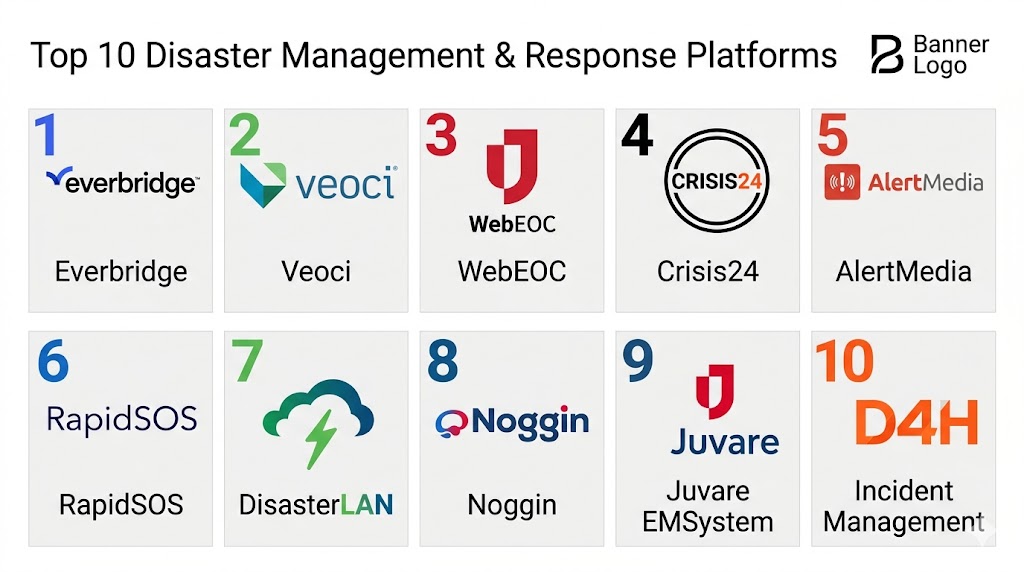
Top 10 Disaster Management & Response Platforms
1- Everbridge Critical Event Management
Short description:
Everbridge is one of the leading critical event management platforms used for emergency communication, public safety alerts, and disaster coordination. It supports governments and enterprises managing large-scale emergency response operations.
Key Features
- Mass notification system
- Incident management workflows
- Real-time threat monitoring
- GIS-based situational awareness
- Automated escalation management
- Emergency communication tools
- Mobile responder coordination
Pros
- Strong emergency alerting capabilities
- Excellent scalability
- Reliable multi-channel communication
Cons
- Premium enterprise pricing
- Complex configuration options
- Requires training for advanced workflows
Platforms / Deployment
- Web / Android / iOS
- Cloud
Security & Compliance
Supports RBAC, MFA, encryption, audit logging, and enterprise-grade security controls.
Integrations & Ecosystem
Integrates with public safety systems, communication networks, GIS platforms, and IoT monitoring tools.
- GIS systems
- Public safety platforms
- IoT sensors
- API integrations
- Communication tools
Support & Community
Strong enterprise support with global emergency management expertise.
2- Veoci Emergency Management Platform
Short description:
Veoci provides emergency management and incident response capabilities designed for government agencies, healthcare systems, airports, and enterprises handling crisis operations.
Key Features
- Incident command workflows
- Resource management tools
- Situation reporting dashboards
- Emergency communication system
- Workflow automation
- Mobile field response tools
- GIS integration support
Pros
- Flexible workflow configuration
- Strong operational visibility
- Good usability for responders
Cons
- Smaller ecosystem compared to larger vendors
- Some advanced features require customization
- Reporting customization can be complex
Platforms / Deployment
- Web / Mobile
- Cloud
Security & Compliance
Supports encryption, RBAC, MFA, and audit tracking.
Integrations & Ecosystem
Integrates with public safety tools, communication systems, and reporting platforms.
- GIS integrations
- Communication tools
- Public safety systems
- APIs
- Reporting platforms
Support & Community
Strong emergency management support with responsive onboarding services.
3- WebEOC
Short description:
WebEOC is a widely adopted crisis management platform used by emergency operations centers for coordinating disaster response and situational awareness.
Key Features
- Emergency operations center workflows
- Incident tracking
- GIS visualization
- Resource allocation management
- Situation reporting
- Communication coordination
- Real-time dashboards
Pros
- Strong government adoption
- Proven emergency operations capabilities
- Good interoperability support
Cons
- Interface may feel outdated
- Complex setup for large deployments
- Advanced customization requires expertise
Platforms / Deployment
- Web
- Cloud / Hybrid
Security & Compliance
Supports access controls, encryption, and audit logging features.
Integrations & Ecosystem
Integrates with GIS systems, emergency communication tools, and public safety databases.
- GIS platforms
- Communication systems
- Emergency databases
- APIs
- Reporting systems
Support & Community
Large public-sector user base with established emergency management community adoption.
4- ArcGIS Mission
Short description:
ArcGIS Mission by Esri provides GIS-powered operational coordination for emergency response teams, field personnel, and disaster management agencies.
Key Features
- GIS situational awareness
- Real-time field coordination
- Live mapping dashboards
- Incident tracking
- Team communication tools
- Mobile responder support
- Data visualization
Pros
- Industry-leading GIS capabilities
- Excellent real-time mapping
- Strong integration flexibility
Cons
- Requires GIS expertise
- Premium licensing costs
- Complex advanced deployments
Platforms / Deployment
- Web / Mobile
- Cloud / Hybrid
Security & Compliance
Supports MFA, encryption, RBAC, and enterprise authentication controls.
Integrations & Ecosystem
Integrates with ArcGIS ecosystem tools, IoT platforms, and public safety systems.
- ArcGIS ecosystem
- IoT integrations
- APIs
- Public safety systems
- Analytics tools
Support & Community
Strong GIS and public safety support ecosystem with extensive training resources.
5- Noggin Emergency Management
Short description:
Noggin provides operational resilience and emergency management tools focused on crisis coordination, incident management, and organizational continuity.
Key Features
- Incident response workflows
- Crisis communication tools
- Emergency planning modules
- Operational resilience dashboards
- Mobile incident reporting
- Resource tracking
- Workflow automation
Pros
- Modern interface design
- Strong operational resilience focus
- Good mobile accessibility
Cons
- Smaller market presence
- Limited deep GIS functionality
- Advanced integrations may require configuration
Platforms / Deployment
- Web / Mobile
- Cloud
Security & Compliance
Supports RBAC, encryption, audit logs, and secure authentication.
Integrations & Ecosystem
Integrates with communication systems, reporting platforms, and enterprise tools.
- APIs
- Notification systems
- ERP integrations
- Reporting tools
Support & Community
Responsive enterprise support with resilience-focused onboarding.
6- AlertMedia Emergency Communication Platform
Short description:
AlertMedia specializes in emergency communication and mass notification systems for organizations managing crisis response and workforce safety.
Key Features
- Mass notification system
- Threat intelligence feeds
- Emergency communication workflows
- Employee safety tracking
- Mobile alerts
- Incident escalation automation
- Crisis dashboards
Pros
- Excellent notification capabilities
- Easy deployment model
- Strong mobile communication tools
Cons
- Limited deep incident management features
- Less GIS functionality
- Primarily communication-focused
Platforms / Deployment
- Web / Android / iOS
- Cloud
Security & Compliance
Supports MFA, encryption, audit logging, and enterprise security controls.
Integrations & Ecosystem
Integrates with HR systems, communication tools, and enterprise applications.
- HR systems
- Communication platforms
- APIs
- Security systems
Support & Community
Strong customer support and rapid onboarding capabilities.
7- Crisis24 Horizon Platform
Short description:
Crisis24 Horizon provides global threat intelligence and crisis management tools for organizations handling international emergency response and security operations.
Key Features
- Global threat intelligence
- Incident monitoring
- Crisis communication
- Travel risk management
- Emergency coordination
- Real-time alerts
- Risk analytics dashboards
Pros
- Strong global intelligence capabilities
- Excellent risk monitoring
- Good operational visibility
Cons
- Premium enterprise pricing
- Complex advanced workflows
- Focused more on corporate risk management
Platforms / Deployment
- Web / Mobile
- Cloud
Security & Compliance
Supports enterprise-grade authentication, encryption, and audit controls.
Integrations & Ecosystem
Integrates with travel systems, communication platforms, and security tools.
- Security systems
- Travel management platforms
- APIs
- Communication tools
Support & Community
Strong enterprise support with global security expertise.
8- SAM Desk Crisis Monitoring
Short description:
SAM Desk provides AI-powered crisis detection and situational awareness tools focused on monitoring global events and operational risks in real time.
Key Features
- AI-powered event monitoring
- Real-time crisis alerts
- Risk intelligence dashboards
- Social media monitoring
- GIS visualization
- Operational risk tracking
- Automated notifications
Pros
- Strong AI monitoring capabilities
- Fast alerting system
- Good situational awareness tools
Cons
- Smaller enterprise ecosystem
- Limited operational workflow depth
- Custom integrations may require effort
Platforms / Deployment
- Web
- Cloud
Security & Compliance
Supports secure authentication and enterprise access management.
Integrations & Ecosystem
Integrates with communication tools, APIs, and intelligence feeds.
- APIs
- GIS systems
- Notification platforms
- Risk intelligence feeds
Support & Community
Growing enterprise support ecosystem focused on crisis intelligence.
9- RapidSOS Emergency Response Platform
Short description:
RapidSOS connects emergency responders with real-time incident data from connected devices, improving emergency dispatch and response coordination.
Key Features
- Real-time emergency data sharing
- Connected device integration
- Emergency dispatch support
- Location intelligence
- Mobile emergency coordination
- Incident analytics
- Public safety integrations
Pros
- Strong connected-device ecosystem
- Excellent emergency response speed
- High operational relevance for public safety
Cons
- Specialized emergency use focus
- Limited broader disaster management workflows
- Dependent on ecosystem integrations
Platforms / Deployment
- Web / Mobile
- Cloud
Security & Compliance
Supports encryption, secure APIs, and public safety-grade security controls.
Integrations & Ecosystem
Integrates with emergency dispatch systems, IoT devices, and communication platforms.
- IoT devices
- Emergency dispatch systems
- APIs
- Public safety tools
Support & Community
Strong public safety ecosystem partnerships and implementation support.
10- Fusion Framework System
Short description:
Fusion Framework System provides operational resilience, emergency management, and business continuity capabilities for enterprises and public organizations.
Key Features
- Crisis management workflows
- Business continuity planning
- Incident response coordination
- Risk assessment tools
- Workflow automation
- Reporting dashboards
- Resource tracking
Pros
- Strong resilience management capabilities
- Good enterprise scalability
- Comprehensive continuity planning
Cons
- Enterprise-focused complexity
- Higher implementation effort
- Requires operational process maturity
Platforms / Deployment
- Web
- Cloud / Hybrid
Security & Compliance
Supports RBAC, encryption, MFA, and enterprise-grade security management.
Integrations & Ecosystem
Integrates with enterprise systems, communication tools, and reporting platforms.
- ERP systems
- APIs
- Communication tools
- Risk platforms
Support & Community
Strong enterprise implementation and resilience consulting ecosystem.
Comparison Table
| Tool Name | Best For | Platforms Supported | Deployment | Standout Feature | Public Rating |
|---|---|---|---|---|---|
| Everbridge | Mass emergency communication | Web, Mobile | Cloud | Critical event management | N/A |
| Veoci | Incident coordination | Web, Mobile | Cloud | Flexible workflows | N/A |
| WebEOC | Emergency operations centers | Web | Hybrid | EOC coordination | N/A |
| ArcGIS Mission | GIS disaster response | Web, Mobile | Cloud / Hybrid | Real-time mapping | N/A |
| Noggin | Operational resilience | Web, Mobile | Cloud | Crisis coordination | N/A |
| AlertMedia | Emergency notifications | Web, Mobile | Cloud | Mass alerts | N/A |
| Crisis24 Horizon | Global risk intelligence | Web, Mobile | Cloud | Threat intelligence | N/A |
| SAM Desk | AI crisis monitoring | Web | Cloud | AI event detection | N/A |
| RapidSOS | Emergency dispatch integration | Web, Mobile | Cloud | Connected emergency data | N/A |
| Fusion Framework | Business continuity | Web | Cloud / Hybrid | Operational resilience | N/A |
Evaluation & Scoring of Disaster Management & Response Platforms
| Tool Name | Core 25% | Ease 15% | Integrations 15% | Security 10% | Performance 10% | Support 10% | Value 15% | Weighted Total |
|---|---|---|---|---|---|---|---|---|
| Everbridge | 9.6 | 8.4 | 9.5 | 9.5 | 9.4 | 9.5 | 8.0 | 9.0 |
| Veoci | 8.8 | 8.5 | 8.6 | 8.7 | 8.7 | 8.6 | 8.7 | 8.7 |
| WebEOC | 9.0 | 7.8 | 8.8 | 8.9 | 9.0 | 8.9 | 8.2 | 8.7 |
| ArcGIS Mission | 9.2 | 7.9 | 9.3 | 9.0 | 9.1 | 9.2 | 7.9 | 8.8 |
| Noggin | 8.6 | 8.5 | 8.4 | 8.6 | 8.5 | 8.5 | 8.8 | 8.6 |
| AlertMedia | 8.4 | 9.0 | 8.2 | 8.7 | 8.5 | 8.7 | 8.9 | 8.6 |
| Crisis24 Horizon | 8.9 | 8.0 | 8.8 | 9.1 | 8.9 | 8.8 | 7.8 | 8.5 |
| SAM Desk | 8.5 | 8.6 | 8.1 | 8.4 | 8.5 | 8.3 | 8.7 | 8.4 |
| RapidSOS | 8.7 | 8.4 | 8.9 | 9.0 | 9.2 | 8.8 | 8.0 | 8.6 |
| Fusion Framework | 8.8 | 7.9 | 8.7 | 9.0 | 8.8 | 8.9 | 8.1 | 8.5 |
These scores are comparative and designed to help organizations evaluate platforms based on operational readiness, scalability, communication capabilities, GIS support, integrations, security, and long-term resilience management value.
Which Disaster Management & Response Platform Is Right for You?
Solo / Small Emergency Teams
Best suited: AlertMedia, SAM Desk
These platforms are easier to deploy and focus on communication and monitoring capabilities.
SMB / Regional Emergency Programs
Best suited: Veoci, Noggin, WebEOC
These provide balanced operational coordination and incident management features.
Mid-Market Government Agencies
Best suited: ArcGIS Mission, Veoci, WebEOC
These offer strong situational awareness and multi-agency coordination support.
Enterprise / National Programs
Best suited: Everbridge, Fusion Framework, Crisis24 Horizon
These provide advanced scalability, resilience planning, and enterprise-grade integrations.
Budget vs Premium
Budget-conscious organizations may prefer lighter communication-focused solutions, while enterprise governments often require advanced GIS, automation, and operational resilience capabilities.
Feature Depth vs Ease of Use
Deep operational capability: Everbridge, ArcGIS, Fusion Framework
Ease of use: AlertMedia, Veoci
Integrations & Scalability
Best integrations: Everbridge, ArcGIS Mission, RapidSOS
Best scalability: Everbridge, Fusion Framework
Security & Compliance Needs
Organizations handling critical infrastructure and public safety operations should prioritize platforms with strong RBAC, MFA, encryption, audit logging, and operational resilience controls.
Frequently Asked Questions
1. What is a Disaster Management & Response Platform?
It is a software platform used to coordinate emergency preparedness, disaster response, communication, and operational recovery during crises.
2. Why are these platforms important?
They improve situational awareness, speed up emergency response, and help organizations coordinate resources and communication during disasters.
3. Do these platforms support GIS mapping?
Yes, many modern disaster management systems include GIS visualization or integrate with mapping platforms like ArcGIS.
4. Can they integrate with public safety systems?
Most enterprise platforms support integrations with emergency dispatch systems, IoT sensors, communication networks, and government databases.
5. Are cloud deployments common?
Yes, cloud-based emergency management systems are increasingly common because they improve accessibility and scalability during crises.
6. What security features are essential?
Encryption, MFA, RBAC, audit logging, and secure APIs are critical for protecting emergency response infrastructure and operational data.
7. What are common implementation challenges?
Cross-agency coordination, staff training, legacy system integration, and communication workflow design are common challenges.
8. Can these systems support mobile responders?
Yes, many platforms provide mobile applications for field responders and emergency coordination teams.
9. How long does implementation take?
Implementation timelines vary depending on deployment scale, integrations, and customization requirements.
10. How should organizations select a platform?
Organizations should evaluate incident management depth, GIS capabilities, communication tools, scalability, integrations, and long-term operational resilience goals.
Conclusion
Disaster Management & Response Platforms have become essential operational systems for governments, public safety agencies, healthcare organizations, utilities, and enterprises managing emergency preparedness and crisis response. Modern platforms combine real-time situational awareness, GIS intelligence, automated communication workflows, predictive analytics, and mobile coordination capabilities to improve operational resilience and response efficiency. Enterprise platforms such as Everbridge, ArcGIS Mission, and Fusion Framework provide extensive scalability and integration ecosystems, while lighter solutions like AlertMedia and SAM Desk focus on communication and rapid monitoring capabilities. The best platform ultimately depends on organizational size, emergency response complexity, integration requirements, and operational maturity. A structured evaluation process combined with pilot testing and interoperability validation can significantly improve deployment success and emergency response readiness over the long term.