Introduction
Water Quality Monitoring Software helps organizations collect, analyze, visualize, and manage water-related environmental data from sensors, IoT devices, treatment systems, laboratory instruments, and field monitoring stations. These platforms are widely used by utilities, environmental agencies, industrial enterprises, municipalities, agriculture organizations, mining companies, and smart city programs to monitor water safety, pollution levels, chemical balance, wastewater operations, and regulatory compliance in real time.
As environmental regulations and sustainability requirements continue increasing, organizations require more advanced water intelligence systems than traditional manual reporting methods. Modern water quality platforms combine AI-driven analytics, predictive forecasting, GIS visualization, IoT integrations, cloud-native monitoring, automated compliance workflows, and operational dashboards to improve environmental visibility and proactive decision-making.
Real-world use cases include:
- Municipal drinking water monitoring
- Industrial wastewater compliance management
- River, lake, and groundwater quality analysis
- Smart city environmental monitoring
- Agricultural irrigation and aquaculture management
Buyers evaluating Water Quality Monitoring Software should focus on:
- Real-time sensor and IoT integration support
- Water chemistry and pollutant monitoring capabilities
- GIS and geospatial visualization functionality
- AI-driven analytics and predictive forecasting
- Automated compliance reporting workflows
- Scalability for large monitoring networks
- Cloud and mobile accessibility
- API ecosystem and interoperability
- Security and operational governance controls
- Historical analytics and environmental trend reporting
Best for: Water utilities, environmental regulators, municipalities, industrial enterprises, agriculture businesses, mining companies, smart city programs, and sustainability teams requiring real-time water intelligence and compliance visibility.
Not ideal for: Organizations that only require lightweight environmental dashboards without sensor integrations, automated reporting, or operational analytics.
Key Trends in Water Quality Monitoring Software
- AI-powered predictive analytics improving contamination forecasting
- IoT water sensors expanding real-time environmental visibility
- Cloud-native monitoring platforms replacing isolated legacy systems
- GIS-based visualization improving watershed and infrastructure analysis
- Smart city water intelligence projects driving enterprise adoption
- Automated compliance workflows simplifying environmental reporting
- Edge analytics improving low-latency monitoring operations
- Satellite and drone integrations improving large-area monitoring capabilities
- ESG and sustainability reporting increasing investment in water intelligence
- Stronger cybersecurity controls protecting critical water infrastructure systems
How We Selected These Tools (Methodology)
- Adoption across environmental, utility, and industrial sectors
- Real-time monitoring and sensor integration capabilities
- GIS and geospatial visualization support
- AI and predictive analytics functionality
- Compliance reporting and governance workflows
- Cloud scalability and deployment flexibility
- API ecosystem and interoperability support
- Security and operational resilience capabilities
- Historical analytics and forecasting tools
- Balance between enterprise, industrial, and environmental monitoring solutions
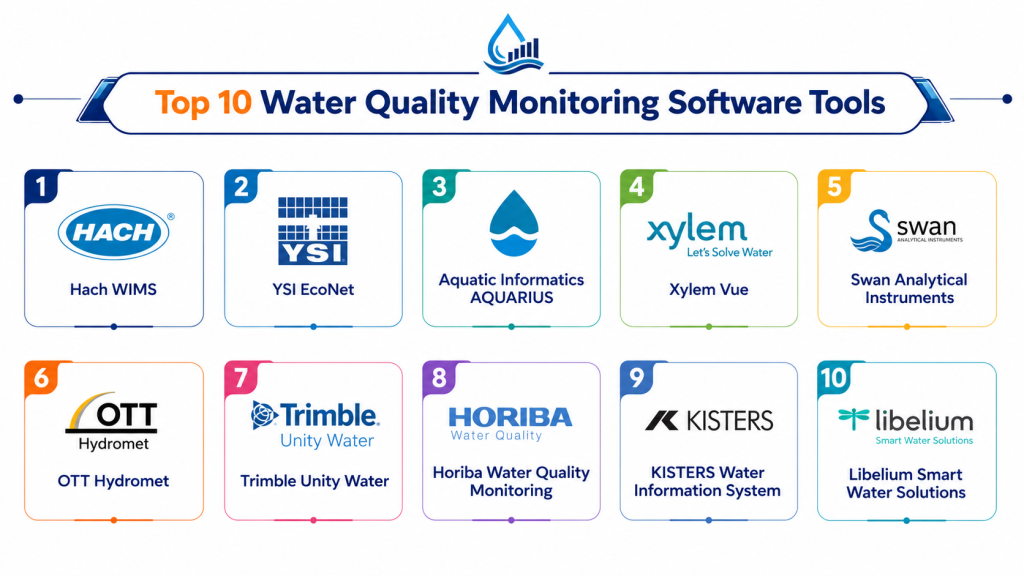
Top 10 Water Quality Monitoring Software Tools
1- Hach WIMS
Short description:
Hach WIMS is one of the most widely used water information management platforms for utilities and environmental agencies, providing operational intelligence, compliance reporting, and water quality analytics.
Key Features
- Water quality data management
- Automated compliance reporting
- Real-time monitoring dashboards
- SCADA integration support
- Historical trend analytics
- Operational forecasting tools
- Laboratory data management
Pros
- Strong utility industry adoption
- Excellent compliance workflows
- Reliable operational reporting
Cons
- Traditional UI design
- Complex enterprise deployment
- Premium enterprise licensing
Platforms / Deployment
- Web / Windows
- Cloud / Self-hosted / Hybrid
Security & Compliance
Supports RBAC, audit logging, encrypted communications, and enterprise authentication controls.
Integrations & Ecosystem
Integrates with SCADA systems, IoT sensors, GIS platforms, and laboratory tools.
- SCADA systems
- APIs
- GIS platforms
- Laboratory systems
- IoT sensors
Support & Community
Strong utility and environmental operations ecosystem.
2- Aquatic Informatics Aquarius
Short description:
Aquatic Informatics Aquarius provides environmental data management and water intelligence workflows for hydrology, water quality, and environmental compliance operations.
Key Features
- Water quality analytics
- Hydrological monitoring
- Environmental forecasting
- GIS visualization support
- Compliance reporting automation
- Sensor network integrations
- Historical trend analysis
Pros
- Strong hydrology workflows
- Excellent environmental analytics
- Good enterprise scalability
Cons
- Requires environmental data expertise
- Complex large-scale deployments
- Premium pricing model
Platforms / Deployment
- Web
- Cloud / Hybrid
Security & Compliance
Supports secure authentication, encryption, and enterprise governance controls.
Integrations & Ecosystem
- GIS systems
- APIs
- Environmental databases
- IoT sensors
Support & Community
Strong water resource management ecosystem.
3- Kisters WISKI
Short description:
Kisters WISKI is a water intelligence and environmental data management platform focused on hydrology, groundwater, water quality, and climate monitoring.
Key Features
- Water quality monitoring
- Hydrological analytics
- Environmental forecasting
- Sensor network management
- GIS visualization
- Compliance reporting workflows
- Real-time dashboards
Pros
- Strong hydrology specialization
- Reliable environmental forecasting
- Good analytics workflows
Cons
- Specialized deployment complexity
- Less lightweight usability
- Enterprise implementation requirements
Platforms / Deployment
- Web / Windows
- Cloud / Self-hosted
Security & Compliance
Supports enterprise authentication, encryption, and operational access controls.
Integrations & Ecosystem
- APIs
- GIS systems
- IoT platforms
- Environmental databases
Support & Community
Strong environmental and water resource support ecosystem.
4- YSI HydroSphere
Short description:
YSI HydroSphere provides cloud-based water monitoring and environmental analytics capabilities for utilities, aquaculture, and environmental operations.
Key Features
- Real-time water monitoring
- Cloud dashboards
- Sensor management workflows
- Environmental alerting
- Historical trend analytics
- Mobile accessibility
- Compliance reporting support
Pros
- Strong real-time monitoring
- Good sensor integration support
- Easy operational visibility
Cons
- Limited advanced AI capabilities
- Smaller enterprise ecosystem
- Less advanced GIS analytics
Platforms / Deployment
- Web / Mobile
- Cloud
Security & Compliance
Supports encrypted communication and secure cloud access controls.
Integrations & Ecosystem
- Environmental sensors
- APIs
- Mobile platforms
- Reporting tools
Support & Community
Strong environmental and aquaculture ecosystem.
5- EarthSoft EQuIS
Short description:
EarthSoft EQuIS provides environmental data management and compliance monitoring workflows for water quality, groundwater, and industrial environmental operations.
Key Features
- Environmental data management
- Water quality analytics
- GIS visualization support
- Compliance automation
- Historical reporting tools
- IoT sensor integrations
- Data governance controls
Pros
- Strong compliance management workflows
- Reliable environmental reporting
- Good enterprise governance features
Cons
- Complex enterprise deployment
- Traditional UI experience
- Requires operational training
Platforms / Deployment
- Web / Windows
- Cloud / Hybrid
Security & Compliance
Supports RBAC, audit logging, encryption, and enterprise authentication controls.
Integrations & Ecosystem
- GIS systems
- APIs
- Environmental databases
- Reporting platforms
Support & Community
Established environmental compliance support ecosystem.
6- Libelium Smart Water
Short description:
Libelium Smart Water provides IoT-driven water quality monitoring for smart cities, industrial operations, and environmental infrastructure projects.
Key Features
- IoT water sensor monitoring
- Real-time analytics dashboards
- Cloud-based monitoring
- Environmental alerts
- Smart city integrations
- Mobile accessibility
- Remote sensor management
Pros
- Strong IoT integration support
- Good smart city workflows
- Flexible sensor deployments
Cons
- Smaller enterprise ecosystem
- Less advanced compliance depth
- Limited large-scale analytics features
Platforms / Deployment
- Web / Mobile
- Cloud
Security & Compliance
Supports encrypted IoT communication and secure API integrations.
Integrations & Ecosystem
- IoT systems
- APIs
- GIS platforms
- Smart city tools
Support & Community
Growing smart infrastructure and IoT ecosystem.
7- WaterTrax
Short description:
WaterTrax is a cloud-based environmental compliance and water quality monitoring platform focused on utilities and municipal operations.
Key Features
- Water compliance reporting
- Real-time operational dashboards
- Sampling workflows
- GIS visualization support
- Laboratory integration
- Environmental alerts
- Mobile inspection support
Pros
- Strong compliance workflows
- Good municipal deployment support
- Reliable reporting tools
Cons
- Limited advanced predictive analytics
- Smaller global ecosystem
- Less advanced AI functionality
Platforms / Deployment
- Web / Mobile
- Cloud
Security & Compliance
Supports secure APIs, encryption, and operational governance controls.
Integrations & Ecosystem
- Laboratory systems
- APIs
- GIS systems
- Reporting platforms
Support & Community
Strong utility and municipal support ecosystem.
8- Siemens Water Management
Short description:
Siemens Water Management provides industrial water monitoring, treatment analytics, and operational intelligence for utilities and industrial infrastructure.
Key Features
- Industrial water monitoring
- Real-time operational analytics
- Predictive maintenance support
- SCADA integration
- Environmental dashboards
- Compliance management
- IoT sensor support
Pros
- Strong industrial scalability
- Excellent infrastructure integrations
- Reliable operational intelligence
Cons
- Enterprise deployment complexity
- Premium pricing model
- Requires industrial infrastructure expertise
Platforms / Deployment
- Web
- Cloud / Hybrid
Security & Compliance
Supports enterprise authentication, encryption, and industrial security controls.
Integrations & Ecosystem
- SCADA systems
- IoT platforms
- APIs
- Industrial analytics tools
Support & Community
Strong industrial and utility operations ecosystem.
9- Sutron XLink
Short description:
Sutron XLink provides environmental telemetry and water quality monitoring workflows for flood monitoring, hydrology, and environmental operations.
Key Features
- Water telemetry monitoring
- Hydrological analytics
- Real-time environmental alerts
- Remote station management
- Historical trend analysis
- Sensor integrations
- Cloud monitoring support
Pros
- Strong telemetry workflows
- Reliable environmental monitoring
- Good remote operations support
Cons
- Specialized environmental focus
- Smaller enterprise ecosystem
- Limited advanced visualization features
Platforms / Deployment
- Web / Windows
- Cloud / Self-hosted
Security & Compliance
Supports encrypted communications and secure telemetry workflows.
Integrations & Ecosystem
- Environmental sensors
- APIs
- Hydrology tools
- GIS systems
Support & Community
Strong environmental telemetry and hydrology ecosystem.
10- Open Water Foundation Tools
Short description:
Open Water Foundation provides open-source environmental data and water intelligence tools for public-sector and research-focused water monitoring initiatives.
Key Features
- Open environmental data tools
- Water analytics dashboards
- GIS visualization support
- Public reporting workflows
- Data sharing capabilities
- Historical trend analysis
- Open-source integrations
Pros
- Open-source flexibility
- Strong public-sector accessibility
- Cost-effective deployment model
Cons
- Limited enterprise governance capabilities
- Smaller commercial support ecosystem
- Less advanced industrial analytics
Platforms / Deployment
- Web
- Cloud / Self-hosted
Security & Compliance
Varies depending on deployment infrastructure.
Integrations & Ecosystem
- GIS systems
- APIs
- Open-source tools
- Environmental datasets
Support & Community
Strong environmental research and public-sector community.
Comparison Table
| Tool Name | Best For | Platforms Supported | Deployment | Standout Feature | Public Rating |
|---|---|---|---|---|---|
| Hach WIMS | Utility water operations | Web, Windows | Hybrid | Compliance automation | N/A |
| Aquatic Informatics Aquarius | Environmental intelligence | Web | Hybrid | Hydrology analytics | N/A |
| Kisters WISKI | Water forecasting | Web, Windows | Hybrid | Hydrological intelligence | N/A |
| YSI HydroSphere | Cloud water monitoring | Web, Mobile | Cloud | Real-time visibility | N/A |
| EarthSoft EQuIS | Environmental compliance | Web, Windows | Hybrid | Data governance | N/A |
| Libelium Smart Water | Smart city monitoring | Web, Mobile | Cloud | IoT integrations | N/A |
| WaterTrax | Municipal compliance | Web, Mobile | Cloud | Sampling workflows | N/A |
| Siemens Water Management | Industrial operations | Web | Hybrid | Industrial water analytics | N/A |
| Sutron XLink | Environmental telemetry | Web, Windows | Hybrid | Remote monitoring | N/A |
| Open Water Foundation | Open-source water analytics | Web | Hybrid | Public-sector accessibility | N/A |
Evaluation & Scoring of Water Quality Monitoring Software
| Tool Name | Core 25% | Ease 15% | Integrations 15% | Security 10% | Performance 10% | Support 10% | Value 15% | Weighted Total |
|---|---|---|---|---|---|---|---|---|
| Hach WIMS | 9.4 | 8.0 | 9.0 | 9.1 | 9.2 | 9.1 | 8.1 | 8.9 |
| Aquatic Informatics Aquarius | 9.2 | 8.1 | 8.9 | 9.0 | 9.1 | 9.0 | 8.2 | 8.8 |
| Kisters WISKI | 9.0 | 7.8 | 8.8 | 8.9 | 9.0 | 8.8 | 8.2 | 8.6 |
| YSI HydroSphere | 8.5 | 8.8 | 8.2 | 8.4 | 8.7 | 8.5 | 8.8 | 8.5 |
| EarthSoft EQuIS | 8.9 | 7.9 | 8.8 | 8.9 | 8.9 | 8.8 | 8.3 | 8.7 |
| Libelium Smart Water | 8.4 | 8.5 | 8.4 | 8.3 | 8.6 | 8.4 | 8.7 | 8.4 |
| WaterTrax | 8.6 | 8.4 | 8.3 | 8.5 | 8.6 | 8.5 | 8.6 | 8.5 |
| Siemens Water Management | 9.1 | 7.7 | 9.0 | 9.2 | 9.1 | 9.0 | 8.0 | 8.8 |
| Sutron XLink | 8.5 | 8.0 | 8.2 | 8.5 | 8.7 | 8.4 | 8.5 | 8.4 |
| Open Water Foundation | 7.9 | 8.4 | 7.8 | 7.5 | 8.1 | 8.0 | 9.3 | 8.1 |
These scores are comparative and designed to help organizations evaluate water quality monitoring platforms based on scalability, operational intelligence, compliance workflows, integrations, analytics depth, security, and long-term environmental management value.
Which Water Quality Monitoring Software Is Right for You?
Solo / Research Teams
Best suited: Open Water Foundation, YSI HydroSphere
These provide affordable and accessible environmental monitoring capabilities for research and lightweight deployments.
SMB / Municipal Operations
Best suited: WaterTrax, Libelium Smart Water
These balance usability, compliance reporting, and sensor management capabilities.
Mid-Market Enterprises
Best suited: EarthSoft EQuIS, Kisters WISKI, YSI HydroSphere
These provide stronger environmental analytics and operational workflows.
Enterprise / Government Programs
Best suited: Hach WIMS, Aquatic Informatics Aquarius, Siemens Water Management
These offer enterprise scalability, predictive analytics, and advanced compliance capabilities.
Budget vs Premium
Budget-friendly: Open Water Foundation, WaterTrax
Premium enterprise: Siemens, Hach WIMS, Aquatic Informatics
Feature Depth vs Ease of Use
Deep analytics: Hach WIMS, Siemens Water Management
Ease of use: YSI HydroSphere, WaterTrax
Integrations & Scalability
Best integrations: Hach WIMS, Siemens, Aquatic Informatics
Best scalability: Siemens, Hach WIMS
Security & Compliance Needs
Organizations managing public water systems or industrial operations should prioritize platforms supporting RBAC, MFA, encryption, audit logging, and secure IoT communication workflows.
Frequently Asked Questions
1. What is Water Quality Monitoring Software?
It is software used to collect, analyze, visualize, and manage environmental water data from sensors, monitoring stations, and laboratory systems.
2. Why is water quality monitoring important?
It helps organizations improve environmental safety, ensure regulatory compliance, reduce operational risks, and protect public health.
3. Can these platforms integrate with IoT sensors?
Yes, most modern water monitoring systems integrate with IoT and environmental sensor networks.
4. Are cloud-based monitoring platforms common?
Yes, cloud-native monitoring platforms are increasingly common because they improve scalability and operational accessibility.
5. What parameters can these systems monitor?
Common parameters include pH, dissolved oxygen, turbidity, conductivity, temperature, chlorine, nitrates, and contaminants.
6. What security features are important?
RBAC, MFA, encryption, secure APIs, and audit logging are important for protecting operational and environmental data.
7. Which industries use water monitoring software most?
Utilities, municipalities, manufacturing, agriculture, mining, environmental agencies, and smart city programs heavily rely on these systems.
8. Can these platforms support predictive analytics?
Yes, many modern platforms include AI-driven forecasting and environmental trend analysis capabilities.
9. What are common implementation challenges?
Sensor calibration, integration complexity, regulatory compliance, and managing large monitoring networks are common challenges.
10. How should organizations choose a platform?
Organizations should evaluate scalability, compliance workflows, integrations, analytics depth, sensor compatibility, and long-term operational requirements.
Conclusion
Water Quality Monitoring Software has become critical infrastructure for utilities, governments, environmental agencies, and industrial organizations seeking real-time environmental intelligence and regulatory visibility. Modern platforms now combine AI-driven analytics, IoT integrations, GIS visualization, predictive forecasting, cloud-native monitoring, and automated reporting workflows to support increasingly advanced environmental operations. Enterprise solutions such as Hach WIMS, Aquatic Informatics Aquarius, and Siemens Water Management provide strong scalability and operational analytics capabilities, while platforms like WaterTrax and Open Water Foundation offer accessible and specialized monitoring workflows for municipal and research-focused deployments. The best solution ultimately depends on operational scale, compliance requirements, integration priorities, sustainability goals, and long-term environmental strategy. A structured evaluation process combined with pilot deployments and operational workflow validation can significantly improve long-term implementation success and environmental management effectiveness.