Introduction
Bias & Fairness Testing Tools help AI and machine learning teams evaluate whether models produce unfair, discriminatory, or inconsistent outcomes across different user groups. These tools analyze datasets, predictions, model outputs, protected attributes, decision thresholds, and performance differences to identify fairness risks before and after deployment.
As organizations use AI for hiring, lending, insurance, healthcare, education, fraud detection, customer service, public services, and generative AI applications, fairness testing has become a core part of responsible AI governance. A model can be accurate overall but still perform poorly or unfairly for specific groups, making bias testing essential for trust, compliance, and ethical AI operations.
Real-world use cases include:
- Auditing lending models for disparate impact
- Testing hiring models for demographic bias
- Evaluating healthcare AI performance across patient groups
- Measuring fairness in fraud detection decisions
- Reviewing generative AI outputs for harmful or biased behavior
Buyers evaluating Bias & Fairness Testing Tools should consider:
- Fairness metrics and bias detection methods
- Support for group and individual fairness
- Dataset and prediction-level analysis
- Bias mitigation algorithms
- Explainability and model interpretability
- Human review and audit workflows
- Integration with MLOps and model monitoring
- Governance and reporting capabilities
- Security and access controls
- Ease of use for technical and non-technical teams
Best for: Data scientists, machine learning engineers, AI governance teams, compliance teams, model risk teams, legal teams, product teams, HR technology teams, fintech teams, healthcare AI teams, and organizations deploying AI in high-impact decision workflows.
Not ideal for: Very small experimental models with no production use, simple rule-based systems, or teams that have not yet defined fairness objectives, protected groups, model ownership, and responsible AI review processes.
Key Trends in Bias & Fairness Testing Tools
- Fairness testing is becoming part of standard AI governance workflows.
- Bias testing is expanding from traditional machine learning into generative AI and large language model applications.
- Enterprises are combining fairness testing with explainability, monitoring, and model risk management.
- Human review is becoming important for interpreting fairness results in sensitive domains.
- Fairness metrics are increasingly being customized by industry, region, and use case.
- Bias detection is moving from offline notebooks into production model monitoring.
- Model cards, audit reports, and governance documentation are becoming more important.
- Open-source fairness libraries remain popular for technical testing and experimentation.
- Enterprise platforms are adding dashboards for cross-functional review and approval.
- Fairness evaluation is being connected with dataset quality, drift monitoring, and responsible AI policy enforcement.
How We Selected These Tools
The tools in this list were selected based on fairness testing depth, bias mitigation support, open-source adoption, enterprise readiness, explainability integration, monitoring features, and practical fit for AI teams.
Selection criteria included:
- Bias detection and fairness metric coverage
- Support for pre-training and post-training analysis
- Bias mitigation algorithms
- Model and dataset fairness testing
- Explainability and interpretability support
- Integration with ML and MLOps workflows
- Governance and audit reporting
- Developer experience and usability
- Community and enterprise adoption
- Suitability for regulated and high-impact AI environments
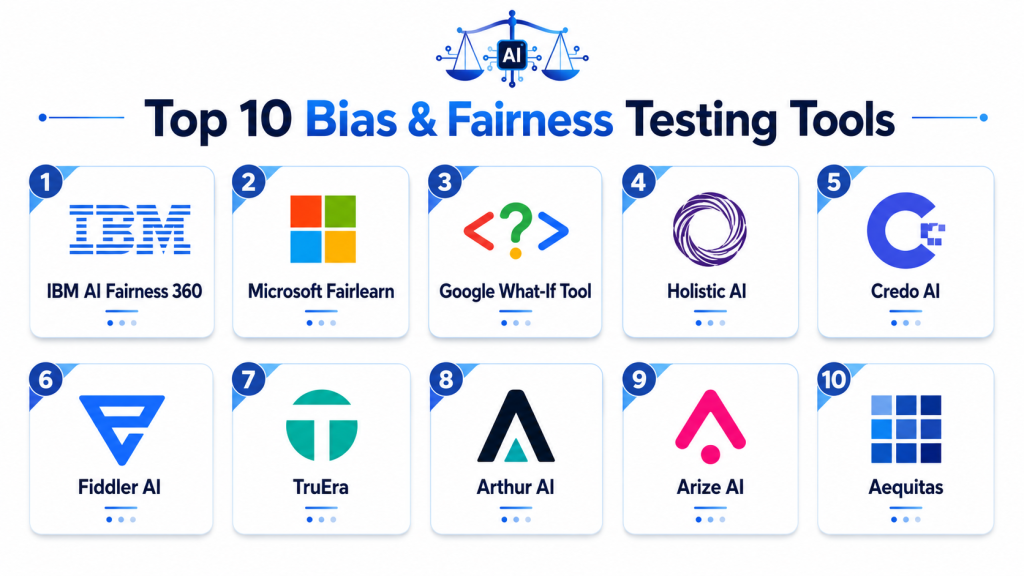
Top 10 Bias & Fairness Testing Tools
1- IBM AI Fairness 360
Short description: IBM AI Fairness 360 is an open-source toolkit for detecting, measuring, and mitigating bias in datasets and machine learning models. It provides a wide range of fairness metrics and mitigation algorithms that help data scientists evaluate unfair outcomes across different groups.
Key Features
- Dataset bias detection
- Model fairness metrics
- Bias mitigation algorithms
- Group fairness analysis
- Individual fairness analysis
- Python and R support
- Responsible AI workflow support
Pros
- Strong fairness metric coverage
- Open-source and widely adopted
- Useful for technical model audits and bias mitigation
Cons
- Requires fairness and statistics knowledge
- Business-friendly reporting must often be built separately
- Production monitoring requires additional tooling
Platforms / Deployment
- Python / R / Linux / macOS / Windows
- Self-hosted / Hybrid
Security & Compliance
- Not publicly stated
- Security depends on deployment environment and data handling practices
Integrations & Ecosystem
IBM AI Fairness 360 fits into technical data science and responsible AI workflows. It is often used in notebooks, model validation pipelines, and fairness audit experiments.
- Python ML workflows
- R workflows
- scikit-learn
- Jupyter notebooks
- Model validation pipelines
- Responsible AI toolchains
Support & Community
Strong open-source community, technical documentation, examples, and responsible AI research ecosystem support.
2- Fairlearn
Short description: Fairlearn is an open-source toolkit that helps teams assess and improve fairness in AI systems. It supports fairness metrics, model comparison, mitigation algorithms, and visual dashboards for evaluating model behavior across groups.
Key Features
- Fairness assessment
- Group metric comparison
- Mitigation algorithms
- Dashboard visualizations
- Model comparison support
- Python-based workflows
- Sociotechnical fairness guidance
Pros
- Strong open-source fairness toolkit
- Practical for ML teams using Python
- Good for both assessment and mitigation
Cons
- Requires fairness context and domain expertise
- Not a full enterprise governance platform
- Production deployment requires additional tooling
Platforms / Deployment
- Python / Linux / macOS / Windows
- Self-hosted / Hybrid
Security & Compliance
- Not publicly stated
- Security depends on deployment and data governance setup
Integrations & Ecosystem
Fairlearn integrates naturally with Python-based machine learning workflows and model validation processes.
- scikit-learn
- Jupyter notebooks
- Python ML pipelines
- Model evaluation workflows
- Responsible AI dashboards
- Data science environments
Support & Community
Active open-source community, strong documentation, and adoption among responsible ML practitioners.
3- Aequitas
Short description: Aequitas is an open-source bias and fairness audit toolkit designed to help teams evaluate model outcomes across different population groups. It is especially useful for auditing algorithmic decision systems and comparing fairness metrics across subgroups.
Key Features
- Bias audit workflows
- Group fairness metrics
- Disparity analysis
- Model comparison
- Fairness reporting
- Python-based workflows
- Audit-oriented outputs
Pros
- Good for structured fairness audits
- Open-source and accessible
- Useful for policy and model risk review
Cons
- Requires fairness and statistics understanding
- Not a complete production monitoring platform
- Less broad than some larger responsible AI suites
Platforms / Deployment
- Python / Data science environments
- Self-hosted / Hybrid
Security & Compliance
- Not publicly stated
- Security depends on deployment and data handling configuration
Integrations & Ecosystem
Aequitas fits into data science, model review, and fairness audit workflows.
- Python workflows
- Data science notebooks
- ML validation pipelines
- Fairness reports
- Policy review workflows
- Model audit processes
Support & Community
Open-source community support and practical use in fairness auditing, research, and responsible AI programs.
4- Microsoft Responsible AI Dashboard
Short description: Microsoft Responsible AI Dashboard helps teams evaluate fairness, errors, interpretability, and model performance inside responsible AI workflows. It is useful for teams that want visual analysis across model behavior, cohorts, and feature impact.
Key Features
- Fairness assessment
- Error analysis
- Model interpretability
- Cohort-based analysis
- Counterfactual analysis
- Visual dashboards
- Azure ML integration
Pros
- Strong visual analysis experience
- Good Microsoft ecosystem integration
- Useful for cross-functional model review
Cons
- Best suited for Microsoft and Python workflows
- Requires model evaluation setup
- Enterprise governance depends on broader processes
Platforms / Deployment
- Python / Azure ML / Web dashboard patterns
- Cloud / Self-hosted / Hybrid options vary
Security & Compliance
- Microsoft Entra ID integration when used with Azure
- RBAC support through platform configuration
- Encryption and audit controls depend on deployment
- Compliance support depends on Azure setup
Integrations & Ecosystem
Microsoft Responsible AI Dashboard integrates with model development and evaluation workflows.
- Azure Machine Learning
- Python ML workflows
- InterpretML
- Error analysis tools
- Fairlearn
- Model validation pipelines
Support & Community
Microsoft ecosystem documentation, responsible AI guidance, open-source components, and Azure enterprise support options.
5- AWS SageMaker Clarify
Short description: AWS SageMaker Clarify helps teams detect bias and explain model predictions in AWS machine learning workflows. It supports bias analysis before and after training, along with feature attribution and model explainability.
Key Features
- Pre-training bias detection
- Post-training bias detection
- Feature attribution
- Model explainability
- SageMaker integration
- Bias reports
- Model monitoring workflow support
Pros
- Strong AWS ecosystem integration
- Useful for AWS ML teams
- Combines fairness and explainability workflows
Cons
- Best suited for AWS environments
- Less complete as standalone governance tooling
- Requires ML expertise to interpret results correctly
Platforms / Deployment
- AWS Cloud / SageMaker environments
- Cloud
Security & Compliance
- IAM integration
- Encryption
- Audit logging through AWS services
- Access controls
- Compliance support depends on AWS configuration
Integrations & Ecosystem
SageMaker Clarify integrates with AWS machine learning and cloud data workflows.
- Amazon SageMaker
- Amazon S3
- AWS IAM
- CloudWatch
- ML pipelines
- AWS data services
Support & Community
AWS provides documentation, training resources, enterprise support plans, and a large machine learning developer ecosystem.
6- Google What-If Tool
Short description: Google What-If Tool is an interactive model analysis tool that helps teams inspect model predictions, test counterfactuals, compare data points, and evaluate fairness-related performance across slices of data.
Key Features
- Interactive model inspection
- Counterfactual analysis
- Data point comparison
- Feature impact exploration
- Fairness-related slice analysis
- Model behavior visualization
- Notebook and TensorBoard workflow support
Pros
- Interactive and visual
- Useful for model debugging
- Good for exploring model behavior across groups
Cons
- Less complete as a modern governance platform
- Requires technical setup
- Production monitoring requires additional tools
Platforms / Deployment
- Web / Notebook environments / TensorBoard patterns
- Self-hosted / Hybrid
Security & Compliance
- Not publicly stated
- Security depends on deployment and data handling configuration
Integrations & Ecosystem
Google What-If Tool fits into model exploration, debugging, and fairness analysis workflows.
- TensorFlow workflows
- Jupyter notebooks
- Model analysis pipelines
- Data science environments
- Interactive dashboards
- Custom ML models
Support & Community
Open-source ecosystem support, documentation, and adoption among data scientists exploring model behavior.
7- Fiddler AI
Short description: Fiddler AI is an AI observability and responsible AI platform that helps teams monitor model performance, explain predictions, detect drift, and evaluate fairness-related risks in production AI systems.
Key Features
- Production model monitoring
- Bias and fairness insights
- Explainability
- Drift detection
- Performance analytics
- Responsible AI dashboards
- LLM monitoring support
Pros
- Strong production observability
- Good explainability and fairness workflows
- Useful for enterprise model risk management
Cons
- Requires production system integration
- Pricing may not fit small teams
- Best value comes with mature MLOps processes
Platforms / Deployment
- Web / APIs / Enterprise AI environments
- Cloud / Hybrid options vary
Security & Compliance
- RBAC
- Encryption
- SSO support
- Audit logging
- Enterprise security controls
- Compliance details vary by plan
Integrations & Ecosystem
Fiddler AI integrates with model serving, monitoring, and AI operations environments.
- ML platforms
- Cloud data platforms
- Model serving systems
- LLM applications
- MLOps pipelines
- Enterprise dashboards
Support & Community
Enterprise support, onboarding assistance, documentation, and AI observability expertise.
8- Arthur AI
Short description: Arthur AI is an AI monitoring and responsible AI platform that helps teams track model performance, drift, bias, fairness, and explainability across deployed AI systems. It is useful for teams that need production-level visibility and alerting.
Key Features
- Bias monitoring
- Model performance tracking
- Drift detection
- Explainability
- Fairness visibility
- LLM evaluation support
- Alerts and dashboards
Pros
- Good production model monitoring
- Useful for bias and performance tracking
- Supports traditional ML and generative AI workflows
Cons
- Requires production integration
- Governance depth depends on implementation
- Smaller teams may not need the full platform
Platforms / Deployment
- Web / APIs / AI infrastructure
- Cloud / Hybrid options vary
Security & Compliance
- RBAC
- Encryption
- Audit logging
- Access controls
- Enterprise security features vary by plan
Integrations & Ecosystem
Arthur AI integrates with production AI and model operations environments.
- Model serving systems
- Cloud AI platforms
- MLOps pipelines
- Monitoring workflows
- LLM applications
- Enterprise AI dashboards
Support & Community
Enterprise support, documentation, onboarding, and guidance for AI monitoring and responsible AI workflows.
9- Arize AI
Short description: Arize AI is an AI observability platform that helps teams monitor model performance, data drift, prediction quality, explainability signals, and fairness-related model behavior in production environments.
Key Features
- Model observability
- Drift detection
- Performance monitoring
- Fairness analysis workflows
- Explainability support
- Data quality tracking
- Production debugging
Pros
- Strong production AI monitoring
- Useful for detecting fairness shifts over time
- Good for MLOps teams managing deployed models
Cons
- Requires integration and instrumentation
- Not primarily a standalone fairness library
- Best value comes with production AI scale
Platforms / Deployment
- Web / APIs / AI infrastructure
- Cloud / Hybrid options vary
Security & Compliance
- RBAC
- Encryption
- SSO support
- Audit logging
- Enterprise security controls
- Compliance details vary by plan
Integrations & Ecosystem
Arize AI integrates with model serving, monitoring, and ML operations workflows.
- ML platforms
- Model serving systems
- Cloud data platforms
- LLM applications
- MLOps pipelines
- AI monitoring systems
Support & Community
Enterprise support, technical documentation, onboarding resources, and AI observability expertise.
10- Holistic AI
Short description: Holistic AI is an AI governance, risk, and compliance platform that helps organizations evaluate AI systems for risks including bias, fairness, accountability, and regulatory alignment. It is useful for teams that need structured AI oversight rather than only technical metrics.
Key Features
- Bias and fairness assessment
- AI risk management
- Governance workflows
- Compliance reporting
- Model and system audits
- Policy alignment
- Documentation management
Pros
- Strong governance and audit focus
- Useful for risk and compliance teams
- Good fit for formal AI oversight programs
Cons
- Less focused on low-level model experimentation
- Requires internal governance maturity
- Best suited for enterprise AI programs
Platforms / Deployment
- Web / Enterprise governance environments
- Cloud
Security & Compliance
- Access controls
- Encryption support
- Audit workflows
- Governance controls
- Compliance features vary by plan
Integrations & Ecosystem
Holistic AI supports governance, risk assessment, compliance, and fairness review workflows across enterprise AI programs.
- AI audit workflows
- Risk management processes
- Policy documentation
- Model review workflows
- Compliance reporting
- Enterprise governance programs
Support & Community
Implementation guidance, governance support, documentation, and responsible AI expertise for enterprise customers.
Comparison Table
| Tool Name | Best For | Platforms Supported | Deployment | Standout Feature | Public Rating |
|---|---|---|---|---|---|
| IBM AI Fairness 360 | Open-source fairness testing | Python / R | Self-hosted / Hybrid | Broad fairness metrics and mitigation | N/A |
| Fairlearn | Fairness assessment and mitigation | Python environments | Self-hosted / Hybrid | Group fairness analysis | N/A |
| Aequitas | Bias audit workflows | Python environments | Self-hosted / Hybrid | Disparity and fairness audit reports | N/A |
| Microsoft Responsible AI Dashboard | Visual responsible AI review | Python / Azure ML | Cloud / Self-hosted / Hybrid options vary | Cohort and error analysis | N/A |
| AWS SageMaker Clarify | AWS ML bias and explainability | AWS Cloud / SageMaker | Cloud | Bias detection inside SageMaker | N/A |
| Google What-If Tool | Interactive model behavior testing | Web / Notebook environments | Self-hosted / Hybrid | Counterfactual model inspection | N/A |
| Fiddler AI | Production AI fairness monitoring | Web / APIs | Cloud / Hybrid options vary | Responsible AI observability | N/A |
| Arthur AI | Bias and drift monitoring | Web / APIs | Cloud / Hybrid options vary | Production model monitoring | N/A |
| Arize AI | Production ML observability | Web / APIs | Cloud / Hybrid options vary | Drift and fairness behavior tracking | N/A |
| Holistic AI | AI governance and risk review | Web / Governance environments | Cloud | AI risk and compliance workflows | N/A |
Evaluation & Scoring of Bias & Fairness Testing Tools
| Tool Name | Core 25% | Ease 15% | Integrations 15% | Security 10% | Performance 10% | Support 10% | Value 15% | Weighted Total |
|---|---|---|---|---|---|---|---|---|
| IBM AI Fairness 360 | 9.5 | 7.2 | 8.7 | 7.6 | 8.5 | 8.5 | 9.4 | 8.55 |
| Fairlearn | 9.0 | 8.0 | 8.7 | 7.6 | 8.4 | 8.5 | 9.4 | 8.57 |
| Aequitas | 8.5 | 7.9 | 8.2 | 7.5 | 8.2 | 8.0 | 9.2 | 8.23 |
| Microsoft Responsible AI Dashboard | 8.9 | 8.3 | 9.0 | 8.8 | 8.6 | 8.8 | 8.4 | 8.70 |
| AWS SageMaker Clarify | 8.8 | 8.0 | 9.0 | 9.1 | 8.7 | 8.8 | 8.2 | 8.65 |
| Google What-If Tool | 8.2 | 8.2 | 8.4 | 7.7 | 8.1 | 8.1 | 9.0 | 8.25 |
| Fiddler AI | 9.0 | 8.1 | 8.8 | 8.9 | 8.8 | 8.8 | 7.9 | 8.66 |
| Arthur AI | 8.8 | 8.0 | 8.6 | 8.7 | 8.7 | 8.6 | 8.0 | 8.48 |
| Arize AI | 8.6 | 8.1 | 8.8 | 8.8 | 8.8 | 8.7 | 8.0 | 8.53 |
| Holistic AI | 8.7 | 8.0 | 8.3 | 8.8 | 8.4 | 8.5 | 7.9 | 8.35 |
These scores are comparative and intended to help buyers evaluate practical fit rather than identify one universal winner. Open-source fairness libraries are strong for technical evaluation and experimentation, while enterprise platforms provide stronger monitoring, governance, auditability, and cross-functional review workflows. The best fit depends on whether the organization needs research-grade metrics, cloud-native ML integration, production monitoring, or formal AI governance.
Which Bias & Fairness Testing Tool Is Right for You?
Solo / Freelancer
Solo data scientists and independent AI builders usually need lightweight, open-source tools for experimentation and model validation. Fairlearn, IBM AI Fairness 360, Aequitas, and Google What-If Tool are practical choices for testing fairness metrics without large platform investment.
SMB
SMBs usually need bias testing without heavy governance overhead. Fairlearn, Microsoft Responsible AI Dashboard, AWS SageMaker Clarify, and Google What-If Tool can help teams evaluate fairness during model development and validation.
Mid-Market
Mid-sized organizations often need fairness testing, explainability, monitoring, and stakeholder reporting. Fiddler AI, Arize AI, Arthur AI, SageMaker Clarify, and Microsoft Responsible AI Dashboard are strong choices for growing AI programs.
Enterprise
Large enterprises usually require bias testing, model risk management, audit trails, governance workflows, production monitoring, and compliance reporting. Fiddler AI, Arthur AI, Arize AI, Holistic AI, AWS SageMaker Clarify, and Microsoft Responsible AI Dashboard are strong enterprise-friendly options.
Budget vs Premium
Open-source tools such as Fairlearn, IBM AI Fairness 360, Aequitas, and Google What-If Tool are useful for budget-conscious technical teams. Premium platforms provide stronger monitoring, dashboards, access controls, support, governance workflows, and enterprise reporting.
Feature Depth vs Ease of Use
IBM AI Fairness 360 provides deep metric and mitigation coverage but requires expertise. Fairlearn is easier for Python ML teams. Aequitas is useful for audit-style fairness reports. Enterprise observability platforms are better for production tracking and stakeholder review.
Integrations & Scalability
Teams using AWS should evaluate SageMaker Clarify. Teams using Azure or Python-based Microsoft workflows should evaluate Responsible AI Dashboard and Fairlearn. Teams with production model portfolios should evaluate Fiddler AI, Arthur AI, or Arize AI.
Security & Compliance Needs
Security-focused organizations should prioritize RBAC, SSO, encryption, audit logs, private deployment options, model inventory integration, controlled data access, and reproducible fairness reports. Regulated teams should also confirm that fairness metrics align with internal policies and legal review processes.
Frequently Asked Questions
1. What is a Bias & Fairness Testing Tool?
A Bias & Fairness Testing Tool helps teams evaluate whether AI models perform differently or unfairly across groups. It can analyze datasets, predictions, outcomes, thresholds, and model behavior using fairness metrics.
2. Why is fairness testing important?
Fairness testing helps identify hidden risks that accuracy alone may miss. A model can perform well overall while producing worse or unfair outcomes for specific groups, which can create ethical, legal, and reputational risks.
3. What is group fairness?
Group fairness evaluates whether model outcomes are balanced across defined groups. Examples include checking differences in approval rates, false positive rates, false negative rates, or prediction quality across populations.
4. What is individual fairness?
Individual fairness focuses on whether similar individuals receive similar model outcomes. It is useful but can be harder to define because similarity depends on the use case and domain context.
5. What are common fairness metrics?
Common metrics include demographic parity, equal opportunity difference, equalized odds, disparate impact, statistical parity difference, false positive rate difference, false negative rate difference, and calibration metrics.
6. What are common bias testing mistakes?
Common mistakes include testing only one fairness metric, ignoring domain context, using weak protected attribute definitions, skipping intersectional analysis, and treating fairness testing as a one-time checklist.
7. Can fairness tools remove all bias?
No. Fairness tools can identify and reduce some forms of bias, but they cannot automatically define what is fair for every context. Human judgment, policy review, domain expertise, and governance are still required.
8. Can these tools support generative AI?
Some responsible AI and monitoring platforms support generative AI evaluation, but traditional fairness libraries are mainly designed for structured ML predictions. Generative AI fairness often needs additional output evaluation and human review.
9. What integrations are most important?
Important integrations include ML frameworks, model registries, MLOps platforms, cloud ML services, notebooks, monitoring tools, data pipelines, governance platforms, and reporting workflows.
10. What should buyers evaluate before choosing a tool?
Buyers should evaluate fairness metric coverage, bias mitigation methods, supported model types, visualization quality, monitoring capability, governance reporting, security controls, integrations, scalability, and ease of interpretation.
Conclusion
Bias & Fairness Testing Tools are essential for organizations that want to build AI systems that are accurate, trustworthy, responsible, and suitable for real-world decision-making. The right tool can help teams detect unfair outcomes, compare model behavior across groups, evaluate trade-offs, document risk reviews, and improve models before and after deployment. IBM AI Fairness 360, Fairlearn, and Aequitas are strong open-source options for technical fairness testing and model audit workflows. Microsoft Responsible AI Dashboard and Google What-If Tool provide useful visual analysis for model behavior, while AWS SageMaker Clarify is strong for AWS-based machine learning teams. Fiddler AI, Arthur AI, and Arize AI are better suited for production monitoring, drift tracking, and ongoing fairness visibility, while Holistic AI supports broader governance and risk review. The best choice depends on model type, deployment environment, fairness goals, security needs, governance maturity, and whether the organization needs development-time testing, production monitoring, or formal AI oversight. Shortlist two or three tools, test them with real model outputs, validate fairness metrics with domain experts, review results with legal and compliance teams, and make fairness testing a continuous part of the full AI lifecycle.