Introduction
Web Application Firewall (WAF) Platforms are security solutions designed to protect web applications and APIs from malicious traffic, attacks, and vulnerabilities. Unlike traditional firewalls that focus on network-level protection, WAFs operate at the application layer, filtering and monitoring HTTP/HTTPS traffic to block threats such as SQL injection, cross-site scripting, bot attacks, and API abuse.
As organizations increasingly rely on web-based services, APIs, and cloud-native applications, the attack surface has expanded significantly. WAF platforms have evolved beyond simple rule-based filtering to include AI-driven threat detection, bot management, and real-time traffic analysis. These tools are now essential for maintaining application security, uptime, and compliance.
Real-world use cases include:
- Protecting e-commerce platforms from fraud and attacks
- Securing APIs and microservices in cloud environments
- Preventing data breaches caused by application vulnerabilities
- Mitigating bot traffic and automated abuse
- Ensuring compliance with security standards
What buyers should evaluate:
- Protection against common and advanced threats
- Ease of deployment and management
- Performance impact and latency
- Bot management capabilities
- Integration with cloud and DevOps workflows
- Custom rule creation and automation
- Scalability for high-traffic applications
- Reporting and analytics
- Cost versus value
Best for: Security teams, DevOps engineers, enterprises, SaaS providers, and businesses running web applications or APIs at scale.
Not ideal for: Organizations without public-facing applications or those with minimal security requirements.
Key Trends in Web Application Firewall Platforms
- AI-driven threat detection and anomaly analysis
- API security and protection as a core feature
- Integration with Zero Trust security frameworks
- Cloud-native and edge-based deployment models
- Advanced bot mitigation and traffic filtering
- Automation of security policies and rule updates
- Real-time threat intelligence integration
- DevSecOps integration with CI/CD pipelines
- Increased focus on performance and low latency
- Subscription-based and usage-based pricing models
How We Selected These Tools (Methodology)
- Evaluated market adoption and vendor credibility
- Assessed depth of application-layer protection features
- Reviewed performance and reliability capabilities
- Considered security posture and available controls
- Analyzed integration with cloud and DevOps ecosystems
- Included tools suitable for enterprise and SMB use cases
- Compared ease of deployment and usability
- Looked at scalability for high-traffic environments
- Focused on real-world applicability and flexibility
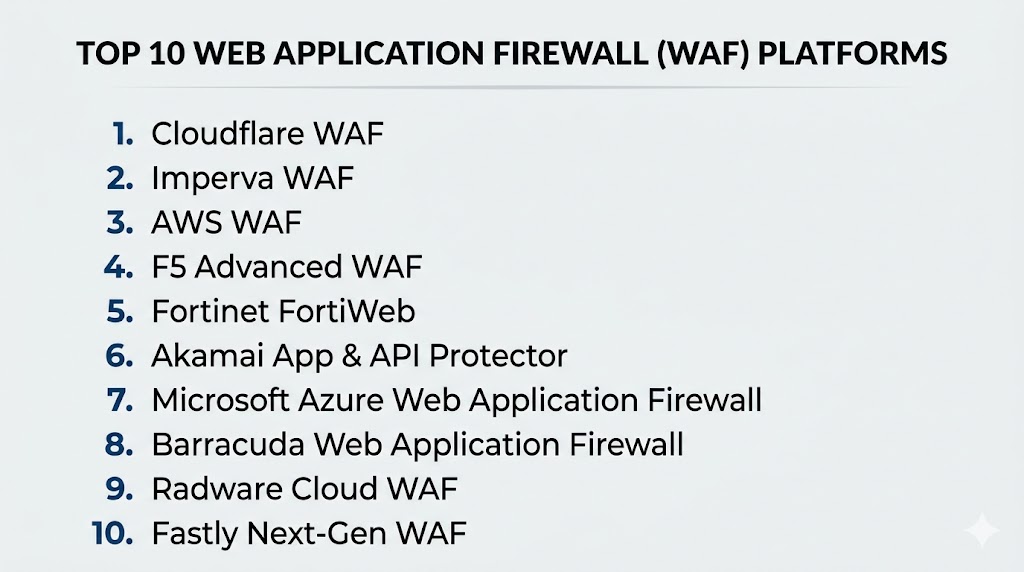
Top 10 Web Application Firewall (WAF) Platforms
#1 — Cloudflare WAF
Short description: A widely used cloud-based WAF that provides edge security, DDoS protection, and performance optimization.
Key Features
- Global edge network protection
- Managed rule sets
- Bot mitigation
- DDoS protection
- API security
- Real-time analytics
Pros
- Easy deployment
- Strong global performance
Cons
- Limited customization in lower tiers
- Pricing can increase with usage
Platforms / Deployment
Web
Cloud
Security & Compliance
Encryption, RBAC (details not publicly stated)
Integrations & Ecosystem
Cloudflare integrates with modern web and cloud platforms.
- CDN services
- APIs
- DevOps tools
Support & Community
Strong documentation and large community.
#2 — Imperva WAF
Short description: An enterprise-grade WAF platform focused on advanced threat protection and compliance.
Key Features
- Advanced threat intelligence
- Bot protection
- API security
- Data protection features
- Real-time monitoring
Pros
- Strong security capabilities
- Good compliance support
Cons
- Higher cost
- Complex configuration
Platforms / Deployment
Cloud / On-premises
Hybrid
Security & Compliance
Not publicly stated
Integrations & Ecosystem
Integrates with enterprise security ecosystems.
- SIEM tools
- Cloud platforms
Support & Community
Enterprise support and documentation.
#3 — AWS WAF
Short description: A cloud-native WAF integrated with AWS services for protecting applications hosted on AWS.
Key Features
- Custom rule creation
- Integration with AWS services
- Real-time monitoring
- Managed rule groups
- API protection
Pros
- Seamless AWS integration
- Scalable
Cons
- Limited outside AWS ecosystem
- Requires AWS knowledge
Platforms / Deployment
Web
Cloud
Security & Compliance
IAM integration, encryption (details not publicly stated)
Integrations & Ecosystem
Deep integration with AWS ecosystem.
- CloudFront
- API Gateway
- Load balancers
Support & Community
Strong community and documentation.
#4 — F5 Advanced WAF
Short description: A high-performance WAF platform designed for enterprise-grade application security.
Key Features
- Advanced threat protection
- Behavioral analysis
- Bot defense
- API protection
- Custom policies
Pros
- Highly customizable
- Strong performance
Cons
- Expensive
- Complex deployment
Platforms / Deployment
Appliance / Cloud
Hybrid
Security & Compliance
RBAC, encryption (details not publicly stated)
Integrations & Ecosystem
Integrates with enterprise infrastructure.
- F5 ecosystem
- APIs
Support & Community
Enterprise-level support.
#5 — Fortinet FortiWeb
Short description: A WAF solution offering application protection and integration with Fortinet security ecosystem.
Key Features
- Machine learning-based detection
- Bot mitigation
- API protection
- Traffic analysis
- Centralized management
Pros
- Strong ecosystem integration
- Good performance
Cons
- Vendor dependency
- UI complexity
Platforms / Deployment
Appliance / Cloud
Hybrid
Security & Compliance
Not publicly stated
Integrations & Ecosystem
Part of Fortinet ecosystem.
- Fortinet security tools
- Network devices
Support & Community
Strong enterprise support.
#6 — Akamai App & API Protector
Short description: A cloud-based WAF platform providing edge security and API protection.
Key Features
- Global CDN integration
- API security
- Bot management
- DDoS protection
- Real-time threat intelligence
Pros
- Excellent performance
- Strong global coverage
Cons
- Premium pricing
- Complex configuration
Platforms / Deployment
Web
Cloud
Security & Compliance
Not publicly stated
Integrations & Ecosystem
Integrates with Akamai ecosystem.
- CDN services
- APIs
Support & Community
Enterprise-level support.
#7 — Microsoft Azure Web Application Firewall
Short description: A WAF integrated into Azure services for protecting web apps and APIs.
Key Features
- Managed rule sets
- Integration with Azure services
- Custom rules
- Threat detection
- Monitoring
Pros
- Strong Azure integration
- Scalable
Cons
- Limited outside Azure
- Requires Azure expertise
Platforms / Deployment
Web
Cloud
Security & Compliance
Azure security controls (details not publicly stated)
Integrations & Ecosystem
Deep integration with Azure ecosystem.
- Azure services
- APIs
Support & Community
Strong documentation and support.
#8 — Barracuda Web Application Firewall
Short description: A security solution offering WAF capabilities with ease of deployment and management.
Key Features
- Threat protection
- Bot mitigation
- API security
- Traffic monitoring
- Compliance tools
Pros
- Easy deployment
- Good support
Cons
- Limited advanced features
- Smaller ecosystem
Platforms / Deployment
Appliance / Cloud
Hybrid
Security & Compliance
Not publicly stated
Integrations & Ecosystem
Supports integration with security tools.
- Network devices
- APIs
Support & Community
Good support and documentation.
#9 — Radware Cloud WAF
Short description: A cloud-based WAF focused on real-time protection and threat intelligence.
Key Features
- Behavioral analysis
- Bot protection
- DDoS mitigation
- Real-time monitoring
- API protection
Pros
- Strong threat intelligence
- Good performance
Cons
- Less popular than competitors
- Limited ecosystem
Platforms / Deployment
Web
Cloud
Security & Compliance
Not publicly stated
Integrations & Ecosystem
Supports integration with cloud tools.
- APIs
- Security tools
Support & Community
Enterprise support available.
#10 — Fastly Next-Gen WAF
Short description: A modern WAF platform built for edge environments and high-performance applications.
Key Features
- Edge-based protection
- Real-time threat detection
- API security
- Custom rule engine
- Low latency performance
Pros
- High performance
- Developer-friendly
Cons
- Requires technical expertise
- Premium pricing
Platforms / Deployment
Web
Cloud
Security & Compliance
Not publicly stated
Integrations & Ecosystem
Integrates with modern DevOps environments.
- APIs
- Edge computing tools
Support & Community
Strong documentation and developer community.
Comparison Table (Top 10)
| Tool Name | Best For | Platform(s) Supported | Deployment | Standout Feature | Public Rating |
|---|---|---|---|---|---|
| Cloudflare WAF | SMB/Enterprise | Web | Cloud | Edge protection | N/A |
| Imperva WAF | Enterprise | Hybrid | Hybrid | Threat intelligence | N/A |
| AWS WAF | Cloud users | Web | Cloud | AWS integration | N/A |
| F5 Advanced WAF | Enterprise | Appliance/Cloud | Hybrid | Customization | N/A |
| Fortinet FortiWeb | Enterprise | Hybrid | Hybrid | ML detection | N/A |
| Akamai App & API Protector | Enterprise | Web | Cloud | Global coverage | N/A |
| Azure WAF | Cloud users | Web | Cloud | Azure integration | N/A |
| Barracuda WAF | SMB | Hybrid | Hybrid | Ease of use | N/A |
| Radware Cloud WAF | Enterprise | Web | Cloud | Behavioral analysis | N/A |
| Fastly WAF | Developers | Web | Cloud | Edge performance | N/A |
Evaluation & Scoring of Web Application Firewall Platforms
| Tool Name | Core (25%) | Ease (15%) | Integrations (15%) | Security (10%) | Performance (10%) | Support (10%) | Value (15%) | Weighted Total (0–10) |
|---|---|---|---|---|---|---|---|---|
| Cloudflare WAF | 9 | 9 | 8 | 8 | 9 | 8 | 8 | 8.6 |
| Imperva WAF | 9 | 7 | 8 | 9 | 8 | 8 | 6 | 8.0 |
| AWS WAF | 8 | 7 | 9 | 8 | 8 | 8 | 7 | 7.9 |
| F5 Advanced WAF | 9 | 6 | 8 | 9 | 9 | 8 | 6 | 8.1 |
| Fortinet FortiWeb | 8 | 7 | 8 | 8 | 8 | 8 | 7 | 7.8 |
| Akamai Protector | 9 | 6 | 8 | 9 | 9 | 8 | 6 | 8.1 |
| Azure WAF | 8 | 7 | 9 | 8 | 8 | 8 | 7 | 7.9 |
| Barracuda WAF | 7 | 8 | 7 | 7 | 7 | 7 | 8 | 7.4 |
| Radware WAF | 8 | 7 | 7 | 8 | 8 | 7 | 7 | 7.6 |
| Fastly WAF | 8 | 7 | 8 | 8 | 9 | 7 | 7 | 7.8 |
How to interpret these scores:
These scores are comparative and reflect common use cases across different organization sizes. Higher scores indicate stronger capabilities, but the best choice depends on your environment, traffic scale, and cloud ecosystem. Enterprise tools excel in security and performance, while SMB-focused tools offer better usability and value.
Which Web Application Firewall Platform Is Right for You?
Solo / Freelancer
Basic hosting security or CDN-based WAF solutions are usually sufficient.
SMB
Cloudflare WAF and Barracuda are ideal for simplicity and cost efficiency.
Mid-Market
AWS WAF and Azure WAF provide strong integration with cloud environments.
Enterprise
Imperva, F5, Akamai, and Fortinet are best for advanced security and scalability.
Budget vs Premium
Budget tools offer basic protection, while premium tools deliver advanced threat detection and customization.
Feature Depth vs Ease of Use
More powerful tools require expertise, while simpler tools focus on ease of deployment.
Integrations & Scalability
Choose tools that align with your cloud provider and scale with your traffic.
Security & Compliance Needs
Organizations handling sensitive data should prioritize advanced protection and compliance features.
Frequently Asked Questions (FAQs)
1. What is a Web Application Firewall?
A WAF protects web applications by filtering and monitoring HTTP/HTTPS traffic.
2. How is a WAF different from a traditional firewall?
A WAF focuses on application-layer threats, while traditional firewalls operate at the network layer.
3. Do WAFs protect APIs?
Yes, modern WAFs include API protection features.
4. Are cloud-based WAFs better?
They offer scalability and ease of deployment, but the choice depends on use case.
5. Can WAFs stop all attacks?
They significantly reduce risk but should be part of a broader security strategy.
6. Do WAFs impact performance?
Modern WAFs are optimized for low latency, especially edge-based solutions.
7. Are WAFs required for compliance?
Many compliance frameworks recommend or require WAF usage.
8. Can I customize WAF rules?
Yes, most platforms allow custom rule creation.
9. How much do WAF platforms cost?
Pricing varies based on traffic, features, and deployment model.
10. How do I choose the right WAF?
Consider your application architecture, traffic scale, and security needs.
Conclusion
Web Application Firewall Platforms are a critical layer of defense for modern web applications and APIs. As cyber threats become more sophisticated, relying solely on traditional security measures is no longer sufficient. WAF platforms provide real-time protection, visibility, and control, helping organizations secure their digital assets while maintaining performance. The best platform depends on your infrastructure, cloud ecosystem, and security priorities. Start by identifying your requirements, shortlist a few solutions, and test them in a real environment to ensure they meet your performance, integration, and protection needs.