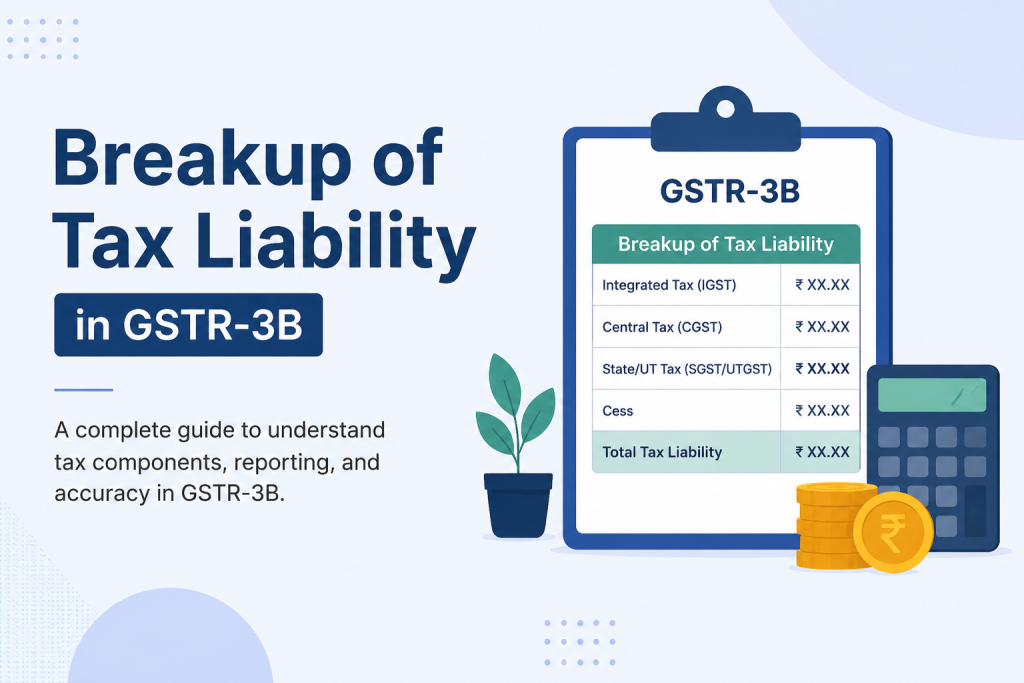
Filing GSTR-3B can seem overwhelming, especially when it comes to reporting your tax liability breakup. This section is crucial because it ensures the government receives the correct GST amount and that you can properly claim Input Tax Credit (ITC). Whether you are a small business owner, accountant, or GST practitioner, understanding this breakup helps avoid errors, penalties, and mismatches during reconciliation.
In this blog, we will cover everything about Breakup of Tax Liability in GSTR-3B, including components, ITC impact, reverse charge, practical tips, and frequently asked questions.
What is the Breakup of Tax Liability?
The Breakup of Tax Liability in GSTR-3B is a structured way to declare:
- Gross tax liability on outward supplies
- Liability under reverse charge
- Eligible ITC that can offset the tax
- Net tax payable for the period
It ensures transparency in your GST payments and facilitates reconciliation with your sales and purchase records.
Why this matters: Without a correct breakup, your tax payment may be incorrect, resulting in penalties or notices during audit.
Components of Tax Liability
GSTR-3B divides tax liability into several key categories:
1. IGST on Outward Supplies
- Applicable to interstate sales of goods and services.
- Tax is collected from the customer and must be declared separately.
- Example: Selling goods from Delhi to Maharashtra attracts IGST instead of CGST + SGST.
Key tip: Ensure your GSTR-1 data matches the IGST reported in GSTR-3B.
2. CGST on Outward Supplies
- Central GST applicable on intrastate sales.
- Combined with SGST/UTGST for intrastate transactions.
- Example: A sale within Karnataka is charged 9% CGST and 9% SGST for a 18% GST product.
Why it matters: Correct allocation ensures central and state governments receive their share.
3. SGST/UTGST on Outward Supplies
- State GST / Union Territory GST applicable on local intrastate sales.
- Split with CGST as per GST slab.
- Helps states track revenue collection accurately.
4. Tax Under Reverse Charge Mechanism (RCM)
- Certain purchases require the recipient to pay GST instead of the supplier.
- Applies to notified goods/services or unregistered suppliers.
- Declared separately in IGST, CGST, or SGST/UTGST under RCM.
Example: Legal services procured from an unregistered lawyer attract RCM; recipient company pays GST.
How Input Tax Credit (ITC) Reduces Liability
- ITC allows you to offset GST paid on purchases against the output tax liability.
- Only eligible ITC can be claimed.
- ITC fields in GSTR-3B cover:
- IGST ITC
- CGST ITC
- SGST/UTGST ITC
Why it matters: Claiming ITC reduces cash outflow, but incorrect claims can trigger notices.
Example:
- Total IGST on sales: ₹50,000
- Eligible ITC on purchases: ₹20,000
- Net IGST payable: ₹50,000 – ₹20,000 = ₹30,000
Step-by-Step Computation of Tax Liability
- Determine gross outward supplies – include all taxable sales, exempt supplies, and exports.
- Identify tax collected – IGST, CGST, SGST/UTGST per applicable rates.
- Include reverse charge liability – calculate tax on RCM purchases.
- Claim eligible ITC – offset against each type of GST.
- Compute net tax payable – add interest or late fees if any.
Practical tip: Use GSTR-2B auto-populated ITC to avoid errors.
Common Mistakes to Avoid
- Mismatch with GSTR-1: Always reconcile outward supplies.
- Incorrect ITC claims: Only eligible ITC should reduce tax.
- Ignoring RCM: Reverse charge on notified services is often overlooked.
- Advance receipts: Tax collected on advances must be reported in the month of receipt.
- State allocation errors: CGST and SGST split must be exact for intrastate sales.
Practical Example of Tax Liability Breakup
| Type of Tax | Amount Collected | ITC Used | Net Tax Payable |
|---|---|---|---|
| IGST | ₹50,000 | ₹20,000 | ₹30,000 |
| CGST | ₹45,000 | ₹15,000 | ₹30,000 |
| SGST/UTGST | ₹45,000 | ₹15,000 | ₹30,000 |
| Total | ₹1,40,000 | ₹50,000 | ₹90,000 |
This table illustrates a simple breakup where ITC is applied to reduce the total liability.
Tips for Accurate Reporting
- Keep invoice-wise records even though GSTR-3B is summary reporting.
- Separate business and personal expenses; only business expenses are eligible for ITC.
- Cross-check RCM applicability on services like legal, transport, or notified goods.
- Reconcile GSTR-3B with GSTR-1 and GSTR-2B monthly to prevent mismatches.
- Maintain documentation for audits and future reference.
FAQs
- What is included in the breakup of tax liability?
IGST, CGST, SGST/UTGST on outward supplies, RCM, and ITC adjustments. - How is reverse charge reported?
Separately under IGST, CGST, or SGST/UTGST fields in GSTR-3B. - Can ITC be claimed against RCM liability?
Yes, if eligible and documented. - Is invoice-wise breakup required?
No, summary reporting is sufficient, but maintain records for audit. - What happens if the breakup is incorrect?
It can trigger mismatch notices, interest, and penalties. - Do advances impact tax liability?
Yes, tax on advances must be reported in the month of receipt. - How to reconcile GSTR-3B with GSTR-1?
Match total outward supplies and tax amounts with GSTR-1 for consistency. - Can tax paid in cash be used to offset liability?
Yes, after applying eligible ITC. - What records should be maintained?
Supplier invoices, ITC claims, RCM proofs, and payment receipts. - Why is this breakup important?
Ensures correct allocation to central/state governments and compliance.
Conclusion
The Breakup of Tax Liability in GSTR-3B is not just a formality—it’s the backbone of GST compliance. Understanding each component, applying ITC correctly, and properly reporting reverse charge liabilities ensures that businesses stay compliant while optimizing cash outflow. Regular reconciliation and meticulous record-keeping make the process smooth and audit-proof.
Informative article about GSTR-3B tax liability breakup. The breakdown of sections makes GST return filing easier to understand.
Helpful guide for understanding GST tax liability. The article explains input credit, output tax, and adjustments very clearly.