Introduction
Differential Privacy Toolkits are specialized privacy-preserving frameworks designed to protect sensitive information while still allowing organizations to analyze and share useful data insights. These toolkits use mathematical privacy techniques to ensure that individual records cannot be identified within datasets, even when performing large-scale analytics, AI training, or statistical reporting.
As organizations increasingly rely on data-driven decision-making, AI systems, and cloud analytics, differential privacy has become a critical technology for balancing data utility with regulatory and privacy requirements. Governments, healthcare providers, financial institutions, and AI companies are adopting differential privacy techniques to reduce re-identification risks and improve trust in data-sharing environments.
Real-world use cases include:
- Privacy-preserving AI model training
- Secure healthcare analytics
- Customer behavior analysis
- Federated learning environments
- Privacy-safe data sharing and reporting
Evaluation Criteria for Buyers
Organizations evaluating Differential Privacy Toolkits should focus on:
- Supported privacy algorithms
- AI and machine learning compatibility
- Scalability for large datasets
- Ease of implementation
- Performance optimization
- Cloud and distributed computing support
- API and SDK flexibility
- Security architecture maturity
- Integration ecosystem
- Documentation and developer usability
Best for: AI teams, healthcare organizations, financial institutions, government agencies, analytics providers, and enterprises managing sensitive customer or operational data.
Not ideal for: Small businesses with limited analytics requirements or organizations that only need basic encryption without advanced privacy-preserving analytics capabilities.
Key Trends in Differential Privacy Toolkits
- Privacy-preserving AI training is accelerating toolkit adoption.
- Differential privacy is increasingly integrated into federated learning systems.
- Enterprises are combining differential privacy with confidential computing technologies.
- AI governance initiatives are increasing demand for privacy-safe analytics.
- Open-source privacy engineering ecosystems continue to expand.
- Cloud-native privacy frameworks are becoming more enterprise-ready.
- Synthetic data generation tools increasingly incorporate differential privacy models.
- Privacy-preserving advertising analytics are gaining momentum.
- Governments and regulators are encouraging stronger anonymization standards.
- Toolkits are simplifying deployment through higher-level APIs and automation.
How We Selected These Tools
The following toolkits were selected based on technical credibility, enterprise relevance, ecosystem maturity, and practical privacy engineering capabilities.
- Industry recognition and adoption
- Differential privacy algorithm support
- AI and analytics compatibility
- Cloud and enterprise deployment readiness
- Developer tooling and APIs
- Scalability for large workloads
- Documentation quality
- Open-source community activity
- Privacy engineering flexibility
- Long-term ecosystem viability
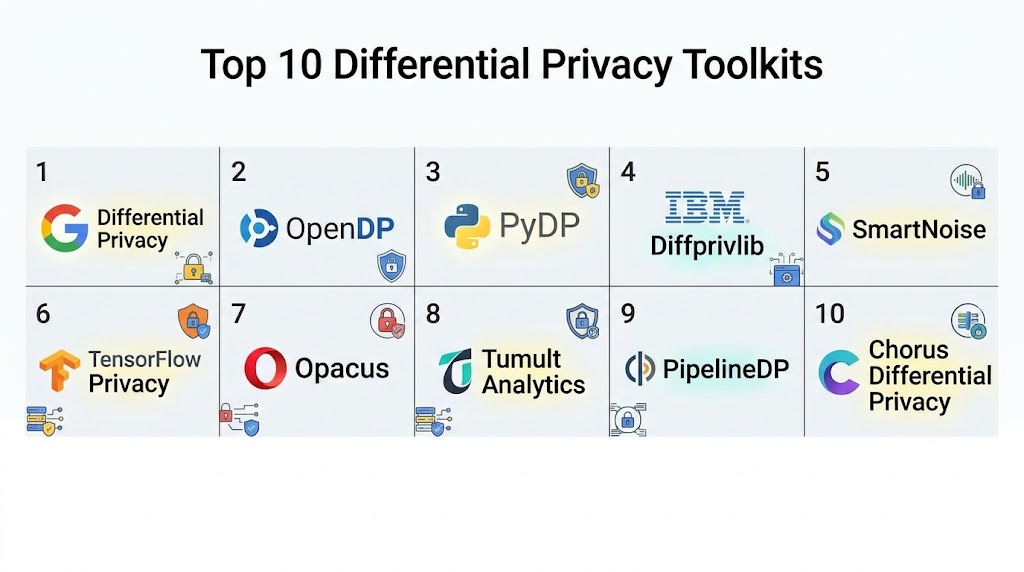
Top 10 Differential Privacy Toolkits
1- Google Differential Privacy
Short description: Google Differential Privacy is one of the most recognized open-source differential privacy libraries designed for large-scale analytics and privacy-preserving data collection systems.
Key Features
- Differential privacy algorithm support
- Noise injection mechanisms
- Privacy budget management
- Statistical aggregation tools
- Open-source APIs
- Scalable analytics processing
- Secure data anonymization
Pros
- Strong industry recognition
- Mature privacy engineering foundation
- Extensive research backing
Cons
- Requires technical expertise
- Limited beginner-friendly interfaces
- Advanced tuning can be complex
Platforms / Deployment
- Linux / Cloud / Hybrid
Security & Compliance
Supports privacy-preserving analytics, secure anonymization workflows, and enterprise privacy controls.
Integrations & Ecosystem
Google Differential Privacy integrates with analytics and machine learning environments.
- AI frameworks
- Analytics pipelines
- Cloud infrastructure
- Data science platforms
- Enterprise reporting systems
Support & Community
Strong open-source ecosystem with active research and privacy engineering adoption.
2- OpenDP
Short description: OpenDP is an open-source differential privacy platform designed to help organizations build trustworthy privacy-preserving data analysis systems.
Key Features
- Differential privacy libraries
- Statistical privacy controls
- Data anonymization functions
- Privacy accounting tools
- Open-source framework
- Reusable privacy components
- Research-oriented APIs
Pros
- Strong academic credibility
- Transparent privacy architecture
- Flexible deployment capabilities
Cons
- Technical learning curve
- Limited enterprise abstraction layers
- Smaller ecosystem than hyperscaler projects
Platforms / Deployment
- Linux / Windows / Cloud
Security & Compliance
Supports privacy-preserving analytics and secure statistical disclosure controls.
Integrations & Ecosystem
OpenDP integrates with research, analytics, and data science environments.
- Python ecosystems
- Data analytics platforms
- Secure research systems
- Statistical environments
- Cloud infrastructure
Support & Community
Strong academic and open-source community focused on privacy engineering research.
3- IBM Diffprivlib
Short description: IBM Diffprivlib is a Python library for differential privacy designed for machine learning, analytics, and privacy-preserving data science workloads.
Key Features
- Differential privacy algorithms
- Machine learning integration
- Statistical privacy tools
- Privacy budget management
- Python-based APIs
- Secure analytics workflows
- Scikit-learn compatibility
Pros
- Strong Python ecosystem support
- AI and ML compatibility
- Good developer accessibility
Cons
- Python-focused environment
- Limited low-level cryptographic flexibility
- Performance tuning may require expertise
Platforms / Deployment
- Windows / Linux / macOS / Cloud
Security & Compliance
Supports privacy-preserving machine learning and secure analytics protections.
Integrations & Ecosystem
IBM Diffprivlib integrates strongly with AI and analytics systems.
- Scikit-learn
- AI pipelines
- Data science environments
- Python analytics stacks
- Cloud AI systems
Support & Community
Good developer documentation and active machine learning research community.
4- TensorFlow Privacy
Short description: TensorFlow Privacy is a privacy-preserving machine learning toolkit built for TensorFlow environments and secure AI model training.
Key Features
- Differentially private machine learning
- Privacy-preserving AI training
- TensorFlow integration
- Gradient clipping
- Privacy accounting
- Secure model optimization
- Federated learning support
Pros
- Strong AI ecosystem compatibility
- Good for large-scale ML projects
- Backed by TensorFlow ecosystem
Cons
- TensorFlow-dependent workflows
- Requires ML expertise
- Advanced tuning complexity
Platforms / Deployment
- Linux / Windows / Cloud
Security & Compliance
Supports privacy-preserving AI training and secure model development.
Integrations & Ecosystem
TensorFlow Privacy integrates with AI infrastructure and MLOps systems.
- TensorFlow
- Kubernetes
- AI pipelines
- Cloud AI platforms
- Federated learning systems
Support & Community
Large machine learning community with strong AI research adoption.
5- PyDP
Short description: PyDP is a Python wrapper for Google Differential Privacy designed for easier developer access to privacy-preserving analytics tools.
Key Features
- Python-based APIs
- Differential privacy aggregation
- Privacy budget controls
- Statistical anonymization
- Simplified implementation
- Data analysis compatibility
- Open-source framework
Pros
- Easier Python integration
- Good analytics compatibility
- Simplified onboarding
Cons
- Python-focused ecosystem
- Smaller enterprise adoption
- Limited low-level flexibility
Platforms / Deployment
- Windows / Linux / Cloud
Security & Compliance
Supports secure anonymization and privacy-preserving data analysis.
Integrations & Ecosystem
PyDP integrates with Python analytics and machine learning environments.
- Python data science tools
- AI pipelines
- Analytics platforms
- Research systems
- Cloud environments
Support & Community
Growing privacy engineering community focused on Python-based analytics.
6- SmartNoise
Short description: SmartNoise is an open-source differential privacy platform designed for secure analytics and privacy-preserving data sharing.
Key Features
- Differential privacy query engine
- Privacy budget accounting
- SQL analytics support
- Secure statistical analysis
- Synthetic data support
- Enterprise privacy controls
- Cloud-compatible architecture
Pros
- Strong analytics usability
- SQL compatibility
- Enterprise privacy focus
Cons
- Smaller ecosystem maturity
- Advanced implementations may require expertise
- Limited AI-specific tooling
Platforms / Deployment
- Linux / Cloud / Hybrid
Security & Compliance
Supports privacy-preserving analytics and enterprise data protection controls.
Integrations & Ecosystem
SmartNoise integrates with analytics and database systems.
- SQL databases
- Data warehouses
- Analytics pipelines
- Cloud systems
- Secure reporting environments
Support & Community
Growing technical ecosystem with increasing enterprise experimentation.
7- Tumult Analytics
Short description: Tumult Analytics is a differential privacy analytics platform focused on secure enterprise reporting and privacy-preserving data collaboration.
Key Features
- Differential privacy analytics
- Secure data aggregation
- Privacy-safe reporting
- Enterprise governance controls
- SQL-based workflows
- Collaborative analytics support
- Data privacy automation
Pros
- Enterprise-friendly architecture
- Good analytics usability
- Strong governance capabilities
Cons
- Specialized deployment focus
- Smaller open-source ecosystem
- Premium enterprise orientation
Platforms / Deployment
- Cloud / Hybrid
Security & Compliance
Supports privacy-preserving analytics and secure enterprise governance protections.
Integrations & Ecosystem
Tumult Analytics integrates with enterprise analytics systems and reporting environments.
- SQL systems
- Cloud analytics platforms
- Governance tools
- Enterprise reporting stacks
- Data collaboration systems
Support & Community
Provides enterprise onboarding and implementation guidance.
8- Meta Opacus
Short description: Meta Opacus is a privacy-preserving deep learning framework designed for secure PyTorch-based machine learning environments.
Key Features
- Differential privacy for deep learning
- PyTorch integration
- Privacy accounting
- Gradient clipping
- Secure AI model training
- Distributed training support
- AI privacy optimization
Pros
- Strong PyTorch compatibility
- Good deep learning support
- Active AI research ecosystem
Cons
- PyTorch-dependent architecture
- Requires AI expertise
- Limited enterprise governance tooling
Platforms / Deployment
- Linux / Windows / Cloud
Security & Compliance
Supports privacy-preserving deep learning and secure AI model training protections.
Integrations & Ecosystem
Meta Opacus integrates with deep learning and AI infrastructure systems.
- PyTorch
- Kubernetes
- AI pipelines
- Cloud ML systems
- Distributed training frameworks
Support & Community
Strong AI research community with active deep learning adoption.
9- Aircloak Insights
Short description: Aircloak Insights provides enterprise-focused privacy-preserving analytics solutions using differential privacy and anonymization technologies.
Key Features
- Privacy-safe analytics
- Differential privacy controls
- Data anonymization
- Enterprise governance features
- Secure analytics environments
- Compliance-oriented workflows
- Cloud analytics compatibility
Pros
- Enterprise analytics focus
- Strong privacy governance
- Good compliance applicability
Cons
- Specialized analytics orientation
- Smaller ecosystem visibility
- Limited developer-focused tooling
Platforms / Deployment
- Cloud / Hybrid
Security & Compliance
Supports secure analytics, privacy governance, and anonymized reporting protections.
Integrations & Ecosystem
Aircloak integrates with enterprise data and reporting systems.
- Data warehouses
- BI platforms
- Cloud analytics systems
- Governance tools
- Enterprise reporting stacks
Support & Community
Provides enterprise support and privacy implementation guidance.
10- Gretel
Short description: Gretel is a privacy engineering platform focused on synthetic data generation and privacy-preserving machine learning workflows.
Key Features
- Synthetic data generation
- Differential privacy support
- AI privacy controls
- Secure data sharing
- Privacy-preserving ML workflows
- Cloud-native deployment
- Data anonymization automation
Pros
- Strong synthetic data capabilities
- Modern AI-focused architecture
- Easier developer onboarding
Cons
- Specialized AI orientation
- Smaller traditional analytics ecosystem
- Premium enterprise capabilities
Platforms / Deployment
- Cloud / Hybrid
Security & Compliance
Supports privacy-preserving AI workflows and secure data anonymization controls.
Integrations & Ecosystem
Gretel integrates with AI and cloud analytics environments.
- AI pipelines
- Cloud infrastructure
- MLOps systems
- Data science platforms
- Enterprise analytics environments
Support & Community
Growing developer and AI privacy engineering ecosystem with modern documentation resources.
Comparison Table
| Tool Name | Best For | Platform(s) Supported | Deployment | Standout Feature | Public Rating |
|---|---|---|---|---|---|
| Google Differential Privacy | Large-scale analytics | Linux / Cloud | Hybrid | Mature privacy algorithms | N/A |
| OpenDP | Research privacy systems | Windows / Linux | Hybrid | Open privacy framework | N/A |
| IBM Diffprivlib | Python privacy ML | Windows / Linux / macOS | Hybrid | Scikit-learn compatibility | N/A |
| TensorFlow Privacy | Privacy-preserving AI | Linux / Windows | Hybrid | TensorFlow AI integration | N/A |
| PyDP | Python analytics privacy | Windows / Linux | Hybrid | Simplified privacy APIs | N/A |
| SmartNoise | Secure SQL analytics | Linux / Cloud | Hybrid | Privacy-safe query engine | N/A |
| Tumult Analytics | Enterprise reporting privacy | Cloud / Hybrid | Hybrid | Governance-focused analytics | N/A |
| Meta Opacus | Deep learning privacy | Linux / Windows | Hybrid | PyTorch differential privacy | N/A |
| Aircloak Insights | Enterprise anonymization | Cloud / Hybrid | Hybrid | Privacy-safe reporting | N/A |
| Gretel | Synthetic privacy data | Cloud / Hybrid | Hybrid | AI-driven synthetic data | N/A |
Evaluation & Scoring of Differential Privacy Toolkits
| Tool Name | Core 25% | Ease 15% | Integrations 15% | Security 10% | Performance 10% | Support 10% | Value 15% | Weighted Total |
|---|---|---|---|---|---|---|---|---|
| Google Differential Privacy | 9 | 7 | 8 | 9 | 8 | 8 | 8 | 8.2 |
| OpenDP | 8 | 6 | 7 | 9 | 7 | 7 | 8 | 7.5 |
| IBM Diffprivlib | 8 | 8 | 8 | 8 | 7 | 8 | 8 | 7.9 |
| TensorFlow Privacy | 9 | 7 | 9 | 8 | 8 | 8 | 7 | 8.1 |
| PyDP | 7 | 8 | 7 | 8 | 7 | 7 | 8 | 7.4 |
| SmartNoise | 8 | 7 | 8 | 8 | 7 | 7 | 7 | 7.6 |
| Tumult Analytics | 8 | 8 | 8 | 8 | 7 | 7 | 7 | 7.7 |
| Meta Opacus | 9 | 7 | 8 | 8 | 8 | 8 | 7 | 8.0 |
| Aircloak Insights | 8 | 7 | 7 | 8 | 7 | 7 | 7 | 7.4 |
| Gretel | 8 | 8 | 8 | 8 | 8 | 8 | 7 | 7.9 |
These scores are intended for comparative evaluation rather than absolute ranking. Some platforms focus heavily on AI privacy and federated learning while others prioritize enterprise analytics and governance. Organizations should align toolkit selection with workload requirements, privacy regulations, and operational complexity needs.
Which Differential Privacy Toolkit Is Right for You?
Solo / Freelancer
Independent developers and researchers may benefit from PyDP, OpenDP, or IBM Diffprivlib because of their strong Python compatibility and accessible analytics workflows.
SMB
Small and medium-sized businesses often benefit from Gretel or SmartNoise for privacy-safe analytics and synthetic data generation with lower operational complexity.
Mid-Market
Mid-market organizations requiring scalable analytics and governance capabilities should evaluate TensorFlow Privacy, Tumult Analytics, or Meta Opacus.
Enterprise
Large enterprises handling regulated datasets and AI workloads should prioritize Google Differential Privacy, TensorFlow Privacy, Aircloak Insights, or enterprise privacy governance platforms.
Budget vs Premium
Open-source differential privacy frameworks reduce licensing costs but may require stronger internal engineering expertise. Enterprise analytics platforms generally provide easier governance and operational controls.
Feature Depth vs Ease of Use
Research-oriented frameworks offer greater customization and algorithm flexibility, while enterprise privacy platforms prioritize usability and governance automation.
Integrations & Scalability
Organizations with large AI, analytics, or cloud-native ecosystems should prioritize platforms with strong MLOps and API integration capabilities.
Security & Compliance Needs
Regulated industries should focus on auditability, privacy accounting, anonymization quality, and governance controls when selecting a toolkit.
Frequently Asked Questions FAQs
1- What is differential privacy?
Differential privacy is a mathematical privacy technique that protects individual records within datasets while still allowing useful analytics and reporting.
2- Why is differential privacy important for AI?
AI systems often rely on sensitive personal data. Differential privacy helps reduce the risk of exposing identifiable information during model training and analytics.
3- Is differential privacy the same as encryption?
No. Encryption protects data access, while differential privacy protects individuals from being identified within analytical outputs or datasets.
4- Does differential privacy reduce data accuracy?
Some statistical accuracy can be reduced because privacy mechanisms inject controlled noise into results. The balance depends on privacy budget settings.
5- Which industries use differential privacy the most?
Healthcare, government, financial services, advertising, telecommunications, and AI research organizations are among the largest adopters.
6- Can differential privacy work with machine learning?
Yes. Several frameworks support privacy-preserving machine learning and federated learning workflows.
7- What is a privacy budget?
A privacy budget measures how much information can safely be revealed from a dataset while maintaining privacy protections.
8- Are these toolkits open source?
Many major differential privacy frameworks such as OpenDP, TensorFlow Privacy, Meta Opacus, and Google Differential Privacy are open source.
9- Is differential privacy difficult to implement?
Implementation complexity depends on the workload, framework, and privacy requirements. AI-focused deployments generally require more expertise.
10- What should organizations evaluate before selecting a toolkit?
Organizations should evaluate algorithm support, scalability, AI compatibility, privacy controls, integration ecosystem, and operational complexity.
Conclusion
Differential Privacy Toolkits are becoming foundational technologies for organizations pursuing secure analytics, privacy-preserving AI, and responsible data governance strategies. As enterprises process increasing amounts of sensitive customer, healthcare, financial, and operational information, traditional anonymization methods are often no longer sufficient to protect against re-identification risks. Frameworks such as Google Differential Privacy, OpenDP, IBM Diffprivlib, and TensorFlow Privacy provide strong foundations for secure analytics and AI model training, while platforms like Gretel, Tumult Analytics, and Aircloak Insights focus on enterprise privacy workflows and synthetic data generation. The ideal toolkit depends on organizational priorities including AI adoption, analytics scale, compliance requirements, and engineering expertise. Research-driven teams may prioritize flexibility and advanced privacy controls, while enterprises often focus more on governance, automation, and operational scalability. Before selecting a platform, organizations should benchmark privacy performance, validate integrations, assess governance requirements, and test how privacy settings affect analytics accuracy and AI outcomes.