Introduction
Ontology Management Tools are specialized platforms designed to create, manage, govern, visualize, and evolve ontologies that define concepts, relationships, metadata, and semantic rules within a domain. These tools are foundational for semantic web technologies, enterprise knowledge graphs, AI reasoning systems, semantic search, data interoperability, and modern knowledge management architectures.
As organizations increasingly adopt AI-driven analytics, large language models, enterprise knowledge graphs, semantic data fabrics, and intelligent automation, ontology management has become critical for ensuring consistent business meaning, data governance, explainable AI, and semantic interoperability across distributed systems. Modern ontology tools now support collaborative ontology engineering, RDF and OWL standards, semantic reasoning, graph visualization, metadata governance, and AI-assisted ontology development.
Real-world use cases include:
- Building enterprise knowledge graphs
- Supporting semantic AI and large language model workflows
- Managing taxonomies and business glossaries
- Enabling semantic interoperability across systems
- Creating governed metadata and ontology-driven data fabrics
Buyers evaluating Ontology Management Tools should consider:
- RDF, OWL, and semantic standards support
- Collaboration and governance capabilities
- Semantic reasoning and inference support
- Visualization and ontology exploration tools
- AI and knowledge graph integration
- Scalability across enterprise environments
- Security and governance controls
- API and semantic query support
- Metadata management functionality
- Ease of ontology lifecycle management
Best for: Enterprise architects, AI engineering teams, semantic web developers, governance teams, knowledge graph engineers, data scientists, regulated industries, and organizations managing AI-ready semantic architectures.
Not ideal for: Simple relational database projects or organizations without semantic interoperability, AI reasoning, or ontology-driven governance requirements.
Key Trends in Ontology Management Tools
- AI-assisted ontology engineering is accelerating rapidly.
- Enterprise knowledge graphs are becoming foundational for AI architectures.
- Semantic interoperability is becoming a priority across regulated industries.
- Hybrid RDF and property graph support is expanding.
- Ontology-driven governance models are improving enterprise AI explainability.
- Collaborative web-based ontology editing is becoming more common.
- Semantic search and retrieval-augmented generation integration is increasing.
- Metadata-driven automation and reasoning engines are evolving rapidly.
- Ontology lifecycle governance is becoming operationally critical.
- Cloud-native semantic platforms are expanding across enterprises.
How We Selected These Tools
The tools in this list were selected based on semantic modeling depth, governance capabilities, standards support, enterprise adoption, AI integration, and ecosystem maturity.
Selection criteria included:
- Ontology modeling capabilities
- RDF and OWL standards support
- Semantic reasoning functionality
- Governance and metadata management
- Visualization and ontology exploration
- AI and knowledge graph compatibility
- Cloud-native deployment flexibility
- Security and collaboration controls
- Enterprise scalability
- Community and ecosystem maturity
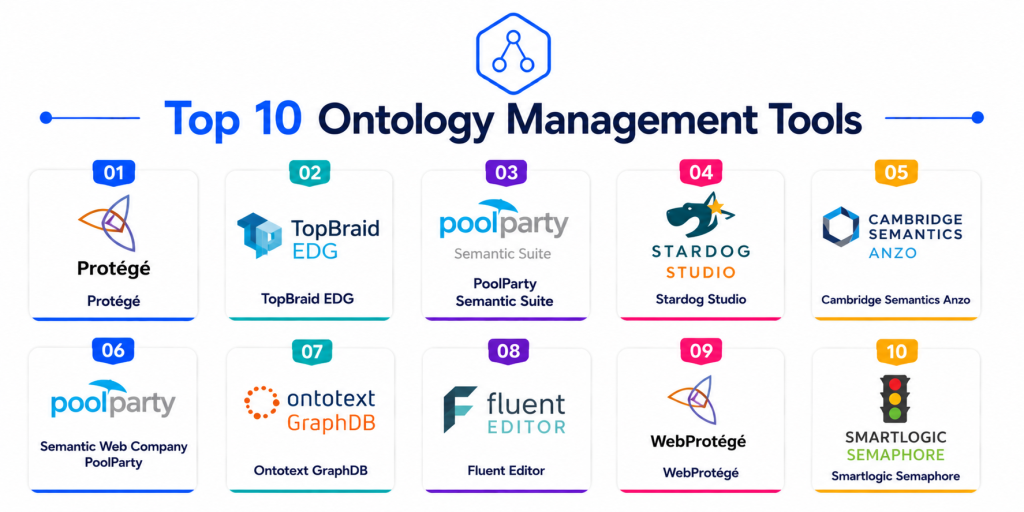
Top 10 Ontology Management Tools
1- Protégé
Short description: Protégé is one of the most widely used open-source ontology editors and ontology engineering platforms for OWL, RDF, semantic web, and knowledge graph development.
Key Features
- OWL ontology editing
- RDF and semantic web support
- WebProtégé collaborative editing
- Semantic reasoning integration
- Ontology visualization
- Plugin extensibility
- SPARQL querying support
Pros
- Large global ontology engineering community
- Strong semantic standards support
- Free and open-source ecosystem
Cons
- Advanced enterprise governance requires additional tooling
- UI can feel technical for non-experts
- Large ontologies may require optimization
Platforms / Deployment
- Windows / macOS / Linux
- Self-hosted / Hybrid
Security & Compliance
- Role-based collaboration support
- Authentication integration
- Access control varies by deployment
Integrations & Ecosystem
Protégé integrates with semantic web and knowledge graph ecosystems.
- OWL
- RDF
- SPARQL
- Semantic reasoners
- Knowledge graph platforms
- AI semantic systems
Support & Community
Very large global ontology engineering and semantic web community. Widely used in research, healthcare, government, and enterprise knowledge graph projects.
2- TopQuadrant EDG
Short description: TopQuadrant EDG is an enterprise semantic governance and ontology management platform focused on knowledge graphs, metadata governance, and controlled vocabularies.
Key Features
- Ontology governance workflows
- Business glossary management
- Taxonomy and semantic model management
- Knowledge graph integration
- Metadata governance
- Semantic collaboration tools
- Controlled vocabulary support
Pros
- Strong enterprise governance capabilities
- Good semantic stewardship workflows
- Useful business and technical collaboration support
Cons
- Enterprise deployment complexity
- Premium licensing considerations
- Requires semantic governance planning
Platforms / Deployment
- Linux / Enterprise infrastructure
- Cloud / Self-hosted / Hybrid
Security & Compliance
- RBAC
- Audit logging
- Authentication integration
- Governance controls
Integrations & Ecosystem
TopQuadrant integrates with enterprise governance and semantic ecosystems.
- Knowledge graphs
- RDF systems
- Metadata platforms
- APIs
- Governance tools
- Analytics environments
Support & Community
Strong enterprise governance ecosystem and semantic enterprise adoption.
3- Stardog
Short description: Stardog provides enterprise ontology management, semantic reasoning, and knowledge graph capabilities for AI-ready semantic architectures.
Key Features
- RDF graph architecture
- Semantic reasoning engine
- Ontology governance
- Virtual graph federation
- SPARQL querying
- AI-ready semantic layer
- Metadata-driven management
Pros
- Strong semantic reasoning support
- Good enterprise knowledge graph integration
- Useful federated semantic querying
Cons
- Requires semantic expertise
- Enterprise operational complexity
- Premium licensing model
Platforms / Deployment
- Linux / Kubernetes / Enterprise infrastructure
- Cloud / Self-hosted / Hybrid
Security & Compliance
- RBAC
- Encryption
- Audit logging
- Identity integration
- Governance controls
Integrations & Ecosystem
Stardog integrates with semantic AI and enterprise graph ecosystems.
- APIs
- GraphQL
- AI frameworks
- Databases
- Analytics tools
- Cloud platforms
Support & Community
Strong semantic AI ecosystem and enterprise knowledge graph adoption.
4- Ontotext GraphDB
Short description: Ontotext GraphDB is a semantic graph database and ontology platform designed for RDF knowledge graphs, semantic reasoning, and linked data management.
Key Features
- RDF graph storage
- Semantic reasoning
- Linked data support
- SPARQL querying
- Ontology visualization
- Data federation
- AI-ready semantic architecture
Pros
- Strong semantic standards support
- Good linked data capabilities
- Useful reasoning and inference support
Cons
- Requires semantic web expertise
- Smaller ecosystem than Neo4j
- Enterprise scaling requires planning
Platforms / Deployment
- Linux / Enterprise infrastructure
- Cloud / Self-hosted / Hybrid
Security & Compliance
- RBAC
- Encryption
- Audit logging
- Authentication integration
- Governance controls
Integrations & Ecosystem
GraphDB integrates with semantic AI and linked data ecosystems.
- SPARQL endpoints
- APIs
- AI systems
- Analytics platforms
- Databases
- Cloud infrastructure
Support & Community
Strong semantic web ecosystem and enterprise knowledge graph adoption.
5- Synaptica Graphite
Short description: Synaptica Graphite is a cloud-based ontology and taxonomy management platform designed for enterprise semantic governance and knowledge graph development.
Key Features
- Ontology lifecycle management
- Taxonomy governance
- Graphical ontology editing
- Workflow collaboration
- Metadata management
- Semantic relationship modeling
- Standards-based interoperability
Pros
- Strong collaborative ontology workflows
- Good usability for subject matter experts
- Useful semantic governance support
Cons
- Smaller ecosystem than larger enterprise platforms
- Enterprise scaling requires planning
- Advanced semantic customization may require expertise
Platforms / Deployment
- Cloud infrastructure
- Cloud
Security & Compliance
- RBAC
- Authentication integration
- Governance controls
- Secure cloud access
Integrations & Ecosystem
Synaptica integrates with enterprise knowledge graph and metadata ecosystems.
- Knowledge graphs
- APIs
- Metadata systems
- Search platforms
- Analytics environments
- Semantic web standards
Support & Community
Growing enterprise semantic governance ecosystem and knowledge graph adoption.
6- WebProtégé
Short description: WebProtégé is a collaborative browser-based ontology engineering platform built on the Protégé ecosystem for distributed semantic modeling teams.
Key Features
- Browser-based ontology editing
- Collaborative semantic modeling
- OWL and RDF support
- Ontology review workflows
- Change tracking
- Semantic visualization
- Team collaboration support
Pros
- Strong collaborative ontology workflows
- Good accessibility for distributed teams
- Free open-source ecosystem
Cons
- Enterprise governance capabilities are more limited
- Large ontology scaling may require tuning
- Advanced integrations require customization
Platforms / Deployment
- Web / Browser-based infrastructure
- Cloud / Self-hosted
Security & Compliance
- Authentication integration
- Collaboration permissions
- Access controls vary by deployment
Integrations & Ecosystem
WebProtégé integrates with semantic web and ontology engineering ecosystems.
- Protégé
- OWL
- RDF
- SPARQL
- Knowledge graphs
- Semantic AI systems
Support & Community
Large academic and semantic web community adoption.
7- PoolParty Semantic Suite
Short description: PoolParty Semantic Suite provides enterprise ontology management, taxonomy governance, semantic AI, and knowledge graph capabilities.
Key Features
- Taxonomy and ontology management
- Semantic search support
- Knowledge graph integration
- Metadata enrichment
- Linked data support
- Semantic AI workflows
- Governance automation
Pros
- Strong semantic AI integration
- Good taxonomy management support
- Useful metadata enrichment capabilities
Cons
- Enterprise operational complexity
- Smaller ecosystem compared to larger semantic platforms
- Advanced semantic modeling requires expertise
Platforms / Deployment
- Linux / Enterprise infrastructure
- Cloud / Self-hosted / Hybrid
Security & Compliance
- RBAC
- Encryption
- Audit logging
- Identity integration
- Governance controls
Integrations & Ecosystem
PoolParty integrates with enterprise semantic and AI ecosystems.
- Knowledge graphs
- AI systems
- Search platforms
- APIs
- Metadata systems
- Analytics environments
Support & Community
Strong semantic AI ecosystem and enterprise taxonomy adoption.
8- Fluent Editor
Short description: Fluent Editor is an ontology engineering environment that uses controlled natural language for ontology development and semantic modeling.
Key Features
- Controlled natural language modeling
- Ontology editing
- Semantic validation
- OWL support
- Reasoning integration
- Semantic visualization
- Natural language ontology management
Pros
- Easier ontology development for non-experts
- Good semantic readability
- Useful natural language semantic workflows
Cons
- Smaller ecosystem
- Limited enterprise governance capabilities
- Advanced semantic scaling requires expertise
Platforms / Deployment
- Windows / Linux
- Self-hosted
Security & Compliance
- Authentication support varies
- Deployment-based security controls
Integrations & Ecosystem
Fluent Editor integrates with ontology and semantic ecosystems.
- OWL
- RDF
- Semantic reasoners
- Knowledge graphs
- Semantic web systems
- Ontology platforms
Support & Community
Smaller but specialized ontology engineering community.
9- NeOn Toolkit
Short description: NeOn Toolkit is an ontology engineering environment supporting ontology evolution, modularization, reuse, and semantic web workflows.
Key Features
- Ontology modularization
- Ontology reuse workflows
- Annotation and documentation
- Ontology evolution support
- OWL and RDF compatibility
- Plugin-based architecture
- Semantic workflow management
Pros
- Strong ontology lifecycle support
- Good modular semantic engineering capabilities
- Open-source extensibility
Cons
- Older interface and ecosystem
- Smaller active community
- Enterprise deployment requires expertise
Platforms / Deployment
- Windows / Linux / macOS
- Self-hosted
Security & Compliance
- Authentication integration varies
- Operational security depends on deployment
Integrations & Ecosystem
NeOn integrates with semantic engineering ecosystems.
- OWL
- RDF
- Eclipse
- Semantic reasoners
- Knowledge graphs
- Ontology workflows
Support & Community
Established semantic engineering ecosystem with academic adoption.
10- Lettria Ontology Toolkit
Short description: Lettria Ontology Toolkit uses AI and large language models to automate ontology creation and semantic modeling workflows.
Key Features
- AI-assisted ontology generation
- Automated class extraction
- Competency question generation
- RDF export support
- Semantic relationship generation
- Text-driven ontology modeling
- LLM-powered semantic automation
Pros
- Strong AI-assisted ontology automation
- Good productivity improvements
- Useful for accelerating semantic modeling
Cons
- Newer ecosystem maturity
- AI-generated models may require validation
- Enterprise governance workflows still evolving
Platforms / Deployment
- Cloud infrastructure
- Cloud
Security & Compliance
- Secure cloud deployment
- Authentication integration
- Operational controls vary by deployment
Integrations & Ecosystem
Lettria integrates with semantic AI and ontology engineering ecosystems.
- RDF
- Knowledge graphs
- AI systems
- APIs
- Semantic workflows
- NLP platforms
Support & Community
Growing semantic AI ecosystem and ontology automation adoption.
Comparison Table
| Tool Name | Best For | Platforms Supported | Deployment | Standout Feature | Public Rating |
|---|---|---|---|---|---|
| Protégé | Open-source ontology engineering | Windows / Linux / macOS | Self-hosted / Hybrid | OWL ontology editing | N/A |
| TopQuadrant EDG | Enterprise semantic governance | Linux / Enterprise infrastructure | Cloud / Self-hosted / Hybrid | Governance workflows | N/A |
| Stardog | AI-ready semantic knowledge graphs | Linux / Kubernetes | Cloud / Self-hosted / Hybrid | Semantic reasoning engine | N/A |
| Ontotext GraphDB | RDF semantic management | Linux / Enterprise infrastructure | Cloud / Self-hosted / Hybrid | Linked data reasoning | N/A |
| Synaptica Graphite | Collaborative ontology governance | Cloud infrastructure | Cloud | Human-in-the-loop semantic workflows | N/A |
| WebProtégé | Collaborative ontology editing | Web / Browser | Cloud / Self-hosted | Browser-based ontology collaboration | N/A |
| PoolParty Semantic Suite | Semantic AI and taxonomy management | Linux / Enterprise infrastructure | Cloud / Self-hosted / Hybrid | Semantic AI integration | N/A |
| Fluent Editor | Natural language ontology engineering | Windows / Linux | Self-hosted | Controlled natural language modeling | N/A |
| NeOn Toolkit | Ontology lifecycle engineering | Windows / Linux / macOS | Self-hosted | Ontology modularization | N/A |
| Lettria Ontology Toolkit | AI-assisted ontology automation | Cloud infrastructure | Cloud | LLM-powered ontology generation | N/A |
Evaluation & Scoring of Ontology Management Tools
| Tool Name | Core 25% | Ease 15% | Integrations 15% | Security 10% | Performance 10% | Support 10% | Value 15% | Weighted Total |
|---|---|---|---|---|---|---|---|---|
| Protégé | 9.4 | 8.1 | 8.9 | 8.5 | 8.8 | 9.2 | 9.5 | 8.99 |
| TopQuadrant EDG | 9.1 | 7.6 | 8.9 | 9.0 | 8.8 | 8.8 | 7.9 | 8.55 |
| Stardog | 9.2 | 7.5 | 8.9 | 9.1 | 8.9 | 8.7 | 7.9 | 8.58 |
| Ontotext GraphDB | 8.9 | 7.6 | 8.7 | 8.9 | 8.8 | 8.5 | 8.1 | 8.48 |
| Synaptica Graphite | 8.8 | 8.2 | 8.6 | 8.7 | 8.5 | 8.4 | 8.3 | 8.46 |
| WebProtégé | 8.7 | 8.5 | 8.5 | 8.2 | 8.4 | 8.8 | 9.0 | 8.56 |
| PoolParty Semantic Suite | 8.9 | 7.8 | 8.7 | 8.8 | 8.7 | 8.5 | 8.0 | 8.45 |
| Fluent Editor | 8.4 | 8.3 | 8.0 | 8.0 | 8.2 | 7.9 | 8.8 | 8.24 |
| NeOn Toolkit | 8.3 | 7.2 | 8.1 | 7.9 | 8.2 | 7.8 | 8.7 | 8.03 |
| Lettria Ontology Toolkit | 8.8 | 8.6 | 8.4 | 8.3 | 8.5 | 8.1 | 8.4 | 8.49 |
These scores are comparative and intended to help organizations evaluate operational fit rather than identify a universal winner. Open-source ontology platforms score highly for flexibility and cost efficiency, while enterprise semantic suites provide stronger governance and operational controls. Buyers should align tool selection with AI strategy, semantic governance maturity, collaboration needs, and operational expertise.
Which Ontology Management Tool Is Right for You?
Solo / Freelancer
Independent semantic developers and researchers often prioritize affordability, flexibility, and standards support. Protégé, WebProtégé, and Fluent Editor are strong choices for smaller ontology engineering projects.
SMB
SMBs usually need collaborative semantic workflows with manageable operational complexity. WebProtégé, Synaptica Graphite, and Lettria Ontology Toolkit provide accessible ontology management and AI-assisted modeling capabilities.
Mid-Market
Mid-sized organizations often require stronger governance visibility, semantic integration, and AI-ready ontology workflows. Stardog, PoolParty Semantic Suite, and TopQuadrant EDG are strong choices for expanding semantic architectures.
Enterprise
Large enterprises typically require metadata governance, semantic reasoning, distributed ontology management, AI integration, and collaborative stewardship workflows. TopQuadrant EDG, Stardog, Ontotext GraphDB, and IBM-oriented semantic ecosystems are strong enterprise-focused options.
Budget vs Premium
Open-source ontology engineering platforms reduce licensing costs but require stronger operational expertise. Enterprise ontology governance suites provide deeper governance, collaboration, and semantic automation capabilities with higher operational investment.
Feature Depth vs Ease of Use
Semantic governance platforms provide deeper ontology lifecycle management, while AI-assisted and natural-language tools simplify adoption and semantic modeling workflows.
Integrations & Scalability
Organizations already invested in knowledge graphs, semantic AI, cloud analytics, RDF ecosystems, or enterprise governance platforms should prioritize ontology tools aligned with existing architectures.
Security & Compliance Needs
Security-focused organizations should prioritize RBAC, audit logging, governance controls, identity integration, semantic stewardship workflows, and secure collaborative ontology editing capabilities.
Frequently Asked Questions
1. What is an Ontology Management Tool?
An Ontology Management Tool helps organizations create, manage, govern, visualize, and evolve semantic models that define concepts, relationships, and rules within a domain.
2. Why are ontology management platforms important?
They improve semantic interoperability, AI explainability, metadata governance, enterprise knowledge sharing, and connected data intelligence.
3. What is the difference between RDF and OWL?
RDF provides a framework for describing resources and relationships, while OWL adds richer semantic logic and reasoning capabilities for ontology engineering.
4. What industries commonly use ontology management tools?
Healthcare, finance, government, manufacturing, telecommunications, life sciences, AI-driven enterprises, and semantic web organizations commonly rely on ontology management platforms.
5. What are common implementation mistakes?
Common mistakes include weak governance planning, inconsistent semantic definitions, poor ontology reuse strategies, overcomplicated models, and insufficient collaboration workflows.
6. Can ontology management tools support AI workloads?
Yes. Modern ontology platforms increasingly support semantic AI, retrieval-augmented generation, explainable AI, graph machine learning, and knowledge graph architectures.
7. What integrations are most important?
Important integrations include RDF systems, knowledge graphs, APIs, AI frameworks, semantic search engines, metadata platforms, and analytics systems.
8. Should organizations choose open-source or enterprise ontology tools?
Open-source tools provide flexibility and lower costs, while enterprise platforms deliver stronger governance, collaboration, semantic stewardship, and operational controls.
9. What is semantic reasoning?
Semantic reasoning uses ontology rules and logic to infer new knowledge, validate relationships, and improve AI and analytics intelligence.
10. What should buyers evaluate before selecting an ontology management platform?
Buyers should evaluate standards support, semantic reasoning, governance capabilities, collaboration workflows, scalability, AI compatibility, security controls, and ecosystem integration.
Conclusion
Ontology Management Tools are becoming foundational for organizations building semantic AI architectures, enterprise knowledge graphs, metadata-driven governance systems, and intelligent data interoperability environments. The right ontology platform can improve semantic consistency, strengthen governance, accelerate AI explainability, simplify knowledge modeling, and enhance enterprise analytics intelligence. Protégé remains one of the most widely adopted open-source ontology engineering platforms, while TopQuadrant EDG and Stardog provide strong enterprise governance and semantic reasoning capabilities. Ontotext GraphDB strengthens RDF and linked data workflows, Synaptica Graphite improves collaborative semantic governance, and WebProtégé enables browser-based ontology collaboration. PoolParty Semantic Suite enhances semantic AI workflows, Fluent Editor simplifies ontology engineering using controlled natural language, NeOn Toolkit supports ontology lifecycle engineering, and Lettria Ontology Toolkit introduces AI-assisted semantic automation. The best choice depends on semantic governance maturity, AI strategy, operational expertise, collaboration needs, and ecosystem alignment. Shortlist two or three ontology platforms, validate semantic modeling workflows using production-like ontologies, test governance and reasoning capabilities carefully, and ensure the selected solution can support long-term enterprise AI and knowledge graph initiatives.