Introduction
Edge AI Inference Platforms help organizations deploy, run, optimize, and manage artificial intelligence models directly on edge devices, gateways, industrial systems, cameras, robots, vehicles, and distributed infrastructure. Instead of sending all data to centralized cloud environments for processing, these platforms allow AI inference to occur closer to where data is generated, reducing latency, bandwidth usage, and operational delays.
As industries increasingly adopt computer vision, predictive maintenance, autonomous systems, industrial automation, smart retail, healthcare monitoring, robotics, and intelligent transportation systems, Edge AI Inference Platforms have become critical for delivering real-time decision-making capabilities. These platforms support AI workloads in environments where connectivity, speed, privacy, and operational reliability are major priorities.
Real-world use cases include:
- Real-time video analytics on smart cameras
- AI-powered predictive maintenance at industrial sites
- Autonomous vehicle and robotics inference processing
- Smart retail customer analytics
- Edge AI monitoring in healthcare and manufacturing
Buyers evaluating Edge AI Inference Platforms should consider:
- AI model optimization capabilities
- Hardware acceleration support
- Real-time inference performance
- Edge device compatibility
- Deployment and orchestration workflows
- Security and device isolation
- Container and Kubernetes integration
- Offline and intermittent connectivity support
- AI framework compatibility
- Scalability across distributed edge fleets
Best for: AI engineering teams, industrial automation organizations, robotics companies, smart city operators, manufacturers, retailers, telecom providers, healthcare technology companies, transportation operators, and enterprises deploying AI workloads at the edge.
Not ideal for: Organizations running only centralized cloud AI workloads without latency-sensitive edge requirements or businesses without distributed edge infrastructure.
Key Trends in Edge AI Inference Platforms
- AI inference is increasingly moving closer to devices and sensors for real-time responsiveness.
- AI accelerator hardware adoption is growing rapidly across edge environments.
- Containerized edge AI deployment is becoming standard for operational flexibility.
- TinyML and lightweight inference models are improving low-power device support.
- AI model lifecycle management at the edge is becoming more important.
- Hybrid cloud-edge AI orchestration is expanding across enterprises.
- Privacy-preserving edge AI processing is reducing dependency on centralized cloud analytics.
- Multi-model inference support is becoming more common in industrial deployments.
- Edge AI observability and monitoring are improving operational reliability.
- GPU, TPU, and NPU optimization ecosystems are evolving rapidly.
How We Selected These Tools
The tools in this list were selected based on inference performance, edge deployment flexibility, AI framework compatibility, hardware ecosystem maturity, scalability, and operational value.
Selection criteria included:
- Edge AI inference optimization capabilities
- Hardware accelerator support
- AI framework compatibility
- Real-time processing performance
- Deployment and orchestration flexibility
- Edge scalability and fleet management
- Security and operational governance
- Container and Kubernetes support
- Ecosystem maturity and community adoption
- Suitability for industrial, commercial, and AI-driven edge workloads
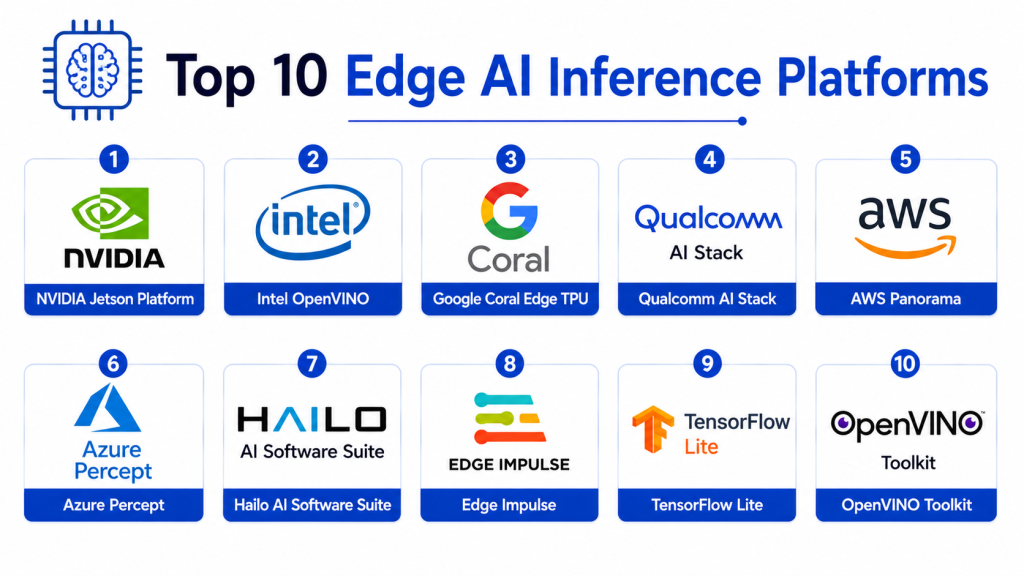
Top 10 Edge AI Inference Platforms
1- NVIDIA Triton Inference Server
Short description: NVIDIA Triton Inference Server is a high-performance AI inference platform designed for deploying machine learning and deep learning models across edge, cloud, and GPU-accelerated environments.
Key Features
- Multi-framework AI inference
- GPU acceleration support
- Real-time inference optimization
- Dynamic batching
- Model version management
- Kubernetes integration
- Edge and cloud deployment flexibility
Pros
- Excellent GPU inference performance
- Strong AI framework support
- Good scalability for enterprise AI workloads
Cons
- Best value with NVIDIA hardware ecosystems
- Advanced optimization requires expertise
- Resource-heavy for smaller edge devices
Platforms / Deployment
- Linux / Kubernetes / GPU systems
- Cloud / Self-hosted / Hybrid
Security & Compliance
- RBAC
- Encryption
- Audit logging support
- Container isolation
- Identity integration
- API security controls
Integrations & Ecosystem
Triton integrates with AI frameworks, Kubernetes environments, and GPU-accelerated infrastructure.
- TensorFlow
- PyTorch
- ONNX
- Kubernetes
- Docker
- NVIDIA AI ecosystem
Support & Community
Strong AI developer ecosystem, enterprise support, and extensive technical documentation are available.
2- OpenVINO Toolkit
Short description: OpenVINO Toolkit from Intel helps optimize and deploy AI inference workloads across Intel CPUs, GPUs, VPUs, and edge AI environments.
Key Features
- AI model optimization
- Intel hardware acceleration
- Computer vision inference
- Edge AI deployment support
- Low-latency processing
- Framework conversion tools
- Multi-device inference execution
Pros
- Strong Intel hardware optimization
- Good edge AI performance efficiency
- Useful computer vision capabilities
Cons
- Best performance with Intel hardware
- Requires optimization expertise
- Advanced deployment workflows may become complex
Platforms / Deployment
- Linux / Windows / Edge devices
- Self-hosted / Hybrid
Security & Compliance
- Encryption support
- Secure runtime controls
- Container compatibility
- Operational logging
- Identity integration varies by deployment
Integrations & Ecosystem
OpenVINO integrates with AI frameworks, Intel hardware, and edge deployment workflows.
- TensorFlow
- PyTorch
- ONNX
- Intel processors
- Edge gateways
- Computer vision pipelines
Support & Community
Strong developer community, AI optimization documentation, and Intel ecosystem resources are available.
3- AWS Panorama
Short description: AWS Panorama enables organizations to run computer vision and AI inference workloads directly on edge appliances and cameras while integrating with AWS cloud services.
Key Features
- Edge computer vision inference
- Camera integration support
- AI model deployment
- Cloud-connected edge analytics
- Real-time video processing
- Operational monitoring
- AI application management
Pros
- Strong AWS integration
- Good computer vision workflows
- Useful cloud-to-edge operational management
Cons
- Best suited for AWS environments
- Primarily focused on vision use cases
- Requires AWS operational expertise
Platforms / Deployment
- Edge appliances / Cameras / Linux
- Cloud / Hybrid
Security & Compliance
- IAM integration
- Encryption
- Audit logs
- Device authentication
- Secure API controls
- Operational monitoring
Integrations & Ecosystem
AWS Panorama integrates with AWS AI, analytics, and operational ecosystems.
- AWS SageMaker
- AWS IoT
- Amazon Rekognition
- CloudWatch
- Video analytics systems
- Edge infrastructure
Support & Community
AWS provides enterprise support, cloud AI resources, and developer documentation.
4- Azure IoT Edge with Azure AI
Short description: Azure IoT Edge combined with Azure AI services enables organizations to deploy AI inference workloads across industrial systems, edge gateways, and distributed infrastructure.
Key Features
- Edge AI deployment
- Containerized AI workloads
- AI model lifecycle support
- Edge analytics
- Real-time inference processing
- Kubernetes compatibility
- Cloud-edge orchestration
Pros
- Strong Microsoft cloud integration
- Good AI and analytics ecosystem
- Useful enterprise edge scalability
Cons
- Requires Azure operational expertise
- Enterprise deployments can become complex
- Pricing and scaling require planning
Platforms / Deployment
- Linux / Windows / Edge gateways
- Cloud / Hybrid
Security & Compliance
- RBAC
- Encryption
- Audit logs
- Microsoft Entra ID integration
- Device authentication
- Secure edge runtime
Integrations & Ecosystem
Azure integrates with AI services, analytics platforms, and industrial edge systems.
- Azure AI services
- Azure IoT Hub
- Kubernetes
- Power BI
- Industrial systems
- Edge infrastructure
Support & Community
Strong Microsoft support ecosystem, enterprise services, and AI development resources.
5- Edge Impulse
Short description: Edge Impulse is an edge AI development and inference platform focused on embedded machine learning, TinyML, and low-power edge device AI deployment.
Key Features
- TinyML workflows
- Embedded AI model optimization
- Edge device deployment
- Sensor data processing
- AI model training support
- Embedded inferencing
- Low-power AI execution
Pros
- Strong embedded AI workflows
- Good low-power device support
- Developer-friendly platform
Cons
- Less suited for large enterprise AI infrastructure
- Smaller ecosystem than hyperscale cloud providers
- Advanced industrial orchestration may require integrations
Platforms / Deployment
- Embedded devices / Linux / Microcontrollers
- Cloud / Self-hosted options vary
Security & Compliance
- Encryption support
- Device authentication
- API security
- Operational visibility varies by deployment
- Compliance support not publicly stated
Integrations & Ecosystem
Edge Impulse integrates with embedded AI hardware and machine learning workflows.
- ARM devices
- TensorFlow Lite
- Microcontrollers
- Edge sensors
- Embedded AI hardware
- APIs
Support & Community
Strong TinyML community, technical tutorials, and embedded AI developer resources are available.
6- TensorFlow Lite
Short description: TensorFlow Lite is a lightweight machine learning inference framework optimized for mobile, embedded, and edge AI environments.
Key Features
- Lightweight AI inference
- Mobile and edge optimization
- TensorFlow model support
- Hardware acceleration compatibility
- Low-latency inference
- Embedded deployment support
- Cross-platform AI execution
Pros
- Large AI ecosystem adoption
- Good embedded and mobile AI support
- Strong framework compatibility
Cons
- Requires development expertise
- Not a complete operational platform by itself
- Production orchestration requires additional tooling
Platforms / Deployment
- Android / Linux / Embedded devices / Edge systems
- Self-hosted / Hybrid
Security & Compliance
- Secure runtime compatibility
- Encryption support
- Container compatibility
- Operational security depends on deployment
Integrations & Ecosystem
TensorFlow Lite integrates with mobile, embedded, and AI deployment ecosystems.
- TensorFlow
- Android
- Edge AI hardware
- TensorFlow Extended
- Embedded systems
- AI accelerators
Support & Community
Very large AI developer community, extensive documentation, and open-source ecosystem support.
7- Qualcomm AI Stack
Short description: Qualcomm AI Stack provides edge AI inference optimization for Snapdragon and Qualcomm-powered devices used in robotics, automotive systems, industrial edge, and smart devices.
Key Features
- AI acceleration optimization
- Mobile and edge AI inference
- Hardware acceleration support
- AI model optimization
- Real-time inference execution
- Edge AI deployment workflows
- Multi-device compatibility
Pros
- Strong mobile and edge AI optimization
- Good hardware acceleration performance
- Useful embedded AI deployment support
Cons
- Best suited for Qualcomm hardware
- Hardware ecosystem dependency
- Enterprise orchestration requires integrations
Platforms / Deployment
- Embedded devices / Edge systems / Mobile devices
- Self-hosted / Hybrid
Security & Compliance
- Secure execution support
- Hardware isolation capabilities
- Encryption support
- Device authentication integration
Integrations & Ecosystem
Qualcomm AI Stack integrates with mobile, automotive, and embedded AI ecosystems.
- Snapdragon platforms
- Edge AI devices
- AI accelerators
- Mobile AI systems
- Embedded hardware
- AI frameworks
Support & Community
Strong hardware ecosystem support, AI optimization guidance, and embedded development resources.
8- KubeEdge
Short description: KubeEdge extends Kubernetes to edge computing environments, allowing organizations to deploy and manage AI inference workloads across distributed edge infrastructure.
Key Features
- Edge Kubernetes orchestration
- AI workload deployment
- Offline edge support
- Cloud-edge synchronization
- Containerized inference support
- Device communication management
- Distributed edge scalability
Pros
- Strong Kubernetes ecosystem alignment
- Good distributed edge scalability
- Useful hybrid cloud-edge orchestration
Cons
- Requires Kubernetes expertise
- Enterprise operational complexity
- Advanced AI optimization requires integrations
Platforms / Deployment
- Linux / Kubernetes / Edge nodes
- Cloud / Self-hosted / Hybrid
Security & Compliance
- RBAC
- Encryption
- Kubernetes security integration
- Audit logging
- Identity controls
Integrations & Ecosystem
KubeEdge integrates with cloud-native and Kubernetes-based AI deployment environments.
- Kubernetes
- CNCF ecosystem
- Edge gateways
- AI containers
- APIs
- DevOps workflows
Support & Community
Strong open-source community, CNCF ecosystem adoption, and Kubernetes operational support.
9- Hailo AI Software Suite
Short description: Hailo AI Software Suite provides AI inference optimization for Hailo AI accelerators used in edge AI, smart vision, industrial automation, and embedded AI systems.
Key Features
- AI accelerator optimization
- Real-time inference processing
- Computer vision support
- Edge AI deployment tools
- Low-power AI execution
- AI model optimization
- Embedded AI support
Pros
- Strong edge AI performance efficiency
- Good low-power inference capabilities
- Useful computer vision acceleration
Cons
- Hardware ecosystem dependency
- Smaller ecosystem than hyperscale AI platforms
- Advanced orchestration requires integrations
Platforms / Deployment
- Embedded devices / Edge AI systems
- Self-hosted / Hybrid
Security & Compliance
- Secure hardware execution
- Encryption support
- Device isolation
- Operational controls vary by deployment
Integrations & Ecosystem
Hailo integrates with edge AI hardware and computer vision environments.
- Hailo accelerators
- Computer vision systems
- AI frameworks
- Edge cameras
- Embedded systems
- Industrial AI devices
Support & Community
Technical documentation, AI accelerator guidance, and embedded AI ecosystem resources are available.
10- Google Coral and Edge TPU Platform
Short description: Google Coral provides Edge TPU acceleration and edge AI inference capabilities for computer vision, embedded AI, robotics, and low-latency inference workloads.
Key Features
- Edge TPU acceleration
- TensorFlow Lite optimization
- Low-power AI inference
- Computer vision support
- Embedded AI deployment
- Real-time edge processing
- AI accelerator integration
Pros
- Strong low-power inference efficiency
- Good embedded AI support
- Useful TensorFlow Lite compatibility
Cons
- Best suited for TensorFlow ecosystems
- Limited compared to full enterprise AI orchestration platforms
- Hardware dependency
Platforms / Deployment
- Embedded devices / Linux / Edge systems
- Self-hosted / Hybrid
Security & Compliance
- Secure hardware support
- Encryption compatibility
- Device isolation
- Operational security varies by deployment
Integrations & Ecosystem
Google Coral integrates with embedded AI and TensorFlow deployment workflows.
- TensorFlow Lite
- Edge TPU hardware
- Embedded systems
- Robotics platforms
- Computer vision applications
- AI accelerators
Support & Community
Strong developer community, AI tutorials, and embedded AI ecosystem support are available.
Comparison Table
| Tool Name | Best For | Platforms Supported | Deployment | Standout Feature | Public Rating |
|---|---|---|---|---|---|
| NVIDIA Triton Inference Server | GPU-accelerated edge AI | Linux / Kubernetes / GPU systems | Cloud / Self-hosted / Hybrid | High-performance GPU inference | N/A |
| OpenVINO Toolkit | Intel-based edge AI | Linux / Windows / Edge devices | Self-hosted / Hybrid | Intel hardware optimization | N/A |
| AWS Panorama | Edge computer vision | Edge appliances / Cameras | Cloud / Hybrid | Camera-based AI analytics | N/A |
| Azure IoT Edge with Azure AI | Enterprise edge AI orchestration | Linux / Windows / Edge gateways | Cloud / Hybrid | Cloud-edge AI integration | N/A |
| Edge Impulse | TinyML and embedded AI | Embedded devices / Microcontrollers | Cloud / Self-hosted options vary | Embedded AI workflows | N/A |
| TensorFlow Lite | Lightweight edge inference | Android / Linux / Embedded devices | Self-hosted / Hybrid | Mobile and embedded AI optimization | N/A |
| Qualcomm AI Stack | Mobile and embedded AI | Embedded devices / Mobile systems | Self-hosted / Hybrid | Snapdragon AI acceleration | N/A |
| KubeEdge | Kubernetes edge AI orchestration | Linux / Kubernetes / Edge nodes | Cloud / Self-hosted / Hybrid | Distributed edge orchestration | N/A |
| Hailo AI Software Suite | Low-power AI acceleration | Embedded devices / Edge AI systems | Self-hosted / Hybrid | Efficient edge AI acceleration | N/A |
| Google Coral and Edge TPU Platform | Embedded TensorFlow inference | Embedded devices / Linux | Self-hosted / Hybrid | Edge TPU acceleration | N/A |
Evaluation & Scoring of Edge AI Inference Platforms
| Tool Name | Core 25% | Ease 15% | Integrations 15% | Security 10% | Performance 10% | Support 10% | Value 15% | Weighted Total |
|---|---|---|---|---|---|---|---|---|
| NVIDIA Triton Inference Server | 9.5 | 7.8 | 9.2 | 9.0 | 9.6 | 9.0 | 8.0 | 9.01 |
| OpenVINO Toolkit | 8.9 | 7.6 | 8.7 | 8.7 | 9.1 | 8.5 | 8.7 | 8.63 |
| AWS Panorama | 8.7 | 7.8 | 9.0 | 8.9 | 8.9 | 8.7 | 8.0 | 8.59 |
| Azure IoT Edge with Azure AI | 9.0 | 7.7 | 9.2 | 9.0 | 9.0 | 8.9 | 8.1 | 8.82 |
| Edge Impulse | 8.5 | 8.8 | 7.9 | 8.3 | 8.5 | 8.4 | 9.0 | 8.51 |
| TensorFlow Lite | 8.8 | 8.0 | 9.0 | 8.5 | 8.8 | 8.8 | 8.9 | 8.74 |
| Qualcomm AI Stack | 8.6 | 7.7 | 8.3 | 8.5 | 8.9 | 8.4 | 8.5 | 8.45 |
| KubeEdge | 8.7 | 7.2 | 8.8 | 8.7 | 8.8 | 8.3 | 8.8 | 8.51 |
| Hailo AI Software Suite | 8.5 | 7.5 | 8.0 | 8.4 | 9.2 | 8.1 | 8.7 | 8.44 |
| Google Coral and Edge TPU Platform | 8.4 | 8.0 | 8.2 | 8.4 | 8.9 | 8.3 | 8.8 | 8.46 |
These scores are comparative and intended to help organizations evaluate operational fit rather than identify a universal winner. GPU-centric platforms score highly for performance and scalability, while embedded AI platforms perform strongly in low-power and lightweight inference environments. Buyers should align platform selection with hardware strategy, latency requirements, AI model complexity, and operational deployment scale.
Which Edge AI Inference Platform Is Right for You?
Solo / Freelancer
Independent AI developers and embedded engineers often prioritize affordability, lightweight inference, and hardware flexibility. Edge Impulse, TensorFlow Lite, and Google Coral are practical choices for prototypes, embedded systems, and small AI edge projects.
SMB
SMBs usually need manageable AI deployment workflows, edge monitoring, and practical inference scalability without large enterprise complexity. OpenVINO Toolkit, TensorFlow Lite, and Azure IoT Edge with Azure AI provide good operational flexibility.
Mid-Market
Mid-sized organizations often require scalable edge orchestration, AI lifecycle management, and distributed deployment support. NVIDIA Triton, KubeEdge, and AWS Panorama are strong choices depending on workload type and cloud ecosystem alignment.
Enterprise
Large enterprises usually require large-scale AI inference orchestration, GPU acceleration, hybrid cloud-edge integration, operational governance, and advanced observability. NVIDIA Triton, Azure IoT Edge with Azure AI, AWS Panorama, and KubeEdge are strong enterprise-focused solutions.
Budget vs Premium
Open-source and lightweight frameworks such as TensorFlow Lite and KubeEdge reduce licensing costs while requiring stronger technical expertise. NVIDIA, AWS, and Azure provide enterprise-grade operational ecosystems with broader orchestration and governance capabilities.
Feature Depth vs Ease of Use
Cloud-native platforms offer easier orchestration and scalability, while embedded-focused platforms provide stronger low-power optimization. GPU-heavy inference platforms provide maximum performance but require more infrastructure planning.
Integrations & Scalability
Organizations already invested in NVIDIA, AWS, Azure, Intel, or Kubernetes ecosystems should prioritize platforms aligned with existing infrastructure and AI operations workflows.
Security & Compliance Needs
Security-focused edge AI deployments should prioritize encryption, RBAC, secure containers, audit logging, identity integration, secure model delivery, and runtime isolation. NVIDIA Triton, Azure IoT Edge, AWS Panorama, and Kubernetes-based deployments provide stronger governance and operational security capabilities.
Frequently Asked Questions
1. What is an Edge AI Inference Platform?
An Edge AI Inference Platform helps organizations deploy and run AI models directly on edge devices, gateways, cameras, industrial systems, and distributed infrastructure instead of relying entirely on centralized cloud processing.
2. Why is edge AI important?
Edge AI reduces latency, improves real-time responsiveness, lowers bandwidth usage, improves operational reliability, and supports AI processing in environments with limited or intermittent connectivity.
3. What is AI inference?
AI inference is the process of running a trained machine learning or deep learning model to generate predictions, classifications, or decisions using live operational data.
4. What industries use Edge AI Inference Platforms most?
Manufacturing, robotics, healthcare, transportation, smart cities, retail, security, logistics, telecommunications, and industrial automation environments commonly use edge AI inference platforms.
5. What hardware accelerators are commonly used?
Common accelerators include GPUs, TPUs, VPUs, NPUs, and specialized AI inference chips designed for high-performance or low-power AI execution.
6. What are common implementation mistakes?
Common mistakes include poor hardware selection, insufficient edge monitoring, weak AI model optimization, inadequate security controls, and deploying AI workloads without lifecycle management planning.
7. Can Edge AI improve privacy?
Yes. Processing data locally at the edge can reduce the need to send sensitive information to centralized cloud systems, improving privacy and reducing compliance risks.
8. What integrations are most important?
Important integrations include Kubernetes, cloud AI services, computer vision pipelines, IoT platforms, edge gateways, AI frameworks, observability tools, and DevOps workflows.
9. Should organizations choose cloud-native or embedded-focused platforms?
Cloud-native platforms are stronger for orchestration and scalability, while embedded-focused platforms are optimized for low-power devices and highly constrained environments.
10. What should buyers evaluate before selecting a platform?
Buyers should evaluate inference performance, hardware compatibility, AI framework support, deployment complexity, security controls, scalability, operational monitoring, edge orchestration, and total infrastructure cost.
Conclusion
Edge AI Inference Platforms are becoming essential for organizations deploying real-time AI workloads across industrial systems, robotics, smart infrastructure, healthcare environments, transportation systems, and intelligent edge devices. The right platform can improve operational responsiveness, reduce latency, optimize bandwidth usage, and enable scalable AI inference directly where data is generated. NVIDIA Triton Inference Server delivers powerful GPU-accelerated inference for enterprise AI workloads, while OpenVINO Toolkit provides strong optimization for Intel-based edge systems. AWS Panorama and Azure IoT Edge extend AI inference into cloud-connected edge environments, while TensorFlow Lite and Edge Impulse simplify lightweight embedded AI deployment. Qualcomm AI Stack, Hailo AI Software Suite, Google Coral, and KubeEdge further strengthen specialized edge AI acceleration and orchestration capabilities. The best choice depends on hardware strategy, AI workload complexity, operational scale, security requirements, and ecosystem alignment. Shortlist two or three platforms, validate real-time inference performance on production hardware, test deployment and monitoring workflows carefully, and ensure the chosen solution can scale effectively with long-term edge AI initiatives.