Introduction
Confidential Computing Platforms are advanced security solutions designed to protect sensitive data while it is actively being processed inside cloud or on-premises environments. Traditional encryption secures information at rest or during transmission, but confidential computing adds another protection layer by isolating workloads in hardware-protected environments known as Trusted Execution Environments or secure enclaves.
As organizations move critical workloads, AI models, analytics systems, and regulated applications into cloud environments, confidential computing has become increasingly important for protecting intellectual property, financial data, healthcare records, and enterprise AI systems from insider threats and advanced cyberattacks.
Real-world use cases include:
- Secure AI model training and inference
- Financial fraud detection systems
- Healthcare analytics and genomic research
- Secure multi-party analytics collaboration
- Privacy-focused cloud computing
Evaluation Criteria for Buyers
When evaluating Confidential Computing Platforms, organizations should focus on:
- Hardware enclave support
- Multi-cloud compatibility
- Kubernetes and container security
- AI workload readiness
- Encryption and key management
- Performance overhead
- Compliance capabilities
- Integration ecosystem
- Deployment flexibility
- Operational visibility and attestation
Best for: Enterprises, financial institutions, healthcare providers, AI infrastructure teams, cloud-native organizations, and regulated industries handling highly sensitive data.
Not ideal for: Small businesses with minimal compliance requirements, low-risk applications, or organizations that primarily use traditional endpoint and network security controls.
Key Trends in Confidential Computing Platforms
- Confidential AI workloads are becoming a major enterprise priority.
- GPU-based confidential computing is expanding for AI acceleration.
- Multi-cloud confidential workload orchestration is growing rapidly.
- Kubernetes-native confidential containers are becoming more common.
- Privacy-preserving analytics and secure data collaboration are driving adoption.
- Zero trust security models are increasingly integrated with confidential computing.
- Hardware-assisted attestation and workload verification are becoming standard requirements.
- Enterprises are demanding stronger sovereign cloud and regional compliance support.
- Edge computing deployments are adopting confidential workload protection.
- Vendors are simplifying developer onboarding with managed confidential computing services.
How We Selected These Tools
The platforms below were selected based on technical maturity, enterprise adoption, and practical deployment capabilities.
- Strong market recognition and industry adoption
- Hardware-backed security architecture
- Cloud and hybrid deployment support
- Integration ecosystem maturity
- AI and analytics workload support
- Kubernetes and container security compatibility
- Enterprise scalability and operational reliability
- Security and compliance capabilities
- Developer tooling and APIs
- Customer adoption across multiple industries
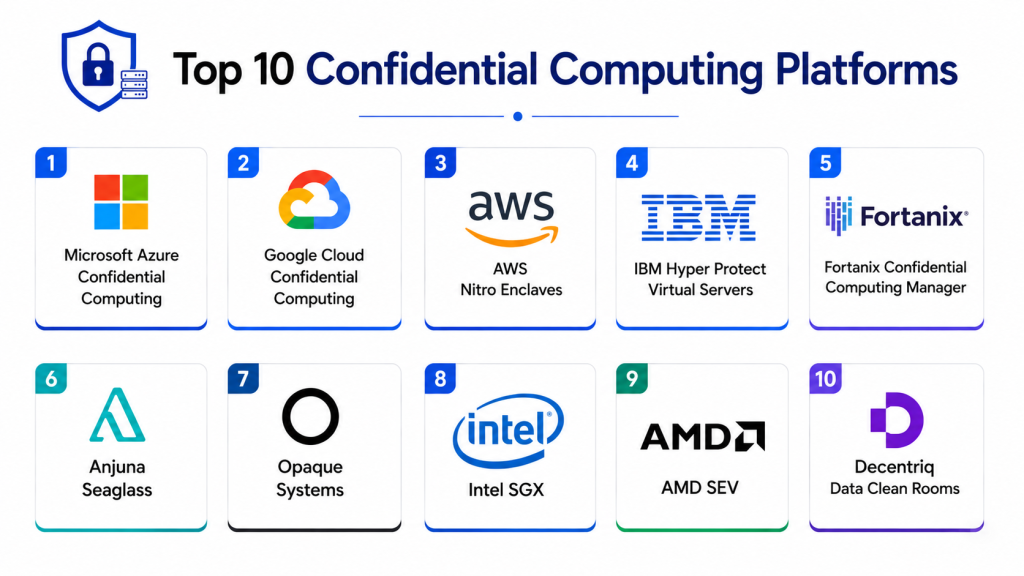
Top 10 Confidential Computing Platforms Tools
1- Microsoft Azure Confidential Computing
Short description: Microsoft Azure Confidential Computing provides secure cloud environments for sensitive workloads using hardware-based isolation technologies. It is commonly used by enterprises running AI, analytics, and regulated cloud applications.
Key Features
- Confidential virtual machines
- Intel SGX support
- AMD SEV-SNP integration
- Secure enclave protection
- Confidential Kubernetes support
- Attestation services
- AI workload protection
Pros
- Deep integration with Microsoft ecosystem
- Strong enterprise security tooling
- Mature cloud-native capabilities
Cons
- Azure-focused architecture
- Advanced deployments may require specialized expertise
- Higher costs for large secure workloads
Platforms / Deployment
- Cloud / Hybrid
Security & Compliance
Supports encryption, RBAC, audit logging, identity integration, attestation services, and enterprise cloud security controls.
Integrations & Ecosystem
Azure integrates well with enterprise infrastructure, AI systems, and DevSecOps workflows.
- Azure Kubernetes Service
- Microsoft Defender
- Azure Key Vault
- GitHub
- Enterprise AI services
Support & Community
Microsoft provides enterprise-grade documentation, onboarding programs, certification resources, and global support services.
2- Google Cloud Confidential Computing
Short description: Google Cloud Confidential Computing helps organizations secure sensitive cloud workloads with hardware-isolated processing environments. It is widely adopted for analytics, AI, and collaborative data processing use cases.
Key Features
- Confidential virtual machines
- Confidential Kubernetes nodes
- AMD SEV technology
- Secure collaborative analytics
- Built-in attestation
- Confidential AI support
- Secure workload isolation
Pros
- Strong AI and analytics ecosystem
- Kubernetes-native architecture
- Good cloud scalability
Cons
- Primarily optimized for Google Cloud
- Advanced configurations can be complex
- Smaller enterprise ecosystem than some competitors
Platforms / Deployment
- Cloud
Security & Compliance
Supports encryption, IAM controls, workload attestation, audit logging, and cloud security governance features.
Integrations & Ecosystem
Google Cloud integrates strongly with analytics and AI platforms.
- Google Kubernetes Engine
- Vertex AI
- BigQuery
- Cloud Key Management
- TensorFlow ecosystem
Support & Community
Strong documentation and growing enterprise support ecosystem for cloud-native deployments.
3- AWS Nitro Enclaves
Short description: AWS Nitro Enclaves provides isolated compute environments within Amazon EC2 infrastructure for highly sensitive workloads and cryptographic processing tasks.
Key Features
- Isolated enclave environments
- AWS Nitro architecture
- Secure cryptographic operations
- Attestation capabilities
- KMS integration
- Lightweight workload isolation
- Secure key handling
Pros
- Tight AWS integration
- Strong cloud-native isolation
- Good for financial workloads
Cons
- AWS-only deployment model
- Less flexible for general application workloads
- Requires cloud engineering expertise
Platforms / Deployment
- Cloud
Security & Compliance
Supports encryption, IAM integration, attestation, workload isolation, and enterprise AWS security services.
Integrations & Ecosystem
AWS Nitro Enclaves integrates deeply with AWS infrastructure and cloud-native security tooling.
- AWS KMS
- Amazon EC2
- AWS Lambda
- CloudWatch
- IAM services
Support & Community
AWS provides extensive technical resources and strong enterprise cloud support programs.
4- IBM Hyper Protect Virtual Servers
Short description: IBM Hyper Protect Virtual Servers delivers confidential cloud infrastructure optimized for highly regulated industries including finance, healthcare, and government operations.
Key Features
- Secure enclave architecture
- Encryption throughout workload lifecycle
- LinuxONE integration
- Confidential container support
- Enterprise workload isolation
- Secure cloud hosting
- Compliance-oriented infrastructure
Pros
- Strong regulated-industry focus
- Enterprise-grade security posture
- Reliable hybrid cloud capabilities
Cons
- Smaller ecosystem than hyperscale cloud providers
- More specialized deployment requirements
- Less developer-focused tooling
Platforms / Deployment
- Cloud / Hybrid
Security & Compliance
Supports encryption, identity controls, workload isolation, attestation, and enterprise governance capabilities.
Integrations & Ecosystem
IBM integrates with enterprise infrastructure and hybrid cloud systems.
- Red Hat OpenShift
- IBM Cloud
- LinuxONE
- Enterprise middleware
- Security orchestration platforms
Support & Community
IBM provides enterprise consulting, onboarding assistance, and industry-focused implementation guidance.
5- Fortanix Confidential Computing Manager
Short description: Fortanix provides centralized confidential workload management across multiple cloud providers and hardware architectures. It is widely used for encryption management and secure workload orchestration.
Key Features
- Multi-cloud confidential computing
- Centralized workload management
- Secure key management
- Hardware enclave support
- Runtime workload protection
- Confidential containers
- Enterprise encryption controls
Pros
- Strong multi-cloud support
- Broad hardware compatibility
- Advanced encryption management
Cons
- Enterprise-oriented pricing
- Complex deployments for smaller teams
- Requires security expertise
Platforms / Deployment
- Cloud / Self-hosted / Hybrid
Security & Compliance
Supports RBAC, encryption lifecycle management, audit logging, and enterprise security governance.
Integrations & Ecosystem
Fortanix integrates with cloud-native infrastructure and enterprise encryption systems.
- Kubernetes
- VMware
- AWS
- Azure
- Google Cloud
Support & Community
Provides enterprise onboarding support and detailed technical documentation for security teams.
6- Anjuna Seaglass
Short description: Anjuna Seaglass enables organizations to secure applications inside confidential computing environments with minimal application modification requirements.
Key Features
- Secure application isolation
- Multi-cloud workload support
- Runtime encryption
- Intel SGX compatibility
- Lift-and-shift deployment approach
- Cloud-native integration
- Confidential application execution
Pros
- Easier migration for existing workloads
- Flexible deployment options
- Strong runtime protection
Cons
- Smaller vendor ecosystem
- Limited community adoption
- Advanced implementations may require vendor support
Platforms / Deployment
- Cloud / Hybrid
Security & Compliance
Supports workload encryption, attestation, runtime isolation, and secure workload governance.
Integrations & Ecosystem
Anjuna integrates with enterprise cloud and orchestration infrastructure.
- Kubernetes
- AWS
- Azure
- Google Cloud
- Intel SGX infrastructure
Support & Community
Vendor support quality is strong, though the community ecosystem is smaller than larger cloud vendors.
7- Opaque Systems
Short description: Opaque Systems focuses on privacy-preserving analytics and secure AI collaboration using confidential computing technologies for regulated and sensitive environments.
Key Features
- Confidential analytics
- Secure collaborative AI
- Privacy-preserving computation
- Confidential Spark processing
- Secure data collaboration
- Enterprise governance controls
- Multi-party analytics
Pros
- Strong analytics specialization
- Excellent for secure collaboration
- Useful for regulated AI workloads
Cons
- Narrower infrastructure focus
- Smaller enterprise ecosystem
- Primarily analytics-oriented
Platforms / Deployment
- Cloud / Hybrid
Security & Compliance
Supports workload encryption, enclave processing, attestation, and privacy-oriented security controls.
Integrations & Ecosystem
Opaque integrates with analytics and data engineering platforms.
- Apache Spark
- Kubernetes
- AWS
- Azure
- Enterprise analytics systems
Support & Community
Growing ecosystem among analytics and data science teams focused on secure collaboration.
8- Intel SGX
Short description: Intel SGX is a hardware-based enclave technology that powers many confidential computing environments and secure application architectures.
Key Features
- Hardware secure enclaves
- Secure memory isolation
- Attestation support
- Developer SDKs
- Secure application execution
- Cryptographic protections
- Trusted execution environments
Pros
- Widely adopted enclave technology
- Strong developer ecosystem
- Mature hardware security architecture
Cons
- Requires compatible hardware
- Complex application development
- Performance overhead for some workloads
Platforms / Deployment
- Windows / Linux / Cloud
Security & Compliance
Supports hardware-level workload isolation, attestation, and secure memory protection.
Integrations & Ecosystem
Intel SGX is integrated into many enterprise confidential computing platforms.
- Kubernetes
- Azure
- IBM Cloud
- Enterprise SDKs
- AI frameworks
Support & Community
Large technical community and extensive research ecosystem around secure enclave development.
9- AMD SEV
Short description: AMD Secure Encrypted Virtualization SEV provides hardware-based memory encryption for virtual machines and confidential cloud workloads.
Key Features
- Virtual machine memory encryption
- Hardware workload isolation
- Secure nested paging
- Confidential virtual machine support
- Hypervisor protection
- Cloud-native virtualization
- Enterprise virtualization security
Pros
- Strong virtualization security
- Broad cloud adoption
- Efficient workload protection
Cons
- Hardware dependency requirements
- Less granular than enclave-focused solutions
- Evolving ecosystem maturity
Platforms / Deployment
- Linux / Cloud / Hybrid
Security & Compliance
Supports encrypted virtualization, secure memory isolation, and confidential infrastructure protections.
Integrations & Ecosystem
AMD SEV integrates across cloud and virtualization environments.
- Azure
- Google Cloud
- VMware
- OpenShift
- Kubernetes
Support & Community
Growing enterprise adoption and strong support from cloud infrastructure providers.
10- Decentriq Data Clean Rooms
Short description: Decentriq specializes in secure data collaboration environments powered by confidential computing infrastructure and privacy-focused analytics controls.
Key Features
- Secure data clean rooms
- Privacy-preserving analytics
- Confidential collaboration
- Secure cross-company data sharing
- Access governance controls
- Confidential analytics environments
- Enterprise data protection
Pros
- Strong privacy collaboration capabilities
- Good for regulated partnerships
- Simplified secure analytics workflows
Cons
- Specialized use cases
- Smaller infrastructure ecosystem
- Limited general-purpose deployment flexibility
Platforms / Deployment
- Cloud
Security & Compliance
Supports encryption, access controls, privacy governance, and secure analytics protections.
Integrations & Ecosystem
Decentriq integrates with analytics and enterprise data collaboration systems.
- Snowflake
- Data warehouses
- Analytics platforms
- Governance tools
- Secure collaboration systems
Support & Community
Provides enterprise onboarding support and customer guidance for privacy-focused deployments.
Comparison Table
| Tool Name | Best For | Platform(s) Supported | Deployment | Standout Feature | Public Rating |
|---|---|---|---|---|---|
| Microsoft Azure Confidential Computing | Enterprise AI security | Cloud / Hybrid | Hybrid | Confidential AI workloads | N/A |
| Google Cloud Confidential Computing | Secure analytics | Cloud | Cloud | Confidential collaborative processing | N/A |
| AWS Nitro Enclaves | Cryptographic isolation | Cloud | Cloud | Lightweight enclave environments | N/A |
| IBM Hyper Protect Virtual Servers | Regulated industries | Cloud / Hybrid | Hybrid | LinuxONE-backed security | N/A |
| Fortanix Confidential Computing Manager | Multi-cloud security | Cloud / Hybrid | Hybrid | Centralized workload orchestration | N/A |
| Anjuna Seaglass | Secure workload migration | Cloud / Hybrid | Hybrid | Minimal application changes | N/A |
| Opaque Systems | Privacy-preserving analytics | Cloud / Hybrid | Hybrid | Secure collaborative analytics | N/A |
| Intel SGX | Secure enclave development | Windows / Linux | Hybrid | Hardware trusted execution | N/A |
| AMD SEV | Secure virtualization | Linux / Cloud | Hybrid | VM memory encryption | N/A |
| Decentriq Data Clean Rooms | Secure data collaboration | Cloud | Cloud | Privacy-focused clean rooms | N/A |
Evaluation & Scoring of Confidential Computing Platforms
| Tool Name | Core 25% | Ease 15% | Integrations 15% | Security 10% | Performance 10% | Support 10% | Value 15% | Weighted Total |
|---|---|---|---|---|---|---|---|---|
| Microsoft Azure Confidential Computing | 9 | 8 | 9 | 9 | 8 | 9 | 7 | 8.5 |
| Google Cloud Confidential Computing | 8 | 8 | 8 | 9 | 8 | 8 | 7 | 8.0 |
| AWS Nitro Enclaves | 8 | 7 | 9 | 9 | 8 | 9 | 7 | 8.1 |
| IBM Hyper Protect Virtual Servers | 8 | 6 | 7 | 9 | 8 | 8 | 6 | 7.5 |
| Fortanix Confidential Computing Manager | 8 | 7 | 8 | 9 | 8 | 8 | 7 | 7.9 |
| Anjuna Seaglass | 7 | 8 | 7 | 8 | 7 | 7 | 7 | 7.3 |
| Opaque Systems | 8 | 7 | 7 | 8 | 7 | 7 | 7 | 7.4 |
| Intel SGX | 9 | 5 | 8 | 9 | 7 | 8 | 7 | 7.7 |
| AMD SEV | 8 | 7 | 8 | 8 | 8 | 7 | 8 | 7.8 |
| Decentriq Data Clean Rooms | 7 | 8 | 7 | 8 | 7 | 7 | 7 | 7.3 |
These scores are designed for comparative evaluation rather than absolute rankings. Some tools focus heavily on infrastructure-level protection while others specialize in analytics or secure collaboration. Organizations should evaluate platforms based on workload sensitivity, deployment model, cloud strategy, and operational expertise requirements.
Which Confidential Computing Platforms Tool Is Right for You?
Solo / Freelancer
Individual developers and small consulting teams may benefit from Intel SGX or lightweight AWS Nitro Enclaves deployments when experimenting with secure applications or privacy-focused AI projects.
SMB
Small and medium-sized businesses usually gain the most value from managed services such as Google Cloud Confidential Computing or Azure Confidential Computing because they reduce operational complexity.
Mid-Market
Mid-market organizations often require stronger hybrid cloud flexibility and governance capabilities. Fortanix and Anjuna provide balanced multi-cloud security and centralized management.
Enterprise
Large enterprises with regulated workloads should prioritize Azure Confidential Computing, IBM Hyper Protect Virtual Servers, or AWS Nitro Enclaves depending on existing cloud investments and compliance requirements.
Budget vs Premium
Cloud-native confidential computing services can reduce infrastructure management costs, while premium enterprise platforms deliver more advanced governance, compliance, and workload orchestration capabilities.
Feature Depth vs Ease of Use
Low-level enclave technologies such as Intel SGX provide extensive flexibility but require specialized expertise. Managed cloud offerings generally provide faster onboarding and easier administration.
Integrations & Scalability
Organizations with large Kubernetes, AI, or multi-cloud deployments should prioritize platforms with mature orchestration ecosystems and API support.
Security & Compliance Needs
Highly regulated industries should focus on attestation, encryption lifecycle management, audit logging, and sovereign cloud support when selecting a platform.
Frequently Asked Questions FAQs
1- What is confidential computing?
Confidential computing protects sensitive data while it is actively being processed inside memory. It uses hardware-isolated secure environments to reduce exposure to insider threats and advanced attacks.
2- Why is confidential computing important for AI?
AI systems often process sensitive datasets and proprietary models. Confidential computing helps secure model training, inference, and collaborative AI workflows from unauthorized access.
3- Is confidential computing only for large enterprises?
No. Smaller organizations with sensitive workloads, regulated data, or privacy-focused applications can also benefit from managed confidential computing services.
4- Does confidential computing affect performance?
Some workload overhead can occur because of encryption and isolation mechanisms. However, modern hardware acceleration has significantly improved performance efficiency.
5- What is a Trusted Execution Environment?
A Trusted Execution Environment is a secure hardware-isolated area where applications can safely process sensitive data without external interference.
6- Which industries use confidential computing the most?
Financial services, healthcare, government, defense, telecommunications, and AI-focused enterprises are among the largest adopters of confidential computing technologies.
7- Can confidential computing work across multiple clouds?
Yes. Several vendors support hybrid and multi-cloud deployments, allowing organizations to secure workloads across AWS, Azure, Google Cloud, and on-premises environments.
8- What is workload attestation?
Attestation verifies that workloads are running inside trusted secure environments before sensitive data or cryptographic keys are released.
9- How difficult is confidential computing adoption?
Complexity depends on the platform and workload type. Managed cloud services are generally easier to deploy than low-level enclave development environments.
10- What should organizations evaluate before choosing a platform?
Organizations should evaluate security architecture, cloud compatibility, integration ecosystem, compliance capabilities, scalability, AI readiness, and operational visibility before selecting a platform.
Conclusion
Confidential Computing Platforms are becoming a critical part of modern cloud security, AI governance, and privacy-focused infrastructure strategies. As organizations process increasing amounts of sensitive information across distributed cloud environments, traditional encryption alone is no longer sufficient for advanced threat protection. Platforms such as Microsoft Azure Confidential Computing, Google Cloud Confidential Computing, AWS Nitro Enclaves, and IBM Hyper Protect Virtual Servers provide strong enterprise-grade workload isolation and secure processing capabilities, while vendors like Fortanix, Opaque Systems, and Decentriq focus on secure analytics, collaboration, and multi-cloud orchestration. The best platform depends heavily on workload requirements, compliance obligations, deployment preferences, and existing cloud investments. Enterprises focused on AI security and regulated environments may prioritize hyperscale cloud ecosystems, while organizations seeking secure collaboration and privacy-preserving analytics may prefer specialized vendors. Before committing to a long-term deployment, organizations should shortlist a few platforms, test real workloads, validate integrations, and carefully evaluate operational complexity, scalability, and security requirements.