Introduction
Semantic Search Platforms help organizations deliver search results based on meaning, intent, context, and relationships rather than simple keyword matching. These platforms use vector embeddings, natural language processing, machine learning, knowledge graphs, and hybrid search techniques to understand what users are actually looking for, even when they do not use exact terms.
As AI applications, enterprise search, product discovery, support portals, and retrieval-augmented generation systems become more important, semantic search has become a core capability for modern digital platforms. It helps users find relevant answers faster, improves search accuracy, supports conversational AI, and reduces friction across customer and employee experiences.
Real-world use cases include:
- Enterprise document and knowledge search
- AI chatbot and RAG retrieval systems
- E-commerce product discovery
- Customer support knowledge base search
- Legal, healthcare, and research document discovery
Buyers evaluating Semantic Search Platforms should consider:
- Vector search and hybrid search capabilities
- Keyword and semantic ranking support
- Natural language query understanding
- Metadata filtering and faceted search
- AI and RAG integration
- Scalability and latency performance
- Security and access controls
- Connectors and API ecosystem
- Relevance tuning and analytics
- Deployment flexibility and cost structure
Best for: AI engineering teams, search product teams, data teams, enterprise IT teams, e-commerce teams, customer support teams, knowledge management teams, and organizations building AI-powered search or RAG applications.
Not ideal for: Very small websites with simple keyword search needs, teams without enough content volume to justify semantic infrastructure, or organizations that only need basic database lookup functionality.
Key Trends in Semantic Search Platforms
- Hybrid search is becoming the default approach because it combines semantic vectors with keyword precision.
- RAG applications are increasing demand for reliable semantic retrieval systems.
- Vector databases and traditional search engines are converging into unified search stacks.
- Metadata-aware semantic filtering is becoming critical for enterprise search accuracy.
- Knowledge graphs are being combined with semantic search for better contextual reasoning.
- Search relevance tuning is becoming more automated through machine learning.
- Multimodal search across text, images, audio, and documents is expanding.
- Permission-aware enterprise search is becoming essential for workplace AI tools.
- Cloud-native vector indexing is improving scalability and deployment speed.
- Observability for search quality, query behavior, and retrieval performance is becoming a key buying factor.
How We Selected These Tools
The tools in this list were selected based on semantic search depth, enterprise adoption, AI integration, scalability, relevance controls, developer experience, and ecosystem maturity.
Selection criteria included:
- Semantic and vector search capabilities
- Hybrid search and keyword ranking support
- Relevance tuning and query understanding
- Enterprise connectors and APIs
- Security and governance controls
- RAG and AI application compatibility
- Search performance and scalability
- Cloud and self-hosted deployment options
- Documentation and developer ecosystem
- Suitability for enterprise, product, e-commerce, and AI search workloads
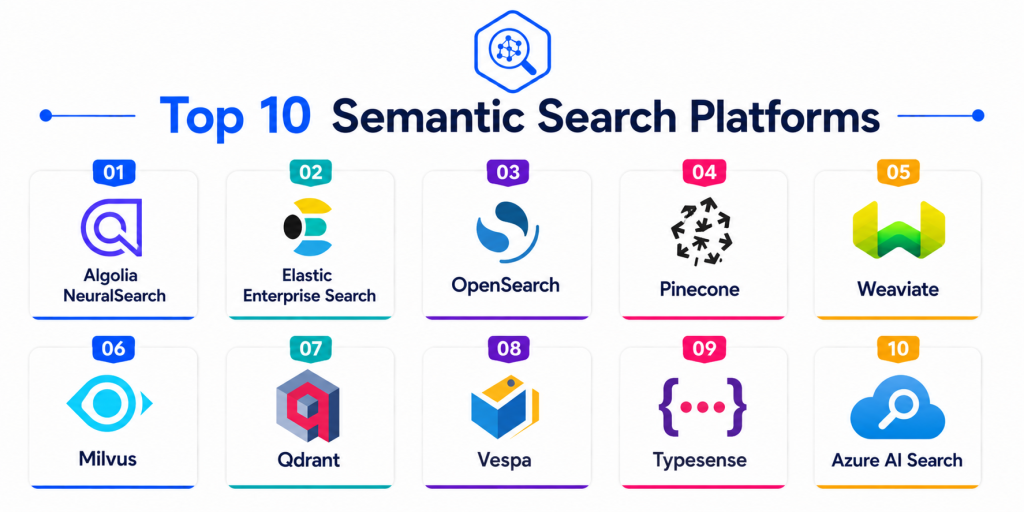
Top 10 Semantic Search Platforms
1- Elasticsearch
Short description: Elasticsearch is a highly flexible search and analytics platform used for keyword search, vector search, hybrid retrieval, observability search, enterprise search, and AI-powered relevance workflows. It is widely adopted by developers and enterprises that need customizable search infrastructure at scale.
Key Features
- Full-text keyword search
- Dense vector search support
- Hybrid search capabilities
- Relevance tuning controls
- Real-time indexing
- Search analytics dashboards
- Scalable distributed architecture
Pros
- Highly flexible and customizable
- Strong developer and enterprise ecosystem
- Good for hybrid keyword and semantic retrieval
Cons
- Requires technical expertise to tune well
- Infrastructure costs can grow at scale
- Complex deployments need experienced administrators
Platforms / Deployment
- Linux / Windows / macOS / Kubernetes
- Cloud / Self-hosted / Hybrid
Security & Compliance
- RBAC
- SSO integration
- Encryption
- Audit logging
- Role-based index controls
- Security features vary by deployment and plan
Integrations & Ecosystem
Elasticsearch integrates with application stacks, observability tools, AI systems, and enterprise data platforms.
- Kibana
- Logstash
- Beats
- Cloud platforms
- Python and Java clients
- AI and RAG frameworks
Support & Community
Large global developer community, strong documentation, enterprise support options, and broad ecosystem adoption.
2- Algolia
Short description: Algolia is a hosted search API platform focused on fast, relevant search experiences for websites, applications, e-commerce platforms, marketplaces, and digital products. It supports semantic and AI-powered discovery features alongside traditional relevance controls.
Key Features
- Hosted search API
- Semantic search capabilities
- Typo tolerance
- Faceted filtering
- Personalization support
- Relevance tuning
- Fast indexing and response performance
Pros
- Very fast search experience
- Easy developer implementation
- Strong e-commerce and product discovery fit
Cons
- Less flexible than self-managed search engines
- Pricing can scale with usage
- Advanced enterprise customization may require planning
Platforms / Deployment
- Web / APIs / JavaScript / Mobile applications
- Cloud
Security & Compliance
- API key controls
- Encryption
- SSO support varies by plan
- Access controls
- Audit features vary by plan
Integrations & Ecosystem
Algolia integrates with web, commerce, and application development ecosystems.
- Shopify
- Salesforce Commerce Cloud
- JavaScript frameworks
- Mobile SDKs
- CMS platforms
- APIs
Support & Community
Strong developer documentation, implementation guides, support plans, and broad product search adoption.
3- Coveo
Short description: Coveo is an enterprise semantic search and AI relevance platform designed for workplace search, customer support search, commerce discovery, knowledge management, and personalized digital experiences.
Key Features
- AI-powered relevance
- Enterprise content connectors
- Semantic search
- Personalized search results
- Customer support search
- Commerce search
- Analytics and relevance reporting
Pros
- Strong enterprise search capabilities
- Good personalization and relevance tuning
- Useful for support, commerce, and workplace search
Cons
- Enterprise pricing model
- Implementation can require planning
- Best value in content-rich environments
Platforms / Deployment
- Web / Enterprise applications / APIs
- Cloud / Hybrid
Security & Compliance
- SSO
- RBAC
- Encryption
- Audit logging
- Permission-aware search controls
- Compliance support varies by deployment
Integrations & Ecosystem
Coveo integrates with enterprise content, commerce, and support ecosystems.
- Salesforce
- ServiceNow
- Sitecore
- Adobe Experience Manager
- Microsoft environments
- APIs
Support & Community
Strong enterprise support, onboarding guidance, documentation, and implementation partner ecosystem.
4- Glean
Short description: Glean is an enterprise AI search platform focused on helping employees search across workplace applications, documents, conversations, tickets, and internal knowledge systems with permission-aware relevance.
Key Features
- Workplace semantic search
- Enterprise connectors
- Permission-aware retrieval
- AI answer generation
- Personalized relevance
- Knowledge discovery
- Search analytics
Pros
- Strong workplace search experience
- Good enterprise connector ecosystem
- Permission-aware search is valuable for internal AI
Cons
- Primarily focused on workplace search
- Less suitable for public product search
- Enterprise deployment requires access governance planning
Platforms / Deployment
- Web / Browser / Enterprise applications
- Cloud
Security & Compliance
- SSO
- RBAC
- Encryption
- Audit logging
- Permission-aware access controls
- Enterprise security controls
Integrations & Ecosystem
Glean integrates with common workplace and collaboration systems.
- Google Workspace
- Microsoft 365
- Slack
- Jira
- Confluence
- Salesforce
Support & Community
Enterprise onboarding, documentation, customer success support, and growing workplace AI ecosystem adoption.
5- Pinecone
Short description: Pinecone is a managed vector database platform designed for semantic search, recommendation systems, AI retrieval, and RAG applications. It is popular among AI teams building applications that need fast vector similarity search at scale.
Key Features
- Managed vector search
- Semantic similarity retrieval
- Metadata filtering
- Scalable vector indexing
- Low-latency search APIs
- RAG application support
- Serverless deployment options
Pros
- Strong AI and RAG developer experience
- Managed infrastructure reduces operational overhead
- Good scalability for vector workloads
Cons
- Primarily vector-focused
- Hybrid search may require additional design
- Costs depend on scale and usage patterns
Platforms / Deployment
- APIs / Cloud infrastructure
- Cloud
Security & Compliance
- API authentication
- Encryption
- Access controls
- Audit and enterprise security features vary by plan
Integrations & Ecosystem
Pinecone integrates with AI development and RAG ecosystems.
- LangChain
- LlamaIndex
- OpenAI-compatible workflows
- Python SDKs
- Cloud platforms
- AI application frameworks
Support & Community
Strong AI developer ecosystem, documentation, tutorials, and managed support options.
6- Weaviate
Short description: Weaviate is an open-source vector database and semantic search platform that supports vector search, hybrid search, schema-based data modeling, and AI-native application development.
Key Features
- Vector search
- Hybrid keyword and vector search
- Semantic data modeling
- Graph-like relationships
- Modular AI integrations
- Metadata filtering
- Cloud and self-hosted options
Pros
- Open-source flexibility
- Strong semantic search capabilities
- Good AI-native developer ecosystem
Cons
- Requires architecture planning at scale
- Operational tuning needed for self-hosting
- Enterprise governance depends on deployment model
Platforms / Deployment
- Linux / Docker / Kubernetes
- Cloud / Self-hosted / Hybrid
Security & Compliance
- Authentication support
- Authorization controls
- Encryption support
- API security
- Enterprise features vary by deployment
Integrations & Ecosystem
Weaviate integrates with AI models, vector workflows, and application development stacks.
- LangChain
- LlamaIndex
- Hugging Face
- OpenAI-compatible workflows
- Kubernetes
- APIs
Support & Community
Active open-source community, developer documentation, and commercial support options.
7- Azure AI Search
Short description: Azure AI Search is a Microsoft cloud search service for building enterprise search, semantic search, vector search, and AI-enriched retrieval experiences across business applications and content repositories.
Key Features
- Full-text search
- Vector search
- Semantic ranking
- AI enrichment
- Faceted filtering
- Document indexing
- Enterprise search APIs
Pros
- Strong Microsoft ecosystem integration
- Good AI enrichment capabilities
- Managed cloud infrastructure
Cons
- Best suited for Azure environments
- Advanced ranking requires tuning
- Cost management needs planning at scale
Platforms / Deployment
- Azure Cloud / APIs / Enterprise applications
- Cloud
Security & Compliance
- Microsoft Entra ID integration
- RBAC
- Encryption
- Audit logging
- Network controls
- Compliance support
Integrations & Ecosystem
Azure AI Search integrates with Microsoft cloud, AI, and enterprise data environments.
- Azure OpenAI workflows
- Azure Blob Storage
- Azure SQL
- Power Platform
- Microsoft 365 ecosystems
- APIs
Support & Community
Strong Microsoft documentation, enterprise support, partner ecosystem, and cloud AI adoption.
8- Amazon OpenSearch Service
Short description: Amazon OpenSearch Service is a managed search and analytics platform used for full-text search, vector search, log analytics, semantic retrieval, and AI-powered application search on AWS.
Key Features
- Full-text search
- Vector search support
- k-nearest neighbor search
- Search dashboards
- Managed cluster operations
- Observability search
- Hybrid retrieval patterns
Pros
- Strong AWS ecosystem integration
- Managed search infrastructure
- Good fit for AWS-native applications
Cons
- Best suited for AWS environments
- Tuning and scaling still require expertise
- Semantic features may require additional model integration
Platforms / Deployment
- AWS Cloud / APIs / Application infrastructure
- Cloud
Security & Compliance
- IAM integration
- Encryption
- Audit logging
- Network isolation
- RBAC-style access controls
- Compliance support
Integrations & Ecosystem
OpenSearch integrates with AWS analytics, security, and AI ecosystems.
- AWS Lambda
- Amazon S3
- CloudWatch
- Bedrock workflows
- Log pipelines
- Application APIs
Support & Community
AWS support plans, OpenSearch community resources, and cloud operations documentation are available.
9- Sinequa
Short description: Sinequa is an enterprise search and knowledge discovery platform designed for complex document search, workplace intelligence, regulated industries, and AI-powered knowledge retrieval.
Key Features
- Enterprise semantic search
- Natural language processing
- Knowledge discovery
- Document intelligence
- Permission-aware search
- AI-powered recommendations
- Enterprise connectors
Pros
- Strong enterprise document search capabilities
- Good for regulated and complex content environments
- Useful knowledge discovery workflows
Cons
- Enterprise implementation effort
- Premium pricing model
- Best suited for large organizations
Platforms / Deployment
- Web / Enterprise applications / APIs
- Cloud / Hybrid
Security & Compliance
- SSO
- RBAC
- Encryption
- Audit logging
- Permission-aware search controls
- Compliance support varies by deployment
Integrations & Ecosystem
Sinequa integrates with enterprise content and workplace systems.
- Microsoft environments
- SharePoint
- File systems
- CRM systems
- ECM platforms
- APIs
Support & Community
Enterprise support, implementation services, and knowledge management expertise are available.
10- Vespa
Short description: Vespa is an open-source platform for large-scale search, recommendation, personalization, and real-time AI inference over structured and unstructured data.
Key Features
- Hybrid search
- Vector search
- Ranking model support
- Real-time indexing
- Large-scale serving
- Recommendation workflows
- Machine-learned ranking
Pros
- Strong large-scale serving architecture
- Good for search and recommendation systems
- Open-source flexibility
Cons
- Requires engineering expertise
- Smaller mainstream ecosystem than Elasticsearch
- Operational complexity for beginners
Platforms / Deployment
- Linux / Kubernetes / Cloud infrastructure
- Cloud / Self-hosted / Hybrid
Security & Compliance
- Authentication support
- Encryption support
- Access controls
- Deployment-based security configuration
Integrations & Ecosystem
Vespa integrates with large-scale AI search and recommendation pipelines.
- Kubernetes
- APIs
- Machine learning models
- Data pipelines
- Application backends
- Cloud infrastructure
Support & Community
Open-source community support, technical documentation, and commercial support options are available.
Comparison Table
| Tool Name | Best For | Platforms Supported | Deployment | Standout Feature | Public Rating |
|---|---|---|---|---|---|
| Elasticsearch | Custom hybrid search | Linux / Windows / macOS / Kubernetes | Cloud / Self-hosted / Hybrid | Flexible keyword and vector search | N/A |
| Algolia | Fast product and app search | Web / APIs / Mobile | Cloud | High-speed search APIs | N/A |
| Coveo | Enterprise AI search | Web / Enterprise applications | Cloud / Hybrid | AI-powered relevance personalization | N/A |
| Glean | Workplace knowledge search | Web / Enterprise applications | Cloud | Permission-aware enterprise search | N/A |
| Pinecone | Vector search for AI apps | APIs / Cloud infrastructure | Cloud | Managed vector retrieval | N/A |
| Weaviate | Open-source semantic search | Linux / Docker / Kubernetes | Cloud / Self-hosted / Hybrid | Hybrid vector and keyword search | N/A |
| Azure AI Search | Microsoft AI search apps | Azure Cloud / APIs | Cloud | AI enrichment and semantic ranking | N/A |
| Amazon OpenSearch Service | AWS-native search analytics | AWS Cloud / APIs | Cloud | Managed k-nearest neighbor search | N/A |
| Sinequa | Complex enterprise knowledge search | Web / Enterprise applications | Cloud / Hybrid | Enterprise document intelligence | N/A |
| Vespa | Large-scale search and recommendation | Linux / Kubernetes | Cloud / Self-hosted / Hybrid | Real-time AI ranking at scale | N/A |
Evaluation & Scoring of Semantic Search Platforms
| Tool Name | Core 25% | Ease 15% | Integrations 15% | Security 10% | Performance 10% | Support 10% | Value 15% | Weighted Total |
|---|---|---|---|---|---|---|---|---|
| Elasticsearch | 9.4 | 7.8 | 9.3 | 9.0 | 9.2 | 9.1 | 8.5 | 8.96 |
| Algolia | 8.8 | 9.1 | 8.8 | 8.7 | 9.4 | 8.7 | 8.0 | 8.77 |
| Coveo | 9.1 | 8.1 | 9.0 | 9.1 | 8.9 | 8.8 | 7.8 | 8.70 |
| Glean | 8.9 | 8.8 | 9.1 | 9.2 | 8.7 | 8.7 | 7.9 | 8.75 |
| Pinecone | 8.9 | 8.7 | 8.7 | 8.6 | 9.2 | 8.5 | 8.3 | 8.71 |
| Weaviate | 8.9 | 8.1 | 8.8 | 8.5 | 8.8 | 8.4 | 8.9 | 8.65 |
| Azure AI Search | 8.9 | 8.2 | 9.1 | 9.2 | 8.9 | 8.8 | 8.1 | 8.76 |
| Amazon OpenSearch Service | 8.8 | 7.9 | 9.0 | 9.1 | 8.9 | 8.7 | 8.2 | 8.62 |
| Sinequa | 8.8 | 7.8 | 8.8 | 9.1 | 8.7 | 8.6 | 7.7 | 8.46 |
| Vespa | 9.0 | 7.1 | 8.5 | 8.4 | 9.4 | 8.3 | 8.8 | 8.56 |
These scores are comparative and intended to help organizations evaluate fit rather than choose a universal winner. Developer-first platforms score highly for flexibility and customization, while managed enterprise search platforms score better for usability, connectors, and governance. Buyers should evaluate actual retrieval quality using their own content, metadata, permissions, and query patterns before making a final decision.
Which Semantic Search Platform Is Right for You?
Solo / Freelancer
Independent developers and small AI builders often need flexible search without heavy enterprise overhead. Weaviate, Pinecone, and Elasticsearch are strong options depending on whether the project needs vector-first retrieval, hybrid search, or full search engine flexibility.
SMB
SMBs usually need easy implementation, strong relevance, and manageable administration. Algolia is strong for websites and product search, Pinecone is useful for AI applications, and Azure AI Search works well for Microsoft-based teams.
Mid-Market
Mid-sized organizations often need stronger integrations, analytics, security controls, and hybrid retrieval capabilities. Elasticsearch, Coveo, Weaviate, and Amazon OpenSearch Service are strong options depending on cloud strategy and technical maturity.
Enterprise
Large enterprises typically require permission-aware search, governance, connectors, scalability, relevance analytics, and AI-ready retrieval. Coveo, Glean, Sinequa, Elasticsearch, and Azure AI Search are strong enterprise-focused options.
Budget vs Premium
Open-source and developer-first platforms such as Weaviate, Vespa, and Elasticsearch can reduce licensing costs but require more engineering effort. Enterprise platforms like Coveo, Glean, and Sinequa offer stronger connectors and governance but usually require larger budgets.
Feature Depth vs Ease of Use
Elasticsearch and Vespa provide deep customization and ranking control but need technical expertise. Algolia and Glean are easier to deploy for specific use cases. Pinecone is simpler for vector search but may need additional systems for full hybrid search workflows.
Integrations & Scalability
Organizations already invested in AWS, Azure, Microsoft 365, Salesforce, ServiceNow, or Kubernetes should prioritize platforms aligned with those ecosystems. Strong connectors and permission handling often matter more than raw vector performance in enterprise environments.
Security & Compliance Needs
Security-focused organizations should prioritize SSO, RBAC, audit logs, encryption, permission-aware indexing, tenant isolation, and secure API controls. Enterprise search platforms are often stronger for workplace governance, while developer platforms require careful implementation.
Frequently Asked Questions
1. What is a Semantic Search Platform?
A Semantic Search Platform helps users find information based on meaning, intent, and context instead of relying only on exact keyword matches. It often uses embeddings, natural language processing, vector search, and hybrid ranking.
2. Why is semantic search important?
Semantic search improves relevance when users ask natural language questions, use synonyms, or search across complex documents. It is especially useful for AI chatbots, enterprise knowledge search, product discovery, and support portals.
3. What is hybrid search?
Hybrid search combines keyword search with vector-based semantic search. This helps capture both exact matches and meaning-based relevance, making it more reliable for enterprise and AI retrieval workloads.
4. What is vector search?
Vector search converts text, images, or other data into numerical embeddings and retrieves items that are semantically similar. It is commonly used in RAG systems, recommendations, and AI-powered search.
5. Are semantic search platforms only for AI applications?
No. They are also used for e-commerce search, customer support search, enterprise workplace search, legal discovery, research portals, and product recommendation systems.
6. What are common implementation mistakes?
Common mistakes include relying only on vector search, ignoring metadata filters, skipping relevance testing, weak access controls, poor content chunking, and failing to monitor search quality over time.
7. Can semantic search improve RAG applications?
Yes. Semantic search is often a core retrieval layer for RAG systems. Better retrieval quality can reduce irrelevant context, improve answer accuracy, and make AI assistants more useful.
8. What integrations are most important?
Important integrations include content repositories, databases, cloud storage, identity systems, AI frameworks, analytics tools, CMS platforms, customer support systems, and business applications.
9. Should organizations choose a vector database or full search platform?
A vector database is useful for AI retrieval, while a full search platform may be better when keyword relevance, filters, facets, permissions, analytics, and search UI controls are also important.
10. What should buyers evaluate before selecting a semantic search platform?
Buyers should evaluate retrieval quality, hybrid search support, latency, indexing speed, metadata filtering, connectors, security controls, scalability, relevance tuning, AI integration, and total operating cost.
Conclusion
Semantic Search Platforms are becoming essential for organizations building AI-powered search, RAG systems, enterprise knowledge discovery, e-commerce product discovery, and customer support automation. The right platform can improve relevance, reduce search friction, support natural language queries, and connect users with the right information faster. Elasticsearch remains a strong choice for flexible hybrid search, while Algolia is excellent for fast customer-facing search experiences. Coveo, Glean, and Sinequa provide strong enterprise knowledge search and permission-aware retrieval capabilities, while Pinecone and Weaviate are strong options for vector-first AI applications. Azure AI Search and Amazon OpenSearch Service fit cloud-native teams that want managed search infrastructure, and Vespa supports large-scale search and recommendation workloads. The best choice depends on content type, user experience goals, AI strategy, security requirements, engineering maturity, and budget. Shortlist two or three platforms, test them with real queries and production-like content, validate permission handling and relevance quality, and choose the platform that best supports long-term semantic search and AI retrieval needs.