Introduction
Crypto Tax Tools help individuals, businesses, traders, accountants, and enterprises calculate, track, report, and manage tax obligations related to cryptocurrency transactions, digital assets, NFTs, staking rewards, decentralized finance activities, and tokenized investments. These platforms automate transaction imports, capital gains calculations, wallet reconciliation, tax reporting, portfolio tracking, and compliance workflows across multiple blockchain ecosystems and exchanges.
As crypto adoption expands globally, tax reporting requirements have become significantly more complex. Users now interact with centralized exchanges, decentralized finance protocols, NFT marketplaces, staking systems, and cross-chain transactions that generate large volumes of taxable events. Crypto tax tools help reduce manual reconciliation work while improving reporting accuracy and compliance readiness.
Real-world use cases include:
- Capital gains tax reporting
- Multi-wallet transaction reconciliation
- NFT and DeFi tax calculations
- Enterprise digital asset accounting
- Accountant and CPA crypto reporting workflows
Evaluation Criteria for Buyers
Organizations and users evaluating Crypto Tax Tools should consider:
- Exchange and wallet integrations
- Multi-chain transaction support
- DeFi and NFT tax compatibility
- Reporting accuracy and reconciliation
- Tax jurisdiction coverage
- Portfolio tracking capabilities
- Automation and API support
- Enterprise accounting integrations
- Audit trail and reporting workflows
- Scalability for high transaction volumes
Best for: Crypto traders, investors, accountants, tax professionals, exchanges, Web3 businesses, and enterprises managing digital asset portfolios.
Not ideal for: Users with very limited crypto activity or organizations that only hold digital assets without taxable transaction complexity.
Key Trends in Tax Tools for Crypto
- DeFi and NFT tax reporting capabilities are becoming standard.
- Multi-chain transaction visibility is increasingly important.
- AI-assisted transaction categorization is improving reconciliation accuracy.
- Enterprise crypto accounting integrations are expanding.
- Real-time portfolio and tax estimation features are growing in popularity.
- Governments are increasing digital asset tax enforcement.
- Tax tools are adding support for staking, liquidity pools, and yield farming.
- Cross-border crypto reporting complexity is driving enterprise demand.
- Wallet-based identity and compliance integrations are expanding.
- Institutional digital asset accounting workflows are becoming more advanced.
How We Selected These Tools
The following crypto tax tools were selected based on ecosystem adoption, reporting capabilities, integration depth, and operational usability.
- Broad exchange and wallet support
- Multi-chain blockchain compatibility
- Tax reporting accuracy and flexibility
- DeFi and NFT transaction support
- Enterprise and accountant workflow capabilities
- API and accounting integrations
- User experience and reconciliation tooling
- Reporting scalability
- Ecosystem reputation and adoption
- Support and onboarding quality
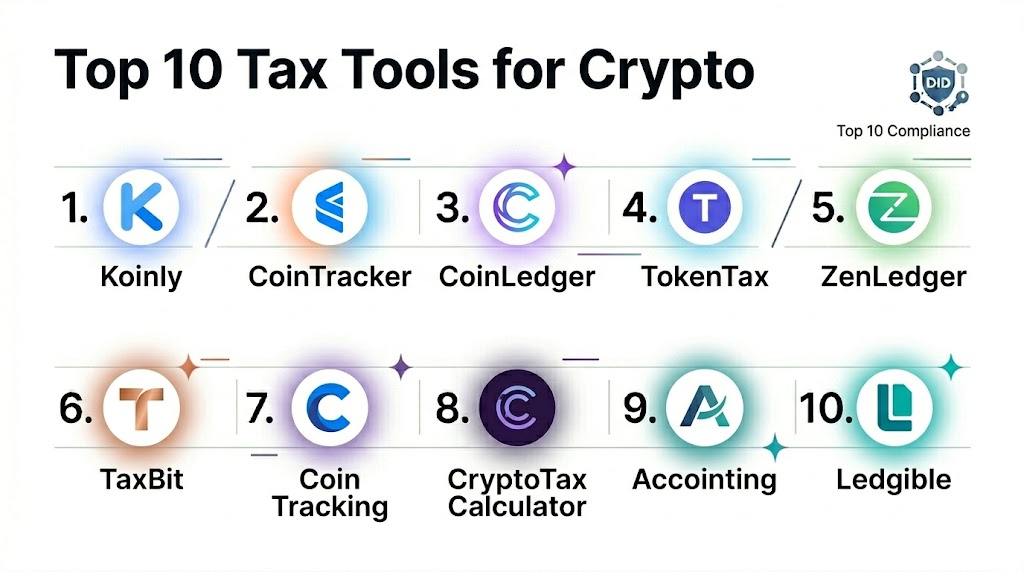
Top 10 Tax Tools for Crypto
1- CoinTracker
Short description: CoinTracker is one of the most widely used crypto tax and portfolio tracking platforms for individual investors, traders, and tax professionals. It supports automated transaction imports and tax reporting across multiple exchanges and wallets.
Key Features
- Automated transaction imports
- Capital gains calculations
- Portfolio tracking
- Multi-wallet support
- NFT and DeFi transaction support
- Tax reporting exports
- Exchange synchronization
Pros
- Strong usability for individuals
- Broad exchange compatibility
- Good portfolio visibility
Cons
- Advanced reconciliation may require manual review
- Premium plans can become expensive
- Complex DeFi workflows may require adjustments
Platforms / Deployment
- Web / Cloud
Security & Compliance
Supports encrypted account connections, authentication protections, and tax reporting workflows.
Integrations & Ecosystem
CoinTracker integrates with exchanges, wallets, and tax reporting systems.
- Coinbase
- Binance
- MetaMask
- Wallet APIs
- Tax filing software
Support & Community
Large retail crypto ecosystem with strong onboarding and documentation resources.
2- Koinly
Short description: Koinly provides crypto tax reporting and portfolio management tools for traders, investors, accountants, and enterprises operating across multiple blockchain ecosystems.
Key Features
- Multi-chain tax reporting
- Exchange and wallet integrations
- NFT and DeFi support
- Capital gains calculations
- Automated transaction imports
- Tax report generation
- Portfolio tracking
Pros
- Broad blockchain compatibility
- Good international tax support
- Strong DeFi coverage
Cons
- Complex transaction reconciliation may require manual review
- Premium pricing for high-volume traders
- Some advanced accounting workflows require expertise
Platforms / Deployment
- Web / Cloud
Security & Compliance
Supports secure API integrations and transaction reporting workflows.
Integrations & Ecosystem
Koinly integrates with exchanges, wallets, and accounting ecosystems.
- Binance
- Kraken
- MetaMask
- Ledger
- Tax reporting systems
Support & Community
Strong global crypto tax community with extensive onboarding content.
3- CoinLedger
Short description: CoinLedger is a crypto tax reporting platform designed for traders, investors, and tax professionals needing automated reconciliation and simplified reporting workflows.
Key Features
- Automated tax calculations
- Portfolio tracking
- Exchange integrations
- DeFi transaction support
- NFT reporting
- Tax-loss harvesting visibility
- Audit-ready reports
Pros
- Easy onboarding experience
- Good reporting usability
- Broad exchange support
Cons
- Enterprise accounting features are more limited
- Complex DeFi workflows may require manual categorization
- Advanced institutional workflows are limited
Platforms / Deployment
- Web / Cloud
Security & Compliance
Supports secure exchange integrations and reporting workflow protections.
Integrations & Ecosystem
CoinLedger integrates with trading platforms and tax reporting ecosystems.
- Coinbase
- Binance
- MetaMask
- Wallet systems
- Tax filing software
Support & Community
Strong user-focused onboarding and support resources for retail and professional users.
4- TokenTax
Short description: TokenTax provides crypto tax automation and accounting support for active traders, enterprises, and high-volume digital asset investors.
Key Features
- Crypto tax automation
- DeFi and NFT support
- Advanced reconciliation workflows
- Tax filing exports
- Accountant collaboration tools
- Multi-exchange integrations
- Enterprise transaction handling
Pros
- Good support for active traders
- Strong accountant collaboration workflows
- Advanced reconciliation support
Cons
- Premium pricing structure
- Complex onboarding for beginners
- Enterprise workflows may require consultation support
Platforms / Deployment
- Web / Cloud
Security & Compliance
Supports secure integrations and tax reporting protections for digital asset workflows.
Integrations & Ecosystem
TokenTax integrates with exchanges and accounting environments.
- Coinbase
- Kraken
- Wallet systems
- Accounting software
- Tax filing workflows
Support & Community
Strong accountant-focused support and enterprise onboarding capabilities.
5- ZenLedger
Short description: ZenLedger is a crypto tax and accounting platform focused on portfolio management, tax reporting, and digital asset compliance workflows.
Key Features
- Crypto tax reporting
- Portfolio management
- Multi-wallet integrations
- NFT and DeFi transaction support
- Tax-loss harvesting visibility
- Accountant reporting workflows
- Transaction reconciliation
Pros
- Good usability for investors
- Strong wallet compatibility
- Useful reporting dashboards
Cons
- Complex DeFi transactions may require review
- Premium features can increase costs
- Large portfolios may require advanced planning
Platforms / Deployment
- Web / Cloud
Security & Compliance
Supports secure exchange integrations and reporting workflow protections.
Integrations & Ecosystem
ZenLedger integrates with exchanges, wallets, and accounting systems.
- Binance
- Coinbase
- Ledger
- Wallet APIs
- Tax reporting tools
Support & Community
Strong onboarding ecosystem for retail investors and tax professionals.
6- CryptoTaxCalculator
Short description: CryptoTaxCalculator provides crypto tax automation and transaction reconciliation for traders, accountants, and enterprises handling complex blockchain activity.
Key Features
- Multi-chain tax calculations
- DeFi transaction support
- NFT tax reporting
- Automated transaction categorization
- Capital gains calculations
- Tax exports
- High-volume transaction handling
Pros
- Strong DeFi transaction support
- Good reconciliation automation
- Useful for active traders
Cons
- Advanced workflows may require review
- Enterprise accounting integration varies
- Premium plans can become costly
Platforms / Deployment
- Web / Cloud
Security & Compliance
Supports secure transaction imports and tax reporting protections.
Integrations & Ecosystem
CryptoTaxCalculator integrates with blockchain ecosystems and exchanges.
- Ethereum wallets
- Binance
- Solana ecosystems
- Accounting exports
- Tax reporting systems
Support & Community
Growing crypto accounting ecosystem with active onboarding support.
7- TaxBit
Short description: TaxBit provides crypto tax reporting and enterprise digital asset accounting infrastructure for institutions, exchanges, and enterprises.
Key Features
- Enterprise crypto accounting
- Automated transaction reporting
- Institutional tax workflows
- Multi-chain compatibility
- Digital asset accounting support
- Audit-ready reporting
- Enterprise reconciliation
Pros
- Strong institutional positioning
- Good enterprise accounting workflows
- Scalable infrastructure
Cons
- Enterprise-oriented deployment
- More complex onboarding
- Premium institutional pricing
Platforms / Deployment
- Cloud
Security & Compliance
Supports enterprise-grade reporting workflows, governance controls, and operational protections.
Integrations & Ecosystem
TaxBit integrates with institutional accounting and digital asset systems.
- Exchanges
- Enterprise accounting systems
- Treasury platforms
- Blockchain APIs
- Institutional reporting systems
Support & Community
Strong enterprise onboarding and institutional accounting support ecosystem.
8- Accointing
Short description: Accointing provides crypto portfolio tracking and tax reporting tools designed for retail investors and active traders.
Key Features
- Portfolio management
- Tax calculations
- Wallet synchronization
- Exchange integrations
- Transaction categorization
- Tax report exports
- Market tracking tools
Pros
- Easy-to-use interface
- Good retail investor workflows
- Useful portfolio analytics
Cons
- Enterprise workflows are limited
- Complex DeFi activity may require manual review
- Advanced accounting integrations are limited
Platforms / Deployment
- Web / Mobile / Cloud
Security & Compliance
Supports secure API integrations and portfolio reporting protections.
Integrations & Ecosystem
Accointing integrates with exchanges, wallets, and portfolio systems.
- Binance
- Coinbase
- Wallet systems
- Mobile portfolio tracking
- Reporting tools
Support & Community
Strong retail investor community with accessible onboarding resources.
9- BearTax
Short description: BearTax is a crypto tax reporting platform focused on transaction imports, tax calculations, and simplified investor reporting workflows.
Key Features
- Automated transaction imports
- Capital gains calculations
- Exchange integrations
- Tax reporting exports
- Portfolio visibility
- Wallet synchronization
- Reporting workflows
Pros
- Simple onboarding
- Good retail usability
- Flexible reporting support
Cons
- Enterprise capabilities are limited
- Complex DeFi reporting may require manual review
- Smaller ecosystem visibility
Platforms / Deployment
- Web / Cloud
Security & Compliance
Supports secure integrations and tax reporting protections.
Integrations & Ecosystem
BearTax integrates with exchanges and portfolio management systems.
- Coinbase
- Binance
- Wallet APIs
- Reporting systems
- Tax workflows
Support & Community
Provides onboarding support and accessible tax reporting documentation.
10- Ledgible
Short description: Ledgible provides enterprise-grade crypto accounting and tax infrastructure for institutions, enterprises, and digital asset finance teams.
Key Features
- Enterprise crypto accounting
- Tax reporting automation
- Multi-entity reporting
- Audit-ready workflows
- Institutional reconciliation
- Blockchain transaction tracking
- Accounting integrations
Pros
- Strong enterprise accounting support
- Good audit and reconciliation workflows
- Institutional scalability
Cons
- Enterprise-focused complexity
- Premium infrastructure pricing
- Less suitable for casual investors
Platforms / Deployment
- Cloud / Hybrid
Security & Compliance
Supports enterprise accounting governance, auditability, and reporting protections.
Integrations & Ecosystem
Ledgible integrates with accounting and institutional finance systems.
- ERP systems
- Accounting software
- Exchanges
- Blockchain APIs
- Treasury systems
Support & Community
Strong enterprise onboarding and institutional finance support ecosystem.
Comparison Table
| Tool Name | Best For | Platform(s) Supported | Deployment | Standout Feature | Public Rating |
|---|---|---|---|---|---|
| CoinTracker | Portfolio and tax tracking | Web / Cloud | Cloud | Strong portfolio visibility | N/A |
| Koinly | Multi-chain crypto taxes | Web / Cloud | Cloud | Broad blockchain support | N/A |
| CoinLedger | Simplified tax workflows | Web / Cloud | Cloud | User-friendly reporting | N/A |
| TokenTax | High-volume traders | Web / Cloud | Cloud | Advanced reconciliation support | N/A |
| ZenLedger | Investor tax management | Web / Cloud | Cloud | Strong reporting dashboards | N/A |
| CryptoTaxCalculator | DeFi tax automation | Web / Cloud | Cloud | Complex DeFi support | N/A |
| TaxBit | Institutional accounting | Cloud | Cloud | Enterprise crypto accounting | N/A |
| Accointing | Retail portfolio tracking | Web / Mobile | Cloud | Portfolio analytics | N/A |
| BearTax | Simple tax reporting | Web / Cloud | Cloud | Easy onboarding | N/A |
| Ledgible | Enterprise crypto accounting | Cloud / Hybrid | Hybrid | Institutional audit workflows | N/A |
Evaluation & Scoring of Tax Tools for Crypto
| Tool Name | Core 25% | Ease 15% | Integrations 15% | Security 10% | Performance 10% | Support 10% | Value 15% | Weighted Total |
|---|---|---|---|---|---|---|---|---|
| CoinTracker | 9 | 9 | 9 | 8 | 8 | 8 | 7 | 8.4 |
| Koinly | 9 | 8 | 9 | 8 | 8 | 8 | 8 | 8.4 |
| CoinLedger | 8 | 9 | 8 | 8 | 8 | 8 | 8 | 8.1 |
| TokenTax | 9 | 7 | 8 | 8 | 8 | 8 | 7 | 7.9 |
| ZenLedger | 8 | 8 | 8 | 8 | 8 | 8 | 8 | 8.0 |
| CryptoTaxCalculator | 8 | 8 | 8 | 8 | 8 | 7 | 8 | 7.9 |
| TaxBit | 9 | 7 | 8 | 9 | 8 | 8 | 7 | 8.0 |
| Accointing | 8 | 9 | 7 | 7 | 8 | 7 | 8 | 7.8 |
| BearTax | 7 | 8 | 7 | 7 | 7 | 7 | 8 | 7.3 |
| Ledgible | 9 | 7 | 8 | 9 | 8 | 8 | 7 | 8.0 |
These scores are comparative evaluations intended to help users and organizations understand relative strengths across crypto tax ecosystems. Some tools prioritize retail usability and portfolio visibility, while others focus more heavily on enterprise accounting, auditability, and institutional reporting workflows.
Which Tax Tool for Crypto Is Right for You?
Solo / Freelancer
Individual investors and casual traders may benefit most from CoinTracker, Koinly, Accointing, or CoinLedger because of their strong usability and portfolio tracking capabilities.
SMB
Small and medium-sized crypto businesses should evaluate ZenLedger, CryptoTaxCalculator, or TokenTax for stronger reconciliation and reporting workflows.
Mid-Market
Mid-market organizations handling complex DeFi activity or accounting requirements should prioritize TokenTax, TaxBit, or Ledgible.
Enterprise
Large enterprises and institutional finance teams should focus on TaxBit, Ledgible, or enterprise-grade accounting and audit platforms.
Budget vs Premium
Retail-focused tax tools are often easier to adopt but may struggle with highly complex transaction workflows. Enterprise-grade solutions provide stronger scalability and governance at higher operational cost.
Feature Depth vs Ease of Use
Simpler tax platforms prioritize onboarding and reporting automation, while advanced enterprise tools focus more heavily on auditability, reconciliation, and accounting integration.
Integrations & Scalability
Organizations with multiple exchanges, wallets, and high-volume blockchain activity should prioritize platforms with strong API integrations and automated reconciliation support.
Security & Compliance Needs
Institutional organizations should focus on governance controls, reporting auditability, accounting integrations, and secure operational workflows before selecting a platform.
Frequently Asked Questions FAQs
1- What are Crypto Tax Tools?
Crypto tax tools automate transaction tracking, tax calculations, reporting, and reconciliation for cryptocurrency and digital asset activity.
2- Why are crypto taxes difficult to manage manually?
Crypto transactions often occur across multiple wallets, exchanges, blockchains, and decentralized finance systems, making manual tracking extremely time-consuming.
3- Can crypto tax tools handle DeFi transactions?
Many modern platforms support decentralized finance activity including staking, swaps, liquidity pools, and yield farming, though some transactions may still require review.
4- Do these tools support NFTs?
Yes. Several crypto tax platforms now support NFT transaction tracking and reporting workflows.
5- Which users benefit most from crypto tax tools?
Active traders, investors, accountants, enterprises, exchanges, and institutions managing large transaction volumes benefit the most.
6- Are crypto tax tools accurate?
Most tools automate calculations effectively, but users should still review reconciliations and transaction categorizations for accuracy.
7- Can these platforms integrate with exchanges and wallets?
Yes. Most platforms support direct integrations with major exchanges and wallet providers through APIs or transaction imports.
8- What should enterprises evaluate before selecting a crypto tax platform?
Enterprises should evaluate accounting integrations, auditability, scalability, governance workflows, reconciliation capabilities, and multi-entity reporting support.
9- Are crypto tax platforms secure?
Leading platforms support encrypted integrations, authentication controls, and secure reporting workflows to protect financial and transaction data.
10- Which platform is best for institutional accounting?
TaxBit and Ledgible are commonly evaluated for institutional accounting and enterprise digital asset reporting workflows.
Conclusion
Tax Tools for Crypto are becoming essential infrastructure for digital asset reporting, portfolio management, and regulatory compliance across retail, enterprise, and institutional environments. As cryptocurrency, NFTs, staking systems, and decentralized finance ecosystems continue to grow, organizations increasingly require automated tools that simplify reconciliation, improve reporting accuracy, and reduce compliance risks. Platforms such as CoinTracker, Koinly, CoinLedger, and ZenLedger provide accessible tax automation for individual investors and active traders, while enterprise-oriented solutions like TaxBit and Ledgible focus on institutional accounting, governance, and audit-ready reporting. The best platform depends heavily on transaction complexity, blockchain activity volume, accounting requirements, and operational scale. Retail users may prioritize usability and portfolio tracking, while enterprises often focus more heavily on auditability, integrations, scalability, and reconciliation automation. Before selecting a crypto tax platform, organizations should validate exchange and wallet compatibility, benchmark reconciliation accuracy, review reporting workflows, and carefully assess long-term scalability for digital asset accounting and tax operations.
This blog gives simple and practical information about crypto tax tools and their importance in modern cryptocurrency investment management today.