Introduction
Responsible AI Tooling helps organizations design, test, monitor, govern, and improve AI systems so they are fair, explainable, safe, secure, privacy-aware, and aligned with business and regulatory expectations. These tools support model governance, bias testing, explainability, content safety, model risk management, audit trails, human review, policy enforcement, and production monitoring.
As enterprises adopt generative AI, machine learning, copilots, chatbots, recommendation engines, automated decision systems, and AI-powered analytics, responsible AI is no longer only an ethics topic. It is now a practical operating requirement for reducing risk, improving trust, protecting users, and ensuring that AI systems behave reliably in real-world workflows.
Real-world use cases include:
- Testing models for bias, fairness, and explainability
- Monitoring AI outputs for harmful or unsafe content
- Governing generative AI applications across teams
- Creating audit trails for model risk and compliance reviews
- Validating AI systems before production deployment
Buyers evaluating Responsible AI Tooling should consider:
- Bias and fairness testing
- Explainability and model interpretability
- AI governance workflows
- Generative AI risk controls
- Model monitoring and drift detection
- Audit trails and documentation
- Human review and approval workflows
- Security and access controls
- Integration with MLOps and LLMOps pipelines
- Policy management and compliance reporting
Best for: AI governance teams, data science teams, MLOps teams, legal and compliance teams, risk teams, enterprise architects, product teams, security teams, and organizations deploying AI in regulated or high-impact environments.
Not ideal for: Small experimental AI projects with no production usage, teams using only simple internal automation, or organizations that have not yet defined model ownership, risk policies, data governance, or AI approval workflows.
Key Trends in Responsible AI Tooling
- Generative AI governance is becoming a major focus as organizations deploy copilots, chatbots, AI agents, and retrieval systems.
- Bias and fairness evaluation is expanding beyond traditional ML into large language model outputs.
- Explainability is becoming important for both technical teams and business stakeholders.
- AI model risk management is moving closer to software release workflows.
- Human-in-the-loop review is becoming important for high-impact AI decisions.
- AI safety guardrails are being integrated into application development pipelines.
- Enterprises are demanding audit trails, model cards, risk reports, and approval workflows.
- Responsible AI platforms are integrating with MLOps, LLMOps, data catalogs, and security tools.
- Continuous monitoring is becoming necessary because AI behavior can change with data, prompts, models, and user inputs.
- Policy-based AI governance is becoming important for controlling shadow AI, third-party models, and internal AI usage.
How We Selected These Tools
The tools in this list were selected based on responsible AI coverage, governance depth, enterprise readiness, AI risk controls, fairness testing, explainability support, monitoring capabilities, and integration maturity.
Selection criteria included:
- Responsible AI governance capabilities
- Bias, fairness, and explainability support
- Generative AI and LLM risk management
- Model monitoring and production oversight
- Auditability and documentation workflows
- Integration with AI development pipelines
- Security and access control features
- Support for enterprise and regulated environments
- Developer and governance team usability
- Practical fit across AI lifecycle stages
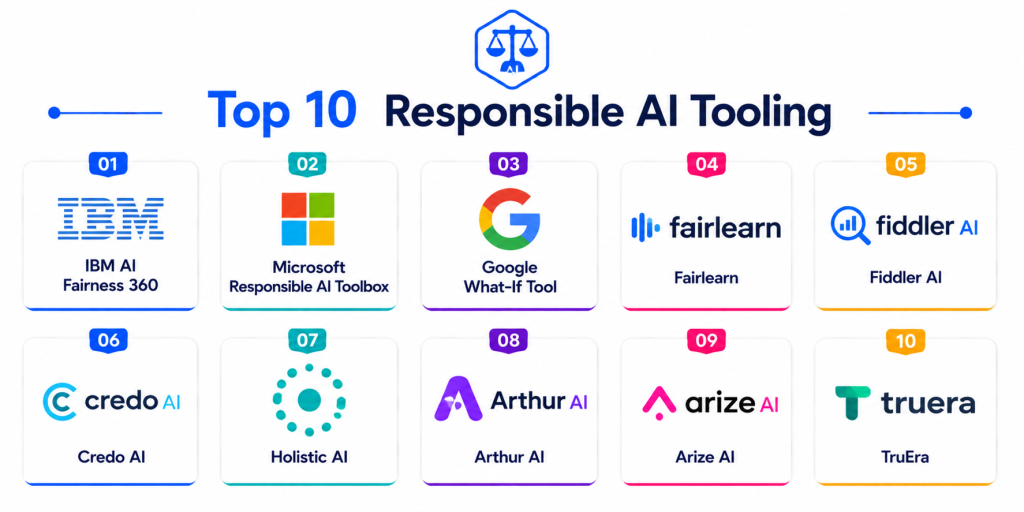
Top 10 Responsible AI Tooling
1- IBM watsonx.governance
Short description: IBM watsonx.governance is an AI governance platform designed to help organizations manage risk, document models, monitor AI behavior, and govern both traditional machine learning and generative AI systems. It is especially relevant for enterprises that need structured model oversight, risk reporting, and governance workflows.
Key Features
- AI model governance workflows
- Generative AI risk management
- Model documentation and lifecycle tracking
- Bias and fairness monitoring
- Explainability support
- Audit trails and reporting
- Integration with enterprise AI environments
Pros
- Strong enterprise governance focus
- Useful for regulated and risk-sensitive AI programs
- Supports both traditional ML and generative AI governance
Cons
- Enterprise setup can be complex
- Best value comes with mature AI governance processes
- Smaller teams may find it more than they need
Platforms / Deployment
- Web / Enterprise AI environments
- Cloud / Hybrid options vary
Security & Compliance
- RBAC
- Encryption
- Audit logging
- Identity integration
- Governance controls
- Compliance support varies by deployment
Integrations & Ecosystem
IBM watsonx.governance integrates with enterprise AI, model development, and governance workflows. It is useful when organizations need model inventory, lifecycle documentation, and compliance-oriented oversight across multiple AI systems.
- IBM watsonx ecosystem
- Machine learning platforms
- Cloud AI services
- Model risk workflows
- Enterprise governance systems
- Third-party AI environments
Support & Community
IBM provides enterprise support, consulting resources, documentation, implementation guidance, and governance expertise for large organizations.
2- Microsoft Azure Responsible AI Tooling
Short description: Microsoft Azure Responsible AI Tooling includes capabilities for model interpretability, fairness assessment, error analysis, content safety, AI governance, and responsible AI development across Azure AI and machine learning environments.
Key Features
- Responsible AI dashboard capabilities
- Model interpretability tools
- Fairness assessment
- Error analysis
- Content safety controls
- AI risk management support
- Azure AI integration
Pros
- Strong Microsoft ecosystem integration
- Good fit for Azure AI and enterprise ML teams
- Useful responsible AI tooling across development and deployment
Cons
- Best suited for Azure-centric organizations
- Some capabilities require technical setup
- Governance maturity depends on internal processes
Platforms / Deployment
- Azure Cloud / Web / APIs
- Cloud / Hybrid options vary
Security & Compliance
- Microsoft Entra ID integration
- RBAC
- Encryption
- Audit logging
- Network controls
- Compliance support through Azure ecosystem
Integrations & Ecosystem
Azure Responsible AI Tooling connects with Microsoft AI, cloud, analytics, and enterprise development workflows.
- Azure Machine Learning
- Azure AI services
- Azure AI Content Safety
- Microsoft Fabric
- Power BI
- Enterprise identity systems
Support & Community
Microsoft provides extensive documentation, enterprise support, partner resources, training, and responsible AI guidance for Azure customers.
3- AWS SageMaker Clarify
Short description: AWS SageMaker Clarify helps machine learning teams detect bias, explain model predictions, and improve transparency in ML workflows. It is useful for AWS-based teams that need fairness checks and explainability as part of model development and deployment.
Key Features
- Bias detection
- Feature attribution
- Model explainability
- Pre-training bias analysis
- Post-training bias analysis
- SageMaker integration
- Model monitoring support patterns
Pros
- Strong AWS ecosystem integration
- Useful for ML fairness and explainability workflows
- Good fit for SageMaker users
Cons
- Best suited for AWS environments
- Less complete as a standalone governance platform
- Requires ML expertise to interpret results correctly
Platforms / Deployment
- AWS Cloud / SageMaker environments
- Cloud
Security & Compliance
- IAM integration
- Encryption
- Audit logging through AWS services
- Access controls
- Compliance support depends on AWS configuration
Integrations & Ecosystem
SageMaker Clarify fits naturally into AWS machine learning workflows and can be combined with broader AWS monitoring and governance services.
- Amazon SageMaker
- Amazon S3
- AWS IAM
- CloudWatch
- ML pipelines
- AWS data services
Support & Community
AWS provides documentation, enterprise support plans, cloud training resources, and a large machine learning developer ecosystem.
4- Google Vertex AI Responsible AI Tooling
Short description: Google Vertex AI Responsible AI Tooling supports model evaluation, explainability, monitoring, safety practices, and governance workflows for teams building and deploying AI on Google Cloud. It is useful for organizations that want responsible AI capabilities integrated into managed ML infrastructure.
Key Features
- Model evaluation workflows
- Explainability support
- Model monitoring
- Data and prediction analysis
- Generative AI safety controls
- Managed AI lifecycle support
- Cloud-native governance patterns
Pros
- Strong Google Cloud AI integration
- Useful for managed AI development workflows
- Good support for model evaluation and monitoring
Cons
- Best suited for Google Cloud environments
- Some responsible AI workflows require configuration
- Governance depends on broader operating processes
Platforms / Deployment
- Google Cloud / Web / APIs
- Cloud
Security & Compliance
- IAM integration
- Encryption
- Audit logging
- Access controls
- Cloud governance controls
- Compliance support through Google Cloud configuration
Integrations & Ecosystem
Vertex AI integrates with Google Cloud data, analytics, AI, and application development environments.
- Vertex AI
- BigQuery
- Cloud Storage
- Model monitoring tools
- AI application workflows
- Enterprise cloud systems
Support & Community
Google Cloud provides enterprise support, documentation, training, and AI engineering resources for production AI teams.
5- Fiddler AI
Short description: Fiddler AI is an AI observability and responsible AI platform focused on model monitoring, explainability, drift detection, performance tracking, and AI risk visibility. It is useful for organizations that need continuous production oversight for ML and generative AI systems.
Key Features
- Model monitoring
- Explainability
- Drift detection
- Bias and fairness insights
- LLM monitoring support
- Performance analytics
- Responsible AI dashboards
Pros
- Strong AI observability capabilities
- Good explainability and monitoring workflows
- Useful for production AI risk management
Cons
- Requires integration with production AI systems
- Best value comes with mature model operations
- Pricing may not fit small teams
Platforms / Deployment
- Web / APIs / Enterprise AI environments
- Cloud / Hybrid options vary
Security & Compliance
- RBAC
- Encryption
- Audit logging
- SSO support
- Enterprise security controls
- Compliance details vary by plan
Integrations & Ecosystem
Fiddler AI integrates with model deployment, monitoring, and AI operations workflows.
- ML platforms
- Model serving systems
- Cloud data platforms
- LLM applications
- MLOps pipelines
- Enterprise dashboards
Support & Community
Fiddler provides enterprise support, documentation, onboarding assistance, and AI observability expertise for production teams.
6- Credo AI
Short description: Credo AI is an AI governance and risk management platform designed to help organizations assess, manage, document, and operationalize responsible AI practices across enterprise AI programs.
Key Features
- AI governance workflows
- Risk assessment management
- Policy and control mapping
- AI system inventory
- Compliance reporting
- Review and approval workflows
- Responsible AI documentation
Pros
- Strong governance and policy focus
- Useful for cross-functional AI oversight
- Good fit for legal, compliance, and risk teams
Cons
- Less focused on low-level model engineering
- Requires organizational governance maturity
- Best value comes with formal AI risk processes
Platforms / Deployment
- Web / Enterprise governance environments
- Cloud
Security & Compliance
- RBAC
- SSO support
- Encryption
- Audit logging
- Governance controls
- Compliance support varies by plan
Integrations & Ecosystem
Credo AI connects governance, risk, compliance, and responsible AI oversight workflows across business and technical teams.
- AI inventory systems
- Model governance workflows
- Risk management processes
- Enterprise documentation
- Compliance workflows
- AI policy management
Support & Community
Credo AI provides enterprise support, implementation guidance, governance resources, and responsible AI program expertise.
7- Arthur AI
Short description: Arthur AI is an AI performance monitoring and responsible AI platform focused on model observability, bias detection, explainability, drift monitoring, and LLM evaluation. It is useful for organizations that need oversight across deployed AI systems.
Key Features
- Model performance monitoring
- Bias detection
- Drift monitoring
- Explainability support
- LLM evaluation support
- Production AI dashboards
- Alerting and reporting
Pros
- Good production model monitoring
- Useful responsible AI and bias workflows
- Supports traditional ML and generative AI use cases
Cons
- Requires production integration
- Governance depth may depend on implementation
- Smaller teams may not need the full platform
Platforms / Deployment
- Web / APIs / AI infrastructure
- Cloud / Hybrid options vary
Security & Compliance
- RBAC
- Encryption
- Audit logging
- Access controls
- Enterprise security features vary by plan
Integrations & Ecosystem
Arthur AI integrates with production AI and model operations environments.
- Model serving systems
- Cloud AI platforms
- MLOps pipelines
- LLM applications
- Monitoring workflows
- Enterprise AI dashboards
Support & Community
Arthur provides enterprise support, documentation, onboarding, and guidance for AI monitoring and responsible AI workflows.
8- Holistic AI
Short description: Holistic AI is an AI governance, risk, and compliance platform that helps organizations evaluate AI systems, manage risk, document controls, and align AI usage with responsible AI policies.
Key Features
- AI risk assessment
- Governance workflows
- Model and system audits
- Compliance support
- Bias and fairness assessment
- Documentation management
- Policy alignment
Pros
- Strong AI governance and audit focus
- Useful for risk and compliance teams
- Good fit for organizations formalizing AI oversight
Cons
- Less focused on deep MLOps engineering
- Requires internal governance processes
- Best suited for structured enterprise AI programs
Platforms / Deployment
- Web / Enterprise governance environments
- Cloud
Security & Compliance
- Access controls
- Encryption support
- Audit workflows
- Governance controls
- Compliance features vary by plan
Integrations & Ecosystem
Holistic AI supports governance, risk assessment, and compliance workflows for AI systems across departments.
- AI audit workflows
- Risk management processes
- Policy documentation
- Model review workflows
- Compliance reporting
- Enterprise governance programs
Support & Community
Holistic AI provides implementation guidance, governance support, documentation, and responsible AI expertise for enterprise customers.
9- Fairlearn
Short description: Fairlearn is an open-source toolkit that helps data scientists assess and improve fairness in machine learning models. It provides metrics, visualizations, and mitigation algorithms for analyzing group fairness and model behavior.
Key Features
- Fairness metrics
- Bias assessment
- Mitigation algorithms
- Model comparison tools
- Group fairness analysis
- Python-based workflows
- Open-source flexibility
Pros
- Strong open-source fairness toolkit
- Useful for technical ML teams
- Good for experimentation and research workflows
Cons
- Not a full enterprise governance platform
- Requires ML and fairness expertise
- Production monitoring must be handled separately
Platforms / Deployment
- Python / Linux / macOS / Windows
- Self-hosted / Hybrid
Security & Compliance
- Not publicly stated
- Security depends on deployment environment and data handling practices
Integrations & Ecosystem
Fairlearn fits into Python-based machine learning development and evaluation workflows.
- scikit-learn
- Python notebooks
- ML pipelines
- Data science workflows
- Model evaluation systems
- Custom fairness analysis
Support & Community
Fairlearn has open-source community support, documentation, and adoption among responsible ML practitioners and researchers.
10- Aequitas
Short description: Aequitas is an open-source bias and fairness audit toolkit designed to help teams evaluate machine learning models for disparities across groups. It is especially useful for fairness audits, technical analysis, and responsible AI research workflows.
Key Features
- Bias auditing
- Group fairness metrics
- Disparity analysis
- Model comparison
- Fairness reporting
- Python-based workflows
- Open-source audit support
Pros
- Useful for fairness audits
- Open-source and accessible
- Good for technical responsible AI analysis
Cons
- Not a complete governance platform
- Requires fairness and statistics knowledge
- Production monitoring requires additional tools
Platforms / Deployment
- Python / Data science environments
- Self-hosted / Hybrid
Security & Compliance
- Not publicly stated
- Security depends on deployment and data handling configuration
Integrations & Ecosystem
Aequitas integrates with data science and responsible AI analysis workflows.
- Python workflows
- ML evaluation pipelines
- Data science notebooks
- Fairness reports
- Model validation processes
- Research environments
Support & Community
Aequitas has open-source community support and is useful for teams conducting fairness audits and bias analysis.
Comparison Table
| Tool Name | Best For | Platforms Supported | Deployment | Standout Feature | Public Rating |
|---|---|---|---|---|---|
| IBM watsonx.governance | Enterprise AI governance | Web / Enterprise AI environments | Cloud / Hybrid options vary | Model governance and risk workflows | N/A |
| Microsoft Azure Responsible AI Tooling | Azure AI governance and safety | Azure Cloud / APIs | Cloud / Hybrid options vary | Responsible AI and content safety ecosystem | N/A |
| AWS SageMaker Clarify | AWS ML explainability and bias testing | AWS Cloud / SageMaker | Cloud | Bias and explainability in SageMaker | N/A |
| Google Vertex AI Responsible AI Tooling | Google Cloud AI evaluation | Google Cloud / APIs | Cloud | Managed AI evaluation and monitoring | N/A |
| Fiddler AI | AI observability and explainability | Web / APIs | Cloud / Hybrid options vary | Production AI monitoring | N/A |
| Credo AI | AI governance and compliance | Web / Governance environments | Cloud | Policy-based AI governance | N/A |
| Arthur AI | AI monitoring and bias detection | Web / APIs | Cloud / Hybrid options vary | Model observability and LLM evaluation | N/A |
| Holistic AI | AI risk and compliance | Web / Governance environments | Cloud | AI audit and risk assessment | N/A |
| Fairlearn | Open-source fairness testing | Python environments | Self-hosted / Hybrid | Fairness metrics and mitigation | N/A |
| Aequitas | Bias audit workflows | Python environments | Self-hosted / Hybrid | Group fairness audit toolkit | N/A |
Evaluation & Scoring of Responsible AI Tooling
| Tool Name | Core 25% | Ease 15% | Integrations 15% | Security 10% | Performance 10% | Support 10% | Value 15% | Weighted Total |
|---|---|---|---|---|---|---|---|---|
| IBM watsonx.governance | 9.3 | 7.8 | 9.0 | 9.2 | 8.8 | 9.0 | 7.8 | 8.73 |
| Microsoft Azure Responsible AI Tooling | 9.0 | 8.1 | 9.2 | 9.2 | 8.8 | 8.9 | 8.1 | 8.78 |
| AWS SageMaker Clarify | 8.6 | 8.0 | 9.0 | 9.1 | 8.7 | 8.8 | 8.2 | 8.61 |
| Google Vertex AI Responsible AI Tooling | 8.8 | 8.0 | 9.0 | 9.1 | 8.8 | 8.8 | 8.1 | 8.62 |
| Fiddler AI | 9.0 | 8.1 | 8.8 | 8.8 | 8.9 | 8.7 | 8.0 | 8.66 |
| Credo AI | 8.9 | 8.2 | 8.5 | 8.9 | 8.5 | 8.7 | 7.9 | 8.51 |
| Arthur AI | 8.8 | 8.0 | 8.6 | 8.7 | 8.8 | 8.6 | 8.0 | 8.50 |
| Holistic AI | 8.7 | 8.0 | 8.3 | 8.8 | 8.4 | 8.5 | 7.9 | 8.35 |
| Fairlearn | 8.2 | 8.0 | 8.3 | 7.6 | 8.3 | 8.2 | 9.2 | 8.27 |
| Aequitas | 8.0 | 7.8 | 8.0 | 7.5 | 8.1 | 7.9 | 9.1 | 8.04 |
These scores are comparative and intended to help organizations evaluate practical fit rather than identify one universal winner. Enterprise governance platforms usually score higher for auditability, policy workflows, and compliance readiness, while open-source fairness toolkits provide stronger flexibility and value for technical teams. The best choice depends on AI maturity, regulatory exposure, deployment environment, monitoring needs, and whether the organization is focused on governance, model behavior, fairness testing, or production observability.
Which Responsible AI Tool Is Right for You?
Solo / Freelancer
Solo AI builders and independent data scientists usually need lightweight fairness and explainability tools rather than full enterprise governance platforms. Fairlearn and Aequitas are practical options for technical fairness checks, model comparison, and responsible AI experimentation.
SMB
SMBs usually need practical responsible AI controls without large governance overhead. AWS SageMaker Clarify, Azure Responsible AI Tooling, Google Vertex AI Responsible AI Tooling, and Fairlearn can help teams start with bias testing, explainability, and model evaluation.
Mid-Market
Mid-sized organizations often need stronger monitoring, audit trails, risk assessments, and cross-team review workflows. Fiddler AI, Arthur AI, Credo AI, and cloud-native responsible AI tools are strong options for growing AI programs.
Enterprise
Large enterprises usually require AI governance, risk management, auditability, documentation, compliance alignment, production monitoring, and cross-functional approval workflows. IBM watsonx.governance, Credo AI, Holistic AI, Fiddler AI, Arthur AI, Microsoft Azure Responsible AI Tooling, and Google Vertex AI Responsible AI Tooling are strong enterprise-focused options.
Budget vs Premium
Open-source tools like Fairlearn and Aequitas are useful for budget-conscious technical teams. Premium platforms provide stronger workflow management, governance reporting, risk controls, monitoring dashboards, support, and enterprise security options.
Feature Depth vs Ease of Use
Cloud-native tools are easier for teams already using AWS, Azure, or Google Cloud. Governance platforms like IBM watsonx.governance, Credo AI, and Holistic AI provide deeper policy and audit workflows. Observability platforms like Fiddler AI and Arthur AI provide stronger production monitoring and model behavior visibility.
Integrations & Scalability
Organizations should prioritize tools that integrate with existing AI development platforms, model registries, data pipelines, LLM applications, identity providers, risk workflows, and monitoring systems. Responsible AI tooling works best when it is connected to the full AI lifecycle rather than used as a one-time checklist.
Security & Compliance Needs
Security-focused organizations should prioritize RBAC, SSO, encryption, audit logs, private deployment options, model inventory, approval workflows, policy mapping, and data handling controls. Regulated industries should also validate evidence collection, explainability reports, and governance documentation before production deployment.
Frequently Asked Questions
1. What is Responsible AI Tooling?
Responsible AI Tooling helps organizations build, test, monitor, and govern AI systems so they are safer, fairer, more explainable, more accountable, and better aligned with business and regulatory expectations.
2. Why is Responsible AI Tooling important?
It reduces risks related to bias, unsafe outputs, privacy exposure, poor explainability, model drift, weak governance, and unapproved AI usage. It also helps organizations build trust with users, regulators, customers, and internal stakeholders.
3. What is AI governance?
AI governance is the process of defining policies, ownership, controls, approvals, monitoring, documentation, and accountability for AI systems across their lifecycle.
4. What is AI explainability?
AI explainability helps humans understand why a model produced a certain prediction, recommendation, classification, or output. It is important for trust, debugging, compliance, and risk review.
5. What is fairness testing in AI?
Fairness testing checks whether model behavior or outcomes differ across groups in ways that may be biased, harmful, or inconsistent with policy expectations.
6. What are common Responsible AI implementation mistakes?
Common mistakes include treating responsible AI as a checklist, skipping production monitoring, ignoring data quality, failing to define ownership, using unclear approval workflows, and relying only on technical metrics without human review.
7. Can Responsible AI tools help with generative AI?
Yes. Many tools now support generative AI risk management, output monitoring, prompt evaluation, content safety, hallucination checks, human review, and governance documentation.
8. What integrations are most important?
Important integrations include MLOps platforms, model registries, cloud AI services, LLM applications, data catalogs, identity providers, monitoring tools, risk systems, and CI/CD pipelines.
9. Should teams use open-source or enterprise Responsible AI tools?
Open-source tools are useful for fairness testing and technical experimentation. Enterprise platforms are better for governance, monitoring, audit trails, compliance workflows, and cross-functional accountability.
10. What should buyers evaluate before selecting a Responsible AI platform?
Buyers should evaluate governance workflows, fairness metrics, explainability, monitoring, generative AI support, audit trails, security, integrations, reporting, deployment flexibility, and how well the tool fits existing AI operating processes.
Conclusion
Responsible AI Tooling is becoming essential for organizations that want to deploy AI safely, transparently, and confidently across real-world business workflows. The right platform can help teams detect bias, explain model behavior, monitor production risks, document decisions, create audit trails, and align AI systems with internal policies and external expectations. IBM watsonx.governance, Credo AI, and Holistic AI are strong choices for enterprise governance and risk management, while Microsoft Azure, AWS SageMaker Clarify, and Google Vertex AI Responsible AI Tooling fit teams already building on major cloud AI platforms. Fiddler AI and Arthur AI are strong for production monitoring and observability, while Fairlearn and Aequitas provide open-source fairness testing for technical teams. The best choice depends on AI maturity, risk exposure, compliance needs, cloud strategy, monitoring requirements, and governance operating model. Shortlist two or three tools, test them with real models and use cases, validate bias and explainability outputs, confirm audit and security controls, and make responsible AI part of the full development and production lifecycle.