Introduction
Resource Management Tools are software platforms designed to help organizations efficiently allocate, track, and optimize resources such as people, time, equipment, and budgets across projects. These tools provide visibility into resource availability, workload distribution, and future capacity planning, enabling teams to avoid overutilization or underutilization.
In modern organizations, where multiple projects run simultaneously, effective resource management is critical for maintaining productivity and profitability. These tools help leaders make data-driven decisions, balance workloads, and ensure the right resources are assigned to the right tasks at the right time.
Common use cases include:
- Workforce planning and scheduling
- Project resource allocation
- Capacity forecasting
- Budget and cost management
- Agency and consulting team utilization
What buyers should evaluate:
- Resource scheduling and allocation features
- Capacity planning and forecasting
- Reporting and analytics
- Integration with project management tools
- Automation capabilities
- Scalability across teams
- Security and access control
- Ease of use and onboarding
- Financial tracking
Best for: Project managers, PMOs, consulting firms, IT teams, and enterprises managing multiple resources across projects.
Not ideal for: Individuals or very small teams that only need basic task tracking.
Key Trends in Resource Management Tools
- AI-driven resource forecasting and demand prediction
- Real-time visibility into team workload and availability
- Integration with project management and financial systems
- Automated scheduling and workload balancing
- Increased focus on employee well-being and burnout prevention
- Scenario planning for future resource allocation
- Cloud-based collaboration and accessibility
- Data-driven insights and predictive analytics
- Hybrid tools combining project + resource management
- Skills-based resource allocation
How We Selected These Tools (Methodology)
- Strong adoption across industries and team sizes
- Comprehensive resource planning and scheduling capabilities
- Proven performance in managing complex workloads
- Integration with project management ecosystems
- Security features such as role-based access control
- Flexibility for different industries and use cases
- Ease of use and onboarding experience
- Reporting and analytics depth
- Vendor reputation and product evolution
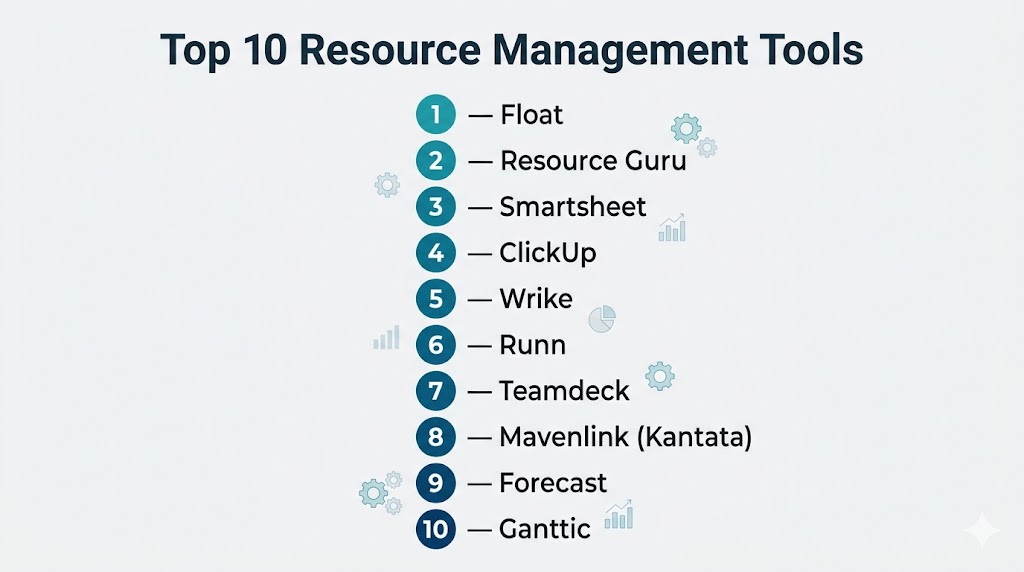
Top 10 Resource Management Tools
#1 — Float
Short description: A leading resource scheduling tool focused on team capacity and forecasting.
Key Features
- Real-time scheduling
- Capacity planning
- Forecasting tools
- Time tracking
- Reporting dashboards
Pros
- Clean interface
- Strong forecasting capabilities
Cons
- Limited project management features
- Pricing may scale
Platforms / Deployment
Web / Cloud
Security & Compliance
Encryption, access control (certifications not publicly stated)
Integrations & Ecosystem
Widely used with project and productivity tools.
- Slack
- Google Workspace
- API
Support & Community
Strong documentation and support.
#2 — Resource Guru
Short description: A simple and effective resource scheduling and management platform.
Key Features
- Resource scheduling
- Availability tracking
- Booking system
- Reporting tools
- Leave management
Pros
- Easy to use
- Quick setup
Cons
- Limited advanced analytics
- Basic UI
Platforms / Deployment
Web / Cloud
Security & Compliance
Not publicly stated
Integrations & Ecosystem
- Slack
- API
Support & Community
Moderate support resources.
#3 — Smartsheet
Short description: A flexible work management tool with strong resource planning features.
Key Features
- Resource management dashboards
- Gantt charts
- Automation
- Reporting tools
- Collaboration features
Pros
- Familiar interface
- Flexible workflows
Cons
- Can become complex
- Learning curve
Platforms / Deployment
Web / Cloud
Security & Compliance
SSO, MFA, encryption
Integrations & Ecosystem
- Microsoft 365
- Google Workspace
- Slack
Support & Community
Strong support ecosystem.
#4 — ClickUp
Short description: An all-in-one productivity tool with resource management capabilities.
Key Features
- Workload views
- Resource allocation
- Automation
- Multiple views
- Reporting
Pros
- Feature-rich
- Flexible
Cons
- Overwhelming for beginners
- Performance issues
Platforms / Deployment
Web / Desktop / Mobile / Cloud
Security & Compliance
SSO, MFA, encryption
Integrations & Ecosystem
- Slack
- GitHub
- Google Workspace
Support & Community
Large community.
#5 — Wrike
Short description: A scalable platform combining project and resource management.
Key Features
- Resource allocation
- Workload management
- Reporting dashboards
- Automation
- Collaboration
Pros
- Enterprise-ready
- Strong reporting
Cons
- Complex UI
- Higher pricing
Platforms / Deployment
Web / Mobile / Cloud
Security & Compliance
SSO, MFA, encryption
Integrations & Ecosystem
- Salesforce
- Slack
- Microsoft Teams
Support & Community
Enterprise-level support.
#6 — Runn
Short description: A real-time resource planning tool focused on forecasting and utilization.
Key Features
- Real-time planning
- Capacity forecasting
- Scenario modeling
- Reporting tools
- Utilization tracking
Pros
- Strong forecasting
- Easy visualization
Cons
- Limited integrations
- Smaller ecosystem
Platforms / Deployment
Web / Cloud
Security & Compliance
Not publicly stated
Integrations & Ecosystem
- API
Support & Community
Moderate support.
#7 — Teamdeck
Short description: A resource management tool designed for agencies and teams.
Key Features
- Resource scheduling
- Time tracking
- Custom reporting
- Availability tracking
- Project tracking
Pros
- Flexible reporting
- Agency-focused
Cons
- UI complexity
- Learning curve
Platforms / Deployment
Web / Cloud
Security & Compliance
Not publicly stated
Integrations & Ecosystem
- API
- Project tools
Support & Community
Moderate support.
#8 — Mavenlink (Kantata)
Short description: A professional services automation tool with strong resource management.
Key Features
- Resource planning
- Financial management
- Project tracking
- Reporting
- Forecasting
Pros
- Strong financial tracking
- Enterprise-ready
Cons
- Expensive
- Complex setup
Platforms / Deployment
Web / Cloud
Security & Compliance
SSO, MFA
Integrations & Ecosystem
- CRM tools
- ERP systems
Support & Community
Enterprise support.
#9 — Forecast
Short description: A resource management tool with AI-driven forecasting and planning.
Key Features
- AI-based forecasting
- Resource allocation
- Time tracking
- Reporting
- Project planning
Pros
- AI capabilities
- Modern interface
Cons
- Pricing
- Setup complexity
Platforms / Deployment
Web / Cloud
Security & Compliance
Not publicly stated
Integrations & Ecosystem
- Slack
- APIs
Support & Community
Growing support ecosystem.
#10 — Ganttic
Short description: A visual resource planning tool with strong scheduling features.
Key Features
- Resource scheduling
- Gantt charts
- Capacity planning
- Reporting
- Visual dashboards
Pros
- Strong visualization
- Easy planning
Cons
- Limited integrations
- Smaller ecosystem
Platforms / Deployment
Web / Cloud
Security & Compliance
Not publicly stated
Integrations & Ecosystem
- API
Support & Community
Moderate support.
Comparison Table (Top 10)
| Tool Name | Best For | Platform(s) Supported | Deployment | Standout Feature | Public Rating |
|---|---|---|---|---|---|
| Float | Forecasting | Web | Cloud | Capacity planning | N/A |
| Resource Guru | Scheduling | Web | Cloud | Simplicity | N/A |
| Smartsheet | Flexible teams | Web | Cloud | Spreadsheet-style | N/A |
| ClickUp | All-in-one | Multi-platform | Cloud | Flexibility | N/A |
| Wrike | Enterprise | Web, Mobile | Cloud | Scalability | N/A |
| Runn | Forecasting | Web | Cloud | Real-time planning | N/A |
| Teamdeck | Agencies | Web | Cloud | Custom reporting | N/A |
| Mavenlink (Kantata) | Services firms | Web | Cloud | Financial tracking | N/A |
| Forecast | AI planning | Web | Cloud | AI forecasting | N/A |
| Ganttic | Visual planning | Web | Cloud | Gantt visualization | N/A |
Evaluation & Scoring of Resource Management Tools
| Tool Name | Core | Ease | Integrations | Security | Performance | Support | Value | Weighted Total |
|---|---|---|---|---|---|---|---|---|
| Float | 9 | 8 | 7 | 7 | 8 | 8 | 7 | 7.9 |
| Resource Guru | 7 | 9 | 6 | 6 | 7 | 7 | 8 | 7.2 |
| Smartsheet | 9 | 8 | 8 | 8 | 8 | 8 | 7 | 8.0 |
| ClickUp | 9 | 7 | 9 | 7 | 7 | 8 | 8 | 8.1 |
| Wrike | 9 | 7 | 8 | 8 | 8 | 8 | 7 | 8.0 |
| Runn | 8 | 8 | 6 | 6 | 8 | 7 | 7 | 7.4 |
| Teamdeck | 8 | 7 | 7 | 6 | 7 | 7 | 7 | 7.3 |
| Mavenlink | 9 | 6 | 8 | 7 | 8 | 8 | 6 | 7.8 |
| Forecast | 9 | 7 | 7 | 6 | 8 | 7 | 7 | 7.7 |
| Ganttic | 8 | 8 | 6 | 6 | 7 | 7 | 8 | 7.4 |
How to interpret:
These scores are comparative across tools in this list. Higher scores indicate better balance across features, usability, and value. Enterprise tools score higher in capability, while simpler tools perform better in ease of use.
Which Resource Management Tool Is Right for You?
Solo / Freelancer
Lightweight tools like Resource Guru or ClickUp are sufficient.
SMB
Float, Smartsheet, and ClickUp provide balance between features and usability.
Mid-Market
Wrike, Runn, and Teamdeck offer better scalability and forecasting.
Enterprise
Mavenlink and Wrike are best for complex resource and financial planning.
Budget vs Premium
Resource Guru and Ganttic are budget-friendly, while Mavenlink and Forecast are premium.
Feature Depth vs Ease of Use
Resource Guru is easiest, Mavenlink is most advanced.
Integrations & Scalability
ClickUp and Wrike lead in integrations.
Security & Compliance Needs
Enterprise tools like Wrike are better suited.
Frequently Asked Questions (FAQs)
What are resource management tools?
They help organizations allocate and manage resources like people, time, and budgets efficiently.
Who should use these tools?
Project managers, PMOs, and teams handling multiple projects.
Do these tools support forecasting?
Yes, many tools include forecasting and capacity planning.
Are resource management tools expensive?
Pricing varies depending on features and scale.
Can they integrate with other tools?
Yes, most tools integrate with project management and collaboration tools.
Are these tools secure?
Security features vary by vendor.
Can small teams use these tools?
Yes, but simpler tools may be more suitable.
What is capacity planning?
It is forecasting resource availability and demand.
Do these tools support automation?
Yes, automation is a common feature.
What mistakes should be avoided?
Avoid overloading resources and poor planning.
Conclusion
Resource management tools play a critical role in helping organizations optimize productivity, balance workloads, and improve project outcomes. Whether you are managing a small team or a large enterprise portfolio, these tools provide the visibility and control needed to allocate resources effectively. Tools like Float and Resource Guru offer simplicity and quick setup, while platforms like Wrike and Mavenlink deliver advanced capabilities for enterprise environments. The best choice depends on your team size, complexity, and integration needs. Instead of choosing one tool blindly, shortlist a few options, test them in real scenarios, and evaluate how well they align with your operational workflows and long-term goals.