Introduction
Airline Reservation Systems are specialized software platforms used by airlines, travel agencies, and booking providers to manage flight inventory, reservations, ticketing, and passenger data. These systems act as the backbone of airline operations, enabling real-time seat availability, pricing updates, and seamless booking experiences for customers worldwide.
As air travel continues to scale globally, these systems have evolved into highly complex platforms that integrate with global distribution systems, payment gateways, and airport operations. Modern solutions now include automation, dynamic pricing, and real-time analytics, helping airlines improve efficiency, reduce costs, and enhance passenger experience.
Common use cases include:
- Managing flight bookings and ticketing
- Handling seat inventory and availability
- Integrating with travel agencies and third-party platforms
- Managing passenger data and check-in processes
- Supporting revenue management and pricing strategies
What buyers should evaluate:
- Scalability and performance under high demand
- Integration with global distribution systems
- Real-time inventory and pricing capabilities
- User experience for booking and management
- Security and compliance standards
- Reporting and analytics features
- Support for multi-channel bookings
- Customization and flexibility
- Reliability and uptime
Best for: Airlines, travel agencies, online travel platforms, and aviation service providers managing large-scale booking operations.
Not ideal for: Small businesses or individuals without complex booking or inventory needs.
Key Trends in Airline Reservation Systems
- Dynamic pricing using advanced algorithms
- Cloud-based deployment for scalability
- Integration with AI for demand forecasting
- Contactless check-in and digital boarding
- Real-time data synchronization across channels
- Enhanced personalization for passengers
- API-driven architecture for integrations
- Automation in ticketing and refunds
- Cybersecurity improvements for data protection
- Expansion of self-service passenger tools
How We Selected These Tools (Methodology)
- Evaluated global adoption among airlines and travel providers
- Assessed reservation, inventory, and ticketing capabilities
- Compared scalability and system reliability
- Reviewed integration with distribution systems and APIs
- Considered security and compliance readiness
- Evaluated reporting and analytics capabilities
- Analyzed user experience and operational efficiency
- Considered vendor support and industry reputation
- Balanced enterprise and mid-market solutions
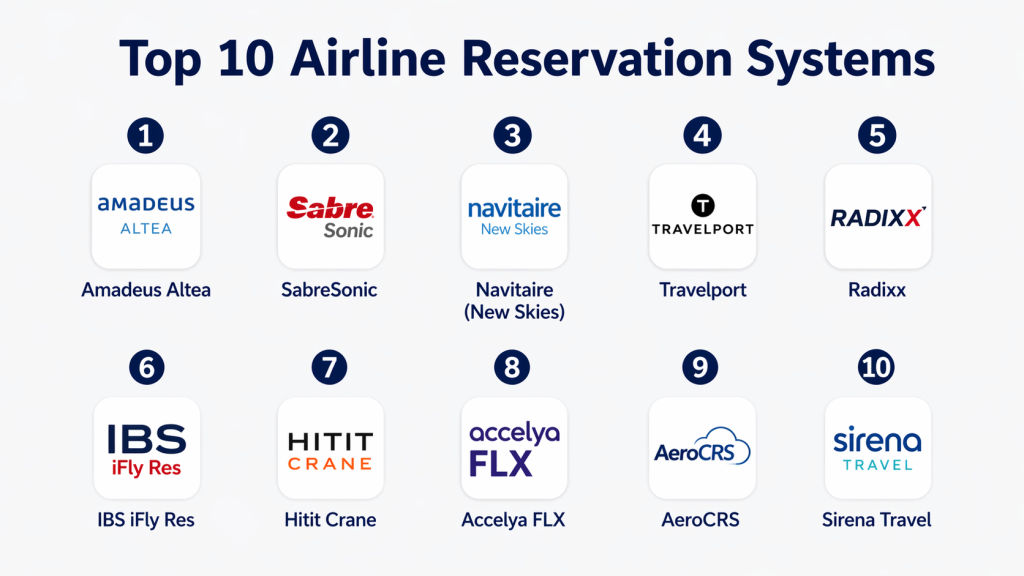
Top 10 Airline Reservation Systems
#1 — Amadeus Altea
Short description: Amadeus Altea is a comprehensive airline IT platform designed for large carriers. It manages reservations, inventory, and departure control in a unified system. It is widely used by global airlines for scalability and performance.
Key Features
- Reservation and inventory management
- Departure control system
- Revenue management tools
- Real-time data processing
- Integration with global distribution systems
Pros
- Highly scalable
- Strong global ecosystem
Cons
- Complex implementation
- High cost
Platforms / Deployment
Web
Cloud
Security & Compliance
Not publicly stated
Integrations & Ecosystem
Extensive integrations with airline systems.
- GDS platforms
- Payment gateways
- APIs
Support & Community
Enterprise-level support with global presence.
#2 — SabreSonic
Short description: SabreSonic is an airline reservation and passenger service system designed for full-service and low-cost carriers. It provides end-to-end management of bookings and operations.
Key Features
- Reservation system
- Inventory management
- Ticketing and pricing
- Customer management
- Analytics tools
Pros
- Comprehensive feature set
- Strong integration capabilities
Cons
- Requires training
- Implementation complexity
Platforms / Deployment
Web
Cloud
Security & Compliance
Not publicly stated
Integrations & Ecosystem
Supports broad integrations.
- GDS systems
- Payment tools
- APIs
Support & Community
Enterprise support available.
#3 — Navitaire (New Skies)
Short description: Navitaire is a reservation system designed primarily for low-cost carriers. It focuses on efficiency, scalability, and digital-first customer experiences.
Key Features
- Reservation management
- Dynamic pricing
- Digital booking tools
- Customer self-service
- Reporting tools
Pros
- Ideal for low-cost airlines
- Strong digital capabilities
Cons
- Limited for full-service carriers
- Customization constraints
Platforms / Deployment
Web
Cloud
Security & Compliance
Not publicly stated
Integrations & Ecosystem
API-driven integrations.
- Payment systems
- Distribution channels
Support & Community
Standard enterprise support.
#4 — Travelport
Short description: Travelport provides a global distribution and reservation platform connecting airlines, agencies, and travelers. It focuses on data-driven travel commerce.
Key Features
- Reservation and distribution
- Pricing and merchandising
- Data analytics
- API integrations
- Multi-channel booking
Pros
- Strong global network
- Data-driven insights
Cons
- Complex ecosystem
- Pricing varies
Platforms / Deployment
Web
Cloud
Security & Compliance
Not publicly stated
Integrations & Ecosystem
Extensive ecosystem.
- Airlines
- Travel agencies
- APIs
Support & Community
Global support services.
#5 — Radixx
Short description: Radixx is a cloud-based passenger service system designed for airlines of all sizes. It offers flexibility and scalability for modern travel operations.
Key Features
- Reservation system
- Inventory management
- E-commerce tools
- Reporting dashboards
- API connectivity
Pros
- Flexible platform
- Scalable solution
Cons
- Feature depth varies
- Limited enterprise adoption
Platforms / Deployment
Web
Cloud
Security & Compliance
Not publicly stated
Integrations & Ecosystem
Supports integrations.
- Payment gateways
- APIs
Support & Community
Standard support services.
#6 — IBS iFly Res
Short description: IBS iFly Res is a modern airline reservation system designed for digital-first carriers. It focuses on scalability and customer experience.
Key Features
- Reservation management
- Customer experience tools
- Dynamic pricing
- Reporting analytics
- API-based integrations
Pros
- Modern architecture
- Strong customer focus
Cons
- Limited legacy support
- Adoption varies
Platforms / Deployment
Web
Cloud
Security & Compliance
Not publicly stated
Integrations & Ecosystem
API-driven ecosystem.
- Payment tools
- Distribution systems
Support & Community
Enterprise support available.
#7 — Hitit Crane
Short description: Hitit Crane is a cloud-based airline reservation and passenger service system designed for airlines seeking cost-effective solutions.
Key Features
- Reservation and ticketing
- Inventory management
- Reporting tools
- Multi-channel booking
- API integrations
Pros
- Cost-effective
- Flexible deployment
Cons
- Limited global presence
- Feature depth varies
Platforms / Deployment
Web
Cloud
Security & Compliance
Not publicly stated
Integrations & Ecosystem
Supports integrations.
- Payment systems
- APIs
Support & Community
Standard support.
#8 — Accelya FLX
Short description: Accelya FLX is a modular airline platform focused on offer and order management. It supports modern retailing strategies for airlines.
Key Features
- Offer and order management
- Dynamic pricing
- Retailing tools
- Data analytics
- API-first architecture
Pros
- Modern approach
- Flexible modules
Cons
- Complex setup
- Requires integration effort
Platforms / Deployment
Web
Cloud
Security & Compliance
Not publicly stated
Integrations & Ecosystem
Strong API ecosystem.
- Airlines
- Payment systems
Support & Community
Enterprise-level support.
#9 — AeroCRS
Short description: AeroCRS is a cloud-based reservation system designed for small and regional airlines. It provides essential booking and management tools.
Key Features
- Reservation system
- Inventory management
- Ticketing
- Reporting tools
- API support
Pros
- Suitable for smaller airlines
- Easy to deploy
Cons
- Limited advanced features
- Scalability constraints
Platforms / Deployment
Web
Cloud
Security & Compliance
Not publicly stated
Integrations & Ecosystem
Basic integrations.
- Payment tools
- APIs
Support & Community
Standard support.
#10 — Sirena Travel
Short description: Sirena Travel provides airline reservation and distribution systems, mainly used in specific regional markets. It focuses on operational efficiency.
Key Features
- Reservation system
- Ticketing
- Distribution tools
- Reporting
- Integration support
Pros
- Regional strength
- Reliable system
Cons
- Limited global reach
- Feature limitations
Platforms / Deployment
Web
Cloud
Security & Compliance
Not publicly stated
Integrations & Ecosystem
Supports integrations.
- Distribution systems
- APIs
Support & Community
Regional support services.
Comparison Table (Top 10)
| Tool Name | Best For | Platform(s) Supported | Deployment | Standout Feature | Public Rating |
|---|---|---|---|---|---|
| Amadeus Altea | Enterprise airlines | Web | Cloud | Full PSS suite | N/A |
| SabreSonic | Full-service airlines | Web | Cloud | End-to-end system | N/A |
| Navitaire | Low-cost carriers | Web | Cloud | Digital-first design | N/A |
| Travelport | Travel distribution | Web | Cloud | Global network | N/A |
| Radixx | Mid-market airlines | Web | Cloud | Flexible platform | N/A |
| IBS iFly Res | Digital airlines | Web | Cloud | Modern UX | N/A |
| Hitit Crane | Cost-focused airlines | Web | Cloud | Affordability | N/A |
| Accelya FLX | Retail-focused airlines | Web | Cloud | Offer management | N/A |
| AeroCRS | Regional airlines | Web | Cloud | Easy deployment | N/A |
| Sirena Travel | Regional markets | Web | Cloud | Distribution tools | N/A |
Evaluation & Scoring of Airline Reservation Systems
| Tool Name | Core (25%) | Ease (15%) | Integrations (15%) | Security (10%) | Performance (10%) | Support (10%) | Value (15%) | Weighted Total |
|---|---|---|---|---|---|---|---|---|
| Amadeus Altea | 10 | 6 | 9 | 8 | 9 | 9 | 6 | 8.4 |
| SabreSonic | 9 | 6 | 9 | 8 | 9 | 9 | 6 | 8.2 |
| Navitaire | 8 | 8 | 8 | 7 | 8 | 8 | 7 | 8.0 |
| Travelport | 9 | 7 | 9 | 8 | 8 | 8 | 7 | 8.1 |
| Radixx | 8 | 7 | 8 | 7 | 8 | 7 | 8 | 7.8 |
| IBS iFly Res | 8 | 7 | 8 | 7 | 8 | 7 | 8 | 7.8 |
| Hitit Crane | 7 | 7 | 7 | 6 | 7 | 7 | 8 | 7.3 |
| Accelya FLX | 9 | 6 | 9 | 8 | 8 | 8 | 7 | 8.1 |
| AeroCRS | 7 | 8 | 6 | 6 | 7 | 7 | 9 | 7.3 |
| Sirena Travel | 7 | 7 | 6 | 6 | 7 | 7 | 8 | 7.2 |
How to interpret scores:
- Higher scores indicate stronger overall capabilities
- Enterprise tools score higher in features and integrations
- Smaller solutions offer better ease of use and value
- Choose based on scale and operational needs
Which Airline Reservation System Is Right for You?
Solo / Freelancer
Not applicable for individuals.
SMB
AeroCRS, Hitit Crane.
Mid-Market
Radixx, IBS iFly Res.
Enterprise
Amadeus Altea, SabreSonic, Travelport, Accelya FLX.
Budget vs Premium
- Budget: AeroCRS, Hitit Crane
- Premium: Amadeus Altea, SabreSonic
Feature Depth vs Ease of Use
- Feature-rich: Amadeus, Sabre
- Easier tools: AeroCRS
Integrations & Scalability
- Strong integrations: Travelport, Amadeus
Security & Compliance Needs
- Enterprise-grade tools preferred
Frequently Asked Questions (FAQs)
Q1: What is an airline reservation system?
It is software that manages flight bookings, inventory, and ticketing for airlines.
Q2: Who uses these systems?
Airlines, travel agencies, and booking platforms use them.
Q3: Are these systems cloud-based?
Most modern systems are cloud-based.
Q4: Do they support real-time booking?
Yes, real-time availability and pricing are core features.
Q5: Are they secure?
Security varies; most include standard protections.
Q6: Can they integrate with other systems?
Yes, integrations with payment and distribution systems are common.
Q7: How long does implementation take?
It can take several months for large systems.
Q8: Are they customizable?
Some platforms offer customization based on needs.
Q9: What are common challenges?
Integration complexity and high implementation costs.
Q10: Can small airlines use them?
Yes, some tools are designed for smaller operators.
Conclusion
Airline reservation systems are critical infrastructure for modern aviation, enabling efficient booking, inventory management, and customer experience. These platforms have evolved into highly scalable and integrated ecosystems that support global travel operations. The right system depends on the size and complexity of your airline or travel business. Large enterprises require robust, feature-rich platforms, while smaller operators benefit from simpler, cost-effective solutions. Modern systems continue to advance with automation, real-time data processing, and improved customer experiences. These innovations help airlines stay competitive and responsive to market demands.