Introduction
Human Resource Information System (HRIS) platforms are software solutions that help organizations store, manage, and process employee data while automating core HR functions such as payroll, attendance, benefits, and reporting. These systems act as a central database for all workforce-related information, enabling HR teams to streamline operations and improve decision-making.
In today’s digital workplace, HRIS platforms have evolved into strategic tools that go beyond administration. They now include analytics, automation, employee self-service, and integrations with payroll, finance, and performance systems—making them essential for scaling HR operations efficiently.
Common use cases include:
- Employee data management and record keeping
- Payroll and benefits administration
- Attendance and leave management
- HR reporting and analytics
- Compliance and audit tracking
What buyers should evaluate:
- Core HR functionality and data management
- Payroll and compliance capabilities
- Employee self-service features
- Reporting and analytics
- Integration with HR, finance, and ERP systems
- Automation and workflow management
- Scalability across teams
- Security and access control
- Ease of implementation
Best for: HR teams, SMBs, enterprises, and organizations seeking centralized HR operations and automation.
Not ideal for: Very small teams that only need basic payroll or attendance tools.
Key Trends in HRIS Platforms
- AI-driven HR automation and employee insights
- Unified platforms combining HR, payroll, and performance
- Employee self-service portals for HR tasks
- Integration with finance, ERP, and productivity tools
- Mobile-first HR access for remote teams
- Predictive analytics for workforce planning
- Cloud-first deployment replacing legacy systems
- Compliance automation for labor laws
- Customizable workflows and no-code automation
- Focus on employee experience and engagement
How We Selected These Tools (Methodology)
- High adoption across SMBs and enterprises
- Strong core HRIS functionality and automation
- Proven reliability and scalability
- Integration ecosystem with HR, payroll, and ERP tools
- Security features such as RBAC and audit logs
- Ease of use and onboarding experience
- Reporting and analytics depth
- Vendor reputation and innovation
- Flexibility across industries
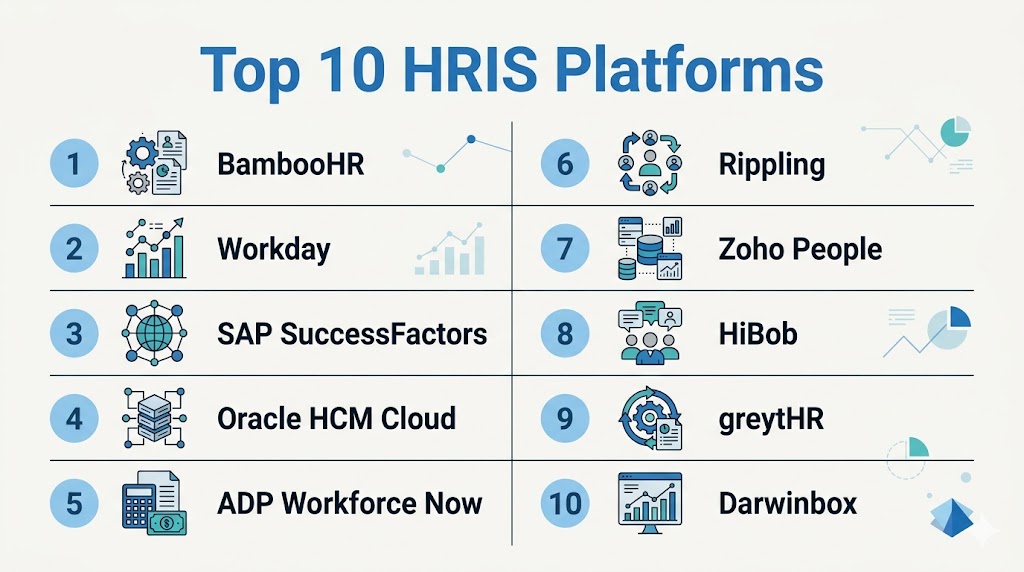
Top 10 HRIS Platforms
#1 — BambooHR
Short description: A user-friendly HRIS platform designed for small to mid-sized businesses.
Key Features
- Employee records management
- Time-off tracking
- Performance management
- Reporting dashboards
- Employee self-service
Pros
- Easy to use
- Strong employee experience
Cons
- Limited enterprise features
- Pricing not transparent
Platforms / Deployment
Web / Mobile / Cloud
Security & Compliance
Not publicly stated
Integrations & Ecosystem
- Payroll tools
- HR apps
- APIs
Support & Community
Strong documentation and support.
#2 — Workday
Short description: An enterprise-grade HRIS platform with advanced analytics and workforce planning.
Key Features
- Core HR
- Workforce planning
- Payroll integration
- Analytics and reporting
- Talent management
Pros
- Highly scalable
- Strong analytics
Cons
- Expensive
- Complex implementation
Platforms / Deployment
Web / Mobile / Cloud
Security & Compliance
SSO, MFA, encryption, RBAC
Integrations & Ecosystem
- ERP systems
- Finance tools
Support & Community
Enterprise-level support.
#3 — SAP SuccessFactors
Short description: A global HRIS platform with strong talent and performance management features.
Key Features
- Core HR
- Payroll and compliance
- Talent management
- Learning management
- Analytics
Pros
- Global capabilities
- Comprehensive features
Cons
- Complex setup
- Requires training
Platforms / Deployment
Web / Mobile / Cloud
Security & Compliance
SSO, MFA, encryption
Integrations & Ecosystem
- SAP ecosystem
- ERP tools
Support & Community
Strong enterprise support.
#4 — Oracle HCM Cloud
Short description: A robust HRIS platform with automation and global workforce management.
Key Features
- Core HR
- Workforce planning
- Payroll integration
- AI insights
- Reporting
Pros
- End-to-end HR solution
- Strong automation
Cons
- Complex
- Expensive
Platforms / Deployment
Web / Mobile / Cloud
Security & Compliance
SSO, MFA, encryption
Integrations & Ecosystem
- Oracle ERP
- Finance tools
Support & Community
Enterprise support.
#5 — ADP Workforce Now
Short description: A widely used HRIS platform with strong payroll and compliance capabilities.
Key Features
- Payroll automation
- HR management
- Benefits administration
- Reporting
- Compliance tools
Pros
- Strong payroll features
- Reliable
Cons
- Interface complexity
- Limited customization
Platforms / Deployment
Web / Mobile / Cloud
Security & Compliance
SSO, MFA, encryption
Integrations & Ecosystem
- HR tools
- Accounting systems
Support & Community
Strong support network.
#6 — Rippling
Short description: An all-in-one HRIS platform combining HR, IT, and payroll automation.
Key Features
- Employee management
- Payroll automation
- IT device management
- Reporting
- Compliance tools
Pros
- All-in-one platform
- Strong automation
Cons
- Pricing complexity
- Setup required
Platforms / Deployment
Web / Cloud
Security & Compliance
SSO, MFA, encryption
Integrations & Ecosystem
- HR tools
- IT systems
Support & Community
Strong support.
#7 — Zoho People
Short description: A cost-effective HRIS platform with strong integration capabilities.
Key Features
- Employee database
- Attendance tracking
- Leave management
- Performance tracking
- Reporting
Pros
- Affordable
- Easy integration
Cons
- Limited enterprise features
- UI complexity
Platforms / Deployment
Web / Mobile / Cloud
Security & Compliance
Not publicly stated
Integrations & Ecosystem
- Zoho ecosystem
- APIs
Support & Community
Strong SMB support.
#8 — HiBob
Short description: A modern HRIS platform focused on employee experience and engagement.
Key Features
- Employee lifecycle management
- Performance tracking
- Analytics
- Engagement tools
- Reporting
Pros
- Modern UI
- Strong engagement features
Cons
- Limited payroll features
- Pricing
Platforms / Deployment
Web / Cloud
Security & Compliance
Not publicly stated
Integrations & Ecosystem
- HR tools
- APIs
Support & Community
Growing support ecosystem.
#9 — greytHR
Short description: A popular HRIS platform for SMBs with strong payroll and compliance features.
Key Features
- Payroll management
- Attendance tracking
- Compliance tools
- Reporting
- Employee self-service
Pros
- Strong compliance
- Affordable
Cons
- Limited customization
- UI improvements needed
Platforms / Deployment
Web / Cloud
Security & Compliance
Not publicly stated
Integrations & Ecosystem
- HR tools
- APIs
Support & Community
Strong regional support.
#10 — Darwinbox
Short description: A modern HRIS platform designed for growing enterprises with strong automation.
Key Features
- Core HR
- Talent management
- Payroll
- Workforce analytics
- Employee experience
Pros
- Modern interface
- Scalable
Cons
- Growing ecosystem
- Limited global presence
Platforms / Deployment
Web / Mobile / Cloud
Security & Compliance
Not publicly stated
Integrations & Ecosystem
- HR tools
- APIs
Support & Community
Growing support.
Comparison Table (Top 10)
| Tool Name | Best For | Platform(s) Supported | Deployment | Standout Feature | Public Rating |
|---|---|---|---|---|---|
| BambooHR | SMB HR | Web, Mobile | Cloud | Ease of use | N/A |
| Workday | Enterprise | Web, Mobile | Cloud | Advanced analytics | N/A |
| SAP SuccessFactors | Global HR | Web, Mobile | Cloud | Talent management | N/A |
| Oracle HCM | Enterprise HR | Web, Mobile | Cloud | Automation | N/A |
| ADP Workforce Now | Payroll-heavy orgs | Web, Mobile | Cloud | Payroll automation | N/A |
| Rippling | All-in-one HR | Web | Cloud | HR + IT integration | N/A |
| Zoho People | SMB | Web, Mobile | Cloud | Affordability | N/A |
| HiBob | Employee experience | Web | Cloud | Engagement tools | N/A |
| greytHR | SMB payroll | Web | Cloud | Compliance | N/A |
| Darwinbox | Growing enterprises | Web, Mobile | Cloud | Modern UX | N/A |
Evaluation & Scoring of HRIS Platforms
| Tool Name | Core | Ease | Integrations | Security | Performance | Support | Value | Weighted Total |
|---|---|---|---|---|---|---|---|---|
| BambooHR | 8 | 9 | 7 | 7 | 8 | 8 | 8 | 8.0 |
| Workday | 10 | 6 | 9 | 9 | 9 | 9 | 6 | 8.5 |
| SAP SuccessFactors | 10 | 6 | 9 | 9 | 9 | 8 | 6 | 8.4 |
| Oracle HCM | 10 | 6 | 9 | 9 | 9 | 8 | 6 | 8.3 |
| ADP Workforce Now | 9 | 7 | 8 | 8 | 8 | 8 | 7 | 8.0 |
| Rippling | 9 | 8 | 9 | 8 | 8 | 8 | 7 | 8.2 |
| Zoho People | 8 | 9 | 7 | 6 | 8 | 7 | 9 | 8.0 |
| HiBob | 8 | 8 | 7 | 6 | 8 | 7 | 8 | 7.8 |
| greytHR | 8 | 8 | 7 | 6 | 8 | 7 | 9 | 7.9 |
| Darwinbox | 9 | 8 | 7 | 7 | 8 | 7 | 8 | 8.0 |
How to interpret:
These scores are comparative across tools in this list. Enterprise tools score higher in capability and scalability, while SMB tools perform better in usability and cost efficiency.
Which HRIS Platform Is Right for You?
Solo / Freelancer
Not required; simple payroll or invoicing tools are enough.
SMB
BambooHR, Zoho People, and greytHR offer simplicity and affordability.
Mid-Market
Rippling, HiBob, and Darwinbox provide balance between features and scalability.
Enterprise
Workday, SAP SuccessFactors, and Oracle HCM are ideal for global operations.
Budget vs Premium
Zoho People and greytHR are budget-friendly, while Workday and SAP are premium.
Feature Depth vs Ease of Use
BambooHR = easiest, Workday = most advanced.
Integrations & Scalability
Rippling and Oracle excel.
Security & Compliance Needs
SAP and Workday are best for strict compliance.
Frequently Asked Questions (FAQs)
What is an HRIS platform?
It is a system used to manage employee data and automate HR processes.
How is HRIS different from HRMS?
HRIS focuses on core HR data, while HRMS includes broader HR functions.
Who should use HRIS software?
Businesses of all sizes managing employee data and HR processes.
Does HRIS include payroll?
Many HRIS platforms include payroll features.
Are HRIS systems cloud-based?
Most modern systems are cloud-based.
Can HRIS integrate with ERP systems?
Yes, integration is a common feature.
Are HRIS platforms secure?
Enterprise tools offer strong security features.
Do HRIS tools support remote teams?
Yes, they support remote workforce management.
What industries use HRIS platforms?
IT, healthcare, retail, and manufacturing.
What mistakes should be avoided?
Choosing tools without scalability or integration.
Conclusion
HRIS platforms are essential for organizations looking to centralize employee data, automate HR processes, and improve operational efficiency. These systems serve as the foundation of modern HR technology by enabling better workforce management and decision-making. While enterprise solutions like Workday, SAP SuccessFactors, and Oracle HCM offer deep capabilities for large organizations, tools like BambooHR and Zoho People provide accessible options for small and mid-sized businesses. The right choice depends on your organization’s size, budget, and integration needs. Instead of selecting one platform immediately, shortlist a few options, test them in real workflows, and evaluate how well they align with your HR strategy and long-term growth goals.