Introduction
IVFHospitalsNow is an independent fertility-care education, research, and provider-discovery platform. It is built for individuals and couples who are exploring assisted reproductive care and want reliable information before they speak with a doctor.
Fertility research is rarely about one question. A person may begin by asking what IVF is, and within a few days they are also asking about testing, medicines, costs, success numbers, clinics, and sometimes treatment in another country. Each of these topics has its own details, and they all connect to each other. A guide that brings them together can save a lot of confusion.
This article explains what IVFHospitalsNow covers, why careful research matters, and how readers can look at costs, outcomes, clinics, and countries in a fair and balanced way. It is for education only. It does not replace advice from a qualified fertility specialist.
What Is IVFHospitalsNow?
IVFHospitalsNow is a platform that combines two things. The first is medically reviewed educational information about fertility care. The second is a set of resources that help people find, understand, shortlist, and later compare fertility providers.
It is designed for people who are at the research stage. Some may be thinking about their first fertility visit. Others may already know the treatment name they want to understand better. The platform covers topics such as IVF, ICSI, IUI, egg freezing, embryo transfer, fertility testing, medications, treatment outcomes, fertility doctors, locations, and country-specific information.
One important point is how the platform approaches providers. It does not depend on promotional “best clinic” lists. It aims to help users compare fertility clinics through sourced information, clear verification status, cost details, and outcome data that is explained properly. The provider directory is still being developed, and providers are published only after verification.
This matters because fertility decisions involve money, time, and emotion. When information is open and sourced, readers can ask better questions instead of relying on marketing claims.
Why Careful Fertility Research Matters
A fertility decision is not like buying a product. It depends on medical history, age, test results, the type of treatment, and many other personal details. That is why a single piece of information is almost never enough.
Here are the areas that people usually need to look at together:
- The type of treatment being discussed
- The cost and what the cost includes
- The expected outcomes and how they were measured
- Diagnostic information and test results
- Clinic details and the doctors who work there
- The city or country where treatment would take place
- Local rules and regulations
- The reproductive technologies the clinic offers
Looking at only one of these can lead to a wrong picture. A low price may leave out important services. A high percentage may come from a group of patients very different from the reader. A single review may describe one person’s experience that does not apply to anyone else. A ranking may be built on criteria that are never explained.
Careful research does not mean reading everything. It means knowing which questions to ask and where reliable answers can be found.
A Detailed Look at the Main Fertility Research Topics
How an IVF Cycle Usually Moves Forward
IVF stands for in vitro fertilization. In simple words, it is a treatment where eggs and sperm are brought together in a laboratory instead of inside the body. A well-planned IVF treatment usually follows a series of stages, though the exact path can be different for each patient.
It often begins with a fertility assessment. The doctor reviews medical history and may suggest tests for both partners, such as hormone checks, an ultrasound, or a semen analysis. These results help the doctor decide whether IVF is suitable at all.
Next comes ovarian stimulation. The patient takes hormone medicines for some days so that the ovaries produce more than one mature egg. During this time, the doctor monitors the response with scans and blood tests.
When the eggs are ready, a short procedure called egg retrieval collects them. In the laboratory, the eggs are combined with sperm for fertilization. Over the next several days, the embryologist watches how the embryos develop. One or more embryos may then be placed in the uterus in a step called embryo transfer. Some embryos may be frozen for later use, depending on the situation. About two weeks after transfer, a pregnancy test is done.
This is a general outline, not a personal medical plan. Medicines, timing, and the number of steps can change from one patient to another, and only the treating specialist can decide what is right.
What Shapes the Price of IVF
Many people want a simple answer to the question of cost, but IVF treatment cost is not one fixed number. It changes with the treatment plan, the clinic, and the place where care is given.
Several things can affect the final amount:
- The type of treatment chosen
- Diagnostic tests before treatment
- Medicines, which can differ a lot in dose and duration
- Laboratory work, including how embryos are handled
- Embryo-related services such as freezing and storage
- The need for more than one treatment cycle
- The location of the clinic
- How the clinic sets its prices
- What is included in a package
The last point deserves extra attention. One clinic may quote a price that covers medicines, monitoring, and laboratory fees. Another may quote only the base procedure and charge for the rest separately. Two numbers that look easy to compare may actually describe two very different things. Before comparing prices, a reader should ask exactly what the quote includes and what may be added later.
Making Sense of Success Numbers
IVF success rates are among the most searched and most misunderstood pieces of fertility information. A percentage on its own says very little. It needs context.
Here is what to look at behind any figure:
- Age. Age of the patient is one of the strongest factors in fertility outcomes, so rates are often shown by age group.
- Patient characteristics. Medical history and the reason for treatment affect results.
- Treatment type. Rates for different treatments are not the same thing.
- Number of cycles. A figure may describe one attempt or several.
- Embryo factors. Embryo quality and the use of fresh or frozen embryos can change the numbers.
- Reporting method. Clinics may count results in different ways.
- The outcome measured. A pregnancy test result and a live birth are not the same event.
- The unit used. A rate may be per cycle, per embryo transfer, or per patient.
Imagine two clinics showing “40%.” If one means live births per transfer for a certain age group and the other means positive pregnancy tests per started cycle, the numbers cannot be placed side by side. Comparing them would be misleading. A published rate also describes a group of past patients. It is not a promise for any new patient.
What to Look For When Researching IVF Clinics
When people start reading about IVF clinics, they often find a long list of names and very little structure. A better approach is to decide in advance what information matters, then look for it in a consistent way.
Useful points to research include:
- Provider verification. Is the provider’s information confirmed, and is the verification status clear?
- Treatment services. Does the clinic offer the treatments the reader is trying to understand?
- Doctors. What qualifications and specialties are listed?
- Location. How far is it, and how often would visits be needed?
- Technologies. Which laboratory and reproductive technologies are available?
- Cost information. Is pricing explained openly?
- Outcome data. Is it published, and does it explain how it was measured?
- Transparency. Does the clinic answer questions clearly?
- Patient support. What guidance and counselling are available?
The aim is not to create a ranking. It is to build a clear picture of each provider using facts that can be checked.
A Fair Way to Compare Fertility Clinics
To compare fertility clinics fairly, a reader should use the same checklist for every provider. Looking at one clinic in great detail and another very briefly leads to uneven conclusions.
A balanced comparison can include:
- Which treatments are available
- Qualifications and specialist information
- How clearly costs are presented
- How outcomes are reported
- Verification status
- Location and travel needs
- Laboratory services
- Communication and support before and during treatment
- The regulatory setting, where it applies
No single item on this list should decide the matter. A clinic with a high success percentage may have unclear pricing. A clinic with lower prices may offer fewer services. A nearby clinic may not provide the specific treatment a patient wants to discuss. Looking across several factors gives a more honest view than any one number or ranking.
Things to Think About Before Researching IVF Abroad
Some patients look into IVF abroad. The reasons vary. They may want treatment that is not easily available in their own country, they may be comparing costs, or they may be exploring different rules about fertility care.
Treatment in another country brings extra points to plan for:
- Which treatments are legally available there
- Cost differences, and what is actually included
- Local regulations that may affect the treatment
- Travel time and the number of trips required
- Language and how well communication will work
- Follow-up care after returning home
- How medical records will be shared between doctors
- Whether the clinic’s details have been verified
- What happens if treatment needs to continue or be repeated
- Legal requirements that apply locally
Medical travel should never be decided by price alone. A proper evaluation by a qualified specialist and careful planning of the whole process, including what happens after the trip, are important parts of the decision.
Why Prices Differ Between Countries
Looking at IVF cost by country shows large differences, and there are real reasons behind them:
- The healthcare system and how fertility care is funded
- Local costs of running a clinic, including staff and premises
- The price of medications in that country
- Laboratory costs
- Taxes or additional fees
- How treatment packages are built
- Which services are included in the price
- Rules and regulations that shape what clinics can offer
- Exchange rates, which can change the cost when converted into another currency
Country-level figures are useful as a starting point, but they are averages or examples. They do not tell a patient what their own total will be. The final amount depends on the individual treatment plan, the clinic, and what the package covers.
Egg Freezing and Planning for the Future
Egg freezing is a process where a woman’s eggs are collected, frozen, and stored so they can possibly be used later. People research it for many reasons, including medical treatments that may affect fertility, or a wish to keep options open for the future.
The basic process is similar to the early part of IVF. The patient takes hormone medicines to help several eggs mature, and the eggs are then collected in a short procedure. They are frozen in a laboratory and stored.
Age and personal health matter a great deal here. The number and quality of eggs a person has can affect how many are collected and how useful they may be later. It is also important to know that frozen eggs do not guarantee a future pregnancy. Eggs still need to be thawed, fertilized, and develop into embryos before any transfer.
Because every person’s situation is different, anyone considering this should talk to a qualified fertility specialist about what it could mean for them.
Understanding ICSI Treatment
ICSI stands for intracytoplasmic sperm injection. In conventional IVF, eggs and sperm are placed together in a dish so fertilization can happen on its own. In ICSI treatment, an embryologist selects a single sperm and injects it directly into a mature egg.
ICSI is carried out as part of an IVF cycle. The earlier steps, such as stimulation and egg retrieval, and the later steps, such as embryo development and transfer, are broadly similar.
A doctor may consider ICSI in certain situations, for example when there are concerns about sperm count or movement. The decision depends on clinical evaluation and test results. ICSI is not automatically better than standard IVF. For some patients it is helpful, and for others conventional fertilization is perfectly suitable.
Looking at Other Fertility Treatment Options
IVF is only one part of fertility care. Depending on the situation, a specialist may talk about several fertility treatment options, including:
- Fertility testing to understand possible causes
- Medication-based approaches
- IUI, or intrauterine insemination, where prepared sperm is placed in the uterus
- IVF
- ICSI as part of IVF
- Embryo transfer, using fresh or frozen embryos
- Egg freezing
- Other assisted reproductive approaches
The right path depends on a person’s medical situation and a specialist’s evaluation. Learning about the full range helps readers understand why a doctor may suggest one approach over another.
Using What You Learn Before You Choose a Provider
Research becomes more valuable when it leads to better conversations. Educational resources can help a reader before the first appointment by allowing them to:
- Learn basic treatment terms so explanations are easier to follow
- Write down questions in advance
- Research cost ranges and understand what drives them
- Review outcome information and how it was measured
- Check provider details and verification status
- Compare relevant factors side by side
- Understand how countries differ
- Bring findings to a qualified specialist and discuss them openly
Notes made during research are worth taking to the appointment. They help the doctor see what the patient already understands and what still needs to be explained.
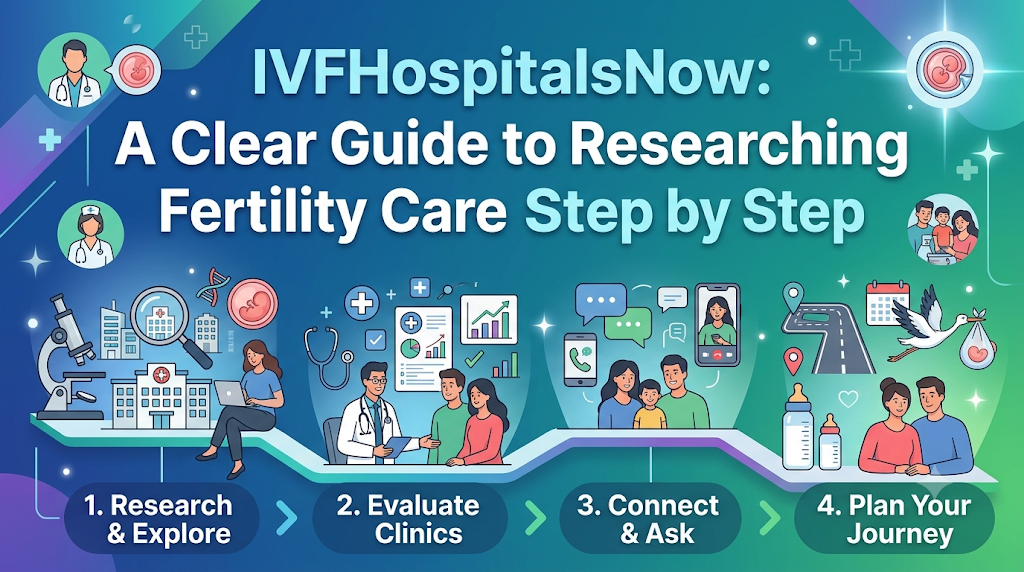
Practical Research Process
- Understand the concern and the treatment categories. Learn the basic terms and the main types of fertility care so you can follow what a doctor explains.
- Gather information on treatment, testing, costs, and outcomes. Write down what each source says and how it measured its numbers.
- Shortlist providers using clear information. Focus on verified details, openly shared costs, and services that match what you want to discuss.
- Compare several factors, not one number. Use the same list for every provider.
- Discuss everything with a qualified fertility specialist. Share your notes and let the doctor guide treatment decisions based on your medical situation.
Common Research Mistakes
- Comparing prices without checking what is included. A lower quote may leave out medicines, tests, or storage.
- Treating one success-rate number as a promise. It describes past patients, not your own outcome.
- Choosing a clinic only because of a high percentage. The number may count different outcomes or different patient groups.
- Ignoring provider verification. Unchecked information makes any comparison weaker.
- Comparing countries without thinking about rules and follow-up care. Cost is only one part of treatment abroad.
- Assuming the cheapest option means the lowest total cost. Extra cycles or added services can change the final amount.
- Assuming one treatment works the same for everyone. Medical situations differ.
- Relying on outdated or unsourced information. Fertility practices and prices change, so sources matter.
Realistic Example
Imagine a woman in her mid-thirties and her husband who have been trying to conceive for some time. Before booking a consultation, they read about the stages of IVF and learn the meaning of terms like ICSI and embryo transfer. They then collect price details from three providers in two countries. One quote is much lower than the others, but when they read the details, they find it excludes medicines and embryo freezing. Another clinic shows a success percentage, but it does not say whether it counts pregnancies or live births.
They create a simple table of what each quote includes, note which providers have clear verification information, and list the questions they still have. At the consultation, they share this with a fertility specialist, who explains which options fit their medical situation. The research did not choose a clinic for them. It helped them hold a more informed conversation.
Useful Comparison Table
| Research Factor | What to Check | Why It Matters |
|---|---|---|
| Treatment cost | What the quote includes and what is charged separately | Prices are only comparable when they cover the same services |
| Success-rate reporting | Age groups, outcome type, and the unit used (per cycle or per transfer) | Different measures cannot be compared directly |
| Provider verification | Whether the provider’s details are confirmed and sourced | Verified information makes comparison more reliable |
| Treatment availability | Whether the clinic offers the treatment you want to discuss | A good price does not help if the service is not offered |
| Location | Distance, travel time, and number of visits needed | Treatment often needs repeated appointments |
| Included services | Medicines, tests, monitoring, freezing, storage | Missing items can raise the final cost |
| Follow-up care | Support after treatment, especially across borders | Care continues after the procedure is done |
| Country regulations | Local rules on treatments and legal requirements | Rules decide what treatment is possible |
Frequently Asked Questions
What affects the cost of IVF?
The treatment type, medicines, tests, laboratory work, embryo freezing or storage, the number of cycles, the clinic’s location, and the way the package is structured can all change the price. Always ask what a quote covers.
How should IVF success rates be read?
Check which age group the figure covers, whether it counts pregnancies or live births, and whether it is per cycle or per transfer. A rate shows past results for a group, not a prediction for one person.
Does a higher success rate mean a better clinic?
Not automatically. Patient mix, reporting method, and treatment approach can all influence the figure. It should be read alongside other information.
What should I check about a clinic before contacting it?
Look at verification status, services offered, doctor qualifications, location, how clearly costs are shared, and whether outcome data is explained.
How can people compare fertility clinics fairly?
Use the same checklist for each one, covering services, costs, outcomes, verification, location, and support, instead of relying on one ranking or number.
What should I consider before looking at treatment in another country?
Think about legal rules, travel, language, follow-up care, record sharing, and what happens if more treatment is needed. A specialist’s evaluation should come first.
Why do prices differ so much between countries?
Healthcare systems, running costs, medicine prices, taxes, regulations, package contents, and exchange rates all play a part.
What is the difference between IVF and ICSI?
Both take place in a laboratory. With ICSI, a single sperm is injected into an egg, while in conventional IVF fertilization happens in a dish. Which is suitable depends on medical evaluation.
Conclusion
Good fertility research is patient and balanced. Reliable information, a clear understanding of what each treatment involves, careful attention to costs, and the right context for success numbers all help readers prepare. Comparing providers on several factors, and understanding how countries differ, makes that preparation stronger. The final step is always a conversation with a qualified medical professional who can look at the individual case. IVFHospitalsNow is there to support the research that comes before that conversation.