Introduction
Imagine an investor owns 100 shares of a company and receives an announcement that the company will issue bonus shares in a 1:1 ratio. At first glance, the announcement can sound like an instant financial benefit because the investor may soon see 100 additional shares in the demat account. This is where many beginners misunderstand the concept. A bonus issue increases the number of shares held, but it does not automatically double the investor’s wealth. The market price can adjust because the same underlying company is now represented by a larger number of outstanding shares.
Understanding how bonus shares work in stock market is therefore important before reacting to a corporate announcement. Beginners may see the word “bonus” and assume that the company is giving away additional value without any economic adjustment. In reality, a bonus issue is generally a capitalization of eligible reserves into share capital. It changes the number of shares and the accounting structure of the company’s equity while the market determines the post-bonus price.
The subject becomes even more important because investors need to understand several connected terms, including bonus ratio, record date, ex-bonus date, eligibility, adjusted market price, average cost, corporate actions and taxation. Confusion around any one of these can lead to poor decisions.
Understanding Bonus Shares in Simple Words
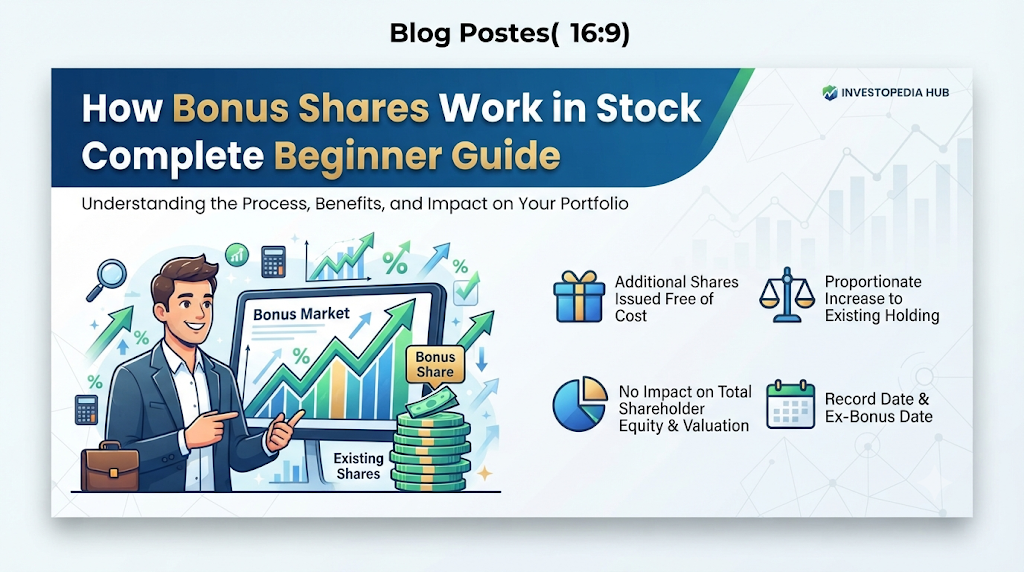
A bonus share is an additional equity share issued by a company to existing eligible shareholders without requiring them to make a separate payment for those new shares.
The company usually announces a specific ratio. For example, a 1:1 bonus means an eligible shareholder receives one additional share for every one share already held. A 1:2 ratio generally means one additional share for every two existing shares.
The shares are generally issued by capitalizing eligible reserves rather than by collecting fresh cash from shareholders. SEBI’s regulatory framework permits bonus issues subject to applicable conditions, including requirements concerning the sources from which the bonus issue is made.
A Simple Example
Suppose an investor owns:
- 100 shares before the bonus
- Bonus ratio: 1:1
- Bonus shares received: 100
- Total shares after the bonus: 200
The investor has twice as many shares.
However, it would be incorrect to conclude that the investor has automatically doubled the investment value.
Suppose the pre-bonus market price was ₹500.
The approximate theoretical post-bonus price for a 1:1 issue could be around ₹250, ignoring market movements and other factors.
Before the adjustment:
100 × ₹500 = ₹50,000
After the adjustment:
200 × ₹250 = ₹50,000
The actual market price can differ because the stock continues to trade based on demand, supply, expectations, company performance and market conditions.
The Common Misunderstanding
The word “bonus” makes the transaction sound like a cash gift.
It is better to think of it as a restructuring of the shareholding units. The investor receives more units, but the market adjusts the value represented by each unit.
Practical Takeaway
When a company announces bonus shares, look beyond the additional number of shares. Examine the company’s financial position, valuation, business quality and long-term prospects.
Why Bonus Shares Are Important for Investors
Bonus issues matter because they can affect the way an investor’s portfolio looks and how the market values each individual share.
The first visible impact is the increase in share quantity. An investor holding 100 shares may hold 200 after a 1:1 bonus, assuming eligibility and successful allotment.
The second impact is the adjustment in the per-share market price. Because the number of shares increases, the market price generally adjusts downward in proportion to the bonus ratio, although actual market movements can produce a different price.
The third impact concerns the investor’s records. Investors need to keep accurate information about original shares, bonus shares, acquisition dates and applicable tax treatment.
The fourth impact is psychological. A lower post-bonus price can make a stock appear more affordable. That does not necessarily mean the company has become cheaper on a valuation basis.
For example, a company trading at ₹1,000 before a 1:1 bonus may trade around a theoretically adjusted ₹500 after the bonus, all else being equal. A beginner might say, “The stock has become half-price.” That statement is incomplete. The investor must also recognize that the number of shares has doubled.
Practical Scenario
An investor sees a company announce a 2:1 bonus. Instead of immediately buying, the investor checks:
- Why the company is issuing the bonus
- The company’s financial performance
- Existing valuation
- Debt and cash position
- Business prospects
- Corporate announcements
- Relevant record-date information
- Personal investment objective
This approach is more useful than buying purely because the word “bonus” appears in the announcement.
The Real Problem Investors Face With Bonus Shares
The biggest difficulty is usually not the calculation. It is misunderstanding what the calculation means.
Online discussions often describe bonus shares as “free shares.” While that description may help explain the mechanics, it can also create the wrong expectation that an investor has received free additional wealth.
Beginners may also confuse a bonus issue with:
- Dividend
- Stock split
- Rights issue
- Buyback
- Special dividend
- Fresh capital raising
These corporate actions have different purposes and economic effects.
Another problem is focusing entirely on eligibility.
An investor may think:
“If I buy the stock before the record date, I will definitely make money.”
That conclusion is unsafe.
Eligibility only addresses whether the investor qualifies for the corporate action. It does not determine whether the stock will generate a profit afterward.
Common Information Problems
Investors can also become confused about:
- Record date
- Ex-bonus date
- Cum-bonus trading
- Credit of shares
- Trading availability
- Adjusted price
- Cost records
- Tax treatment
Corporate-action processing has also become more streamlined. SEBI’s framework provides for bonus shares to be made available for trading on the next working date of allotment under the applicable process, with the record date designated as T day and the next working day as the deemed allotment date.
Better Approach
Treat a bonus announcement as information about a corporate action, not as an investment recommendation.
How Bonus Shares Work Step by Step
Step 1: The Company Announces a Bonus Issue
The process begins when a company announces that it proposes to issue bonus shares.
The announcement normally specifies the proposed bonus ratio and relevant corporate-action details. The company must follow applicable corporate, securities and exchange requirements.
Why it matters: The announcement tells investors what corporate action is being proposed, but it does not automatically mean the investor will receive shares immediately.
Practical example: A company announces a 1:2 bonus. An investor should understand that the proposed issue means one bonus share for every two existing eligible shares.
Common mistake: Assuming the bonus shares are immediately available for trading.
Better approach: Read the official corporate-action announcement and track the relevant dates.
Step 2: The Bonus Ratio Is Understood
The ratio determines how many additional shares an eligible investor receives.
For example:
- 1:1 means one bonus share for every one existing share.
- 1:2 means one bonus share for every two existing shares.
- 2:1 means two bonus shares for every one existing share.
Why it matters: The ratio determines the change in share quantity.
Practical example: With 300 eligible shares under a 1:2 ratio, the investor would generally receive 150 bonus shares.
Common mistake: Reading 1:2 as two bonus shares for every one existing share.
Better approach: Always read the ratio as “bonus shares : existing shares.”
Step 3: The Record Date Is Established
The record date is the date used to determine which shareholders are entitled to receive the corporate benefit.
Investors should not rely on guesswork when determining eligibility.
Why it matters: Missing the relevant eligibility requirement can mean that an investor does not receive the bonus.
Practical example: If a company publishes a specific record date, the investor should verify the applicable trading and settlement requirements rather than simply assuming that buying around the announcement is sufficient.
Common mistake: Buying on the announcement date and assuming that automatically guarantees eligibility.
Better approach: Check the company’s exchange filing and the applicable market settlement rules.
Step 4: Eligible Holdings Are Determined
Once the relevant eligibility process is completed, the number of bonus shares is calculated according to the announced ratio.
Why it matters: Your existing eligible shareholding determines the number of bonus shares.
Practical example: An investor with 500 eligible shares under a 1:1 bonus may receive 500 additional shares.
Common mistake: Assuming the bonus is based on the amount of money invested.
Better approach: Calculate it based on the number of eligible shares.
Step 5: Bonus Shares Are Allotted
The company and relevant market infrastructure process the bonus allotment.
The additional shares may appear in the investor’s demat account according to the applicable corporate-action timeline.
Why it matters: Allotment and trading availability are separate concepts.
Practical example: An investor sees a corporate-action update and later sees the additional securities credited.
Common mistake: Assuming a corporate announcement immediately means the shares can be sold.
Better approach: Wait for the applicable allotment and trading status.
Step 6: The Market Price Adjusts
This is one of the most important parts of understanding bonus shares.
When the number of shares increases, the per-share price generally adjusts to reflect the increased share count.
For a 1:1 bonus, the theoretical price can be approximately half the previous price, ignoring market movement.
Why it matters: It explains why receiving additional shares does not automatically double wealth.
Practical example: 100 shares at ₹600 represent ₹60,000. After a 1:1 bonus, 200 shares might theoretically trade around ₹300, still representing ₹60,000 before other market movements.
Common mistake: Looking only at the share quantity.
Better approach: Always consider total portfolio value along with share quantity and price.
Step 7: The Investor Reviews the Investment
After the corporate action, the investor should reassess the holding rather than automatically selling or buying more.
Why it matters: A bonus issue does not change every aspect of the company’s business.
Practical example: If the company’s earnings, debt, competitive position and valuation remain attractive, an investor may continue following the original investment thesis.
Common mistake: Treating the bonus as a reason by itself to hold or sell.
Better approach: Return to the original investment thesis and update it using current information.
Step 8: Tax and Record-Keeping Are Considered
Investors should maintain accurate records for tax reporting and future transactions.
Bonus shares can have specific tax implications, particularly when they are later sold. Investors should not assume that the accounting cost is the same as the market price at the time of receipt.
Why it matters: Incorrect records can create problems when calculating gains later.
Practical example: An investor receives bonus shares and keeps the corporate-action statement and relevant transaction records.
Common mistake: Deleting old purchase records after receiving bonus shares.
Better approach: Preserve original purchase documents, bonus allotment records and broker statements.
Key Factors That Influence a Bonus Issue
Bonus Ratio
The ratio determines the number of additional shares received. A larger ratio means a larger change in the number of shares, but not automatically a larger economic benefit.
Company’s Reserves
A bonus issue generally involves capitalization of eligible reserves into share capital. Investors should understand that the transaction is linked to the company’s capital structure rather than being a cash payment.
Record Date
The record date determines the relevant shareholder entitlement process. Investors should verify the company’s official announcement rather than relying on social media posts.
Ex-Bonus Adjustment
The market price can adjust to reflect the increased number of shares. This is why comparing the pre-bonus and post-bonus prices without considering the ratio can be misleading.
Company Fundamentals
A bonus issue does not automatically improve:
- Revenue quality
- Profitability
- Cash flow
- Competitive position
- Debt management
- Business prospects
Investors should therefore continue analyzing the company.
Market Sentiment
Even after an expected adjustment, actual prices can move because investors react to earnings, economic conditions, news and expectations.
Investor Time Horizon
Someone investing for several years may evaluate the company very differently from a short-term trader focused on price movements around the corporate action.
Tax and Record Requirements
Investors should understand the applicable tax treatment and preserve appropriate records. Tax rules can change, so current official guidance should be checked before filing.
Detailed Breakdown of Bonus Shares
Bonus Shares and Company Capital Structure
A company has different components within its equity structure. When eligible reserves are capitalized into share capital, the number of equity shares can increase.
The investor receives additional shares without making a separate payment for those bonus shares.
This does not mean that the company has suddenly received additional cash from the shareholder.
The transaction is therefore different from a fresh issue in which investors subscribe by paying money for newly issued shares.
Bonus Shares and Market Value
Consider a simplified example.
An investor owns 1,000 shares at ₹400 each.
The holding is worth:
1,000 × ₹400 = ₹4,00,000
Now suppose the company declares a 1:1 bonus.
The investor may receive another 1,000 shares.
Total shares become:
2,000 shares
If the market price theoretically adjusts to ₹200, the holding would still represent approximately:
2,000 × ₹200 = ₹4,00,000
This is a simplified illustration. Actual market prices can move above or below the theoretical level.
The important concept is that more shares do not automatically mean more wealth.
Why Companies Issue Bonus Shares
Companies may consider bonus issues for several corporate and capital-structure reasons.
A bonus issue can increase the number of shares available in the market and reduce the nominal trading price per share after adjustment.
It can also signal that the company has accumulated eligible reserves that can be capitalized.
However, investors should not interpret every bonus issue as proof that the company is financially superior to other companies.
The underlying business remains the key consideration.
Bonus Shares vs Dividend
A dividend generally represents a distribution of money to eligible shareholders, subject to the company’s declaration and applicable rules.
A bonus issue provides additional shares instead.
This means the immediate experience is very different.
With a dividend, the investor may receive a cash amount.
With a bonus issue, the investor receives additional securities.
Neither should automatically be described as “better.” Their effects and purposes are different.
Bonus Shares vs Stock Split
Bonus shares and stock splits can both increase the number of shares held by an investor, but they are not the same corporate action.
A stock split changes the face value structure of existing shares and increases the number of shares accordingly.
A bonus issue generally capitalizes eligible reserves and issues additional shares to eligible shareholders.
The accounting mechanics and corporate purposes differ even though both can result in a lower per-share market price.
Bonus Shares vs Rights Issue
A rights issue gives eligible shareholders an opportunity to subscribe to additional shares, normally at specified terms and for consideration.
A bonus issue does not require the eligible shareholder to make a separate payment for the bonus shares.
The investor therefore needs to understand whether an announcement refers to a bonus, rights issue, split or another corporate action.
Bonus Shares and Cost of Acquisition
Tax treatment is an important area where investors should avoid assumptions.
Bonus shares can have a specific tax cost treatment when they are eventually sold. Under the applicable tax framework, the cost treatment of bonus shares is not necessarily the market value on the date they are credited.
This is one reason investors should preserve corporate-action records and verify current tax rules before filing returns.
The Income Tax Department’s current filing materials continue to require appropriate capital-gains information, including cost of acquisition, when relevant.
For significant transactions, a qualified tax professional can help determine the correct treatment based on the investor’s circumstances.
Does a Bonus Issue Make a Stock Cheaper?
Not automatically.
The market price per share can become lower after the bonus adjustment because there are more shares representing the company’s equity.
A lower price per share should not be confused with a lower valuation.
For example, a company at ₹1,000 that becomes ₹500 after a 1:1 bonus has not automatically become “50% cheaper” in economic terms.
The number of shares has also doubled.
Does a Bonus Issue Guarantee Profit?
No.
A bonus issue itself does not guarantee a return.
The market price can rise, fall or remain volatile after the corporate action.
An investor should therefore evaluate the company rather than buying solely because a bonus issue has been announced.
Common Mistakes Beginners Make With Bonus Shares
Mistake 1: Thinking Bonus Means Free Wealth
The additional shares do not automatically create equivalent additional wealth.
Better approach: Calculate both the new share count and the adjusted value.
Mistake 2: Buying Only Because of the Bonus Announcement
A bonus announcement can attract attention, but attention is not the same as investment quality.
Better approach: Study the company’s fundamentals and valuation.
Mistake 3: Ignoring the Record Date
Investors may misunderstand eligibility if they rely on informal posts.
Better approach: Verify the official corporate-action information.
Mistake 4: Confusing Bonus Shares With Dividends
Additional shares are not the same as receiving cash.
Better approach: Understand the corporate action before making a decision.
Mistake 5: Confusing Bonus Issues With Stock Splits
Both can increase share quantity, but their mechanics differ.
Better approach: Learn the purpose and structure of each action.
Mistake 6: Assuming the Price Must Rise After the Bonus
There is no such guarantee.
Better approach: Treat future price movement as uncertain.
Mistake 7: Ignoring Tax Records
Investors may forget to preserve the details needed when shares are later sold.
Better approach: Keep purchase and corporate-action records together.
Mistake 8: Following Social Media Tips
Messages such as “buy before bonus and double your money” are not reliable investment analysis.
Better approach: Verify information through official company and exchange disclosures.
Mistake 9: Looking Only at Share Quantity
Seeing the number of shares double can create a false sense of wealth.
Better approach: Monitor total investment value.
Mistake 10: Making an Emotional Decision
Excitement around a corporate action can lead to impulsive buying or selling.
Better approach: Follow a written investment plan.
Don’t Do This Checklist
- Do not assume bonus shares guarantee profit.
- Do not buy solely because a company announced a bonus.
- Do not ignore the record date.
- Do not confuse bonus shares with dividends.
- Do not delete old investment records.
- Do not trust guaranteed-return claims.
- Do not use emergency funds based on a bonus announcement.
- Do not rely entirely on social media recommendations.
- Do not ignore applicable tax requirements.
- Do not confuse a lower share price with a cheaper valuation.
Practical Real-Life Examples of Bonus Shares
Example 1: Salaried Investor
A salaried employee owns 200 shares of a company that announces a 1:1 bonus. The investor initially thinks the holding will double in value. After learning about price adjustment, the investor understands that the share count can double while the per-share price can adjust.
Learning: More shares do not automatically mean more wealth.
Example 2: New Investor
A new investor sees social media posts encouraging people to buy before the record date. Instead of immediately buying, the investor checks the company’s financial performance and the official corporate-action announcement.
Learning: Corporate actions should be evaluated alongside fundamentals.
Example 3: Long-Term Investor
An investor has held a company for several years and receives bonus shares. Rather than selling immediately, the investor updates the portfolio records and reviews whether the original investment thesis remains valid.
Learning: A bonus issue is an event to review, not necessarily a reason to exit.
Example 4: Short-Term Trader
A trader expects the stock to rise because of the bonus announcement. The market instead moves lower because of broader sentiment and valuation concerns.
Learning: Corporate actions cannot predict short-term market direction.
Example 5: Tax-Conscious Investor
An investor receives bonus shares but does not record the corporate-action details. Several years later, the investor sells the shares and struggles to reconstruct the required information.
Learning: Good record keeping should begin when the shares are received, not when they are sold.
Two Useful Tables for Better Understanding
Bonus Ratio and Shareholding Example
| Bonus Ratio | Existing Shares | Additional Shares | Total Shares After Bonus |
|---|---|---|---|
| 1:1 | 100 | 100 | 200 |
| 1:2 | 100 | 50 | 150 |
| 2:1 | 100 | 200 | 300 |
| 3:1 | 100 | 300 | 400 |
These are mathematical illustrations only. Actual eligibility depends on the company’s announced corporate action and applicable market rules.
Bonus Shares Compared With Other Corporate Actions
| Corporate Action | What Investor Receives | Separate Payment Usually Required | Main Point to Understand |
|---|---|---|---|
| Bonus Issue | Additional shares | No | Existing eligible holders receive shares according to the announced ratio |
| Dividend | Cash distribution | No | Investor receives money rather than additional shares |
| Stock Split | More shares with adjusted face value | No | Existing shares are divided into a larger number of shares |
| Rights Issue | Opportunity to subscribe to shares | Yes, generally | Eligible holders can buy additional shares under specified terms |
| Buyback | Cash consideration for shares tendered and accepted | No | Company purchases shares under the applicable buyback process |
Tools, Methods, and Frameworks Readers Can Use
Corporate Action Tracker
Maintain a simple list of company announcements, record dates, bonus ratios and allotment information.
Why it helps: It reduces confusion when several corporate actions occur at once.
Mistake avoided: Relying on memory or social media posts.
Shareholding Calculator
Use a simple calculator or spreadsheet to determine how many bonus shares may be received.
Why it helps: It makes ratios easier to understand.
Mistake avoided: Misreading a 1:2 ratio as 2:1.
Portfolio Review Sheet
Record:
- Original shares
- Bonus shares
- Total shares
- Average cost information
- Current market value
- Investment objective
Why it helps: It provides a complete view instead of focusing on share quantity.
Investment Journal
Write down why the investment was originally made and whether the reasons remain valid after the bonus issue.
Why it helps: It prevents emotional reactions.
Mistake avoided: Selling or buying simply because the share count changed.
Risk Checklist
Before making a decision, review:
- Company fundamentals
- Valuation
- Debt
- Earnings quality
- Market conditions
- Investment horizon
- Personal risk tolerance
Why it helps: It keeps the corporate action in its proper context.
Tax Record Folder
Keep purchase contracts, broker statements, corporate-action statements and other relevant records.
Why it helps: Accurate records can simplify future capital-gains calculations and tax filing.
Expert Tips to Make Better Decisions
1. Understand the Ratio First
Do not make a decision until you can calculate the additional shares. A basic ratio mistake can distort your expectations.
2. Look at Total Value
Always multiply your total shares by the market price when assessing the portfolio. Share quantity alone can be misleading.
3. Separate Corporate Action From Investment Quality
A bonus issue tells you something about the company’s capital structure, but it does not automatically tell you whether the stock is attractively valued.
4. Check Official Announcements
Corporate-action dates can be important. Use reliable company and exchange disclosures rather than forwarded messages.
5. Understand Price Adjustment
A lower post-bonus price is often a normal part of the adjustment process. Do not automatically interpret it as a loss caused by poor business performance.
6. Preserve Records
Keep documentation from the original purchase and bonus allotment. It can become important when shares are eventually sold.
7. Do Not Chase the Announcement
If the only reason for buying is “bonus shares are coming,” stop and reassess the investment thesis.
8. Compare Valuation Properly
Compare valuation measures on an appropriately adjusted basis. A lower nominal share price does not automatically mean the stock is undervalued.
9. Keep Your Time Horizon Clear
Short-term trading around corporate actions and long-term investing are different approaches. Know which one you are actually following.
10. Avoid Guaranteed-Profit Claims
No bonus issue can guarantee a future market return. Treat such claims as a warning sign.
11. Separate Emergency Money
Do not use money needed for essential expenses simply because a corporate action appears attractive.
12. Review Fundamentals
Study earnings, cash flows, debt, business prospects and competitive position rather than focusing only on the bonus.
13. Understand Tax Treatment
Tax rules can be technical and may change. Verify current rules before filing or making decisions based on expected tax outcomes.
14. Do Not Confuse Price With Value
A stock trading at a lower nominal price after a bonus is not necessarily more affordable from a valuation perspective.
15. Ask for Professional Help When Necessary
If the investment is large, tax circumstances are complicated or you are uncertain about regulatory requirements, consider speaking with a qualified professional.
Case Studies: How Better Understanding Changes Decisions
Case Study 1: The Investor Who Expected Double Wealth
Profile: A salaried investor holds 500 shares.
Situation: The company announces a 1:1 bonus.
Problem: The investor assumes that 1,000 shares will mean twice the investment value.
Wrong Approach: The investor starts planning expenses around the expected increase in wealth.
Better Approach: The investor calculates the theoretical price adjustment and understands that doubling the share count does not automatically double portfolio value.
Result or Learning: The investor avoids treating a corporate action as guaranteed wealth.
Key Takeaway: Always consider share quantity and price together.
Case Study 2: The Investor Who Bought Only for the Bonus
Profile: A beginner follows stock-market discussions online.
Situation: A company announces a bonus issue and social media posts encourage buying before the relevant date.
Problem: The investor has not studied the company.
Wrong Approach: Buying solely because a bonus is expected.
Better Approach: The investor reviews financial performance, valuation, debt, business prospects and personal investment objectives.
Result or Learning: The investor recognizes that the corporate action alone cannot establish whether the stock is a suitable investment.
Key Takeaway: A bonus announcement is not a substitute for investment research.
Case Study 3: The Investor Who Ignored Records
Profile: A long-term investor receives bonus shares and keeps holding them for several years.
Situation: The investor eventually decides to sell part of the holding.
Problem: The investor cannot easily locate the original purchase and bonus-allotment information.
Wrong Approach: Assuming the broker’s current portfolio screen contains every historical detail needed.
Better Approach: Maintain transaction and corporate-action records from the beginning.
Result or Learning: Better documentation makes future tax and portfolio review easier.
Key Takeaway: Corporate-action records are part of responsible investing.
Risk Awareness: What Investors Must Check First
Market Risk
The stock price can decline after a bonus issue.
How to reduce the risk: Avoid assuming that the corporate action predicts future returns.
Valuation Risk
A stock may appear cheaper because its per-share price has adjusted, while its underlying valuation remains high.
How to reduce the risk: Evaluate valuation using appropriate financial measures.
Volatility Risk
Prices can move sharply around corporate announcements.
How to reduce the risk: Avoid emotional decisions based on short-term price movements.
Misinformation Risk
Social media can contain incorrect record dates, bonus ratios or exaggerated profit claims.
How to reduce the risk: Verify corporate-action information from reliable official disclosures.
Tax Risk
Incorrect understanding of tax treatment can lead to reporting problems.
How to reduce the risk: Keep records and verify current tax rules.
Liquidity Risk
A stock may not always trade with the liquidity an investor expects.
How to reduce the risk: Consider trading activity and your ability to exit without excessive market impact.
Emotional Risk
The word “bonus” can create excitement and unrealistic expectations.
How to reduce the risk: Use a written investment plan.
Company-Specific Risk
A bonus issue does not protect an investor from weak earnings, business problems or governance concerns.
How to reduce the risk: Continue fundamental research after the corporate action.
Data and Privacy Risk
Investors may encounter fraudulent websites or messages asking for personal or financial information.
How to reduce the risk: Do not share passwords, OTPs, PINs or sensitive financial credentials in response to unsolicited messages.
Checklist Before Taking Action
Before buying, selling or changing your investment because of a bonus issue, review the following:
- I understand the bonus ratio.
- I know how many additional shares I may receive.
- I have verified the relevant corporate-action information.
- I understand the record-date process.
- I understand that the share price may adjust.
- I have considered total portfolio value.
- I have reviewed the company’s fundamentals.
- I have considered valuation.
- I am not relying on guaranteed-profit claims.
- I am not using emergency funds for the decision.
- I have reviewed my investment horizon.
- I understand the difference between a bonus and a stock split.
- I understand the difference between a bonus and a dividend.
- I will maintain appropriate transaction records.
- I will verify applicable tax treatment.
- I will seek professional advice if my circumstances require it.
The checklist should be used as a pause point before action. Its purpose is not to predict the stock’s future price. Instead, it helps ensure that the decision is based on understanding rather than excitement.
Strategic Insights for Better Decision-Making
Think in Terms of Total Portfolio Value
A professional approach focuses on the total value of the holding rather than simply counting shares.
If the share quantity increases but the price adjusts proportionately, the immediate economic value may remain broadly similar before other market movements.
Review the Original Investment Thesis
Ask why you bought the company in the first place.
Was the decision based on:
- Business growth?
- Financial strength?
- Competitive advantage?
- Valuation?
- Long-term opportunity?
If those reasons remain valid, the bonus does not necessarily change the investment decision.
Avoid Herd Mentality
A bonus announcement can attract a large amount of online attention.
Investors should avoid assuming that a popular stock is automatically a good investment.
Market popularity and investment suitability are different concepts.
Understand Adjusted Prices
Historical price charts can sometimes require interpretation after corporate actions.
Comparing an old unadjusted price directly with a post-bonus price can produce misleading conclusions.
Investors should use appropriately adjusted information when evaluating historical performance.
Consider Position Size
A bonus increases the number of shares in the portfolio. Investors should continue thinking about how large that position is relative to the overall portfolio.
A corporate action should not automatically cause an investor to become overexposed to one company.
Maintain Investment Discipline
The best response to a corporate action is usually not an emotional reaction.
Understand the event, verify the details, evaluate the company and then decide whether any action is actually necessary.
Key Terms Explained for Beginners
- Bonus Share: An additional equity share issued to eligible existing shareholders without requiring a separate payment for the bonus shares.
- Bonus Issue: A corporate action through which a company issues additional shares to eligible shareholders according to an announced ratio.
- Bonus Ratio: The relationship between bonus shares and existing shares, such as 1:1 or 1:2.
- Record Date: The date used to determine shareholder eligibility for a corporate action.
- Ex-Bonus Date: The date from which the security trades without the entitlement to the upcoming bonus under the applicable market process.
- Cum-Bonus: A security trading with the entitlement to the relevant corporate action.
- Corporate Action: An event initiated by a company that affects shareholders or securities, such as dividends, bonuses, splits or rights issues.
- Market Price: The price at which the stock is trading in the market.
- Face Value: The nominal value assigned to a share for corporate and accounting purposes.
- Market Capitalization: The market value of a company’s outstanding equity shares.
- Demat Account: An electronic account used to hold securities.
- Capitalization of Reserves: The process of converting eligible reserves into share capital as part of a corporate action such as a bonus issue.
- Stock Split: A corporate action that divides existing shares into a larger number of shares while adjusting the face value per share.
- Rights Issue: An offer that gives eligible shareholders an opportunity to subscribe to additional shares under specified terms.
- Capital Gain: The gain or loss arising when an investment is sold for a different amount from its relevant cost basis, subject to applicable tax rules.
Who Should Read This Blog
Beginners
New investors can use this guide to understand bonus ratios, eligibility and price adjustment without relying on complicated market terminology.
Students
Students learning about equity markets can use bonus shares as a practical example of corporate actions and capital structure.
Salaried Employees
Salaried investors can better understand what happens when companies in their portfolios announce bonus issues.
Small Business Owners
Business owners who invest surplus funds can use the framework to evaluate corporate actions more carefully.
New Investors
New investors can avoid the common mistake of assuming that additional shares automatically mean additional wealth.
Traders
Traders can use the information to understand why corporate actions can affect price calculations and market behavior.
Loan Seekers
People managing borrowing alongside investments should understand that a bonus issue does not create guaranteed liquidity or repayment capacity.
Crypto Learners
Investors moving between asset classes can use the same principle of understanding structure, risk and valuation rather than relying on promotional claims.
Finance Bloggers
Finance writers can use accurate terminology when explaining bonus issues to readers.
Finance Content Creators
Content creators can explain corporate actions responsibly without making unsupported return claims.
People Improving Money Awareness
Anyone trying to make more informed financial decisions can benefit from understanding how corporate actions affect investments.
People Trying to Avoid Financial Mistakes
Readers who want to reduce emotional investing and misinformation risk can use the checklist and examples as a decision framework.
Frequently Asked Questions
1. What are bonus shares?
Bonus shares are additional shares issued by a company to eligible existing shareholders without requiring them to make a separate payment for those shares. They are normally issued according to a predetermined ratio.
2. How bonus shares work in stock market for beginners?
An eligible shareholder receives additional shares according to the announced bonus ratio. The share price generally adjusts to reflect the increased number of shares, so receiving more shares does not automatically mean the investment value doubles.
3. What does a 1:1 bonus share mean?
A 1:1 bonus generally means one additional share is issued for every one eligible existing share. For example, someone holding 100 eligible shares may receive 100 bonus shares and have 200 shares afterward.
4. Do bonus shares increase investor wealth immediately?
Not necessarily. The number of shares increases, but the market price generally adjusts because the company’s equity is represented by more shares. Future wealth depends on subsequent market performance and the underlying company.
5. What is the bonus share record date?
The record date is used to determine which shareholders are eligible for the corporate action. Investors should verify the applicable record date and settlement requirements through reliable official information.
6. Are bonus shares the same as dividends?
No. A dividend generally involves a distribution of money, while a bonus issue provides additional shares. They have different purposes and effects on an investor’s portfolio.
7. Are bonus shares the same as stock splits?
No. Both can increase the number of shares, but their corporate and accounting mechanics differ. A bonus issue generally involves capitalization of eligible reserves, while a split changes the denomination structure of existing shares.
8. Can investors make guaranteed profits from bonus shares?
No. A bonus issue does not guarantee profit. The stock price can rise, fall or remain volatile after the corporate action, depending on market and company-specific factors.
9. How should beginners evaluate a bonus announcement?
Beginners should first understand the ratio, eligibility and price adjustment. They should then review the company’s fundamentals, valuation, investment objective, risk tolerance and relevant tax considerations.
10. Are bonus shares taxable?
The tax treatment of receiving and later selling bonus shares can involve specific rules. Investors should not assume that the market value at the time of receipt automatically becomes the tax cost. Current tax rules should be verified before filing.
11. Should investors buy a stock because it announces a bonus?
A bonus announcement alone should not be treated as a reason to buy. Investors should evaluate the business, valuation, financial performance and personal investment objectives before making a decision.
12. What is the best next step after learning how bonus shares work in stock market?
The best next step is to understand the specific corporate announcement, verify the applicable dates and ratio, review the company’s fundamentals, maintain proper records and avoid decisions based only on the word “bonus.”
Conclusion
Understanding how bonus shares work in stock market becomes much easier once investors stop viewing the word “bonus” as an automatic profit signal and start viewing it as a corporate action that changes the number of shares they own. A company may issue additional shares to eligible shareholders according to a predetermined ratio, but the market price generally adjusts to reflect the larger number of outstanding shares. This means an investor can hold more shares without immediately having proportionately more wealth. The real value of the investment continues to depend on the company’s performance, valuation, market conditions and the investor’s overall strategy. For beginners, the most important step is to understand the bonus ratio correctly. A 1:1 bonus, for example, means one additional share for each eligible existing share, while a 1:2 ratio means one additional share for every two eligible shares. Investors should also understand the record date and applicable settlement process rather than relying on social media messages or informal market discussions. Another important lesson is that bonus shares should not be confused with dividends, stock splits or rights issues. Each corporate action has different mechanics and implications. Investors should also preserve purchase records and corporate-action statements because these details can become important when securities are sold and tax calculations are required. A responsible investor does not buy a stock simply because a bonus has been announced. Instead, the investor asks whether the underlying business is financially sound, whether the valuation is reasonable, whether the investment fits the portfolio and whether the associated risks are acceptable. Emotional reactions can be particularly dangerous around highly discussed corporate actions because online conversations can create expectations of easy or guaranteed gains. No bonus issue can guarantee a future return. Market prices remain uncertain and can be affected by earnings, economic conditions, investor sentiment and company-specific developments.