Introduction
Getting started in the stock market often feels like learning a new language. You hear terms like day trading, scalping, swing trading, and positional trading, and it is easy to wonder if they all mean the same thing.
The main difference comes down to time. How long do you want to keep your money locked into a stock?
Many beginners jump into trading without understanding how holding time affects stress, profits, and daily routines. Choosing the wrong style can lead to staring at computer screens all day while ignoring your regular job, or panicking when a short-term trade moves against you. This guide breaks down positional trading and swing trading in plain English, helping you see how they work, where they differ, and which path matches your real life.
What Is Swing Trading?
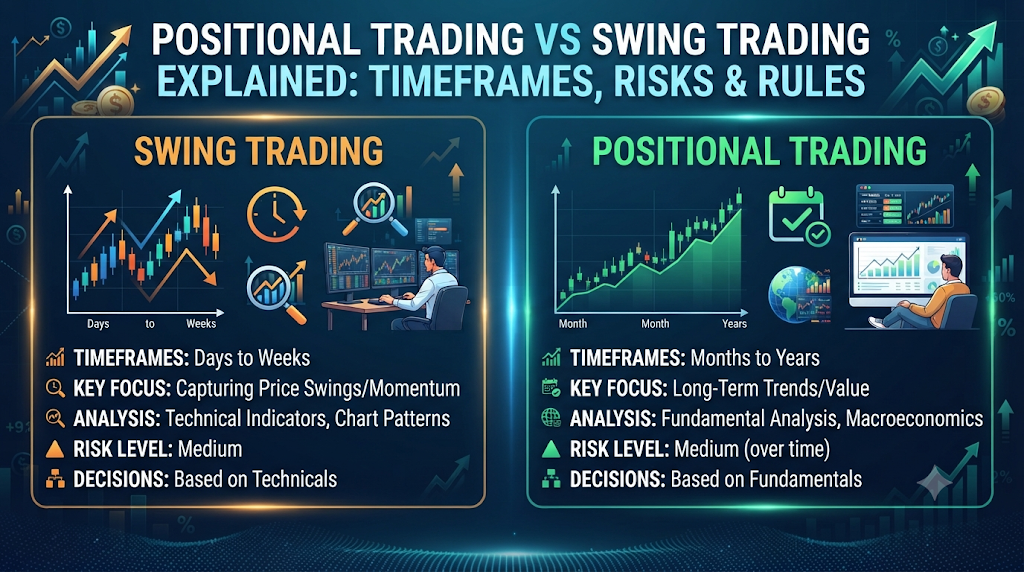
Swing trading is a style where you buy or short-sell a stock and hold it for a few days to a few weeks.
Why Does It Matter?
Markets rarely move in a straight line. Even in a strong upward trend, prices zig-zag up and down. Swing traders try to catch these individual “swings.” They buy when a stock dips to a temporary low (support) and sell when it reaches a temporary high (resistance).
How It Works
A swing trader looks at daily charts. They use technical analysis—such as moving averages or momentum indicators—to find stocks that are ready to bounce.
- Timeframe: 2 days to 4 weeks.
- Goal: Capture quick, medium-sized price moves without committing to a multi-month hold.
- Example: You notice shares of a retail company pulling back slightly to a major moving average line. You buy the stock on Tuesday, expecting buyers to step back in. Two weeks later, the price climbs 8%, and you sell to lock in your profit.
What Is Positional Trading?
Positional trading is a longer-term strategy where you hold stocks for several weeks, months, or even a year.
Why Does It Matter?
While swing traders focus on short-term price waves, positional traders look at the bigger picture. They ride major market trends. This approach requires patience because you ignore daily price noise and minor market bumps.
How It Works
Positional traders look at both technical charts (weekly and daily trends) and fundamental factors (company earnings, industry growth, and economic health). They want to buy a strong company when it starts a major upward trend and stay in the trade as long as that trend remains intact.
- Timeframe: 1 month to several months.
- Goal: Profit from large, sustained market movements.
- Example: A tech hardware company launches a popular new product, and its quarterly earnings beat expectations. A positional trader buys the stock as it breaks out to a new high, ignoring daily ups and downs, and holds it for six months as the broader trend moves higher.
Key Differences Between Positional Trading and Swing Trading
| Feature | Swing Trading | Positional Trading |
| Holding Period | Days to a few weeks | Weeks to several months |
| Chart Timeframe | Daily charts (and hourly charts) | Daily and weekly charts |
| Time Commitment | Moderate to high (daily monitoring) | Low (weekly or end-of-day reviews) |
| Main Focus | Technical price swings and momentum | Major trends and business momentum |
| Trade Frequency | Higher number of trades per year | Lower number of trades per year |
| Stress Level | Higher (prices move fast in the short term) | Lower (daily noise is ignored) |
Practical Examples: A Day in the Life
To understand how these strategies look in practice, consider two investors with different routines.
The Swing Trader: Rohit
Rohit works a standard 9-to-5 job, but he loves analyzing charts. Every evening after dinner, he opens his trading platform. He scans 50 stocks looking for chart patterns where a stock has dipped temporarily. He places limit orders for the next morning. During his lunch break at work, he quickly checks his phone to see if any of his positions hit their target or need a stop-loss adjustment. He typically closes his trades within 10 days.
The Positional Trader: Priya
Priya is a busy project manager who does not have time to look at stock charts during the work week. Instead, she reviews the markets on Sunday evening. She looks at weekly charts of strong industries, checks upcoming company earnings reports, and buys stocks breaking into long-term upward trends. She sets a safety stop-loss order with her broker and leaves the trade alone for months, only checking in once a week.
Common Mistakes to Avoid
1. Turning a Swing Trade into a Positional Trade
This is a classic beginner trap. A swing trader buys a stock for a quick 5-day bounce. The stock drops instead. Instead of cutting losses, the trader says, “I will just become a positional trader and hold it for the long term.”
- The Fix: Decide your timeframe before you enter the trade. If a short-term trade fails, exit according to your plan rather than changing your rules halfway through.
2. Ignoring Overall Market Direction
Buying a stock during a severe market downturn is like trying to swim up a waterfall.
- The Fix: Always check the direction of the broader market index (like the S&P 500 or Nifty) before entering any swing or positional trade. Trading with the overall market trend increases your odds of success.
3. Over-Trading Swing Positions
Because swing trading involves shorter timeframes, beginners often get tempted to open too many positions at once, leading to high transaction costs and emotional fatigue.
- The Fix: Quality matters more than quantity. Focus on 2 to 4 solid setups rather than spreading your capital across 15 weak trades.
Risks and Limitations
Every trading style carries distinct risks that you must manage carefully.
- Market Gaps (Positional Risk): Positional traders hold stocks overnight and over weekends. If unexpected bad news breaks on a Saturday (such as a regulatory crackdown or sudden geopolitical conflict), the stock can open significantly lower on Monday, bypassing your stop-loss order.
- False Breakouts (Swing Risk): Swing traders often enter stocks that look like they are about to surge, only for the price to reverse immediately. This is known as a false breakout and can lead to frequent small losses if strict risk management is not used.
- Emotional Stress: Short-term price swings can test your patience. If you check your portfolio 20 times a day, swing trading can cause anxiety during turbulent market weeks.
Decision-Making Framework: Which One Should You Choose?
Use this simple step-by-step framework to figure out which strategy fits your life:
- Check Your Schedule: How much daily free time do you have? If you can only look at markets once a week, positional trading is a better fit. If you enjoy daily chart analysis, consider swing trading.
- Evaluate Your Patience: Can you watch a stock drop for three weeks during a normal market pullback without panicking? If yes, you have the mindset for positional trading.
- Assess Capital and Costs: Frequent trading incurs more broker fees and taxes. Positional trading keeps transaction turnover lower.
- Test Both on Paper: Before risking real money, track 5 swing setups and 5 positional setups on paper for one month to see which style feels more natural to your temperament.
Checklist for Starting Your First Trade
Before you place your first trade in either style, make sure you have checked these boxes:
- Defined your maximum risk per trade (never risk more than 1–2% of your total capital on a single idea).
- Established clear entry and exit points before buying.
- Set a stop-loss order to protect against unexpected drops.
- Confirmed that your chosen stock has healthy daily trading volume.
- Verified that the broader market trend supports your trade direction.
Key Terms Explained
- Support Level: A price area where a stock tends to stop falling because buyers step in to purchase shares.
- Resistance Level: A price area where a stock tends to stop rising because sellers step in to take profits.
- Stop-Loss Order: An automatic instruction given to your broker to sell a stock if it falls to a specific price, limiting your potential loss.
- Moving Average: A technical indicator that smooths out price data over a specific number of days to show the overall trend direction.
- Breakout: When a stock price moves above a resistance level or past a known trading range, often signaling higher prices ahead.
Frequently Asked Questions
Which is more profitable, swing trading or positional trading?
Neither style is automatically more profitable. Profitability depends entirely on your skill, discipline, risk management, and the current market environment. Positional traders capture larger percentage gains per trade, but fewer total trades. Swing traders make smaller gains per trade, but can execute more trades over the course of a year.
How much money do I need to start swing trading?
You can start swing trading with a small amount of capital, provided your broker allows fractional shares or low-cost execution. However, you need enough capital to buy at least a few shares while keeping your risk small per trade. Many beginners start practicing with a small, comfortable sum they can afford to lose while learning.
Do I need to quit my job to be a swing trader?
No. In fact, many successful swing traders work full-time jobs. Because swing trading uses daily charts, you can analyze the market in the evening after work and place your orders for the next day, or use automated stop-loss orders.
Which strategy has lower risk?
Both carry risk, but the nature of the risk differs. Swing trading exposes you to short-term price volatility and false breakouts. Positional trading exposes you to overnight and weekend gap risks where unexpected news can drop a stock price instantly. Proper stop-loss management helps control risk in both styles.
Can I do both swing trading and positional trading at the same time?
Yes, many experienced market participants keep a hybrid approach. They might keep a core long-term portfolio for positional investments while using a smaller pool of capital to capture short-term swing trading opportunities.
Which style involves higher trading fees?
Swing trading generally incurs higher transaction costs because you enter and exit positions more frequently. Positional trading involves fewer trades, which usually results in lower overall brokerage fees and lower tax turnover.
Conclusion
Choosing between positional trading and swing trading is not about finding the “best” strategy—it is about finding the strategy that matches your personality and schedule.
If you prefer a slower pace, care about company fundamentals, and only want to check your portfolio weekly, positional trading offers a calm, structured approach. If you love daily price action, technical analysis, and want shorter holding periods, swing trading provides dynamic opportunities.
Start by evaluating your available time and stress tolerance. Protect your capital with strict stop-losses, and give yourself time to learn how market trends behave before committing large amounts of money.