Introduction
Computers run our modern world. Big companies run thousands of servers and cloud apps every single second. This creates a massive ocean of data. When a computer system breaks or slows down, finding the real problem is very hard. It is like looking for a tiny needle in a giant digital haystack. Old monitoring tools rely on simple rules. They often fail because modern systems change constantly.
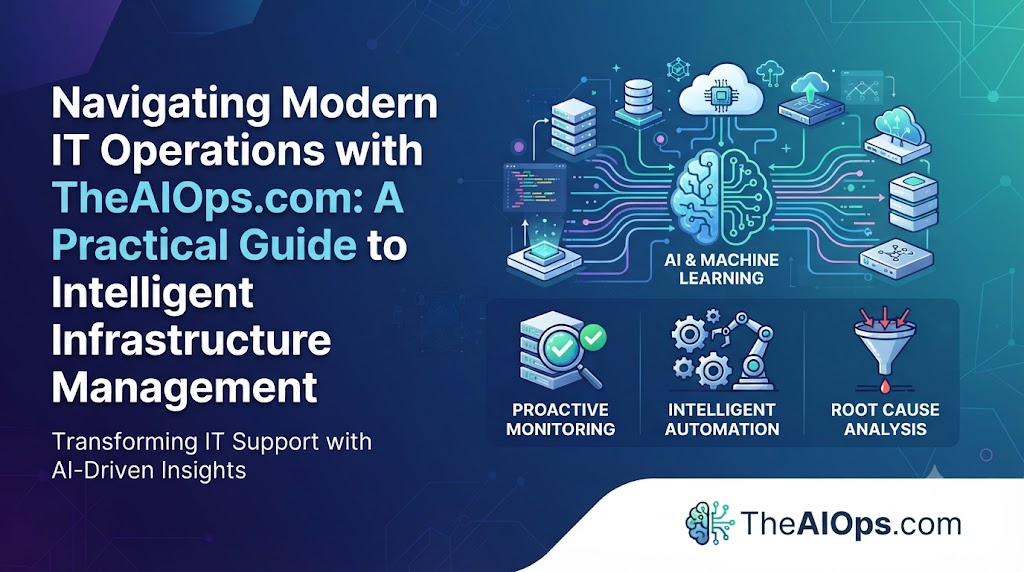
This is why companies use Artificial Intelligence for IT Operations.
Platforms, learning hubs, and consulting services like TheAIOps.com help people and businesses understand and master this smart way of running IT systems.
What is TheAIOps.com?
TheAIOps.com is a specialized learning and consulting hub. It focuses entirely on artificial intelligence for IT operations.
It does not sell just one piece of software. Instead, it is a central place to learn how machine learning, big data, observability, and automation work together.
The platform connects several important areas:
- Learning programs for AIOps Training
- Structured lessons found in a clear AIOps Course
- Knowledge validation through AIOps Certification
- Guides on modern AIOps Tools and enterprise AIOps Platforms
- Advisory help through AIOps Consulting and managed AIOps Services
- Real-world steps for smooth AIOps Implementation
By linking these topics together, the hub helps engineers build real skills to manage complex digital systems safely.
Understanding Artificial Intelligence for IT Operations
To understand what TheAIOps.com teaches, let’s break down the main idea.
Artificial Intelligence for IT Operations means using smart computer programs to manage computer servers, networks, and apps automatically.
Why Old Monitoring Tools Fail
Old monitoring tools use fixed limits. For example, an alarm rings if CPU usage goes above 90% for five minutes.
But cloud systems change all the time. Fixed limits cause two big problems:
- False Alarms: Alarms ring even when high usage is completely normal. This tires out the IT team.
- Missed Failures: Real problems happen when metrics stay below the limit, but a strange mix of small errors causes a crash.
How Machine Learning Helps
Machine learning models learn what normal system behavior looks like over time. They check millions of past data points.
If a database slows down because of a hidden memory leak, the system spots the change right away. It catches the issue even if no fixed alarm limit was crossed.
The Value of AIOps Training
As computer networks get smarter, engineering teams need new skills. AIOps Training helps bridge the gap between old system care and data-driven management.
Good training teaches engineers to look past basic server screens. Students learn how to collect, clean, and study data from many different sources.
Training shows how machine learning spots strange behavior and groups related alarms together.
Instead of just staring at dashboards, engineers learn how to build automated workflows that fix routine issues before humans even notice.
What is Inside an AIOps Course?
A good AIOps Course follows a clear step-by-step path:
- IT Basics: Learning how traditional monitoring and ticketing work.
- Observability Basics: Learning how to collect logs, metrics, and traces from apps.
- Data Flow: Understanding how data moves from servers into central storage.
- Machine Learning Basics: Learning how algorithms spot patterns and normal behavior.
- Anomaly Detection: Studying how algorithms spot unusual system habits.
- Event Correlation: Grouping noisy alarms into single, clear incidents.
- Root-Cause Analysis: Using data links to find the exact reason a system failed.
- Predictive Analytics: Guessing when hardware might break before it actually fails.
- Automation: Writing safe scripts to fix common issues automatically.
- Implementation: Rolling out solutions safely across business systems.
AIOps Certification and Professional Growth
Many tech workers use AIOps Certification exams to check their knowledge and guide their studies.
Certificates do not replace hands-on experience. However, they prove that an engineer understands key concepts and best practices.
Exams test knowledge of data pipelines, alarm reduction, and safe automation.
For hiring managers, certified team members show a strong drive to modernize IT systems using smart data tools.
Exploring AIOps Tools and Platforms
The tech world includes many AIOps Tools and full-scale AIOps Platforms.
A tool usually fixes one specific job, like reading log files. An AIOps platform acts like a control center that connects many tools into one system.
How Data Moves Through a Platform
An enterprise platform usually follows this simple path:
Data Collection → Processing → Analysis → Correlation → Detection → Prediction → Action
- Collection: Gathering logs, metrics, and events from servers and apps.
- Processing: Cleaning the data so different formats match.
- Analysis: Running machine learning to set normal baselines.
- Correlation: Grouping related alarms together to stop noise.
- Detection: Spotting strange behavior or failures.
- Prediction: Guessing future bottlenecks before they slow users down.
- Action: Launching automatic fixes or paging the right engineer.
AIOps Implementation as a Real Project
Adopting smart IT tools takes careful planning. AIOps Implementation is a real engineering project, not a quick software download.
Projects fail when companies buy expensive software without changing how their teams work.
A successful rollout follows clear steps:
- Check the Setup: Review current monitoring tools and find missing blind spots.
- Pick Clear Goals: Focus on specific headaches, like noisy alarms or slow troubleshooting.
- Check Data Quality: Make sure logs and metrics are clean and accurate.
- Connect Systems: Link data streams into the analysis platform safely.
- Test Carefully: Run models in a test zone to make sure false alarms stay low.
- Measure Success: Track whether problem-fixing gets faster over time.
AIOps Consulting and Services
Many companies need outside help when updating their systems. AIOps Consulting and professional AIOps Services give businesses a clear path forward.
Consultants review current setups, test available tools, and design clean data architectures.
Services might include setting up data pipelines, connecting observability apps, and training internal staff.
Expert help stops companies from making costly mistakes, like collecting useless data or automating broken processes.
Core Skills for an AIOps Engineer
An AIOps Engineer works where system administration, software coding, and data science meet.
The job requires several key skills:
- Deep knowledge of Linux and cloud servers
- Good understanding of computer networks and container apps
- Hands-on practice with monitoring tools
- Coding skills in languages like Python for automation
- Basic knowledge of machine learning and data patterns
- Strong troubleshooting habits during system outages
Building these skills takes time, study, and real-world practice.
Monitoring vs. Observability
It helps to know the difference between basic monitoring and deep observability.
- Monitoring tells you when something breaks. It watches set limits and sounds an alarm.
- Observability helps you understand why something broke by looking inside system logs and traces.
Smart operations need high observability. Without clean logs and detailed data, machine learning models cannot find hidden patterns or root causes.
Spotting Anomalies and Finding Root Causes
Two core parts of smart operations are anomaly detection and event correlation.
Anomaly Detection
An anomaly is any behavior that strays far from normal patterns.
For example, if an online store checkout normally takes 100 milliseconds, a sudden slowdown paired with failed orders is flagged as an anomaly.
Machine learning catches these small shifts much faster than humans staring at screens.
Event Correlation
During a major cloud crash, monitoring tools can spit out thousands of alarms in minutes.
Event correlation software groups these flashing alarms into one single incident ticket.
Instead of reading fifty server warnings, the team sees one root cause—like a dropped network packet that caused database timeouts downstream.
Predictive Analytics and Automated Fixes
Moving past quick fixes, modern systems use predictive analytics to stop outages before users notice.
Predictive Analytics
By studying past CPU and storage trends, predictive models can guess when a server will run out of disk space weeks ahead of time. This lets teams fix the issue proactively.
Automated Fixes
Once an issue is found and its root cause is clear, automated scripts can fix it.
For example, if an app runs out of memory, a script can safely restart the service without waking up an engineer at midnight.
However, automated actions must always be tested carefully to prevent bad scripts from making outages worse.
Real-World Examples
Here is how these ideas work in real life:
Example 1: Alarm Overload
- Problem: A database glitch generates 3,000 alert emails in two minutes.
- Data: Raw event logs stream from twenty servers at once.
- Analysis: The platform groups all 3,000 alarms into one single incident.
- Insight: The root cause is a brief network drop on one switch port.
- Action: The system alerts the network team and hides duplicate noise.
Example 2: Slow Web App
- Problem: Users report that a login page loads very slowly.
- Data: Trace logs point to delays in an external payment app.
- Analysis: Anomaly detection notes that the external app is three times slower than normal.
- Insight: The slowdown lives outside the core internal system.
- Action: The system opens a support ticket with the third-party vendor.
Common Mistakes to Avoid
Companies trying to adopt smart IT operations often make these mistakes:
- Buying Tools First: Purchasing expensive software before defining the actual problem.
- Ignoring Data Quality: Feeding messy or duplicate logs into machine learning models.
- Automating Too Fast: Turning on auto-fixes before proving the models work reliably.
- Removing Humans: Taking people out of the loop completely, leading to big mistakes.
- Forgetting the Goal: Treating the project like an AI experiment instead of an IT reliability upgrade.
Benefits and Limits
Potential Benefits
- Massive drop in false alarms and alert fatigue
- Much faster root-cause analysis during outages
- Spotting unusual behavior before users complain
- Better use of operational data across teams
- Safe, consistent automated fixes for routine tasks
Limits and Challenges
- High initial effort needed to clean up data
- Hard to connect old legacy systems with new cloud tools
- Risk of false alarms if models are poorly trained
- Ongoing need to tune and maintain machine learning rules
- High technical skill requirements for staff
A Simple Learning Path for Beginners
If you want to learn this field, follow this clear path:
- Learn the Basics: Study Linux, networking, and basic IT operations.
- Learn Monitoring: See how metrics, logs, and traces are gathered.
- Study Observability: Understand how distributed app tracing works.
- Learn Core Concepts: Study anomaly detection and alarm reduction.
- Learn Data Basics: Get comfortable with basic data patterns and machine learning.
- Practice Automation: Learn scripting to build simple workflows.
- Build Lab Projects: Set up small monitoring setups to test your skills.
Who Benefits Most?
Smart IT operations knowledge is useful for many tech roles:
- System Admins: Moving from manual server work to automated fleet management.
- DevOps Engineers: Building fast, self-healing deployment pipelines.
- SRE Professionals: Reducing manual toil and keeping systems stable.
- Cloud Engineers: Managing complex multi-cloud setups smoothly.
- IT Leaders: Planning smart tool budgets and operational strategies.
Frequently Asked Questions
1. What is the main goal of AIOps?
The main goal is to use artificial intelligence and machine learning to study IT data, cut down alarm noise, spot strange behavior, and fix computer problems faster.
2. How is an AIOps platform different from old monitoring?
Old monitoring uses fixed limits to sound alarms. AIOps platforms gather data from many sources, use machine learning to set dynamic baselines, link related events, and predict future failures.
3. Do I need a math degree to learn AIOps?
No. While knowing basic tech concepts helps, the field focuses mostly on IT systems, app visibility, and automation. Most learners come from system admin or DevOps backgrounds.
4. Can AI completely replace IT operations teams?
No. Automated tools handle routine tasks, but human engineers are still needed to set policies, check complex incidents, make architecture choices, and handle edge cases.
5. What kind of data do these tools analyze?
They analyze telemetry data, which includes system logs, metrics, event traces, and help-desk ticket details.
6. What is the difference between monitoring and observability?
Monitoring tells you when a system breaks. Observability helps you figure out why it broke by looking deep inside system logs and data flows.
7. How long does an implementation project take?
Timelines vary based on company size and data readiness. Most projects start with a small test pilot focused on one specific alarm problem before expanding.
8. What is the hardest part of adopting these systems?
Bad data quality is usually the biggest hurdle. If an organization feeds messy or broken logs into a platform, the AI will produce bad results.
9. What skills matter most for an AIOps engineer?
Key skills include solid IT operations experience, cloud server knowledge, observability tools, basic data study, and automation scripting with Python.
10. How do resource hubs like TheAIOps.com help?
They offer clear training guides, learning paths, and implementation tips that show professionals how to apply smart technology to everyday IT environments.
Conclusion
Modern computer systems create more data than any human team can read by hand. Artificial intelligence and machine learning give teams the power to turn that data ocean into clear answers.
By connecting monitoring, log tracking, alarm grouping, and automation, businesses can stop firefighting and start managing systems proactively.
Learning hubs like TheAIOps.com provide the training, tools, and strategies needed to succeed in modern IT operations.
Mastering these skills helps engineers build stronger, faster, and smarter digital systems.