Introduction
Buying shares in a company right when it enters the stock market can feel exciting. Companies often run large advertisements, news channels talk about them constantly, and people hope for quick gains on the listing day.
However, many beginner investors rush into IPOs without understanding how to analyze them. When the market hype fades, some of these newly listed companies lose value, leaving everyday investors with losses.
Evaluating an IPO requires careful thinking. This guide will help you understand how to look past the excitement, study a company’s actual foundation, and make smart investment choices using simple terms and real-world logic.
What Is an IPO?
IPO stands for Initial Public Offering.
- Simple Meaning: It is the process where a private company offers its shares to the general public for the first time to raise money.
- Why It Matters: Before an IPO, only private owners, founders, and early investors (like venture capitalists) own the company. Once public, anyone can buy a piece of the business through the stock market.
- Example: Imagine a popular local coffee shop that wants to open 500 new stores across the country. Instead of taking a huge bank loan, the owners decide to sell 20% of their business to the public to collect the money needed for expansion. That is an IPO.
Why IPOs Attract So Much Attention
New stock market listings often create high energy in the financial world. Understanding why people get excited helps you stay calm and objective.
Potential for Growth
Early backers of successful companies often make significant gains over time. Investors hope that buying a company during its IPO stage will yield similar long-term rewards.
Listing Day Gains
Sometimes, a stock’s price jumps sharply on its very first day of trading. This creates an urge among retail investors to grab shares quickly before trading begins.
Brand Familiarity
When a famous consumer brand goes public, people feel comfortable buying its stock because they use its products daily. However, a popular brand does not automatically mean a profitable business.
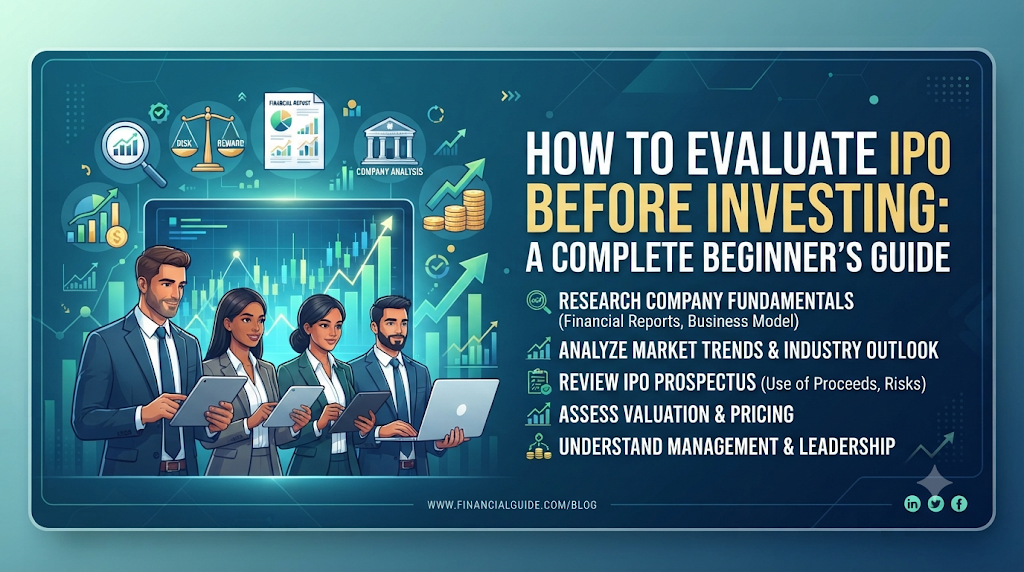
How to Evaluate an IPO: Step-by-Step
Evaluating a new stock listing does not require a finance degree. You just need a clear checklist to review the company’s background and health.
[ Understand Business ] ➔ [ Analyze Financials ] ➔ [ Check Valuation ] ➔ [ Review Management ] ➔ [ Assess Risks ]
1. Read the Draft Red Herring Prospectus (DRHP)
- What it is: The official legal document a company files with market regulators before launching its IPO.
- Why it matters: It contains all honest details about the company’s debts, legal cases, promoters, and business plans.
- What to check: Look at the “Risk Factors” section. This is where the company legally lists everything that could go wrong with their business.
2. Understand the Business Model
- What it is: The specific way a company makes money.
- Why it matters: If you cannot explain how the business earns a profit in one simple sentence, you should think twice before investing.
- Example: A software company that charges a monthly subscription fee has a clear, predictable business model compared to a firm with unpredictable, one-time sales.
3. Check the Use of Proceeds
- What it is: The exact plan for how the company will spend the money raised from the IPO.
- Why it matters: Good companies raise money to grow—like building a factory, funding research, or buying new equipment. Bad or weak companies raise money simply to pay off old debts or let early private owners cash out and leave.
- Rule of thumb: Expansion and debt reduction are generally positive signs; heavy cash withdrawal by existing owners requires caution.
4. Analyze Financial Health
- What it is: Reviewing the company’s revenue, profit margins, and debt levels over the last few years.
- Why it matters: Sales growth is good, but consistent net profit is even better. A company can have high sales while losing money on every single item it sells.
- What to check: Look for steady revenue growth and manageable levels of debt. Avoid companies whose debts are growing faster than their earnings.
5. Evaluate the Valuation
- What it is: Measuring how expensive or cheap the stock price is compared to the company’s actual earnings and assets.
- Why it matters: Even a wonderful, fast-growing company is a bad investment if you pay too much for its shares.
- Common tool: The Price-to-Earnings (P/E) Ratio compares the share price to the company’s per-share profit. Compare the IPO’s P/E ratio with established competitors in the same industry to see if it is overpriced.
Real-World Example: Two Different IPOs
Consider two hypothetical companies launching an IPO in the same year:
- Company Alpha is an online retail platform growing its sales rapidly. However, it spends three dollars on advertising for every one dollar of profit it keeps, and it uses 80% of the IPO money to pay off bank loans.
- Company Beta is a manufacturing firm with steady, moderate growth, clean accounting, low debt, and a clear plan to use 90% of the IPO funds to build a new factory that will increase production capacity.
While Company Alpha gets more media attention because of its flashy tech label, Company Beta offers a much safer, more stable foundation for a thoughtful investor.
Common Mistakes Beginners Make
Avoid these frequent traps when looking at new stock offerings:
- Investing Based on Hype: Buying shares simply because friends, family, or social media influencers talk about an upcoming listing.
- Ignoring the Debt: Looking only at total sales growth while ignoring heavy loans that could strain the company’s cash flow.
- Chasing Quick Listing Gains: Assuming every stock price will double on day one. Many stocks drop below their offer price soon after listing.
- Skipping the Fine Print: Relying entirely on newspaper headlines instead of reading sections of the official company document.
Key Risks and Limitations of IPOs
Every investment carries risk, but IPOs have unique challenges because the company has no public trading history:
- Lack of Historical Data: Unlike older public companies with decades of performance records, a new listing has a limited public track record.
- Promoter Sell-Off: If early venture capitalists sell a large portion of their shares during the IPO, it can signal that they believe the company has reached its peak growth valuation.
- High Volatility: Newly listed stocks often experience wild price swings in their first few months as early buyers and sellers try to find a stable price balance.
Decision-Making Framework
Use this simple 4-step framework before putting your money into any IPO:
- The Business Test: Do I understand how this company makes money? Will people still use its products five years from now?
- The Numbers Test: Are revenues growing, and is the company actually generating net profits or healthy cash flows?
- The Purpose Test: Is the raised money going toward business growth, or just paying off old debts and founders?
- The Price Test: Is the valuation reasonable compared to similar companies already trading in the market?
If an IPO passes all four checks, it deserves a deeper look. If it fails even two, stepping back is usually the wisest choice.
Key Terms
- Draft Red Herring Prospectus (DRHP): The official legal document a company submits to regulators to provide full details of its business operations and financial health.
- Listing Day: The first day a company’s shares become publicly tradable on the stock exchange.
- Price-to-Earnings (P/E) Ratio: A financial metric comparing a company’s share price to its annual earnings per share, used to check if a stock is expensive.
- Promoters: The founders or main owners who control the creation and primary direction of the business.
- Retail Investor: An individual everyday person who buys and sells securities for their own personal account rather than managing institutional money.
- Valuation: The financial estimate of how much a company is worth based on its assets, earnings, and market potential.
Frequently Asked Questions
What is the difference between an IPO and the secondary market?
An IPO happens in the primary market, where the company itself sells new shares and collects the money directly. The secondary market is where everyday investors buy and sell those existing shares among themselves through a stock exchange, without the company getting any more money from those trades.
Can I lose all my money investing in an IPO?
Yes. If a company performs poorly, faces heavy losses, or goes bankrupt after going public, its stock price can drop drastically, resulting in severe losses for shareholders.
Do I need a lot of money to apply for an IPO?
No. Stock exchanges set minimum lot sizes for IPO bids, which are often affordable for individual retail investors. However, you should only invest money you do not need for immediate daily expenses.
Why do some stocks drop in price right after listing?
If an IPO is overpriced by the investment bankers managing the sale, public buyers may refuse to purchase shares at that high price once trading begins, causing the market price to fall.
How do I know if an IPO is oversubscribed?
Stock exchanges publish daily bidding data during the IPO open period. Oversubscription means investors applied for more shares than the company actually made available, which often signals high market interest.
Is a famous brand name a guarantee of a good IPO investment?
No. A famous consumer brand can still suffer from high operational costs, heavy debt, or poor management, making it a weak investment despite its popularity.
Where can I find the official documents for an upcoming IPO?
You can find official draft documents on the websites of stock market regulators, financial news portals, or the investor relations page of the company launching the IPO.
Should beginners invest in every hot IPO?
No. Beginners should focus on learning basic financial analysis, studying company fundamentals, and avoiding emotional decisions driven by short-term market excitement.
Conclusion
Evaluating an IPO is an exercise in patience and discipline. While market hype and media buzz can make every new stock look like a guaranteed winner, successful investing relies on looking past the noise.
By studying the business model, reviewing financial health, checking how the raised money will be used, and comparing valuations, you can separate strong companies from short-term trends. Take your time, read the official documents, and always prioritize long-term business strength over quick listing gains.