Introduction
Endpoint Telemetry Platforms collect, analyze, and monitor real-time data from endpoints such as laptops, desktops, servers, mobile devices, virtual machines, and cloud workloads. These platforms provide deep operational and security visibility into device behavior, user activity, system events, application performance, and threat indicators across distributed environments.
Modern organizations rely heavily on endpoint telemetry to improve cybersecurity, operational monitoring, threat detection, compliance reporting, and IT performance management. With hybrid work, cloud-native infrastructure, remote endpoints, and increasing ransomware attacks, businesses need continuous visibility into endpoint activities to reduce risks and improve incident response.
Real-world use cases include:
- Detecting suspicious endpoint behavior
- Monitoring endpoint health and performance
- Supporting threat hunting and incident response
- Collecting logs and behavioral analytics
- Improving compliance and audit readiness
Buyers evaluating Endpoint Telemetry Platforms should consider:
- Telemetry collection depth
- Real-time monitoring capabilities
- Endpoint performance impact
- Threat detection and analytics
- Scalability across distributed environments
- Cloud and hybrid infrastructure support
- Integration with SIEM and XDR platforms
- Automation and response workflows
- Compliance and audit capabilities
- Ease of deployment and administration
Best for: Security operations centers, enterprise IT teams, managed security providers, threat hunting teams, compliance-driven industries, cloud operations teams, and organizations managing distributed endpoints.
Not ideal for: Very small organizations with limited infrastructure or teams only needing basic antivirus visibility instead of deep telemetry analytics.
Key Trends in Endpoint Telemetry Platforms
- AI-assisted behavioral analytics are becoming standard capabilities.
- Extended Detection and Response integration is rapidly growing.
- Cloud-native telemetry pipelines are replacing legacy collection models.
- Real-time threat correlation across endpoints and cloud workloads is improving.
- Endpoint telemetry is increasingly integrated with identity and access management systems.
- Automation and autonomous remediation workflows are becoming more advanced.
- Telemetry retention and compliance reporting requirements are increasing.
- Lightweight agents are reducing endpoint performance impact.
- Unified observability and security analytics are converging.
- Zero Trust security strategies are driving deeper endpoint visibility requirements.
How We Selected These Tools
The platforms in this list were selected based on telemetry visibility depth, operational maturity, scalability, security capabilities, and ecosystem integration strength.
Selection criteria included:
- Market adoption and industry reputation
- Telemetry collection capabilities
- Threat detection and analytics depth
- Scalability across enterprise environments
- Endpoint performance efficiency
- Integration ecosystem maturity
- Security and compliance functionality
- Automation and response workflows
- Cloud and hybrid infrastructure support
- Customer fit across enterprise and mid-market organizations
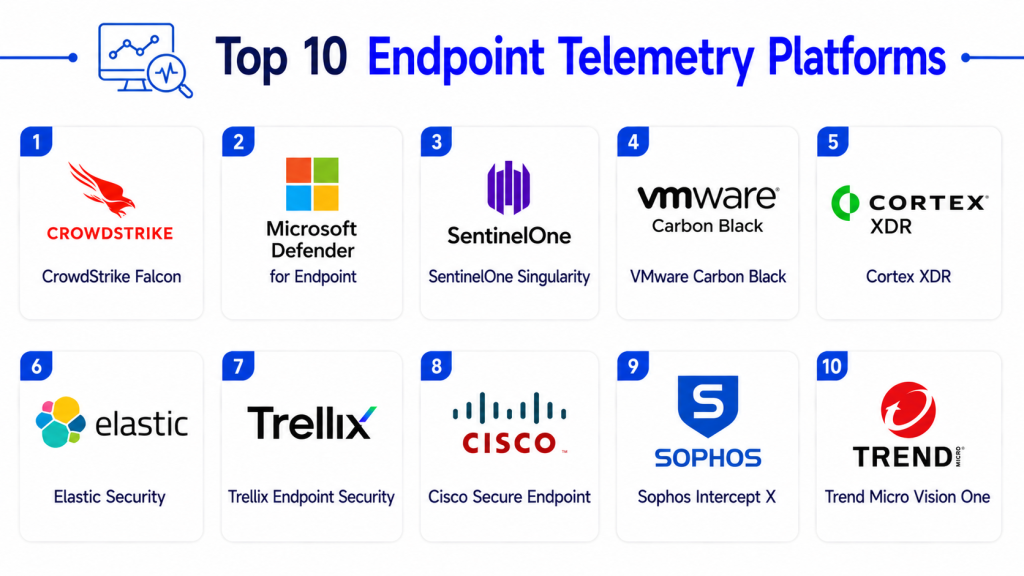
Top 10 Endpoint Telemetry Platforms
1- Microsoft Defender for Endpoint
Short description: Microsoft Defender for Endpoint is a widely adopted endpoint security and telemetry platform offering deep behavioral analytics, threat detection, and operational visibility across enterprise environments.
Key Features
- Real-time endpoint telemetry collection
- Behavioral threat analytics
- Threat hunting capabilities
- Automated investigation and remediation
- Cloud-based telemetry analysis
- Attack surface reduction
- Endpoint vulnerability management
Pros
- Deep Microsoft ecosystem integration
- Strong enterprise threat visibility
- Unified endpoint security workflows
Cons
- Best experience within Microsoft environments
- Advanced configuration can be complex
- Premium licensing tiers may increase costs
Platforms / Deployment
- Windows / macOS / Linux / iOS / Android
- Cloud
Security & Compliance
- MFA
- RBAC
- Audit logs
- Encryption
- SSO/SAML
- GDPR support
- SOC 2
Integrations & Ecosystem
Microsoft Defender integrates deeply across Microsoft security, cloud, and operational ecosystems.
- Microsoft Sentinel
- Azure
- Intune
- Microsoft 365
- Defender XDR
- SIEM platforms
Support & Community
Extensive enterprise documentation with large global administrator community.
2- CrowdStrike Falcon
Short description: CrowdStrike Falcon is a cloud-native endpoint telemetry and threat intelligence platform known for lightweight agents, behavioral analytics, and advanced threat hunting capabilities.
Key Features
- Real-time telemetry streaming
- Threat intelligence integration
- Behavioral analytics
- Cloud-native architecture
- Managed threat hunting
- Endpoint detection and response
- AI-assisted threat analysis
Pros
- Lightweight endpoint agent
- Excellent threat detection capabilities
- Strong cloud scalability
Cons
- Premium enterprise pricing
- Advanced workflows may require expertise
- Smaller operational tooling outside security focus
Platforms / Deployment
- Windows / macOS / Linux / iOS / Android
- Cloud
Security & Compliance
- MFA
- RBAC
- Audit logs
- Encryption
- SOC 2
- ISO 27001
Integrations & Ecosystem
CrowdStrike integrates with SIEM, SOAR, cloud, and threat intelligence ecosystems.
- Splunk
- Azure
- AWS
- ServiceNow
- Palo Alto Networks
- SIEM platforms
Support & Community
Strong enterprise support with active cybersecurity community.
3- SentinelOne Singularity
Short description: SentinelOne Singularity combines endpoint telemetry, AI-powered analytics, and autonomous response capabilities within a unified security operations platform.
Key Features
- Real-time endpoint telemetry
- Autonomous threat response
- Behavioral AI analytics
- Endpoint detection and response
- Threat hunting workflows
- Cloud workload visibility
- Automated remediation
Pros
- Strong AI-driven automation
- Excellent ransomware protection
- Unified endpoint visibility
Cons
- Enterprise pricing structure
- Advanced tuning may be required
- Reporting customization varies
Platforms / Deployment
- Windows / macOS / Linux / Kubernetes
- Cloud
Security & Compliance
- MFA
- RBAC
- Encryption
- Audit logs
- SOC 2
Integrations & Ecosystem
SentinelOne supports integrations across security, cloud, and operational ecosystems.
- Splunk
- ServiceNow
- AWS
- Azure
- Okta
- SIEM platforms
Support & Community
Strong enterprise onboarding and security operations support.
4- VMware Carbon Black
Short description: VMware Carbon Black provides endpoint telemetry, behavioral analytics, and threat detection capabilities for enterprise security operations teams.
Key Features
- Endpoint telemetry streaming
- Behavioral analytics
- Threat hunting tools
- Incident investigation
- Real-time monitoring
- Cloud workload visibility
- Policy enforcement
Pros
- Strong threat hunting functionality
- Good cloud workload support
- Enterprise operational visibility
Cons
- Interface complexity
- Administrative overhead
- Advanced tuning may require expertise
Platforms / Deployment
- Windows / macOS / Linux
- Cloud / Hybrid
Security & Compliance
- RBAC
- MFA
- Audit logs
- Encryption
Integrations & Ecosystem
Carbon Black integrates with enterprise security and monitoring platforms.
- VMware environments
- Splunk
- ServiceNow
- SIEM platforms
- Threat intelligence tools
Support & Community
Strong enterprise support with mature cybersecurity ecosystem resources.
5- Palo Alto Networks Cortex XDR
Short description: Cortex XDR combines endpoint telemetry, network analytics, and cloud visibility to improve threat detection and operational correlation.
Key Features
- Endpoint telemetry analytics
- Cross-domain threat correlation
- Behavioral analytics
- Threat investigation workflows
- AI-assisted detection
- Cloud workload monitoring
- Automated response capabilities
Pros
- Strong cross-environment visibility
- Advanced detection analytics
- Good integration with security ecosystems
Cons
- Premium enterprise pricing
- Learning curve for advanced workflows
- Best experience within Palo Alto environments
Platforms / Deployment
- Windows / macOS / Linux
- Cloud
Security & Compliance
- MFA
- RBAC
- Audit logs
- Encryption
- SOC 2
Integrations & Ecosystem
Cortex XDR integrates deeply with Palo Alto Networks and broader SIEM ecosystems.
- Prisma Cloud
- Splunk
- Cortex XSOAR
- AWS
- Azure
- SIEM platforms
Support & Community
Strong enterprise security support and extensive operational documentation.
6- Elastic Security
Short description: Elastic Security combines endpoint telemetry, observability, and SIEM capabilities using the Elastic Stack for large-scale analytics and threat visibility.
Key Features
- Endpoint telemetry collection
- SIEM analytics
- Threat hunting
- Behavioral analytics
- Observability integration
- Real-time dashboards
- Cloud-native scalability
Pros
- Strong analytics flexibility
- Large-scale data processing
- Unified observability and security workflows
Cons
- Requires operational expertise
- Complex deployment at scale
- Advanced tuning may be necessary
Platforms / Deployment
- Windows / macOS / Linux
- Cloud / Self-hosted
Security & Compliance
- RBAC
- MFA
- Encryption
- Audit logs
Integrations & Ecosystem
Elastic integrates across observability, cloud, and security analytics ecosystems.
- Kubernetes
- AWS
- Azure
- Google Cloud
- SIEM tools
- REST APIs
Support & Community
Large open-source and enterprise community with extensive technical resources.
7- Splunk Enterprise Security
Short description: Splunk Enterprise Security uses telemetry analytics, SIEM capabilities, and advanced data correlation to support large-scale security operations.
Key Features
- Endpoint telemetry ingestion
- Threat analytics
- Behavioral monitoring
- Correlation searches
- Threat intelligence integration
- Security dashboards
- Automated alerting
Pros
- Excellent analytics capabilities
- Highly scalable telemetry processing
- Strong SIEM ecosystem
Cons
- High operational complexity
- Expensive at large data volumes
- Requires skilled administrators
Platforms / Deployment
- Windows / Linux
- Cloud / Self-hosted
Security & Compliance
- MFA
- RBAC
- Audit logs
- Encryption
Integrations & Ecosystem
Splunk integrates with extensive operational, cloud, and cybersecurity ecosystems.
- CrowdStrike
- AWS
- Azure
- ServiceNow
- Palo Alto Networks
- SOAR platforms
Support & Community
Large enterprise user community with mature support ecosystem.
8- Trend Micro Vision One
Short description: Trend Micro Vision One provides endpoint telemetry, XDR analytics, and threat intelligence visibility across enterprise environments.
Key Features
- Endpoint telemetry analytics
- XDR threat correlation
- Threat intelligence
- Behavioral monitoring
- Cloud workload visibility
- Automated investigation
- Risk scoring
Pros
- Strong XDR capabilities
- Unified security visibility
- Good ransomware detection
Cons
- Enterprise-focused pricing
- Advanced analytics may require tuning
- Reporting customization can vary
Platforms / Deployment
- Windows / macOS / Linux
- Cloud
Security & Compliance
- MFA
- RBAC
- Audit logs
- Encryption
Integrations & Ecosystem
Trend Micro integrates with security operations and cloud ecosystems.
- AWS
- Azure
- SIEM platforms
- ServiceNow
- Splunk
Support & Community
Strong enterprise support with established cybersecurity ecosystem.
9- Cisco Secure Endpoint
Short description: Cisco Secure Endpoint combines endpoint telemetry, malware protection, and security analytics for distributed enterprise environments.
Key Features
- Endpoint telemetry collection
- Threat analytics
- Malware detection
- Behavioral monitoring
- Automated remediation
- Device trajectory tracking
- Cloud analytics
Pros
- Strong enterprise security integration
- Good device visibility
- Scalable cloud analytics
Cons
- Best within Cisco ecosystems
- Advanced workflows may require expertise
- Administrative complexity
Platforms / Deployment
- Windows / macOS / Linux / Android
- Cloud
Security & Compliance
- MFA
- RBAC
- Audit logs
- Encryption
Integrations & Ecosystem
Cisco Secure Endpoint integrates across Cisco security and operational ecosystems.
- Cisco XDR
- SecureX
- Splunk
- SIEM platforms
- Threat intelligence systems
Support & Community
Large enterprise networking and cybersecurity support ecosystem.
10- Sophos Intercept X
Short description: Sophos Intercept X provides endpoint telemetry, threat detection, and behavioral analytics focused on ransomware prevention and operational simplicity.
Key Features
- Endpoint telemetry monitoring
- Behavioral AI analytics
- Threat hunting
- Ransomware protection
- Root cause analysis
- Automated response
- Device health monitoring
Pros
- Strong ransomware protection
- User-friendly management
- Good SMB and mid-market fit
Cons
- Advanced enterprise analytics are limited
- Ecosystem depth smaller than larger vendors
- Complex enterprise customization may vary
Platforms / Deployment
- Windows / macOS / Linux / Mobile
- Cloud
Security & Compliance
- MFA
- RBAC
- Encryption
- Audit logs
Integrations & Ecosystem
Sophos integrates with operational and security management ecosystems.
- Sophos Central
- SIEM platforms
- Microsoft environments
- AWS
- REST APIs
Support & Community
Good onboarding experience with active customer support ecosystem.
Comparison Table
| Tool Name | Best For | Platforms Supported | Deployment | Standout Feature | Public Rating |
|---|---|---|---|---|---|
| Microsoft Defender for Endpoint | Microsoft enterprise environments | Windows / macOS / Linux / Mobile | Cloud | Deep Microsoft ecosystem visibility | N/A |
| CrowdStrike Falcon | Enterprise threat hunting | Windows / macOS / Linux / Mobile | Cloud | Lightweight telemetry agent | N/A |
| SentinelOne Singularity | Autonomous endpoint response | Windows / macOS / Linux | Cloud | AI-driven remediation | N/A |
| VMware Carbon Black | Enterprise threat analytics | Windows / macOS / Linux | Cloud / Hybrid | Behavioral threat hunting | N/A |
| Palo Alto Cortex XDR | Cross-domain telemetry analytics | Windows / macOS / Linux | Cloud | Unified XDR visibility | N/A |
| Elastic Security | Observability and security analytics | Windows / macOS / Linux | Cloud / Self-hosted | Unified telemetry analytics | N/A |
| Splunk Enterprise Security | Large-scale telemetry analytics | Windows / Linux | Cloud / Self-hosted | Advanced SIEM analytics | N/A |
| Trend Micro Vision One | XDR operations | Windows / macOS / Linux | Cloud | Threat correlation visibility | N/A |
| Cisco Secure Endpoint | Cisco security environments | Windows / macOS / Linux / Android | Cloud | Device trajectory tracking | N/A |
| Sophos Intercept X | SMB and mid-market security | Windows / macOS / Linux / Mobile | Cloud | Ransomware protection | N/A |
Evaluation & Scoring of Endpoint Telemetry Platforms
| Tool Name | Core 25% | Ease 15% | Integrations 15% | Security 10% | Performance 10% | Support 10% | Value 15% | Weighted Total |
|---|---|---|---|---|---|---|---|---|
| Microsoft Defender for Endpoint | 9.5 | 8.0 | 9.4 | 9.5 | 9.0 | 8.8 | 8.5 | 8.97 |
| CrowdStrike Falcon | 9.6 | 8.5 | 9.0 | 9.6 | 9.4 | 8.9 | 7.8 | 8.98 |
| SentinelOne Singularity | 9.2 | 8.2 | 8.7 | 9.2 | 9.1 | 8.5 | 8.0 | 8.69 |
| VMware Carbon Black | 8.8 | 7.3 | 8.4 | 8.9 | 8.7 | 8.1 | 7.5 | 8.18 |
| Palo Alto Cortex XDR | 9.3 | 7.8 | 9.1 | 9.4 | 9.0 | 8.6 | 7.6 | 8.63 |
| Elastic Security | 8.9 | 7.0 | 9.0 | 8.7 | 8.8 | 8.4 | 8.4 | 8.42 |
| Splunk Enterprise Security | 9.1 | 6.8 | 9.5 | 9.0 | 9.2 | 8.7 | 7.0 | 8.40 |
| Trend Micro Vision One | 8.8 | 8.0 | 8.2 | 8.8 | 8.6 | 8.2 | 8.1 | 8.34 |
| Cisco Secure Endpoint | 8.7 | 7.7 | 8.8 | 8.9 | 8.5 | 8.3 | 7.8 | 8.29 |
| Sophos Intercept X | 8.5 | 8.8 | 7.8 | 8.6 | 8.4 | 8.4 | 8.9 | 8.47 |
These scores are comparative and intended to help organizations evaluate platform fit rather than identify a universal winner. Enterprise-focused platforms typically provide stronger scalability and analytics depth, while SMB-focused tools often prioritize simplicity and operational efficiency. Buyers should align platform selection with security maturity, infrastructure complexity, and integration requirements.
Which Endpoint Telemetry Platform Is Right for You?
Solo / Freelancer
Solo users and small IT operations teams often prioritize operational simplicity and lower management overhead. Sophos Intercept X provides user-friendly endpoint telemetry and ransomware protection capabilities.
SMB
SMBs typically need affordable deployment, operational simplicity, and strong endpoint protection. Sophos Intercept X and Microsoft Defender for Endpoint provide strong usability and operational visibility.
Mid-Market
Mid-market organizations often require stronger telemetry analytics and automation. SentinelOne Singularity and Trend Micro Vision One provide balanced operational capabilities and scalability.
Enterprise
Large enterprises generally prioritize scalability, advanced analytics, threat hunting, and ecosystem integration. CrowdStrike Falcon, Microsoft Defender for Endpoint, and Palo Alto Cortex XDR remain strong enterprise-focused options.
Budget vs Premium
Sophos and Microsoft Defender provide cost-efficient operational visibility for many organizations. CrowdStrike and Palo Alto Cortex XDR target premium enterprise security operations environments.
Feature Depth vs Ease of Use
CrowdStrike and Splunk provide deep analytics capabilities but may require experienced security teams. Sophos and Microsoft Defender focus more on usability and simplified management.
Integrations & Scalability
Organizations with large SIEM, XDR, and cloud ecosystems should prioritize platforms with mature APIs and operational integrations such as CrowdStrike, Splunk, and Microsoft Defender.
Security & Compliance Needs
Highly regulated industries should prioritize platforms with strong audit logging, encryption, RBAC, compliance reporting, and advanced threat investigation workflows.
Frequently Asked Questions
1. What is an Endpoint Telemetry Platform?
An Endpoint Telemetry Platform collects and analyzes real-time data from endpoints such as laptops, servers, cloud workloads, and mobile devices to improve visibility and security operations.
2. Why is endpoint telemetry important?
Endpoint telemetry improves threat detection, operational visibility, incident response, compliance reporting, and overall infrastructure monitoring.
3. How is endpoint telemetry different from antivirus software?
Traditional antivirus focuses mainly on malware prevention, while telemetry platforms provide deeper behavioral analytics, threat hunting, and operational visibility.
4. Can these platforms support cloud workloads?
Yes. Most modern endpoint telemetry platforms support cloud infrastructure, hybrid environments, and containerized workloads.
5. Are Endpoint Telemetry Platforms only for enterprises?
No. Many vendors provide SMB-friendly deployment models with simplified operational workflows and lower management overhead.
6. What integrations are most important?
Important integrations include SIEM platforms, SOAR tools, cloud services, identity providers, ITSM platforms, and threat intelligence systems.
7. What are common implementation challenges?
Common challenges include telemetry data overload, poor alert tuning, insufficient workflow planning, and integration complexity.
8. Do telemetry agents impact endpoint performance?
Modern platforms increasingly use lightweight agents designed to minimize CPU, memory, and bandwidth usage on endpoints.
9. Are self-hosted deployment options still available?
Yes. Some platforms still support self-hosted deployments, especially for organizations with strict compliance or operational requirements.
10. What should buyers evaluate first?
Buyers should prioritize telemetry visibility depth, detection capabilities, scalability, endpoint performance impact, and ecosystem integration support.
Conclusion
Endpoint Telemetry Platforms have become essential for organizations seeking deeper visibility into endpoint behavior, operational health, and cybersecurity risks across distributed environments. As cloud adoption, remote work, ransomware threats, and hybrid infrastructure continue growing, businesses increasingly require continuous telemetry analytics to improve incident response, operational monitoring, and compliance readiness. Enterprise organizations may benefit most from platforms like CrowdStrike Falcon, Microsoft Defender for Endpoint, and Palo Alto Cortex XDR because of their scalability and advanced analytics capabilities, while SMB and mid-market teams may achieve faster operational value with Sophos Intercept X or Trend Micro Vision One. The right platform ultimately depends on operational maturity, infrastructure complexity, security requirements, integration priorities, and budget considerations. Organizations should shortlist a few solutions, validate telemetry visibility in real-world operational environments, test integrations with existing SIEM and security platforms, and ensure the chosen platform can scale alongside future operational and cybersecurity requirements.