Introduction
Supply Chain Control Tower Platforms are centralized systems that provide real-time visibility, analytics, and orchestration across the entire supply chain. They act as a digital command center, integrating data from suppliers, logistics partners, warehouses, and transportation systems into a single dashboard.
These platforms have become critical as supply chains grow more complex and global. Businesses now need not only visibility but also predictive insights and automated decision-making to respond quickly to disruptions, delays, and demand changes.
Common Use Cases
- Monitoring shipments, inventory, and logistics in real time
- Identifying and resolving supply chain disruptions
- Optimizing inventory and demand planning
- Improving supplier collaboration
- Automating logistics and transportation decisions
What Buyers Should Evaluate
- Real-time visibility capabilities
- Predictive analytics and AI features
- Integration with ERP and logistics systems
- Automation and decision-making capabilities
- Scalability across global operations
- Industry-specific customization
- Ease of use and dashboards
- Security and compliance
- Performance and reliability
Best for: Supply chain leaders, operations managers, logistics teams, manufacturing companies, and enterprises managing complex global supply networks
Not ideal for: Small businesses with simple supply chains or limited logistics complexity
Key Trends in Supply Chain Control Tower Platforms
- AI-driven predictive analytics for disruption management
- Autonomous execution systems that act without human intervention
- Real-time multi-tier visibility across suppliers and partners
- Integration of planning, visibility, and execution layers
- Digital twin simulations for supply chain optimization
- Sustainability tracking and carbon monitoring
- API-first architectures for seamless integration
- Cloud-native platforms replacing legacy systems
- Event-driven alerting and exception management
- Increased focus on resilience and risk mitigation
How We Selected These Tools Methodology
- Evaluated global market adoption and enterprise usage
- Assessed visibility, planning, and execution capabilities
- Reviewed AI and analytics features
- Considered integration with ERP, TMS, and WMS systems
- Analyzed scalability and performance
- Included tools across visibility, planning, and execution models
- Focused on usability and dashboards
- Balanced innovation with real-world applicability
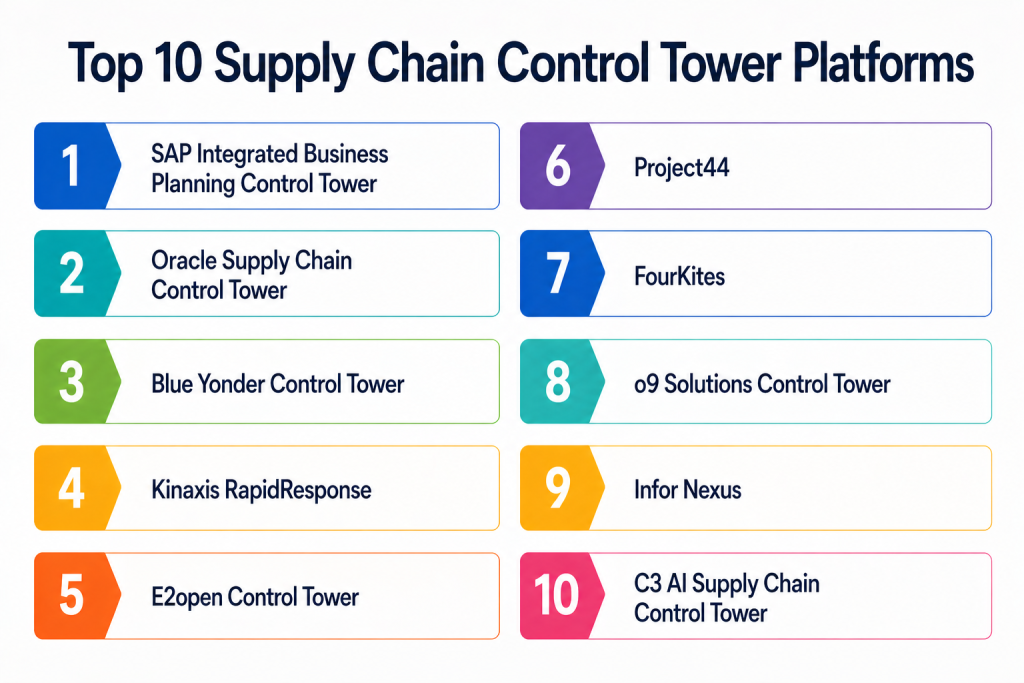
Top 10 Supply Chain Control Tower Platforms
#1 — SAP Integrated Business Planning Control Tower
Short description: SAP IBP Control Tower provides end-to-end supply chain visibility and planning capabilities. It integrates deeply with SAP systems and supports real-time decision-making for large enterprises.
Key Features
- Real-time supply chain visibility
- Integrated planning and forecasting
- Scenario simulation
- Demand and inventory optimization
- Advanced analytics
Pros
- Strong enterprise integration
- Scalable for global operations
Cons
- Complex implementation
- Requires SAP ecosystem
Platforms / Deployment
Web — Cloud
Security & Compliance
SSO, encryption — Not publicly stated
Integrations & Ecosystem
Deep integration with SAP ERP and supply chain systems.
- ERP systems
- Analytics tools
- APIs
Support & Community
Enterprise-level support and global partner ecosystem
#2 — Oracle Supply Chain Control Tower
Short description: Oracle offers a cloud-based control tower with AI-driven insights, risk monitoring, and end-to-end visibility across supply chain operations.
Key Features
- End-to-end visibility
- Predictive analytics
- Risk management
- Exception handling
- Real-time dashboards
Pros
- Strong analytics capabilities
- Cloud-native architecture
Cons
- Complex setup
- Higher cost
Platforms / Deployment
Web — Cloud
Security & Compliance
Not publicly stated
Integrations & Ecosystem
Integrates with Oracle Cloud and enterprise systems.
- ERP
- Logistics systems
- APIs
Support & Community
Enterprise-grade support
#3 — Blue Yonder Control Tower
Short description: Blue Yonder focuses on AI-powered supply chain orchestration with strong predictive analytics and real-time visibility.
Key Features
- Real-time visibility
- AI-driven insights
- Demand sensing
- Exception management
- Scenario modeling
Pros
- Strong AI capabilities
- Industry-specific solutions
Cons
- Complex implementation
- Requires training
Platforms / Deployment
Web — Cloud
Security & Compliance
Not publicly stated
Integrations & Ecosystem
Supports integrations with ERP and logistics tools.
- ERP systems
- Supply chain platforms
Support & Community
Professional support services
#4 — Kinaxis RapidResponse Control Tower
Short description: Kinaxis offers a concurrent planning and control tower platform designed for fast decision-making and scenario analysis.
Key Features
- Real-time data synchronization
- Scenario simulation
- Concurrent planning
- Collaboration tools
- Analytics dashboards
Pros
- Fast decision-making
- Strong planning capabilities
Cons
- Learning curve
- Premium pricing
Platforms / Deployment
Web — Cloud
Security & Compliance
Not publicly stated
Integrations & Ecosystem
Integrates with enterprise supply chain systems.
- ERP
- Planning tools
Support & Community
Strong enterprise support
#5 — E2open Control Tower
Short description: E2open provides multi-tier supply chain visibility across partners, suppliers, and logistics networks.
Key Features
- Multi-tier visibility
- Supplier collaboration
- Logistics tracking
- Analytics dashboards
- Risk management
Pros
- Strong network visibility
- Partner collaboration
Cons
- Complex onboarding
- Requires integration effort
Platforms / Deployment
Web — Cloud
Security & Compliance
Not publicly stated
Integrations & Ecosystem
Connects with supply chain partners and systems.
- Logistics systems
- ERP
- APIs
Support & Community
Enterprise support
#6 — Project44 Control Tower
Short description: Project44 focuses on real-time transportation visibility and predictive logistics intelligence.
Key Features
- Shipment tracking
- Predictive ETA
- Carrier visibility
- Exception alerts
- Analytics
Pros
- Best-in-class visibility
- Easy deployment
Cons
- Limited planning features
- Focused on logistics
Platforms / Deployment
Web — Cloud
Security & Compliance
Not publicly stated
Integrations & Ecosystem
Integrates with logistics and carrier systems.
- Carrier networks
- APIs
Support & Community
Good support
#7 — FourKites Control Tower
Short description: FourKites offers real-time supply chain visibility with strong carrier network integration.
Key Features
- Real-time tracking
- Predictive analytics
- Risk alerts
- Carrier integrations
- Dashboard insights
Pros
- Strong carrier network
- Accurate tracking
Cons
- Limited planning capabilities
- Integration effort required
Platforms / Deployment
Web — Cloud
Security & Compliance
Not publicly stated
Integrations & Ecosystem
Connects with global carriers and systems.
- Logistics providers
- APIs
Support & Community
Strong customer support
#8 — o9 Solutions Control Tower
Short description: o9 Solutions provides a digital control tower with advanced analytics and AI-powered planning capabilities.
Key Features
- AI-driven analytics
- Scenario modeling
- Demand forecasting
- Real-time insights
- Collaboration tools
Pros
- Strong analytics
- Planning-focused
Cons
- Complex implementation
- Requires expertise
Platforms / Deployment
Web — Cloud
Security & Compliance
Not publicly stated
Integrations & Ecosystem
Integrates with enterprise systems and data platforms.
- ERP
- Data platforms
Support & Community
Professional support
#9 — Infor Nexus Control Tower
Short description: Infor Nexus provides real-time visibility across orders, shipments, and inventory with AI-powered disruption management.
Key Features
- Real-time visibility
- AI-powered insights
- Risk management
- Supply chain tracking
- Collaboration tools
Pros
- Strong visibility features
- Good for global supply chains
Cons
- Complex integration
- Learning curve
Platforms / Deployment
Web — Cloud
Security & Compliance
Not publicly stated
Integrations & Ecosystem
Integrates with ERP and logistics systems.
- ERP
- Logistics tools
Support & Community
Enterprise support
#10 — C3 AI Supply Chain Control Tower
Short description: C3 AI offers a control tower platform powered by AI for predictive insights, risk analysis, and supply chain optimization.
Key Features
- AI-driven insights
- Scenario analysis
- Risk forecasting
- Real-time visibility
- Predictive analytics
Pros
- Strong AI capabilities
- Advanced analytics
Cons
- Complex setup
- Enterprise-focused
Platforms / Deployment
Web — Cloud
Security & Compliance
Not publicly stated
Integrations & Ecosystem
Integrates with enterprise systems and data platforms.
- ERP
- Data systems
Support & Community
Enterprise support
Comparison Table
| Tool Name | Best For | Platform Supported | Deployment | Standout Feature | Public Rating |
|---|---|---|---|---|---|
| SAP IBP | Enterprise | Web | Cloud | Integrated planning | N/A |
| Oracle Control Tower | Enterprise | Web | Cloud | AI insights | N/A |
| Blue Yonder | Enterprise | Web | Cloud | AI orchestration | N/A |
| Kinaxis | Enterprise | Web | Cloud | Concurrent planning | N/A |
| E2open | Enterprise | Web | Cloud | Multi-tier visibility | N/A |
| Project44 | Logistics | Web | Cloud | Shipment visibility | N/A |
| FourKites | Logistics | Web | Cloud | Carrier network | N/A |
| o9 Solutions | Enterprise | Web | Cloud | Advanced analytics | N/A |
| Infor Nexus | Enterprise | Web | Cloud | Real-time tracking | N/A |
| C3 AI | Enterprise | Web | Cloud | AI-driven insights | N/A |
Evaluation & Scoring of Supply Chain Control Tower Platforms
| Tool Name | Core | Ease | Integrations | Security | Performance | Support | Value | Weighted Total |
|---|---|---|---|---|---|---|---|---|
| SAP IBP | 9 | 7 | 9 | 8 | 9 | 9 | 6 | 8.3 |
| Oracle | 9 | 7 | 9 | 8 | 9 | 8 | 6 | 8.2 |
| Blue Yonder | 9 | 7 | 8 | 8 | 9 | 8 | 6 | 8.1 |
| Kinaxis | 9 | 8 | 8 | 8 | 9 | 8 | 6 | 8.2 |
| E2open | 8 | 7 | 9 | 7 | 8 | 8 | 7 | 8.0 |
| Project44 | 7 | 9 | 7 | 7 | 8 | 8 | 8 | 7.9 |
| FourKites | 7 | 9 | 7 | 7 | 8 | 8 | 8 | 7.9 |
| o9 Solutions | 9 | 7 | 8 | 8 | 9 | 8 | 6 | 8.1 |
| Infor Nexus | 8 | 7 | 8 | 7 | 8 | 8 | 7 | 7.9 |
| C3 AI | 9 | 6 | 8 | 8 | 9 | 8 | 6 | 8.0 |
These scores are comparative and reflect strengths across visibility, planning, and execution. Organizations should align selections with their operational needs.
Which Supply Chain Control Tower Platform Is Right for You
Solo / Small Business
Basic logistics tools are sufficient. Control towers may be unnecessary.
SMB
Project44 and FourKites are easier to deploy and focused on visibility.
Mid-Market
E2open and Infor Nexus offer balanced capabilities.
Enterprise
SAP IBP, Oracle, Blue Yonder, and Kinaxis provide full-scale solutions.
Budget vs Premium
Visibility tools are more affordable, while enterprise platforms require higher investment.
Feature Depth vs Ease of Use
Enterprise tools offer depth, while visibility tools focus on simplicity.
Integrations & Scalability
SAP and Oracle provide strong integration ecosystems.
Security & Compliance Needs
Large enterprises should prioritize enterprise-grade platforms.
Frequently Asked Questions
1. What is a supply chain control tower
It is a centralized platform that provides real-time visibility and control across supply chain operations.
2. How do control towers improve supply chain efficiency
They provide insights, automate decisions, and reduce delays through predictive analytics.
3. What is the difference between visibility and execution platforms
Visibility platforms track data, while execution platforms automate actions.
4. Are these platforms suitable for all industries
Yes, but customization is often required based on industry needs.
5. How long does implementation take
Implementation varies depending on complexity and integration requirements.
6. Can control towers integrate with ERP systems
Yes, most platforms support integration with ERP and logistics systems.
7. Do they use AI
Yes, many platforms use AI for predictive analytics and decision-making.
8. What are common challenges
Integration complexity and data quality issues are common challenges.
9. Are they cloud-based
Most modern platforms are cloud-based for scalability.
10. What are alternatives
Traditional supply chain management tools or standalone logistics systems.
Conclusion
Supply chain control tower platforms have become essential tools for managing complex global supply chains. They provide visibility, analytics, and automation in a unified system. The right platform depends on your organization’s size, complexity, and operational goals. Smaller businesses may prioritize simplicity, while enterprises require advanced planning and orchestration capabilities. Modern platforms are evolving with AI, automation, and predictive analytics, enabling faster and more accurate decision-making. Security, scalability, and integration capabilities remain critical factors when selecting a solution. A practical approach is to shortlist a few tools and test them through pilot implementations.