Introduction
Ride-hailing apps are digital platforms that connect passengers with drivers for on-demand transportation. Instead of hailing a taxi on the street, users can book rides through a mobile app, track drivers in real time, and pay digitally. These platforms have transformed urban mobility by making transportation more accessible, predictable, and efficient.
With rapid urbanization and increasing smartphone adoption, ride-hailing has become a core part of daily commuting. Modern platforms now go beyond simple ride booking by offering features like AI-based pricing, safety tools, multi-modal transport options, and integrations with payments and maps. Businesses also use these apps for employee transportation and logistics.
Common use cases include:
- Daily commuting in cities
- Airport transfers and intercity travel
- Business travel and employee transport
- Late-night or emergency rides
- Delivery and logistics services
What buyers should evaluate:
- Availability in your region
- Pricing transparency and surge behavior
- Safety features and driver verification
- App usability and booking speed
- Payment options
- Ride options (economy, premium, shared)
- Customer support quality
- Reliability and wait times
- Driver quality and ratings
Best for: Urban commuters, travelers, business professionals, and companies managing employee transportation.
Not ideal for: Rural areas with limited driver availability or users needing fixed, long-distance transport where traditional rentals may be better.
Key Trends in Ride-Hailing Apps for Beyond
- AI-driven dynamic pricing and demand forecasting
- Integration with public transport systems
- Electric vehicle (EV) adoption across fleets
- Enhanced safety features like real-time ride monitoring
- Subscription-based ride plans
- Multi-modal transport (bikes, autos, cars, buses)
- Voice-enabled booking and automation
- Driver incentives powered by data analytics
- Sustainability tracking (carbon emissions per ride)
- Expansion into logistics and delivery services
How We Selected These Tools (Methodology)
- Evaluated global and regional market adoption
- Assessed ride availability and geographic coverage
- Compared feature sets across booking, safety, and payments
- Reviewed user experience and app performance
- Considered driver ecosystem and supply reliability
- Analyzed pricing models and flexibility
- Evaluated safety and compliance signals
- Checked scalability for both individuals and businesses
- Considered innovation in AI and mobility integration
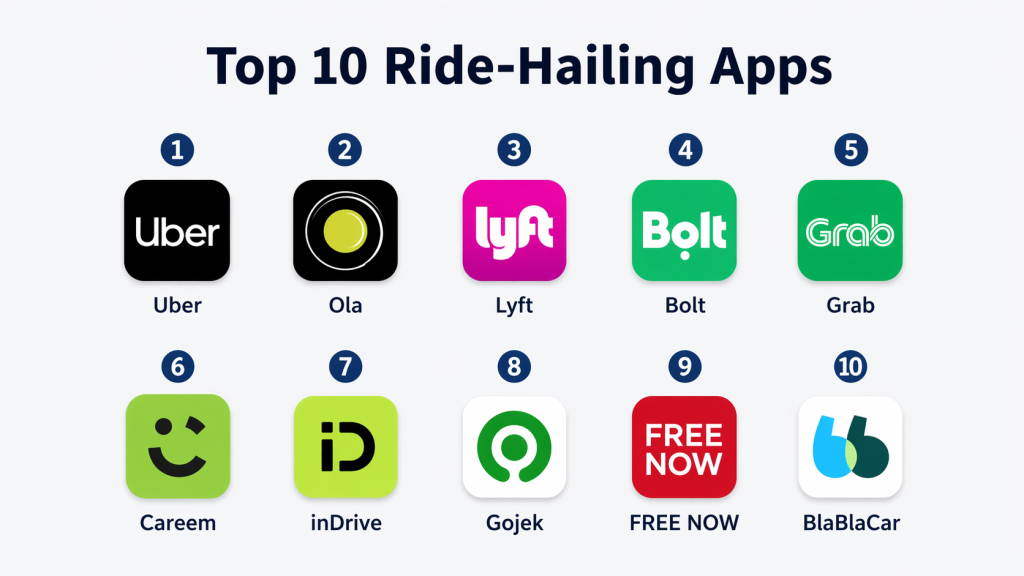
Top 10 Ride-Hailing Apps
#1 — Uber
Short description: Uber is one of the most widely used ride-hailing platforms globally, offering a range of services from budget rides to premium options. It caters to both individual users and businesses with consistent availability. The platform is known for its strong technology backbone and global presence.
Key Features
- Real-time ride tracking
- Multiple ride options (economy, premium, shared)
- Cashless payments
- Ride scheduling
- Safety toolkit
- Driver ratings system
Pros
- Wide global availability
- Reliable service in urban areas
Cons
- Surge pricing during peak hours
- Pricing can vary significantly
Platforms / Deployment
iOS / Android
Cloud
Security & Compliance
MFA, encryption, ride tracking
Compliance: Not publicly stated
Integrations & Ecosystem
Uber integrates with maps, payments, and business tools.
- Payment gateways
- Map services
- Business travel tools
Support & Community
In-app support with large global user base.
#2 — Ola
Short description: Ola is a major ride-hailing platform focused on India and other select markets. It offers diverse ride options including autos, bikes, and cars. The platform is tailored for local commuting needs and affordability.
Key Features
- Auto, bike, and car rides
- Cash and digital payments
- Ride scheduling
- Localized pricing
- Safety features
Pros
- Affordable pricing
- Strong presence in India
Cons
- Limited global availability
- Service quality can vary
Platforms / Deployment
iOS / Android
Cloud
Security & Compliance
Basic security features
Compliance: Not publicly stated
Integrations & Ecosystem
Supports local payment systems and maps.
- Wallet integrations
- Map services
Support & Community
Regional support with large user base.
#3 — Lyft
Short description: Lyft is a ride-hailing platform primarily operating in North America, known for its user-friendly interface and focus on customer experience. It offers various ride categories and subscription options.
Key Features
- Ride scheduling
- Multiple ride types
- Subscription plans
- Driver tipping
- Safety monitoring
Pros
- Clean user interface
- Good customer experience
Cons
- Limited to specific regions
- Pricing can fluctuate
Platforms / Deployment
iOS / Android
Cloud
Security & Compliance
Encryption, safety tools
Compliance: Not publicly stated
Integrations & Ecosystem
Integrates with maps and payment systems.
- Payment tools
- Navigation systems
Support & Community
Responsive support with strong regional presence.
#4 — Bolt
Short description: Bolt is a fast-growing ride-hailing platform in Europe and Africa, offering affordable rides and expanding mobility services. It focuses on cost efficiency and driver incentives.
Key Features
- Affordable rides
- Ride tracking
- Multiple transport options
- Driver ratings
- Promotions and discounts
Pros
- Competitive pricing
- Growing coverage
Cons
- Limited availability in some regions
- Feature set still evolving
Platforms / Deployment
iOS / Android
Cloud
Security & Compliance
Not publicly stated
Integrations & Ecosystem
Supports standard integrations.
- Payment systems
- Map services
Support & Community
Growing support infrastructure.
#5 — Grab
Short description: Grab is a Southeast Asia-based super app offering ride-hailing along with food delivery and payments. It is widely used for both personal and business transportation.
Key Features
- Ride booking
- Digital payments
- Delivery services
- Safety features
- Loyalty programs
Pros
- Multi-service platform
- Strong regional dominance
Cons
- Limited outside Southeast Asia
- App can feel complex
Platforms / Deployment
iOS / Android
Cloud
Security & Compliance
Encryption, MFA
Compliance: Not publicly stated
Integrations & Ecosystem
Extensive ecosystem within its platform.
- Payments
- Delivery services
- APIs
Support & Community
Strong regional support and ecosystem.
#6 — Careem
Short description: Careem is a ride-hailing and mobility platform operating mainly in the Middle East and South Asia. It offers multiple services beyond rides, including deliveries and payments.
Key Features
- Ride booking
- Wallet system
- Scheduling
- Safety tools
- Multi-service platform
Pros
- Strong regional presence
- Integrated services
Cons
- Limited global reach
- Feature depth varies
Platforms / Deployment
iOS / Android
Cloud
Security & Compliance
Not publicly stated
Integrations & Ecosystem
Supports payments and services integration.
- Wallet
- Delivery services
Support & Community
Regional support network.
#7 — inDrive
Short description: inDrive offers a unique ride-hailing model where passengers can negotiate fares directly with drivers. It is popular in price-sensitive markets.
Key Features
- Fare negotiation
- Ride tracking
- Multiple vehicle types
- Cash payments
- Rating system
Pros
- Flexible pricing
- User control over fares
Cons
- Less predictable pricing
- Availability varies
Platforms / Deployment
iOS / Android
Cloud
Security & Compliance
Not publicly stated
Integrations & Ecosystem
Basic integrations.
- Maps
- Payments
Support & Community
Growing global user base.
#8 — Gojek
Short description: Gojek is a Southeast Asian super app offering ride-hailing, delivery, and financial services. It is widely used for daily commuting and services.
Key Features
- Ride booking
- Delivery services
- Digital payments
- Loyalty programs
- Multi-service ecosystem
Pros
- All-in-one platform
- Strong regional adoption
Cons
- Limited outside region
- App complexity
Platforms / Deployment
iOS / Android
Cloud
Security & Compliance
Not publicly stated
Integrations & Ecosystem
Extensive ecosystem integrations.
- Payments
- Delivery
- APIs
Support & Community
Strong community and support.
#9 — FREE NOW
Short description: FREE NOW is a European mobility platform offering ride-hailing, taxis, and other transport services. It focuses on urban mobility solutions.
Key Features
- Taxi and ride booking
- Payment options
- Ride tracking
- Business travel support
- Multi-modal transport
Pros
- Strong in Europe
- Supports licensed taxis
Cons
- Limited global presence
- Feature depth varies
Platforms / Deployment
iOS / Android
Cloud
Security & Compliance
Not publicly stated
Integrations & Ecosystem
Supports mobility integrations.
- Payment systems
- Transport services
Support & Community
Regional support services.
#10 — BlaBlaCar
Short description: BlaBlaCar is a long-distance ride-sharing platform connecting drivers with passengers traveling the same route. It focuses on cost-sharing rather than traditional ride-hailing.
Key Features
- Long-distance ride sharing
- Cost splitting
- Booking system
- Ratings and reviews
- Route matching
Pros
- Cost-effective for long trips
- Community-driven
Cons
- Not for instant rides
- Limited urban use
Platforms / Deployment
iOS / Android
Cloud
Security & Compliance
Not publicly stated
Integrations & Ecosystem
Basic integrations.
- Payments
- Maps
Support & Community
Strong community-based support.
Comparison Table (Top 10)
| Tool Name | Best For | Platform(s) Supported | Deployment | Standout Feature | Public Rating |
|---|---|---|---|---|---|
| Uber | Global users | iOS, Android | Cloud | Global availability | N/A |
| Ola | India users | iOS, Android | Cloud | Multi-ride options | N/A |
| Lyft | North America | iOS, Android | Cloud | User experience | N/A |
| Bolt | Budget rides | iOS, Android | Cloud | Low pricing | N/A |
| Grab | Southeast Asia | iOS, Android | Cloud | Super app ecosystem | N/A |
| Careem | Middle East | iOS, Android | Cloud | Integrated services | N/A |
| inDrive | Price control | iOS, Android | Cloud | Fare negotiation | N/A |
| Gojek | Southeast Asia | iOS, Android | Cloud | Multi-service platform | N/A |
| FREE NOW | Europe | iOS, Android | Cloud | Taxi integration | N/A |
| BlaBlaCar | Long-distance | iOS, Android | Cloud | Ride sharing | N/A |
Evaluation & Scoring of Ride-Hailing Apps
| Tool Name | Core (25%) | Ease (15%) | Integrations (15%) | Security (10%) | Performance (10%) | Support (10%) | Value (15%) | Weighted Total |
|---|---|---|---|---|---|---|---|---|
| Uber | 9 | 9 | 8 | 8 | 9 | 8 | 7 | 8.5 |
| Ola | 8 | 8 | 7 | 7 | 8 | 7 | 9 | 8.0 |
| Lyft | 8 | 9 | 7 | 7 | 8 | 8 | 7 | 7.9 |
| Bolt | 7 | 8 | 6 | 6 | 7 | 7 | 9 | 7.5 |
| Grab | 9 | 8 | 9 | 8 | 8 | 8 | 7 | 8.3 |
| Careem | 8 | 8 | 7 | 7 | 8 | 7 | 7 | 7.8 |
| inDrive | 7 | 8 | 6 | 6 | 7 | 7 | 9 | 7.4 |
| Gojek | 9 | 8 | 9 | 8 | 8 | 8 | 7 | 8.3 |
| FREE NOW | 7 | 7 | 7 | 6 | 7 | 7 | 7 | 7.0 |
| BlaBlaCar | 7 | 8 | 6 | 6 | 7 | 7 | 9 | 7.4 |
How to interpret scores:
- Higher scores indicate better overall performance
- Some apps prioritize affordability over features
- Regional apps may score lower globally but perform better locally
- Choose based on your usage and location
Which Ride-Hailing App Is Right for You?
Solo / Freelancer
Uber, Ola, or inDrive for flexible and quick rides.
SMB
Ola, Uber, and Grab for affordability and availability.
Mid-Market
Uber and Grab for balance between features and reliability.
Enterprise
Uber for Business and similar enterprise offerings.
Budget vs Premium
- Budget: Ola, Bolt, inDrive
- Premium: Uber, Lyft
Feature Depth vs Ease of Use
- Feature-rich: Grab, Gojek
- Easy-to-use: Uber, Lyft
Integrations & Scalability
- Strong ecosystem: Uber, Grab, Gojek
Security & Compliance Needs
- Better safety features: Uber, Lyft
Frequently Asked Questions (FAQs)
Q1: What is a ride-hailing app?
It is a mobile app that connects passengers with drivers for on-demand transportation services.
Q2: Are ride-hailing apps safe?
Most apps include safety features like ride tracking, driver verification, and emergency support.
Q3: How is pricing calculated?
Pricing is based on distance, time, demand, and surge conditions.
Q4: Can I schedule rides in advance?
Yes, most apps allow ride scheduling.
Q5: Do these apps support cash payments?
Some apps support cash, while others are fully digital.
Q6: Are ride-hailing apps available everywhere?
Availability depends on the region and local regulations.
Q7: Can businesses use these apps?
Yes, many apps offer business travel solutions.
Q8: What are common issues users face?
Surge pricing, driver cancellations, and availability during peak hours.
Q9: Can I switch between apps easily?
Yes, users often install multiple apps for flexibility.
Q10: Are there alternatives to ride-hailing apps?
Yes, traditional taxis, public transport, and rentals are alternatives.
Conclusion
Ride-hailing apps have transformed how people move in cities by making transportation faster, more accessible, and digitally driven. From daily commuting to business travel, these platforms offer flexible solutions for different needs and budgets. However, the best app depends heavily on your location, usage frequency, and budget preferences. Global platforms provide consistency, while regional apps often offer better pricing and localized services. As the industry evolves, features like AI pricing, EV adoption, and multi-service ecosystems are becoming standard. This means users can expect more personalized and efficient experiences over time.