Introduction
When people start investing in the stock market, they often hear two famous terms: growth investing and value investing. These are two completely different ways to pick stocks.
Choosing the right approach can feel confusing. One style tells you to buy popular, fast-moving companies that are changing the world. The other tells you to hunt for quiet, unloved companies that the market has ignored or underpriced.
If you do not understand the differences, you might buy the wrong stocks for your personality. You could panic and sell when prices drop, or miss out on steady gains. This guide explains how both strategies work, what makes them unique, and how to decide which one fits your financial goals.
What Is Growth Investing?
Growth investing is a strategy where you buy shares in companies that are expanding rapidly and increasing their sales and profits at an above-average rate compared to the rest of the market.
Why Does It Matter?
Growth companies often reinvest their earnings back into their own businesses instead of paying cash dividends to shareholders. They use that money to build new products, enter new markets, or hire top talent. This helps them expand quickly, which can lead to high stock price increases over time.
How It Works
Imagine a startup software company that doubles its revenue every year. Even if its current profits look small because it spends heavily on research and expansion, investors buy the stock because they expect the company to dominate its industry in the future.
- Professional term: Price-to-Earnings Ratio (P/E Ratio): A measure of how much investors are willing to pay for each dollar of a company’s earnings. Growth stocks usually have high P/E ratios because people expect huge future profits.
- Why it matters: A high P/E means the stock is expensive today, but investors accept that cost for the promise of rapid future growth.
What Is Value Investing?
Value investing is a strategy where you buy stocks that trade for less than their actual financial worth. Value investors believe the stock market sometimes overreacts to bad news, causing good companies to go on sale.
Why Does It Matter?
Value investing helps you buy assets at a discount. By purchasing a stock below its intrinsic value (its true calculated worth), you build a margin of safety. This means even if things do not go perfectly, your downside risk is lower because you did not overpay.
How It Works
Think of shopping at a clearance sale. A sturdy winter jacket is marked down by 50% simply because winter is ending, but the jacket’s quality has not changed. Value investors look for strong, stable companies—like banks, utility providers, or established manufacturers—that are temporarily cheap due to short-term market fears.
- Professional term: Margin of Safety: The difference between the intrinsic value of a stock and its current market price.
- Why it matters: It acts as a financial cushion against calculation errors or unexpected market downturns.
How Growth Investing and Value Investing Work
To understand these strategies better, it helps to look at how they operate in the real world.
The Growth Investing Process
- Identify Trends: Look for industries changing the world, such as artificial intelligence, renewable energy, or digital payments.
- Analyze Revenue Growth: Check if the company is growing its sales by 15% to 20% or more each year.
- Evaluate Leadership: Look for visionary management teams that can scale a business successfully.
- Accept Volatility: Prepare for wild price swings because these stocks are priced for perfection.
The Value Investing Process
- Screen for Low Multiples: Look for low P/E ratios or low Price-to-Book (P/B) ratios compared to industry peers.
- Check Financial Health: Ensure the company has manageable debt and steady cash flow, so it does not go bankrupt.
- Identify the Mispricing: Ask why the stock is cheap. Is it a temporary panic, or is the business actually failing?
- Be Patient: Wait for the market to realize the company’s true worth, which can take months or years.
Practical Examples
Example 1: The Growth Investor
Meet Alex. Alex invests in a cloud-computing company. The company loses money today because it spends heavily on data centers, but its customer base grows by 30% annually. Alex believes cloud computing is the future. Five years later, the company turns a profit, and its stock price multiplies several times over.
Example 2: The Value Investor
Meet Priya. Priya invests in a well-established retail bank. The bank’s stock dropped 20% because of a short-term drop in consumer spending. However, the bank has zero debt, steady earnings, and pays a healthy dividend. Priya buys the stock at a discount. Two years later, the market recovers, and the stock price bounces back to its normal level.
Common Mistakes
- Chasing Hype Without Research: Buying a growth stock simply because everyone on social media is talking about it often leads to buying at the absolute peak. Always check if the revenue growth matches the hype.
- Falling Into Value Traps: Buying a cheap stock without checking its debt. A stock trading at a low price is not a bargain if the underlying business is dying due to poor management or new technology.
- Impatience: Expecting value stocks to pop up overnight, or panicking when a growth stock drops 15% in a single month. Both strategies require long-term patience.
Risks and Limitations
- Growth Investing Risks: Because growth stocks are expensive, any minor earnings miss can cause their stock prices to crash hard. They perform poorly during periods of rising interest rates because future profits are worth less today.
- Value Investing Risks: Value stocks can remain cheap for a very long time—a phenomenon known as a “value trap.” If the industry is shrinking, the stock may never recover its former glory.
Comparison: Growth Investing vs Value Investing
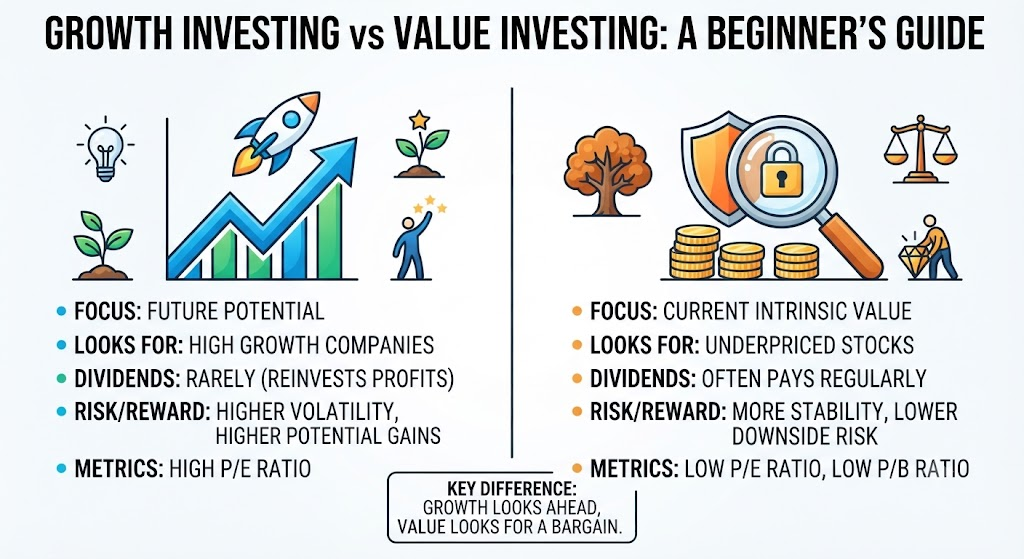
| Feature | Growth Investing | Value Investing |
|---|---|---|
| Primary Focus | Future earnings and market expansion | Current financial worth and discounts |
| Stock Pricing | Usually high P/E ratios (expensive) | Usually low P/E or P/B ratios (cheap) |
| Dividends | Rarely pays dividends; reinvests cash | Often pays regular cash dividends |
| Market Condition Fit | Thrives in low interest rates and booming economies | Thrives during market recoveries or economic uncertainty |
| Main Risk | High volatility and sharp price drops | Value traps and slow long-term recovery |
Checklist for Choosing a Strategy
- Assess Your Risk Tolerance: Can you handle watching your portfolio drop 30% in exchange for high future potential? (Growth) Or do you prefer steady, stable companies with lower volatility? (Value)
- Define Your Timeline: Are you investing for 10 to 20 years away? (Growth gives compounding time) Do you want regular income or lower downside risk now? (Value)
- Check Your Temperament: Do you get anxious when stocks are expensive? Or do you get excited when good companies go on sale?
- Consider a Blend: Remember that you do not have to choose just one. Many successful investors own a mix of both growth and value stocks.
Key Terms
- Intrinsic Value: The calculated, true economic worth of a company based on its assets, earnings, and future cash flow.
- Dividend: A portion of a company’s profit paid out regularly to its shareholders.
- Bear Market: A market condition where stock prices fall significantly, typically by 20% or more from recent highs.
- Bull Market: A market condition where stock prices rise or are expected to rise.
- Compound Interest: The ability of an investment to generate earnings, which are then reinvested to generate their own earnings.
FAQs
Can I do both growth and value investing?
Yes. Many investors practice “blend investing,” holding both fast-growing technology companies and stable, discounted value stocks to balance their portfolios.
Which strategy makes more money?
Neither strategy is universally better. Growth investing can outperform during economic booms, while value investing often wins during market corrections or slow economic periods. Historical data shows that leadership shifts back and forth between the two over different decades.
Do growth stocks pay dividends?
Most growth companies do not pay dividends because they prefer to reinvest every dollar back into expanding their operations. Value companies are more likely to pay regular dividends.
Are value stocks safer than growth stocks?
Value stocks generally experience lower price volatility, but they are not risk-free. If a cheap company goes bankrupt or faces permanent structural decline, you can still lose money.
How do interest rates affect these strategies?
High interest rates usually hurt growth stocks more because their projected future profits are discounted more heavily today. Value stocks often hold up better during high-rate environments because they generate immediate cash flows.
Conclusion
Growth investing and value investing represent two different ways to look at the stock market. Growth investors look forward, betting on innovation, disruption, and rapid expansion. Value investors look around, hunting for hidden discounts and financial stability in established businesses.
Understanding your own temperament and financial goals will help you choose the path that keeps you calm during market swings. Whether you prefer the excitement of fast-growing innovators or the steady safety of discounted bargains, consistency and patience remain the true keys to long-term investing success.