Introduction
Most people want their money to grow. They look at the stock market, see a company doing very well, and feel tempted to put all their savings into that single stock. It feels exciting. You imagine fast profits and easy gains.
However, the real world of investing is unpredictable. Even the strongest companies can face sudden losses due to bad management, new laws, or unexpected economic shifts. When a portfolio lacks variety, a single bad event can wipe out years of savings.
This guide explains how diversification works, why it matters, and how you can use it to build a safer, steadier financial future without needing a degree in finance.
What Is Diversification in Investing?
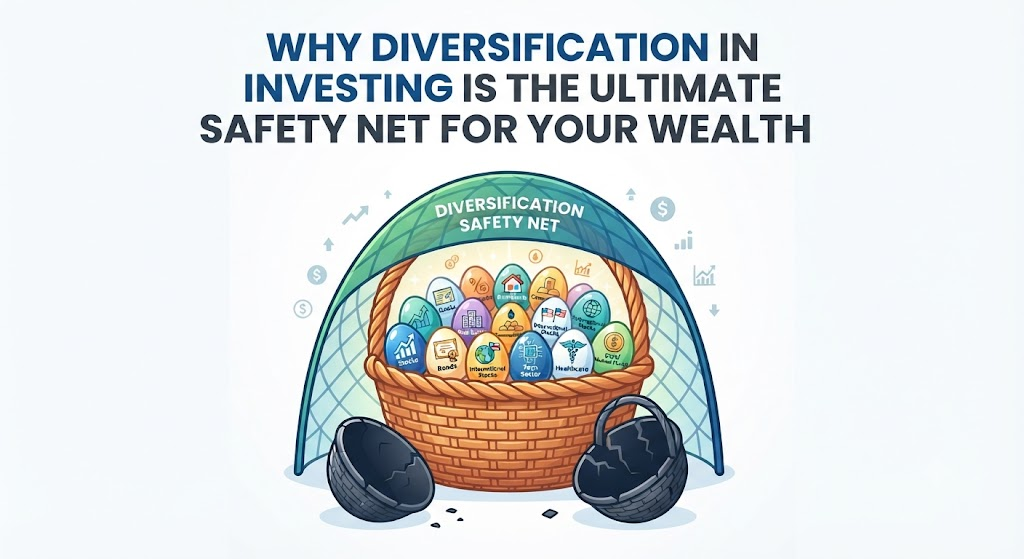
Diversification is a risk-management strategy where you spread your money across various financial instruments, industries, and asset classes.
- Simple meaning: Mixing different types of investments so your financial security does not depend on just one thing.
- Why it matters: Different investments react differently to economic events. When one goes down, another might go up, keeping your overall wealth stable.
- Example: Instead of buying shares of only one electric car company, you buy a mix of stocks from technology, healthcare, and energy companies, along with some government bonds.
How Diversification Works
Markets move in cycles. When tech stocks grow rapidly, energy stocks might stay flat or drop. When interest rates rise, certain banking stocks benefit while real estate might slow down.
Diversification works because different assets have a low correlation. Correlation is a statistical term for how two things move together.
- High correlation: Two stocks that always go up and down together.
- Low correlation: Two investments that do not follow the same path.
When you hold assets with low correlation, the losses in one area get balanced out by the gains in another. This creates a smoother, less stressful journey for your portfolio.
Why Diversification Matters
Without diversification, investing is essentially gambling. Here is why spreading your money changes everything:
- Reduces Severe Losses: It cushions the blow when a specific market sector crashes.
- Lowers Emotional Stress: Watching a single stock crash can cause panic. A diversified portfolio experiences milder ups and downs, helping you stay calm.
- Creates Steady Growth: You capture the growth of multiple winning industries instead of betting on a single outcome.
- Protects Against the Unknown: No one can predict the future. Diversification protects you against unexpected global events, regulatory changes, or sudden company failures.
Key Pillars of a Diversified Portfolio
A well-diversified portfolio is built across multiple layers. Here are the core areas to consider:
1. Asset Classes
An asset class is a group of investments that behave similarly. The major classes include:
- Equities (Stocks): Ownership shares in companies. They offer high growth potential but higher risk.
- Fixed Income (Bonds): Loans you give to governments or corporations in exchange for regular interest. They offer lower returns with greater safety.
- Cash and Equivalents: Savings accounts or short-term deposits for total liquidity and safety.
- Alternatives: Real estate, commodities (like gold), or digital assets.
2. Sectors and Industries
Within stocks, do not buy only technology companies. Spread your investments across:
- Healthcare
- Financial services
- Consumer goods
- Utilities
- Energy
3. Geography
Investing only in your home country exposes you to local economic troubles. Global diversification lets you invest in international markets, capturing growth from expanding economies worldwide.
Practical Example: The Two Investors
Imagine two investors, Aarav and Riya, who each have $10,000 to invest.
- Aarav puts all $10,000 into a single trending tech startup. Within a year, the company faces unexpected regulatory fines, and its stock price drops by 70%. Aarav’s portfolio value crashes to $3,000.
- Riya diversifies her $10,000. She puts $4,000 into a broad stock market index fund, $3,000 into government bonds, $2,000 into international equities, and $1,000 into gold. Even when the tech sector dips, her bonds and gold rise in value, keeping her total portfolio value stable at around $9,600.
Riya preserves her capital while Aarav suffers a heavy loss.
Common Mistakes in Diversification
Many investors think they are diversified when they are actually taking on hidden risks. Avoid these common traps:
- Over-Diversification (Diworsification): Buying 50 different stocks in the exact same industry is not diversification; it is just clutter. It dilutes your potential returns without reducing risk.
- The Illusion of Variety: Buying shares in five different clothing brands is not true diversification because they all react to the exact same economic pressures (like consumer spending habits).
- Ignoring Asset Allocation: Spending 95% of your money on high-risk stocks and 5% on bonds is an unbalanced approach that still leaves you vulnerable to a major stock crash.
- Chasing Past Performance: Buying whatever asset performed best last year rather than building a balanced long-term mix.
Risks and Limitations of Diversification
While diversification is powerful, it has clear limits:
- It Does Not Eliminate All Risk: If the entire global economy enters a recession, most risk assets will drop together. Diversification reduces specific risk, not systemic market risk.
- It Can Limit Massive Gains: If one particular stock skyrockets by 500%, a diversified portfolio will only capture a fraction of that gain because your money was spread out.
- Management Costs: Holding dozens of individual stocks or paying fees across multiple complex funds can increase your costs. Using low-cost index funds or mutual funds solves this issue.
Decision Framework: How to Build Your Diversified Portfolio
Follow these steps to create a balanced investment plan:
- Determine Your Goal and Time Horizon: Are you investing for retirement in 30 years or buying a house in 3 years? Longer timelines allow for more risk.
- Choose Your Asset Mix: Decide what percentage of your money goes to stocks (for growth) and what goes to bonds or cash (for stability).
- Select Broad Market Funds: Instead of picking individual stocks, look at mutual funds or exchange-traded funds (ETFs) that hold hundreds of companies at once.
- Include Global Exposure: Add international funds to protect against local market downturns.
- Review and Rebalance Annually: Once a year, check your portfolio. If stocks grew much faster than bonds, sell a small portion of stocks to buy bonds, bringing your mix back to your original target.
Checklist for Investors
- Have I invested in more than one asset class (stocks, bonds, cash)?
- Are my stock holdings spread across different industries?
- Do I have exposure to international markets, or am I entirely dependent on one country?
- Am I using low-cost index funds or ETFs to achieve broad market coverage easily?
- Do I have an emergency fund in cash before taking market risks?
- Do I review my portfolio at least once a year to rebalance my holdings?
Key Terms
- Asset Allocation: The process of dividing your investment money among different major categories like stocks, bonds, and cash.
- Correlation: A measure of how two different investments move in relation to each other.
- Equity: Ownership in a corporation, usually represented by shares of stock.
- Fixed Income: Investments like bonds that pay a fixed return over time.
- Index Fund: A type of mutual fund or ETF designed to track the performance of a broad market index, offering instant diversification.
- Portfolio: A collection of all your financial investments held together.
- Rebalancing: The act of resetting your portfolio back to your original asset mix by buying or selling assets.
- Risk Tolerance: Your ability and willingness to stomach financial ups and downs in pursuit of higher returns.
Frequently Asked Questions
Does diversification guarantee that I will never lose money?
No. Diversification reduces the risk of catastrophic losses from a single bad investment, but it cannot protect you from broad market downturns when entire economies decline.
How many stocks do I need to own to be fully diversified?
Owning individual stocks requires holding 20 to 30 companies across unrelated sectors to achieve safety. However, buying a single broad market index fund or ETF gives you instant diversification across hundreds of companies immediately.
Is diversification only for wealthy investors?
Not at all. Modern financial platforms and low-cost index funds allow beginners to start diversifying with very small amounts of money.
Can I diversify too much?
Yes. Buying too many overlapping funds or dozens of similar stocks can lead to “diworsification,” where management fees eat into your returns without lowering your risk any further.
How often should I check or change my diversified portfolio?
Checking your portfolio daily can cause emotional stress. A yearly review is usually enough to check your asset balance and rebalance if necessary.
Should younger investors hold more stocks or bonds?
Generally, younger investors have a longer time horizon to recover from market drops, so they often hold a higher percentage of growth-focused assets like stocks.
What is the easiest way for a beginner to diversify?
Investing in a total stock market index fund or a multi-asset fund is one of the simplest ways for a beginner to achieve instant diversification with a single purchase.
Does international investing really help reduce risk?
Yes. Different countries experience different economic cycles, inflation rates, and political events. Adding international exposure helps smooth out local market crashes.
Conclusion
Diversification is the foundation of smart, stress-free investing. By spreading your wealth across different asset classes, industries, and regions, you protect yourself from the sudden failure of any single investment. It will not make you rich overnight, and it will not eliminate all market risk, but it provides the safety net needed to stay invested for the long term and grow your wealth with confidence.