Introduction
Many new investors think stock prices only move because of company earnings or global news. Yet, one of the most powerful forces driving the Indian stock market sits inside a grand building in Mumbai: the Reserve Bank of India.
When the RBI makes a policy decision, millions of rupees shift across the financial system within minutes. Bank stocks react, real estate shares jump, and consumer goods companies feel the pressure.
Many beginners find central bank policies confusing because of heavy economic jargon. Terms like “repo rate,” “liquidity adjustment facility,” and “cash reserve ratio” sound like a foreign language.
Misunderstanding these rules can cost investors dearly. For instance, buying bank stocks right when interest rates peak can lead to heavy losses.
This guide breaks down how RBI policies actually work, how they affect different sectors, and how you can use this knowledge to make better investment choices.
What Is Monetary Policy?
Monetary policy is the set of tools the central bank uses to manage the supply, availability, and cost of money in an economy.
Think of the RBI as the driver of the Indian economy. Just like a driver uses the accelerator to speed up and the brakes to slow down, the RBI uses monetary policy to control economic speed.
When the economy moves too slowly, the RBI pumps money in to encourage spending. When prices rise too fast, the RBI pulls money out to cool things down.
Why It Matters
Money is the fuel for the stock market. If fuel flows freely, businesses grow fast and stock prices climb. If the fuel supply tightens, businesses struggle for capital and stock prices fall.
Key RBI Tools That Move the Stock Market
The RBI uses specific tools to control money in the banking system. Knowing these terms helps you understand daily financial news.
1. Repo Rate (Repurchase Rate)
- Simple Meaning: The interest rate at which the RBI lends money to commercial banks.
- Why It Matters: If the repo rate goes up, banks pay more to borrow from the RBI. Banks pass this cost on by raising loan rates for regular people and businesses.
- Example: If the repo rate rises from 6.0% to 6.5%, your home loan EMI increases, and companies pay higher interest on their business loans.
2. Reverse Repo Rate
- Simple Meaning: The interest rate the RBI pays banks when they park their extra cash with the central bank.
- Why It Matters: A higher reverse repo rate encourages banks to keep their money safe with the RBI instead of lending it out to companies or consumers. This reduces the money supply in the economy.
3. Cash Reserve Ratio (CRR)
- Simple Meaning: The exact percentage of total deposits that commercial banks must keep with the RBI as cash.
- Why It Matters: If the CRR is 4%, a bank cannot lend 4 out of every 100 rupees deposited by customers. Raising the CRR leaves banks with less money to lend, which slows down economic activity.
4. Statutory Liquidity Ratio (SLR)
- Simple Meaning: The percentage of deposits that banks must keep in safe assets like government securities (G-secs).
- Why It Matters: This ensures banks have a safety net, but it also limits the amount of cash available for corporate loans.
How RBI Rate Cuts Impact Indian Stocks
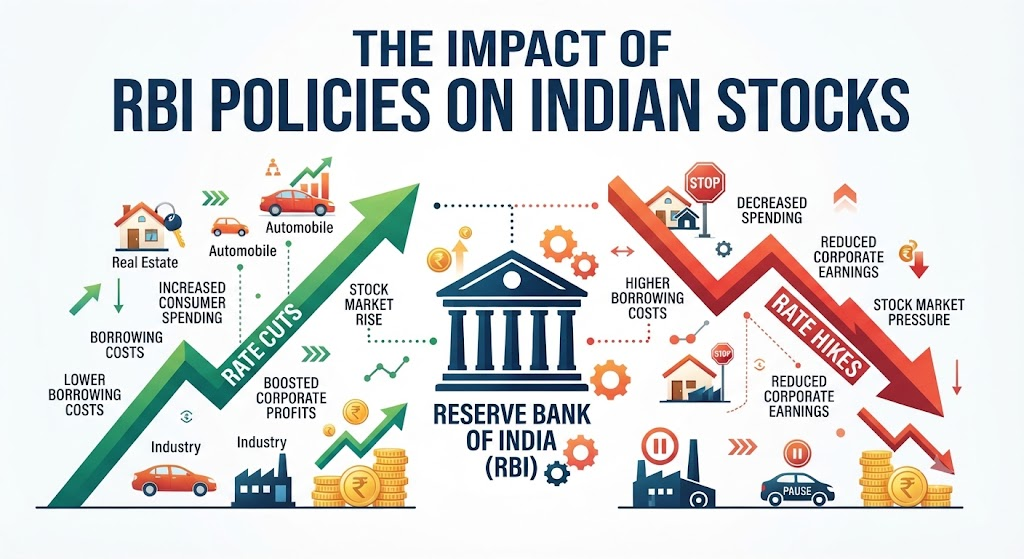
When the RBI lowers the repo rate, it follows an expansionary monetary policy (often called a dovish stance).
How the Process Works
- Lower Borrowing Costs: Banks get cheaper funds from the RBI and pass the benefit to borrowers.
- Higher Spending: Consumers buy more cars and houses because loans are cheap.
- Cheaper Corporate Expansion: Companies borrow money at lower rates to build new factories, launch new products, and hire workers.
- Boosted Profits: Lower interest expenses mean higher net profits for companies.
- Stock Market Rise: Higher profits drive up stock valuations as investors chase growth.
Sectors That Benefit Most
- Real Estate: Home buyers rush to purchase apartments when home loan rates drop.
- Automobiles: Lower vehicle loan rates drive up car and two-wheeler sales.
- Banking and NBFCs: Credit growth picks up, though falling interest rates can sometimes squeeze profit margins temporarily.
- Infra and Capital Goods: Companies borrow heavily to fund big construction projects.
How RBI Rate Hikes Impact Indian Stocks
When inflation climbs too high, the RBI shifts to a contractionary monetary policy (a hawkish stance) and raises interest rates.
How the Process Works
- Higher Borrowing Costs: Loans become expensive for everyone.
- Lower Spending: Consumers delay buying expensive items like homes and cars.
- Slower Business Growth: Companies postpone expansion plans because funding costs too much.
- Lower Profits: Higher interest payments eat into corporate earnings.
- Stock Market Correction: Disappointing earnings reports cause stock prices to drop.
Sectors That Face Pressure
- Real Estate: High home loan rates freeze property sales.
- Auto: Expensive vehicle financing cuts down monthly sales numbers.
- Debt-Heavy Companies: Businesses with heavy loans struggle to service their debt, hurting their stock value.
Real-World Practical Considerations
Understanding monetary policy on paper is simple, but real markets behave with more complexity.
- The Expectation Game: Stock markets rarely wait for the RBI to announce a rate cut or hike. Investors price in future actions months in advance. If analysts expect a rate cut, stock prices often rise before the official announcement.
- Global Spillover Effects: The RBI does not work in a vacuum. If the US Federal Reserve raises interest rates, foreign institutional investors (FIIs) often pull their money out of Indian stocks to chase higher returns abroad, regardless of what the RBI does.
- Inflation Triggers: The RBI’s primary mandate is to keep inflation within a target range (usually 2% to 6%, centered around 4%). If vegetable or crude oil prices spike, the RBI’s hands are tied. They must keep rates high to fight inflation, even if the stock market wants lower rates.
Common Mistakes Investors Make
- Mistake 1: Reacting Late to Policy Announcements.
- Why people do it: They wait for the newspaper headline saying “RBI cuts rates” and buy stocks immediately.
- Why it fails: Smart institutional investors priced that move in weeks ago. By the time retail investors buy, the stock may already be at its peak.
- Mistake 2: Ignoring Debt Levels During Rate Hikes.
- Why people do it: They focus only on a company’s revenue growth.
- Why it fails: When the RBI raises rates, companies with heavy debt watch their interest expenses skyrocket, crushing their net profits.
- Mistake 3: Treating All Banks the Same Way.
- Why people do it: Assuming rate changes affect every bank equally.
- Why it fails: Banks with a high share of low-cost deposits (CASA) handle rate cycles much better than banks that rely on expensive wholesale borrowings.
Decision-Making Framework for Investors
When the RBI announces a major policy shift, use this simple framework to review your portfolio:
- Step 1: Identify the Policy Stance. Is the RBI cutting rates (growth-focused) or hiking rates (inflation-focused)?
- Step 2: Check Your Portfolio Debt. Do the companies you own carry high loans or do they sit on a cash surplus? (Rate hikes hurt debt-heavy firms; rate cuts help them).
- Step 3: Look at Sector Cyclicality. Shift focus toward defensive sectors (like FMCG and pharma) during high-inflation, high-rate cycles, and toward cyclical sectors (like auto, real estate, and metals) when rates start coming down.
- Step 4: Monitor Bond Yields. Watch how government bond yields react. Rising bond yields often pull money away from risky equities into safe debt instruments.
Key Terms
- Repo Rate: The interest rate charged by the RBI when commercial banks borrow money from it.
- Reverse Repo Rate: The interest rate paid by the RBI to commercial banks for parking their excess funds with it.
- Inflation: The general increase in prices and fall in the purchasing value of money over time.
- Cash Reserve Ratio (CRR): The minimum percentage of deposits that commercial banks must hold with the RBI in cash.
- Hawkish Stance: A central bank policy focused on raising interest rates to fight high inflation.
- Dovish Stance: A central bank policy focused on lowering interest rates to stimulate economic growth.
- Liquidity: The ease with which assets, such as stocks or cash, can be bought or sold in the market.
- FII (Foreign Institutional Investor): Large foreign funds that invest money in Indian financial markets.
FAQs
How does an RBI rate cut affect my existing stock portfolio?
Lower interest rates reduce corporate borrowing costs and encourage consumer spending. This generally boosts corporate profits and pushes stock prices upward, particularly in sectors like real estate, automobiles, and banking.
Why do stock markets fall when the RBI raises interest rates?
When the RBI raises rates, loans become expensive. Businesses pay more to service their debt, and consumers spend less. This slows down corporate earnings growth, leading investors to sell stocks.
Does the RBI control stock prices directly?
No. The RBI does not set or control stock prices. It controls interest rates and money supply. Stock prices move as a reaction to how these monetary changes impact company earnings and investor sentiment.
What is the difference between CRR and Repo Rate?
The Repo Rate is the interest rate charged on loans given by the RBI to commercial banks. The Cash Reserve Ratio (CRR) is the percentage of total customer deposits that banks must keep idle with the RBI without earning any interest.
How does inflation influence RBI policy decisions?
Price stability is the RBI’s primary goal. When inflation rises above the comfort zone, the RBI raises interest rates to cool down consumer demand and stabilize prices.
Should I sell my stocks immediately when the RBI announces a rate hike?
Not necessarily. Markets often price in rate hikes before they happen. Selling in a panic can lock in losses. Instead, review the debt levels and business strength of the companies in your portfolio.
Do foreign investors care about RBI policies?
Yes. Foreign Institutional Investors (FIIs) monitor RBI policies closely. Higher interest rates in India can attract foreign capital looking for better fixed returns, while shifting currency values also impact their overall investment returns.
Where can I check official RBI policy updates?
You can find all official policy announcements, press releases, and monetary policy committee (MPC) meeting minutes directly on the official website of the Reserve Bank of India (rbi.org.in).
Conclusion
The Reserve Bank of India holds the steering wheel of the nation’s financial system. Its policy choices regarding interest rates and money supply directly shape corporate earnings and market direction.
By looking past daily news headlines and understanding how rate cycles impact debt, consumer spending, and sector performance, you can build a resilient portfolio. Always look at a company’s financial health and debt levels before making investment decisions, keeping the broader economic cycle in mind.