Introduction
Stock markets go up and down. Most of the time, investors enjoy watching their wealth grow as share prices rise. However, economic troubles, high inflation, or sudden global events can trigger a market crash. During a crash, panic spreads quickly. Investors sell their shares in a hurry, causing stock prices across almost every industry to plummet.
Watching your portfolio lose value in a matter of days is stressful. Many everyday investors make the mistake of selling all their stocks in a panic, locking in their losses. Others stay fully invested in risky, high-growth companies that get hit the hardest when fear takes over the market.
Smart investors prepare for these storms ahead of time. Instead of trying to time the unpredictable market, they build a resilient portfolio containing defensive assets. This article explores how defensive stocks work, which sectors offer the best protection, and how you can select the right companies to keep your money safe during a severe market downturn.
What Are Defensive Stocks?
A defensive stock is a share in a company that provides steady, reliable products and services regardless of the current economic climate.
Simple Meaning
Think of defensive stocks as the financial equivalent of wearing a heavy winter coat during a blizzard. While everyone else is freezing and running for cover, the coat keeps you warm and safe from harsh conditions.
Why It Matters
When a recession or market crash happens, people lose jobs, businesses cut spending, and consumers tighten their belts. However, people still need to eat, turn on their lights, buy basic medicines, and use household cleaning products. Because demand for these essential items does not drop during tough times, the companies that sell them continue to make steady profits.
Example
Imagine a company that makes laundry detergent and toothpaste. Even if the stock market crashes by thirty percent tomorrow, families will still brush their teeth and wash their clothes. They might stop buying luxury cars or expensive vacations, but they will not stop buying basic hygiene products. This steady consumer demand protects the company’s revenue and supports its stock price.
How Defensive Stocks Work During a Market Crash
To understand why defensive stocks hold their value better than other shares, you need to look at how different sectors behave during a financial crisis.
Cyclical vs. Defensive Companies
Stock market companies generally fall into two categories:
- Cyclical Stocks: These belong to industries that rise and fall along with the health of the economy. Examples include car manufacturers, luxury clothing brands, airlines, and high-end restaurants. When times are good, people spend freely on these items. When times get tough, buyers disappear, and these companies suffer massive drops in revenue and stock value.
- Defensive Stocks: These belong to non-cyclical industries. Their business performance stays relatively flat and predictable whether the economy is booming or crashing.
Beta: Measuring Market Sensitivity
Financial experts use a metric called Beta to measure how much a stock’s price moves compared to the overall market.
- A Beta of 1.0 means the stock moves right along with the broader market.
- A Beta greater than 1.0 means the stock is more volatile than the market (if the market drops 10%, these stocks might drop 20%).
- A Beta of less than 1.0 means the stock is less volatile. Most true defensive stocks have a low Beta (often between 0.5 and 0.8), meaning they experience much milder price swings when a market crash occurs.
Key Sectors That Offer Strong Protection
Not all industries are created equal when the market turns red. Several specific sectors consistently act as safe havens during a financial downturn.
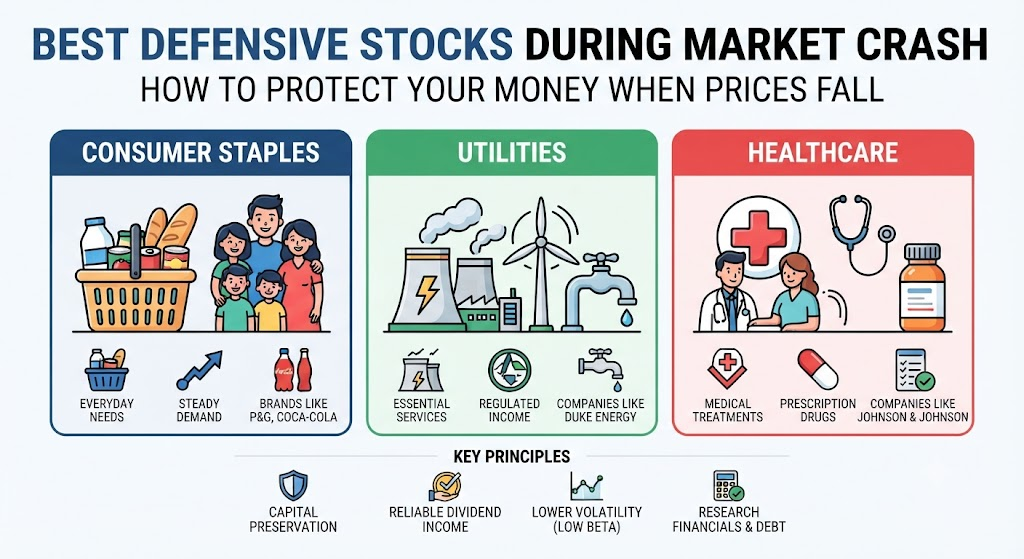
1. Consumer Staples
Consumer staples include everyday household goods, food, beverages, and personal care products.
- Why they work: People consume these goods daily regardless of personal financial strain.
- Examples: Companies that sell groceries, baby formula, soap, and packaged foods.
2. Utilities
Utilities provide essential services like electricity, natural gas, water, and waste management to homes and businesses.
- Why they work: Turning on your lights and running tap water are non-negotiable expenses. Furthermore, utility companies often operate as regulated monopolies, guaranteeing steady cash flow and reliable income.
- Examples: Regional power generation and water distribution companies.
3. Healthcare
Healthcare covers pharmaceutical drug makers, medical device manufacturers, hospitals, and health insurance providers.
- Why they work: Medical treatments, prescription drugs, and emergency surgeries cannot be delayed simply because the stock market is crashing.
- Examples: Major drug manufacturing corporations and medical supply companies.
Why Defensive Stocks Matter for Your Portfolio
Investing isn’t just about making money when the market goes up; it is also about keeping what you have earned when the market goes down.
Capital Preservation
The math of stock market losses is brutal. If your portfolio drops by 50% during a crash, you need a 100% gain just to get back to where you started. Defensive stocks soften the blow during a downturn, reducing the depth of your portfolio’s decline and making a full financial recovery much faster.
Reliable Dividend Income
Many defensive companies are mature, established businesses with stable cash flows. Instead of pouring all their money back into risky expansion projects, they return a portion of their profits to shareholders through dividends (regular cash payments made to investors).
- Dividend: A share of profits paid out regularly to stockholders.
- Why it matters: Even if the stock price drops temporarily during a crash, receiving steady dividend checks gives you cash to live on or reinvest into cheap stocks at a discount.
Important Factors to Check Before Buying Defensive Stocks
Even though defensive stocks are safer than growth or tech stocks during a crash, you cannot buy them blindly. Use these criteria to evaluate potential investments:
| Evaluation Factor | What to Look For | Why It Matters |
| Debt Level | Low to moderate debt | High interest payments crush companies when credit tightens during a financial crisis. |
| Dividend History | 10+ years of steady payments | Proves the company can generate cash through past recessions and market crashes. |
| Profit Margins | Stable or expanding margins | Shows the company has pricing power to pass rising costs onto consumers without losing sales. |
| Business Model | Essential products or services | Ensures customer demand will not dry up during a severe economic slump. |
Common Mistakes Investors Make with Defensive Stocks
Even experienced investors fall into traps when trying to build a defensive portfolio. Avoid these common errors:
- Chasing High Yields Blindly: A massive dividend yield can sometimes be a warning sign that the company is in financial trouble and its stock price has collapsed. Always check if the dividend is safe and backed by real earnings.
- Ignoring Valuation: Buying a great defensive stock at an artificially inflated price can still lead to heavy losses if a market crash hits. Never overpay for safety.
- Selling Everything Else: Defensive stocks are meant to balance your portfolio, not replace every growth asset you own. Selling all your growth stocks means you miss out when the market recovers and starts rising again.
- Expecting Zero Loss: Defensive stocks are less volatile, not invincible. When a severe panic hits the market, almost everything drops to some degree, even if it drops less than the broader indexes.
Decision-Making Framework: How to Add Defensive Stocks
Follow this simple framework to integrate defensive stocks into your investment strategy sensibly:
- Assess Your Current Risk: Look at your existing portfolio. Do you own mostly high-risk tech or growth stocks? If yes, you are exposed to heavy losses during a crash.
- Determine Your Allocation: Decide what percentage of your portfolio should be in defensive assets (often 20% to 40% depending on your age and risk tolerance).
- Screen for Quality: Look for mature companies in consumer staples, utilities, and healthcare with clean balance sheets and low debt.
- Check the Dividend Record: Review whether the company has successfully maintained or grown its dividend payments through past economic downturns.
- Buy Gradually: Do not invest all your money at once. Use a strategy like dollar-cost averaging to buy shares in pieces over time.
Key Terms
- Bear Market: A market condition where stock prices fall significantly (usually 20% or more) over a sustained period.
- Consumer Staples: Essential products like food, beverages, and hygiene items that people buy regardless of economic conditions.
- Dividend Yield: A financial ratio that shows how much a company pays out in dividends each year relative to its stock price.
- Non-Cyclical Industry: An industry that performs steadily during both economic booms and recessions.
- Volatility: The speed and size of price changes in a stock or the overall market over time.
FAQs
Are defensive stocks guaranteed to make money during a crash?
No. Defensive stocks are not immune to losses. They simply tend to fall much less than high-growth stocks or the overall market because their underlying businesses remain profitable during tough times.
Do defensive stocks pay good dividends?
Yes. Because these are mature companies with stable cash flows, they frequently pay consistent and reliable dividends compared to young technology companies that reinvest all earnings into growth.
Should I hold defensive stocks all the time?
Many long-term investors keep a permanent allocation of defensive stocks in their portfolios to smooth out volatility and generate steady dividend income year-round.
Are utility stocks safe during high inflation?
Utility companies often have regulated pricing structures, which can sometimes make it slower for them to adjust rates when inflation rises. However, their essential service model still provides strong baseline stability during market crashes.
How do I find the Beta of a stock?
You can look up the Beta of any stock easily on major financial websites, stock screeners, or your online brokerage account research tab.
Conclusion
Market crashes are an inevitable part of investing. While watching your account balance drop is never fun, preparing your portfolio ahead of time makes all the difference. Defensive stocks provide a sturdy financial shield by focusing on essential goods and services that people cannot live without. By adding stable consumer staples, reliable utilities, and strong healthcare companies to your holdings, you protect your capital, maintain steady dividend income, and position yourself to weather any economic storm.