Introduction
Every day, headlines flash across financial networks about corporate profits, central bank meetings, and global events. For many retail investors, reading these headlines feels like watching a storm from behind a window. You see the market jump up or crash down, and you wonder how people make money from these sudden shifts.
News trading is the attempt to capture financial gains from these exact moments of volatility. But it is not as simple as reading a good headline and buying a stock. Markets react instantly—sometimes before retail traders even finish reading the news article.
Understanding how news trading works requires looking past the excitement of breaking headlines. This guide breaks down the mechanics of event-driven trading, the common traps that catch beginners, and the practical steps needed to manage risk in fast-moving markets.
What Is News Trading?
News trading is a short-term trading strategy where participants buy or sell financial assets based on newly released information.
Unlike long-term investing, which focuses on a company’s financial health over years, news trading focuses on the immediate price reaction that happens within minutes, hours, or days of an announcement.
Why Does It Matter?
Stock prices move based on expectations. When reality differs from those expectations, prices change rapidly. News trading matters because announcements act as catalysts that force the market to reprice stocks almost instantly.
Practical Example
Imagine a major technology company announces that its quarterly profits doubled analysts’ expectations. Within seconds, institutional buy orders flood the market, pushing the stock price up by 8%. A news trader attempts to capture a portion of that upward movement before the price stabilizes.
How News Trading Works
The news trading process relies on speed, data interpretation, and risk management. Understanding the workflow helps clarify how professional participants approach market-moving events.
1. The Catalyst Event
The process begins with a scheduled or unscheduled event. Scheduled events include government jobs reports, inflation data releases, and corporate earnings announcements. Unscheduled events include sudden geopolitical conflicts, CEO resignations, or unexpected regulatory crackdowns.
2. Market Interpretation and Reaction
Algorithms and institutional investors parse the incoming data within milliseconds. If the news is better than expected, buying pressure surges. If it is worse, selling pressure takes over.
3. The Price Spike and Volatility
During the initial minutes after major news, bid and ask prices fluctuate wildly. Spread widens—meaning the gap between the price buyers are willing to pay and sellers are asking for grows larger.
4. Order Execution and Exit
A news trader enters a position either right as the news breaks (momentum trading) or after the initial panic settles and the market begins a sustained trend. Because news trades have a very short lifespan, positions are usually closed out quickly to avoid sudden reversals.
Types of News That Move the Markets
Not all news moves stocks equally. Understanding which announcements carry the highest market impact helps traders focus their attention where it matters.
Corporate Earnings Reports
Every quarter, publicly traded companies report their revenue, profit, and future guidance. Missing or beating earnings estimates often triggers immediate double-digit price movements.
Economic Data Releases
Macroeconomic indicators—such as Gross Domestic Product (GDP) growth, inflation rates, and employment reports—affect the entire stock market. Strong economic data can boost stock indices, while weak data can spark broad sell-offs.
Central Bank Announcements
Interest rate decisions and monetary policy statements from institutions like the Federal Reserve dictate borrowing costs. A surprise rate hike can cause stock prices to drop across multiple sectors within seconds.
Regulatory and Legal News
Antitrust lawsuits, drug approvals by health agencies, or sudden tax policy changes can instantly destroy or create billions of dollars in market value for specific industries.
Common Risks and Limitations
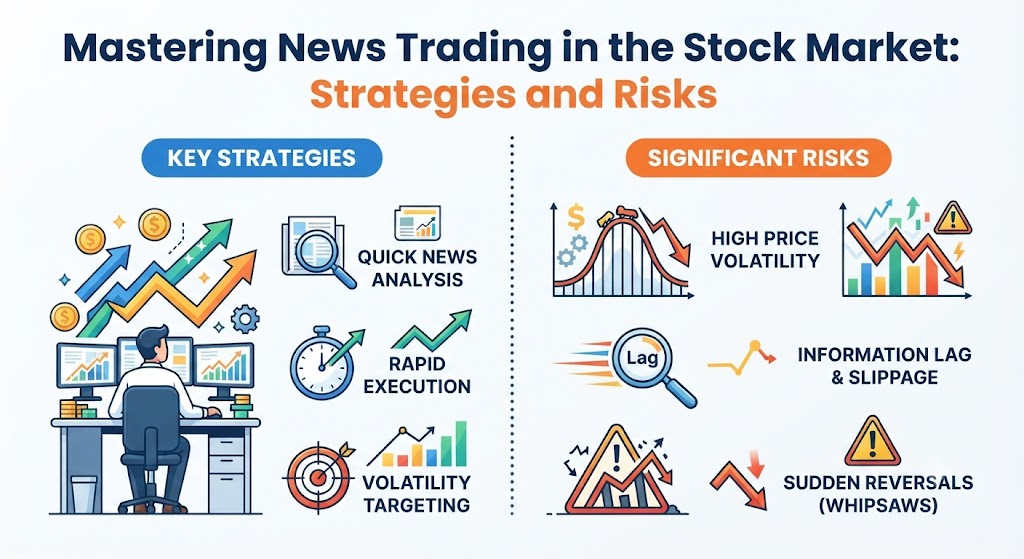
News trading is widely considered one of the most difficult trading styles. Several operational challenges make it particularly risky.
Slippage
Slippage occurs when your trade is executed at a different price than expected due to extreme market volatility. During major news events, orders may be filled at much worse prices, turning a planned small loss into a large one.
Whipsaws
A whipsaw happens when a stock price spikes sharply in one direction on the news, trapping breakout buyers, and then instantly reverses direction to trap short-sellers. This sudden fake-out catches many beginners off guard.
Information Asymmetry
Large institutional firms use high-frequency trading (HFT) algorithms and direct data feeds that deliver news milliseconds faster than standard retail trading platforms. By the time a retail trader reads a headline, institutional orders may already be completing.
Mistakes Beginners Should Avoid
Entering the news trading arena without preparation often leads to rapid financial losses. Avoiding these common mistakes can protect your trading capital.
- Trading purely on the headline: Buying a stock just because a news alert sounds positive without checking underlying details or valuation metrics.
- Ignoring the broader market trend: Trying to buy a stock on good news when the overall stock market is in a sharp downward trend.
- Failing to use stop-loss orders: Leaving a volatile trade open without an automated exit point, risking catastrophic losses if the price crashes.
- Chasing fast-moving prices: Entering a trade late after a stock has already spiked 15%, leaving no room for further upside.
Decision Framework: Should You Trade the News?
Before attempting to trade a breaking news event, use this step-by-step checklist to evaluate your readiness:
- Check the Event Schedule: Know the exact minute the report or earnings release is scheduled.
- Assess Your Execution Speed: Ensure your broker provides reliable execution without excessive latency during high-volume periods.
- Define Risk Parameters: Determine the exact maximum amount you are willing to lose on the trade before entering.
- Identify Key Levels: Mark major support and resistance levels on the chart to anticipate where price reactions might stall.
- Wait for Confirmation: Avoid jumping in blindly during the first five seconds of chaos; wait to see how institutional volume settles.
Key Terms
- Bid-Ask Spread: The difference between the highest price a buyer is willing to pay and the lowest price a seller is willing to accept for a stock.
- Slippage: The difference between the expected price of a trade and the actual execution price during fast-moving markets.
- Guidance: A company’s official forecast of its future earnings and business performance provided to investors.
- Volatility: A statistical measure of how rapidly and severely a stock’s price fluctuates over time.
- Whipsaw: A sharp price movement in one direction followed immediately by a sudden reversal in the opposite direction.
- Momentum Trading: A strategy where traders buy stocks showing high upward price velocity and volume.
- High-Frequency Trading (HFT): Automated trading systems that use powerful computers to execute orders in milliseconds.
- Earnings Beat: When a company’s reported revenue or profit exceeds the average estimates calculated by financial analysts.
Frequently Asked Questions
Can beginners make money trading news events?
While possible, it is extremely difficult. Most professional traders avoid trading raw breaking news due to unpredictable algorithms and high volatility. Beginners often lose money because they react slower than institutional systems.
Is news trading the same as day trading?
News trading is a specific sub-type of day trading. While a day trader might buy stocks based on technical chart patterns or momentum, a news trader specifically waits for macroeconomic announcements or corporate earnings catalysts.
Why does a stock drop even after reporting good earnings?
If analysts expected a company’s profits to grow by 30%, but profits only grew by 20%, the stock price often falls. Markets trade on expectations; beating a weak estimate or failing to meet lofty expectations causes sell-offs.
What is the safest way to trade around earnings announcements?
Many experienced investors prefer waiting until after the initial earnings announcement volatility settles, allowing them to analyze the conference call and management guidance before taking a calculated position.
How do algorithms affect news trading?
Algorithms parse text and numbers from press releases within milliseconds, executing trades before human eyes can even read the headline. This makes manual news trading against algorithms very challenging.
Do I need special software for news trading?
Professional news traders use direct financial news terminals and low-latency brokers. Standard retail trading apps often experience delays during high-volume economic data releases.
Should I hold news trades overnight?
Holding volatile news trades overnight exposes you to gap risk—where the stock opens significantly lower the next morning due to after-hours or overseas news developments. Most news traders close positions before the market closes.
Conclusion
News trading is an exciting but hazardous approach to the stock market. While headlines provide the sparks that create massive price movements, trying to catch those movements requires discipline, fast execution, and strict risk management.
Instead of treating news like a get-rich-quick signal, treat it as a test of market psychology. Focus on understanding how expectations drive prices, protect your capital with clear stop-loss rules, and remember that patience often outperforms impulsive reaction in volatile markets.