Introduction
Hearing the word “recession” can make anyone nervous. People worry about their jobs, their savings, and their investments in the stock market. When economic news turns negative, watching your stock portfolio drop can make you want to sell everything and hide your money under a mattress.
Yet, selling in a panic is usually the most expensive mistake an investor can make. To survive and grow your wealth during tough economic times, you need to understand what actually happens when a recession hits.
This guide explains how recessions impact the stock market, why stock prices fall, which industries survive best, and how you can protect and grow your money without needing a degree in finance.
What Is a Recession?
A recession is a significant decline in general economic activity that lasts for several months or longer.
In simple terms, a recession happens when people and businesses stop spending money. Because everyone spends less, businesses make less profit. When profits drop, companies may stop hiring, cut wages, or lay off workers. This creates a loop: fewer jobs mean less spending, which causes even more economic slowdown.
Why It Matters
For everyday investors, a recession matters because the stock market is closely tied to company profits. If businesses are not making money, their stock prices usually go down. Understanding this connection helps you keep a calm mind when stock prices start falling.
How Recessions Impact the Stock Market
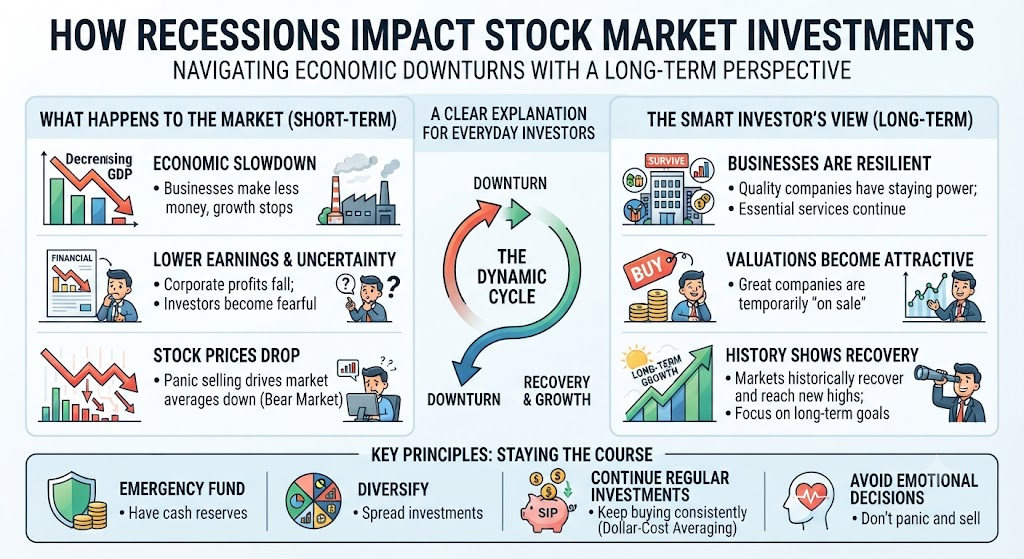
The stock market and the economy are connected, but they are not the exact same thing. The stock market is forward-looking. This means stock prices usually start falling before a recession is officially announced, because investors try to guess what will happen in the future.
The Chain Reaction
- Economic Slowdown: Interest rates rise, inflation goes up, or consumer spending drops.
- Lower Profits: Companies sell fewer goods and services.
- Market Drop: Investors realize corporate earnings will fall, so they sell their stocks. Share prices go down across the board.
- The Bottom and Recovery: Eventually, stock prices fall so low that buying them becomes a bargain. Smart investors and institutions start buying again, and the market begins to recover long before the actual recession ends.
Why Stock Prices Fall During Economic Downturns
When a recession hits, fear takes over the market. But behind that fear are real financial reasons why stock prices drop.
- Lower Earnings: If a clothing brand sells half as many jackets during a recession, its revenue drops, and its stock price falls to match the lower profit.
- Reduced Investor Confidence: Investors get scared about the future. They prefer to hold cash or safe assets like government bonds instead of risky stocks.
- Margin Pressure: Companies face higher borrowing costs because central banks often raise interest rates to fight inflation before a recession begins. This makes it expensive for businesses to run their daily operations.
Different Sectors in a Recession: Who Wins and Who Loses?
Not all companies suffer equally during a downturn. The stock market is divided into different sectors, and some perform much better than others when times get tough.
Defensive Sectors (The Survivors)
Defensive sectors sell products that people must buy no matter how bad the economy is. These companies usually hold their value well during recessions.
- Utilities: People always need electricity, water, and gas.
- Healthcare: People still need medicine, doctor visits, and hospital care.
- Consumer Staples: Everyone needs groceries, toilet paper, and toothpaste.
Cyclical Sectors (The Hard Hit)
Cyclical sectors sell things people want to buy when they have extra cash, but skip when money is tight. These stocks usually drop hard during a recession.
- Discretionary Spending: Luxury cars, high-end clothing, and expensive vacations.
- Travel and Hospitality: Airlines, hotels, and cruise lines.
- Financials: Banks make fewer loans and face higher default rates when people struggle to pay their debts.
Practical Examples: How Different Investors React
Example 1: The Panic Seller
Rohan started investing during a booming market. When a recession hit and his portfolio dropped by 20%, he panicked. He sold all his stocks to “stop the bleeding.” By selling at a loss, he locked in his losses and missed the eventual market rebound a year later.
Example 2: The Long-Term Planner
Priya has been investing for ten years. When a recession hits, she knows her portfolio will drop. Instead of selling, she sticks to her monthly investment plan. Because stock prices are lower, her regular monthly contribution buys more shares of great companies at a discount. When the economy recovers, her portfolio grows faster.
Common Mistakes Investors Make During Recessions
- Trying to Time the Bottom: Waiting for the absolute lowest point to buy stocks usually fails because no one can predict exact market turning points.
- Selling Good Companies Out of Fear: Selling strong, healthy companies just because their stock price dropped temporarily.
- Stopping SIPs or Regular Investments: Halting your regular monthly investments prevents you from buying stocks when they are on sale.
- Chasing High-Risk Assets: Trying to make quick money back by buying extremely risky or unproven stocks during a downturn.
Risks and Limitations
Investing during a recession comes with real challenges.
- Job Insecurity: Your primary income source (your job) could be at risk during a recession, which makes having an emergency fund critical before you invest.
- Extended Downturns: Some recessions last longer than expected, testing your patience and emotional discipline.
- Company Failures: Weaker companies with too much debt can go bankrupt during severe recessions, meaning their stock could go to zero. This is why investing in strong, stable businesses or index funds is important.
Decision-Making Framework: What Should You Do?
Use this simple framework to manage your investments during a recession:
- Secure an Emergency Fund: Ensure you have 3 to 6 months of living expenses saved in cash before touching your investments.
- Review Your Portfolio Check: Look at your holdings. Are you heavily invested in high-risk companies with heavy debt?
- Focus on Quality: Ensure your portfolio includes stable, profitable companies or broad market index funds.
- Automate Your Investments: Keep investing a fixed amount regularly. This strategy, called dollar-cost averaging, removes emotion from your decisions.
- Ignore Daily News: Avoid checking your portfolio every single day. Short-term drops do not matter if your goal is 5, 10, or 20 years away.
Key Terms
- Bear Market: A market condition where stock prices fall by 20% or more from recent highs, often happening during recessions.
- Cyclical Stocks: Shares of companies whose performance is closely tied to the overall health of the economy.
- Defensive Stocks: Shares of stable companies that provide steady products and services regardless of economic conditions.
- Dollar-Cost Averaging: The practice of investing a fixed amount of money at regular intervals, regardless of whether the market is up or down.
- Diversification: Spreading your investments across different industries and asset classes to reduce risk.
- Earnings: The profit a company makes over a specific period.
- Inflation: The rate at which the general price of goods and services is rising.
- Recession: A significant, widespread economic slowdown lasting more than a few months.
FAQs
Can I lose all my money if a recession causes a market crash?
If you invest in individual companies that go bankrupt, you can lose your money. However, if you invest in a diversified portfolio or broad market index funds representing hundreds of top companies, it is extremely rare to lose everything, as entire economies historically recover and grow.
Should I stop investing during a recession?
No. Stopping your investments means you miss the chance to buy great stocks at lower prices. Continuing to invest during a downturn is one of the most effective ways to build long-term wealth.
How long do stock market downturns usually last?
Most stock market corrections and bear markets last anywhere from a few months to a couple of years. While they feel long while you are living through them, they are short compared to long periods of economic growth.
Is cash safer than stocks during a recession?
Cash loses purchasing power over time due to inflation. While cash is safe for short-term emergency needs, keeping all your wealth in cash during a recession means inflation slowly eats away at your savings.
How do I know if a company will survive a recession?
Look for companies with low debt, steady cash flow, essential products or services, and a history of staying profitable even during difficult economic periods.
Should I buy cyclical stocks during a recession?
Some investors buy cyclical stocks near the bottom of a recession because they rebound quickly when the economy recovers. However, this requires higher risk tolerance and market knowledge. Beginners are usually better off sticking to stable, diversified investments.
Conclusion
Recessions are an unavoidable part of the economic cycle. While watching your investment portfolio drop is never fun, recessions offer some of the best long-term buying opportunities for disciplined investors.
By keeping an emergency fund, staying calm, focusing on quality companies, and continuing your regular investment routine, you can turn economic downturns into stepping stones for your financial future.