Introduction
Data Transformation Tools help organizations clean, standardize, enrich, restructure, validate, aggregate, and prepare raw data for analytics, reporting, artificial intelligence, machine learning, and operational workflows. These platforms play a critical role in modern data engineering pipelines by converting raw and inconsistent data into trusted, analytics-ready datasets.
As organizations increasingly rely on cloud analytics platforms, AI models, real-time dashboards, and modern data stacks, data transformation has become one of the most important stages in the data lifecycle. Data Transformation Tools improve data quality, simplify pipeline management, reduce manual processing, and help organizations scale analytics operations efficiently across distributed systems.
Real-world use cases include:
- Transforming raw warehouse data for BI dashboards
- Cleaning and standardizing enterprise datasets
- Preparing AI and machine learning training datasets
- Building analytics-ready data models
- Automating cloud-native ELT workflows
Buyers evaluating Data Transformation Tools should consider:
- Scalability for large datasets
- Cloud data warehouse compatibility
- SQL and code-based transformation support
- Workflow orchestration capabilities
- Data lineage and observability features
- Real-time and batch processing support
- Security and governance controls
- Ease of collaboration across teams
- Integration with analytics ecosystems
- Cost efficiency and operational simplicity
Best for: Data engineers, analytics engineers, BI teams, AI and machine learning teams, cloud architects, enterprise analytics teams, and organizations operating modern data platforms.
Not ideal for: Small teams with only basic spreadsheet-level data cleanup needs or organizations without large-scale analytics and cloud data processing requirements.
Key Trends in Data Transformation Tools
- ELT-first architectures are replacing traditional ETL models.
- SQL-based transformation workflows are becoming more dominant.
- AI-assisted transformation and data quality automation are improving rapidly.
- Cloud-native transformation platforms are expanding across enterprises.
- Real-time transformation pipelines are growing in importance.
- Data lineage and governance visibility are becoming operational priorities.
- Kubernetes-native transformation workflows are increasing.
- Data observability integration is becoming standard across platforms.
- Collaborative analytics engineering workflows are evolving rapidly.
- AI and machine learning pipeline integration is becoming more common.
How We Selected These Tools
The tools in this list were selected based on transformation flexibility, scalability, cloud-native compatibility, observability, ecosystem maturity, and enterprise adoption.
Selection criteria included:
- Data transformation capabilities
- Cloud warehouse integration support
- Scalability across distributed environments
- Workflow automation flexibility
- Data lineage and observability functionality
- Security and governance controls
- AI and analytics workflow support
- Developer and analytics engineering experience
- Ecosystem maturity and adoption
- Suitability for modern cloud analytics architectures
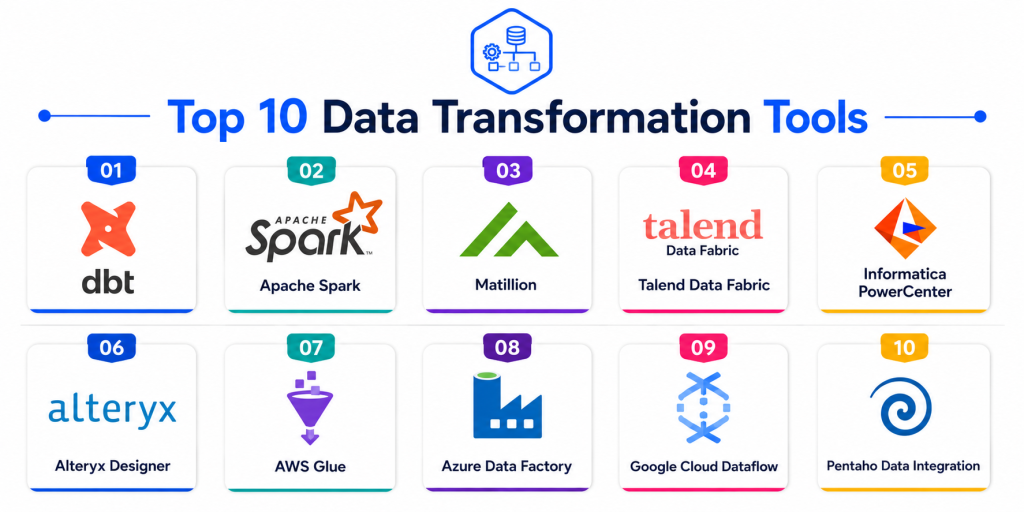
Top 10 Data Transformation Tools
1- dbt
Short description: dbt is one of the most widely adopted analytics engineering platforms for transforming cloud warehouse data using SQL-based workflows and modular data modeling.
Key Features
- SQL-based data transformation
- Modular transformation workflows
- Data lineage visibility
- Automated testing capabilities
- Version-controlled analytics workflows
- Documentation generation
- Cloud warehouse optimization
Pros
- Excellent analytics engineering workflows
- Strong modern data stack integration
- Large community adoption
Cons
- SQL-focused architecture may limit non-SQL workflows
- Requires analytics engineering expertise
- Advanced governance requires premium features
Platforms / Deployment
- Cloud data warehouses / Linux / Cloud infrastructure
- Cloud / Self-hosted / Hybrid
Security & Compliance
- RBAC
- Audit logging
- Authentication integration
- Secure cloud execution
- Encryption support
Integrations & Ecosystem
dbt integrates deeply with cloud analytics and modern data ecosystems.
- Snowflake
- BigQuery
- Redshift
- Databricks
- Git platforms
- BI systems
Support & Community
Large analytics engineering ecosystem with strong enterprise and open-source adoption.
2- Apache Spark
Short description: Apache Spark is a distributed data processing engine widely used for large-scale transformation, analytics, AI processing, and real-time data workflows.
Key Features
- Distributed data processing
- Batch and streaming transformations
- Scalable compute engine
- SQL and Python support
- Machine learning integration
- Real-time analytics support
- Cluster-based execution
Pros
- Excellent scalability for massive datasets
- Strong AI and analytics ecosystem support
- Good streaming and batch flexibility
Cons
- Requires distributed systems expertise
- Infrastructure management complexity
- Operational tuning required at scale
Platforms / Deployment
- Linux / Kubernetes / Distributed clusters
- Cloud / Self-hosted / Hybrid
Security & Compliance
- RBAC integration
- Encryption support
- Authentication integration
- Audit logging
- Secure cluster execution
Integrations & Ecosystem
Spark integrates with modern analytics and big data ecosystems.
- Databricks
- Hadoop
- Kafka
- Snowflake
- Kubernetes
- Cloud platforms
Support & Community
Very large open-source ecosystem and extensive enterprise analytics adoption.
3- Databricks
Short description: Databricks provides unified analytics and data transformation capabilities for large-scale cloud data engineering, AI, and machine learning workflows.
Key Features
- Distributed data transformations
- Lakehouse architecture
- AI and machine learning integration
- Collaborative notebooks
- Streaming and batch processing
- Workflow automation
- Unified analytics platform
Pros
- Strong AI and analytics integration
- Excellent cloud scalability
- Good collaborative engineering workflows
Cons
- Enterprise pricing model
- Requires Spark expertise
- Operational costs require management
Platforms / Deployment
- Cloud analytics infrastructure
- Cloud
Security & Compliance
- RBAC
- Encryption
- Audit logging
- Identity integration
- Compliance support
Integrations & Ecosystem
Databricks integrates with cloud analytics and AI ecosystems.
- Spark
- Snowflake
- MLflow
- Kafka
- Cloud platforms
- Data warehouses
Support & Community
Strong enterprise analytics ecosystem and growing AI engineering adoption.
4- Talend Data Fabric
Short description: Talend Data Fabric provides enterprise-grade data integration and transformation capabilities for cloud, hybrid, and distributed analytics environments.
Key Features
- Visual transformation workflows
- Data quality management
- Cloud and hybrid integration
- Real-time transformation support
- Metadata management
- Data governance tools
- Workflow automation
Pros
- Strong enterprise governance capabilities
- Good low-code transformation workflows
- Useful hybrid integration support
Cons
- Enterprise licensing complexity
- Advanced deployments require expertise
- Operational overhead for smaller teams
Platforms / Deployment
- Linux / Windows / Enterprise infrastructure
- Cloud / Self-hosted / Hybrid
Security & Compliance
- RBAC
- Audit logging
- Encryption
- Compliance support
- Data governance controls
Integrations & Ecosystem
Talend integrates with enterprise analytics and operational systems.
- SAP
- Snowflake
- Databases
- Cloud platforms
- APIs
- Data warehouses
Support & Community
Enterprise support ecosystem and strong enterprise integration adoption.
5- Informatica Intelligent Data Management Cloud
Short description: Informatica provides enterprise data transformation, integration, governance, and cloud-native analytics workflow capabilities.
Key Features
- Enterprise data transformation
- Metadata management
- AI-powered automation
- Data quality workflows
- Cloud-native integration
- Workflow orchestration
- Governance visibility
Pros
- Strong enterprise governance
- Good AI-assisted automation
- Extensive enterprise ecosystem support
Cons
- Enterprise pricing model
- Complex deployments for smaller teams
- Requires operational planning
Platforms / Deployment
- Cloud analytics environments / Enterprise infrastructure
- Cloud / Hybrid
Security & Compliance
- RBAC
- Encryption
- Audit logging
- Compliance support
- Identity integration
Integrations & Ecosystem
Informatica integrates with enterprise analytics and operational ecosystems.
- Snowflake
- SAP
- Oracle
- Databases
- Cloud platforms
- Enterprise applications
Support & Community
Strong enterprise support and large-scale enterprise analytics adoption.
6- Matillion
Short description: Matillion is a cloud-native data transformation platform optimized for ELT workflows and cloud data warehouse automation.
Key Features
- Cloud-native ELT workflows
- Visual transformation builder
- Data pipeline automation
- SQL transformation support
- Workflow scheduling
- Cloud warehouse optimization
- Monitoring dashboards
Pros
- Strong cloud warehouse integration
- Good low-code workflow capabilities
- Useful analytics engineering workflows
Cons
- Best suited for cloud-native environments
- Advanced transformations require expertise
- Enterprise pricing considerations
Platforms / Deployment
- Cloud analytics infrastructure
- Cloud
Security & Compliance
- RBAC
- Encryption
- Audit logging
- Authentication integration
- Secure cloud execution
Integrations & Ecosystem
Matillion integrates with cloud analytics and modern data ecosystems.
- Snowflake
- BigQuery
- Redshift
- Databricks
- APIs
- Cloud storage systems
Support & Community
Growing analytics engineering ecosystem and enterprise cloud analytics adoption.
7- AWS Glue
Short description: AWS Glue is a serverless data integration and transformation platform designed for cloud-native analytics and distributed data processing workflows.
Key Features
- Serverless data transformations
- ETL and ELT automation
- Metadata cataloging
- Distributed Spark processing
- Workflow scheduling
- Cloud-native scalability
- Data discovery capabilities
Pros
- Strong AWS ecosystem integration
- Managed operational model
- Good scalability for cloud analytics
Cons
- Best suited for AWS environments
- Spark expertise often required
- Cost optimization requires planning
Platforms / Deployment
- AWS Cloud / Serverless infrastructure
- Cloud
Security & Compliance
- IAM integration
- Encryption
- Audit logging
- Secure APIs
- Compliance controls
Integrations & Ecosystem
AWS Glue integrates deeply with AWS analytics and AI services.
- S3
- Redshift
- Athena
- SageMaker
- Lambda
- CloudWatch
Support & Community
Strong AWS ecosystem support and cloud-native analytics adoption.
8- Azure Synapse Analytics
Short description: Azure Synapse Analytics provides cloud-native data transformation, analytics processing, and enterprise data engineering capabilities.
Key Features
- Distributed data transformations
- SQL and Spark support
- Cloud-native analytics
- Data pipeline orchestration
- Real-time analytics support
- AI and ML integration
- Unified analytics environment
Pros
- Strong Microsoft ecosystem integration
- Good enterprise analytics support
- Unified analytics and transformation workflows
Cons
- Best suited for Azure-centric environments
- Complex enterprise deployments
- Operational costs require management
Platforms / Deployment
- Azure Cloud / Enterprise analytics environments
- Cloud / Hybrid
Security & Compliance
- RBAC
- Encryption
- Audit logging
- Microsoft Entra ID integration
- Compliance support
Integrations & Ecosystem
Azure Synapse integrates with Microsoft cloud analytics ecosystems.
- Power BI
- Azure Data Factory
- Databricks
- SQL Server
- AI services
- Cloud infrastructure
Support & Community
Strong enterprise analytics ecosystem and Microsoft cloud adoption.
9- Trifacta
Short description: Trifacta provides visual data transformation and preparation capabilities for analytics, AI workflows, and enterprise data engineering environments.
Key Features
- Visual transformation workflows
- Data profiling
- AI-assisted transformations
- Data quality automation
- Cloud-native processing
- Workflow automation
- Transformation recommendations
Pros
- Strong visual workflow experience
- Good data quality visibility
- Useful low-code transformation support
Cons
- Enterprise pricing model
- Advanced workflows require expertise
- Smaller ecosystem compared to Spark-based platforms
Platforms / Deployment
- Cloud analytics environments / Enterprise infrastructure
- Cloud / Hybrid
Security & Compliance
- RBAC
- Audit logging
- Encryption
- Compliance support
- Secure workflow execution
Integrations & Ecosystem
Trifacta integrates with analytics and cloud transformation ecosystems.
- Snowflake
- BigQuery
- Databricks
- Cloud storage
- APIs
- Analytics systems
Support & Community
Enterprise support ecosystem and analytics engineering adoption.
10- Pentaho Data Integration
Short description: Pentaho Data Integration is a data transformation and integration platform supporting enterprise ETL, ELT, and analytics workflows.
Key Features
- Visual transformation design
- Batch and streaming workflows
- Data integration support
- Workflow automation
- Metadata management
- Distributed execution support
- Enterprise reporting integration
Pros
- Mature transformation ecosystem
- Good hybrid deployment flexibility
- Useful enterprise workflow support
Cons
- Older interface compared to modern platforms
- Operational complexity at scale
- Advanced cloud-native support is more limited
Platforms / Deployment
- Linux / Windows / Enterprise infrastructure
- Cloud / Self-hosted / Hybrid
Security & Compliance
- RBAC
- Audit logging
- Authentication integration
- Encryption support
- Secure execution controls
Integrations & Ecosystem
Pentaho integrates with enterprise analytics and operational systems.
- Databases
- Hadoop
- Cloud platforms
- APIs
- BI systems
- Data warehouses
Support & Community
Established enterprise analytics ecosystem and operational support availability.
Comparison Table
| Tool Name | Best For | Platforms Supported | Deployment | Standout Feature | Public Rating |
|---|---|---|---|---|---|
| dbt | Analytics engineering workflows | Cloud data warehouses | Cloud / Self-hosted / Hybrid | SQL-first transformations | N/A |
| Apache Spark | Large-scale distributed transformations | Linux / Kubernetes | Cloud / Self-hosted / Hybrid | Massive distributed processing | N/A |
| Databricks | Unified analytics and AI workflows | Cloud analytics environments | Cloud | Lakehouse transformation workflows | N/A |
| Talend Data Fabric | Enterprise transformation governance | Linux / Windows | Cloud / Self-hosted / Hybrid | Enterprise data quality management | N/A |
| Informatica Intelligent Data Management Cloud | Enterprise data governance | Cloud analytics infrastructure | Cloud / Hybrid | AI-powered automation | N/A |
| Matillion | Cloud-native ELT workflows | Cloud analytics infrastructure | Cloud | Visual cloud transformations | N/A |
| AWS Glue | Serverless cloud transformations | AWS Cloud | Cloud | Managed Spark transformations | N/A |
| Azure Synapse Analytics | Unified Microsoft analytics workflows | Azure Cloud | Cloud / Hybrid | Unified transformation and analytics | N/A |
| Trifacta | Visual data preparation workflows | Cloud analytics infrastructure | Cloud / Hybrid | AI-assisted transformations | N/A |
| Pentaho Data Integration | Enterprise ETL and ELT workflows | Linux / Windows | Cloud / Self-hosted / Hybrid | Mature transformation ecosystem | N/A |
Evaluation & Scoring of Data Transformation Tools
| Tool Name | Core 25% | Ease 15% | Integrations 15% | Security 10% | Performance 10% | Support 10% | Value 15% | Weighted Total |
|---|---|---|---|---|---|---|---|---|
| dbt | 9.3 | 8.5 | 9.1 | 8.8 | 8.9 | 9.0 | 9.1 | 9.02 |
| Apache Spark | 9.5 | 7.0 | 9.2 | 8.8 | 9.6 | 9.1 | 9.0 | 9.03 |
| Databricks | 9.4 | 8.2 | 9.3 | 9.0 | 9.4 | 9.0 | 8.2 | 8.98 |
| Talend Data Fabric | 8.9 | 7.8 | 8.8 | 9.1 | 8.8 | 8.7 | 8.0 | 8.63 |
| Informatica Intelligent Data Management Cloud | 9.0 | 7.7 | 9.0 | 9.2 | 8.9 | 8.9 | 7.8 | 8.67 |
| Matillion | 8.8 | 8.4 | 8.9 | 8.7 | 8.8 | 8.5 | 8.4 | 8.63 |
| AWS Glue | 8.9 | 8.0 | 9.1 | 9.0 | 9.0 | 8.7 | 8.3 | 8.73 |
| Azure Synapse Analytics | 9.0 | 7.9 | 9.0 | 9.1 | 9.1 | 8.8 | 8.1 | 8.76 |
| Trifacta | 8.7 | 8.5 | 8.5 | 8.7 | 8.6 | 8.4 | 8.2 | 8.47 |
| Pentaho Data Integration | 8.5 | 7.4 | 8.4 | 8.5 | 8.5 | 8.3 | 8.7 | 8.35 |
These scores are comparative and intended to help organizations evaluate operational fit rather than identify a universal winner. SQL-first and cloud-native platforms score highly for analytics engineering efficiency, while distributed compute platforms excel in scalability and AI-driven processing. Buyers should align tool selection with infrastructure architecture, analytics maturity, operational expertise, and governance requirements.
Which Data Transformation Tool Is Right for You?
Solo / Freelancer
Independent analytics engineers and small data teams often prioritize lightweight workflows, affordability, and rapid setup. dbt and Trifacta are practical choices for analytics-focused transformation workflows.
SMB
SMBs usually need scalable cloud-native transformation capabilities without excessive operational overhead. Matillion, AWS Glue, and dbt provide strong flexibility for growing analytics operations.
Mid-Market
Mid-sized organizations often require stronger observability, hybrid integration support, and scalable distributed transformations. Databricks, Azure Synapse Analytics, and Talend Data Fabric are strong choices for expanding analytics operations.
Enterprise
Large enterprises typically require governance controls, distributed processing, AI-driven automation, and large-scale transformation reliability. Apache Spark, Databricks, Informatica, Talend, and Azure Synapse Analytics are strong enterprise-focused platforms.
Budget vs Premium
Open-source and SQL-first platforms reduce operational costs but may require more engineering expertise. Enterprise transformation suites provide stronger governance and operational visibility with higher licensing and infrastructure investment.
Feature Depth vs Ease of Use
Visual transformation tools simplify adoption for business and analytics teams, while distributed engineering platforms provide deeper scalability, AI integration, and transformation flexibility.
Integrations & Scalability
Organizations already invested in AWS, Azure, Databricks, Snowflake, or modern cloud analytics ecosystems should prioritize transformation platforms aligned with their existing infrastructure environments.
Security & Compliance Needs
Security-focused organizations should prioritize RBAC, audit logging, encryption, governance controls, identity integration, and secure distributed execution capabilities. Enterprise transformation suites generally provide stronger governance support.
Frequently Asked Questions
1. What is a Data Transformation Tool?
A Data Transformation Tool converts raw, inconsistent, or unstructured data into analytics-ready datasets suitable for reporting, AI, machine learning, and operational workflows.
2. Why are data transformation platforms important?
They improve data quality, automate data preparation, simplify analytics workflows, reduce manual effort, and help organizations scale modern data operations.
3. What is the difference between ETL and ELT?
ETL transforms data before loading it into storage systems, while ELT loads raw data first and performs transformations later using scalable cloud compute engines.
4. What industries commonly use data transformation tools?
Technology, finance, healthcare, retail, logistics, manufacturing, telecommunications, AI-driven organizations, and cloud-native enterprises commonly rely on these platforms.
5. Why is dbt popular in modern analytics stacks?
dbt simplifies SQL-based transformations, improves collaboration, provides lineage visibility, and integrates deeply with cloud data warehouses.
6. What are common implementation mistakes?
Common mistakes include weak monitoring, poor governance planning, overcomplicated transformations, insufficient data quality validation, and weak dependency management.
7. Can data transformation tools support AI workflows?
Yes. Modern transformation platforms increasingly support AI data preparation, feature engineering, machine learning pipelines, and analytics automation.
8. What integrations are most important?
Important integrations include cloud data warehouses, orchestration platforms, AI frameworks, Kubernetes, observability systems, APIs, and BI platforms.
9. Should organizations choose visual transformation tools or code-based platforms?
Visual platforms simplify adoption for non-engineering teams, while code-based platforms provide deeper scalability, automation flexibility, and engineering control.
10. What should buyers evaluate before selecting a data transformation platform?
Buyers should evaluate scalability, observability, governance, workflow flexibility, cloud compatibility, integration depth, operational complexity, and total cost of ownership.
Conclusion
Data Transformation Tools are essential for organizations building modern analytics environments, AI workflows, cloud-native data platforms, and enterprise-scale reporting operations. The right transformation platform can improve data quality, automate analytics workflows, strengthen observability, simplify governance, and enable scalable distributed data processing. dbt remains a leading choice for analytics engineering and SQL-first transformations, while Apache Spark and Databricks provide massive scalability for distributed analytics and AI workloads. Talend and Informatica strengthen enterprise governance and integration capabilities, while AWS Glue and Azure Synapse Analytics simplify cloud-native transformation workflows. Matillion and Trifacta improve accessibility through visual transformation capabilities, and Pentaho continues to support hybrid enterprise transformation environments. The best choice depends on infrastructure architecture, analytics maturity, operational expertise, governance requirements, and cloud ecosystem alignment. Shortlist two or three platforms, validate transformation performance and observability using production-like datasets, test integrations carefully, and ensure the selected solution can support long-term analytics and AI growth initiatives.