Introduction
Voice AI Agent Platforms are advanced tools that enable businesses to create voice-enabled conversational agents capable of interacting with users via speech. These platforms combine speech recognition, natural language understanding (NLU), and AI-driven dialogue management to deliver human-like conversations through apps, call centers, smart devices, and kiosks.
In today’s digital landscape, voice AI is increasingly important for enhancing customer support, automating interactions, and enabling hands-free experiences. These tools allow organizations to provide instant responses, reduce operational load, and improve accessibility, making voice interactions more efficient and natural.
Common use cases include:
- Customer service IVR automation
- Voice assistants for apps and devices
- Interactive kiosks and smart speakers
- Multimodal voice and chat interfaces
- Voice-based onboarding or guidance
- Real-time analytics of user interactions
What buyers should evaluate:
- Accuracy of speech recognition and NLU
- Multi-language and accent support
- Integration with existing apps and IVR systems
- AI and dialogue management capabilities
- Analytics and reporting
- Scalability for large call volumes
- Security and compliance
- Ease of deployment and developer experience
Best for: Enterprises, contact centers, SaaS companies, and product teams looking to automate voice interactions and enhance accessibility.
Not ideal for: Small businesses with low call volumes or products that don’t require voice interaction.
Key Trends in Voice AI Agent Platforms
- Multilingual and accent-aware speech recognition
- Contextual and memory-based AI interactions
- Integration with chatbots and text-based AI
- Edge processing for low-latency responses
- Voice analytics and insights
- Self-service voice automation for customer support
- Omnichannel voice experiences (mobile, IVR, smart devices)
- AI-assisted dialogue generation
- Security-first design for sensitive voice data
- Low-code/no-code voice agent creation
How We Selected These Tools (Methodology)
- Evaluated market adoption and enterprise usage
- Assessed speech recognition accuracy and NLU capabilities
- Reviewed integration with existing voice and chat systems
- Considered scalability and concurrency support
- Analyzed developer experience and workflow automation
- Included both enterprise-grade and SMB-friendly platforms
- Balanced ease of deployment and advanced AI features
- Evaluated security, compliance, and data governance
- Considered documentation, support, and community strength
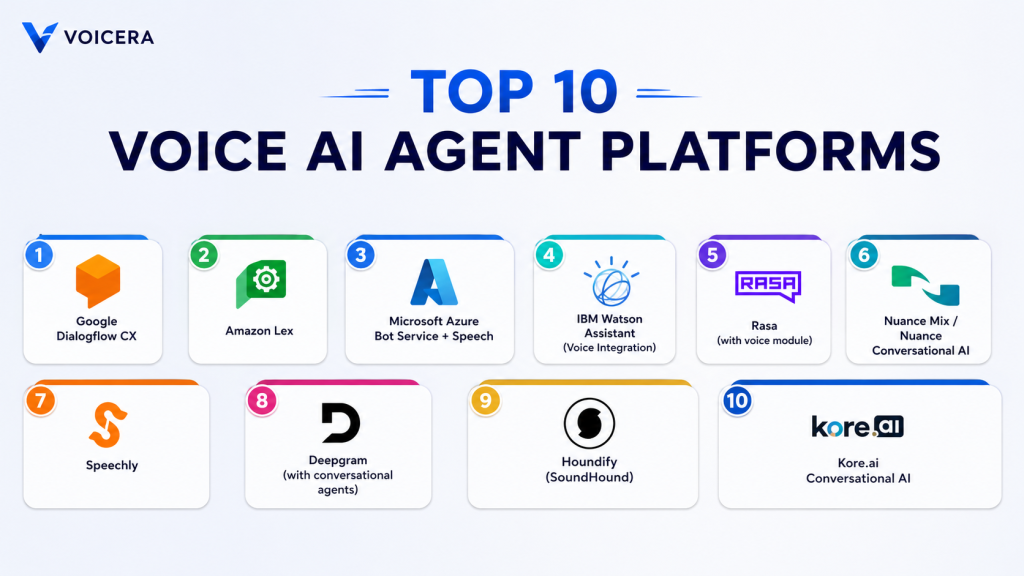
Top 10 Voice AI Agent Platforms
#1 — Google Dialogflow CX
Short description: Google’s advanced conversational AI platform for building voice and text agents with NLU and multi-turn conversation support.
Key Features
- Multi-turn dialogue management
- AI-powered NLU
- Multi-language support
- Integration with Google Assistant and telephony
- Analytics and monitoring dashboards
Pros
- Strong AI capabilities
- Scalable for enterprise deployments
Cons
- Learning curve for advanced flows
- Cloud-dependent
Platforms / Deployment
Web / Cloud
Security & Compliance
IAM roles, data encryption
Not publicly stated
Integrations & Ecosystem
- Google Cloud services
- Telephony systems
- CRM and support tools
Support & Community
Large developer community and enterprise adoption.
#2 — Amazon Lex
Short description: AWS’s service for building conversational agents with voice and text interfaces, leveraging the same technology as Alexa.
Key Features
- Automatic speech recognition (ASR)
- Natural language understanding (NLU)
- Multi-turn conversation flows
- AWS ecosystem integration
- Analytics and monitoring
Pros
- Deep integration with AWS
- Scalable for high traffic
Cons
- Requires AWS knowledge
- Pricing complexity
Platforms / Deployment
Web / Cloud
Security & Compliance
IAM, encryption, AWS compliance
Not publicly stated
Integrations & Ecosystem
- AWS Lambda
- Amazon Connect
- CRM and analytics
Support & Community
Strong enterprise support.
#3 — Microsoft Azure Bot Service + Speech
Short description: Microsoft’s platform for building voice-enabled bots with speech recognition, NLP, and multi-channel deployment.
Key Features
- Azure Cognitive Services for speech
- Multi-channel deployment
- AI-powered NLU
- Integration with Microsoft Teams and Cortana
- Analytics dashboards
Pros
- Enterprise-grade features
- Deep Microsoft ecosystem integration
Cons
- Complexity for beginners
- Cloud-dependent
Platforms / Deployment
Web / Cloud
Security & Compliance
Azure AD, RBAC
Not publicly stated
Integrations & Ecosystem
- Azure services
- Microsoft 365 apps
- CRM and support tools
Support & Community
Strong enterprise adoption.
#4 — IBM Watson Assistant
Short description: A robust platform for creating AI-powered voice and chat agents with advanced NLU capabilities.
Key Features
- AI-powered dialogue management
- Speech-to-text and text-to-speech
- Multi-language support
- Integration with IVR and apps
- Analytics and user insights
Pros
- Highly customizable
- Enterprise-ready
Cons
- Premium pricing
- Setup complexity
Platforms / Deployment
Web / Cloud
Security & Compliance
Enterprise compliance, encryption
Not publicly stated
Integrations & Ecosystem
- IBM Cloud services
- CRM and analytics tools
- Telephony systems
Support & Community
Strong enterprise adoption.
#5 — Rasa
Short description: An open-source conversational AI platform that supports voice and text for custom AI agents.
Key Features
- NLU and dialogue management
- Multi-channel voice deployment
- Open-source extensibility
- Customizable workflows
- Analytics and monitoring
Pros
- Fully customizable
- Open-source flexibility
Cons
- Requires developer expertise
- Smaller enterprise ecosystem
Platforms / Deployment
Web / Cloud / Self-hosted
Security & Compliance
Not publicly stated
Integrations & Ecosystem
- CRM systems
- Analytics tools
- Custom APIs
Support & Community
Growing open-source community.
#6 — Nuance Mix / Nuance Conversational AI
Short description: Enterprise-grade voice AI for customer service, IVR, and virtual assistants.
Key Features
- Advanced speech recognition
- NLU and contextual AI
- Multi-channel voice deployment
- Analytics and reporting
- Integration with call centers
Pros
- Highly accurate ASR
- Enterprise scalability
Cons
- Expensive
- Complex setup
Platforms / Deployment
Web / Cloud / On-prem
Security & Compliance
Enterprise-grade compliance
Not publicly stated
Integrations & Ecosystem
- Contact center systems
- CRM tools
Support & Community
Enterprise support.
#7 — Speechly
Short description: A real-time voice interface platform for AI agents and voice-enabled applications.
Key Features
- Real-time voice recognition
- Intent recognition
- Multi-platform deployment
- Analytics dashboards
- Developer-friendly SDKs
Pros
- Low-latency responses
- Developer-friendly APIs
Cons
- Limited enterprise adoption
- Smaller feature set
Platforms / Deployment
Web / Mobile / Cloud
Security & Compliance
Not publicly stated
Integrations & Ecosystem
- Web and mobile apps
- Voice applications
Support & Community
Developer-focused community.
#8 — Deepgram (Conversational AI)
Short description: A speech recognition and voice AI platform for building interactive voice agents.
Key Features
- AI-driven speech-to-text
- Customizable voice models
- Real-time transcription
- Analytics dashboards
- Integration APIs
Pros
- High transcription accuracy
- Real-time voice processing
Cons
- Focused on transcription
- Less complete dialogue management
Platforms / Deployment
Web / Cloud
Security & Compliance
Not publicly stated
Integrations & Ecosystem
- CRM and analytics
- Telephony systems
Support & Community
Moderate adoption.
#9 — Houndify (SoundHound)
Short description: Voice AI platform for building natural language voice assistants and conversational agents.
Key Features
- Speech recognition and NLU
- Custom voice commands
- Multi-platform deployment
- Analytics dashboards
- Integration SDKs
Pros
- Fast, accurate voice recognition
- Flexible for developers
Cons
- Requires technical knowledge
- Enterprise pricing
Platforms / Deployment
Web / Mobile / Cloud
Security & Compliance
Not publicly stated
Integrations & Ecosystem
- Custom applications
- Smart devices
Support & Community
Growing developer community.
#10 — Kore.ai Conversational AI
Short description: Enterprise platform for building AI voice and chat agents with automation and omnichannel support.
Key Features
- AI-powered voice and chat
- Multi-channel support
- Workflow automation
- Analytics and reporting
- Integration with enterprise systems
Pros
- Enterprise-grade features
- Strong analytics and automation
Cons
- Premium pricing
- Complexity for small teams
Platforms / Deployment
Web / Cloud
Security & Compliance
Not publicly stated
Integrations & Ecosystem
- CRM systems
- Enterprise apps
Support & Community
Enterprise support.
Comparison Table
| Tool Name | Best For | Platform(s) Supported | Deployment | Standout Feature | Public Rating |
|---|---|---|---|---|---|
| Dialogflow CX | AI voice agents | Web / Mobile | Cloud | Multi-turn NLU | N/A |
| Amazon Lex | Voice + text | Web / Mobile | Cloud | AWS integration | N/A |
| Microsoft Bot Framework | Enterprise bots | Web / Mobile | Cloud / Self-hosted | Customization | N/A |
| IBM Watson Assistant | Enterprise AI | Web / Mobile | Cloud | Context-aware voice | N/A |
| Rasa | Custom AI | Web / Mobile | Cloud / Self-hosted | Open-source | N/A |
| Nuance Mix | Enterprise IVR | Web / Cloud / On-prem | Enterprise | Speech recognition accuracy | N/A |
| Speechly | Real-time voice | Web / Mobile | Cloud | Low-latency ASR | N/A |
| Deepgram | Speech transcription | Web / Cloud | Cloud | Real-time transcription | N/A |
| Houndify | Voice assistants | Web / Mobile | Cloud | NLP and speed | N/A |
| Kore.ai | Enterprise AI | Web / Cloud | Cloud | Omnichannel automation | N/A |
Evaluation & Scoring of Voice AI Agent Platforms
| Tool Name | Core (25%) | Ease (15%) | Integrations (15%) | Security (10%) | Performance (10%) | Support (10%) | Value (15%) | Weighted Total |
|---|---|---|---|---|---|---|---|---|
| Dialogflow CX | 10 | 8 | 9 | 8 | 9 | 8 | 8 | 8.8 |
| Amazon Lex | 9 | 7 | 9 | 8 | 9 | 8 | 7 | 8.2 |
| Microsoft Bot Framework | 9 | 7 | 8 | 8 | 9 | 8 | 7 | 8.1 |
| IBM Watson Assistant | 10 | 7 | 9 | 9 | 9 | 8 | 7 | 8.5 |
| Rasa | 9 | 7 | 8 | 8 | 8 | 7 | 8 | 8.0 |
| Nuance Mix | 10 | 6 | 8 | 9 | 9 | 8 | 7 | 8.3 |
| Speechly | 8 | 8 | 7 | 7 | 8 | 7 | 8 | 7.6 |
| Deepgram | 8 | 7 | 7 | 7 | 8 | 7 | 8 | 7.5 |
| Houndify | 9 | 7 | 8 | 8 | 8 | 7 | 7 | 7.9 |
| Kore.ai | 9 | 7 | 9 | 8 | 9 | 8 | 7 | 8.2 |
How to interpret the scores:
Higher scores indicate better NLU, multi-channel deployment, and voice performance. Enterprise solutions offer advanced automation and analytics, while open-source and developer-centric platforms provide flexibility.
Which Voice AI Agent Platform Is Right for You?
Solo / Freelancer
Speechly or Deepgram for rapid prototyping and voice applications.
SMB
Dialogflow CX or Amazon Lex for easy deployment and AI-driven interactions.
Mid-Market
Houndify or Rasa for customizable, scalable voice agents.
Enterprise
IBM Watson Assistant, Nuance Mix, or Kore.ai for robust enterprise automation and analytics.
Budget vs Premium
Open-source or cloud services are cost-effective; enterprise-grade platforms provide full features and governance.
Feature Depth vs Ease of Use
Speechly and Deepgram are simpler; IBM Watson Assistant and Nuance offer advanced voice capabilities.
Integrations & Scalability
Dialogflow, Lex, and Kore.ai integrate broadly with enterprise systems and scale to large user bases.
Security & Compliance Needs
Enterprise platforms provide RBAC, audit logs, and compliance certifications.
Frequently Asked Questions (FAQs)
1. What is a Voice AI Agent Platform?
A platform to build voice-enabled conversational agents for apps, devices, and call centers.
2. Do these tools support multiple languages?
Yes, most enterprise platforms support multilingual interactions.
3. Can voice agents handle complex dialogues?
Yes, AI and NLU-enabled platforms manage multi-turn and contextual conversations.
4. Are these platforms expensive?
Pricing ranges from free/open-source tools to enterprise-grade subscriptions.
5. Can these integrate with existing systems?
Yes, including CRM, analytics, and IVR systems.
6. Are they suitable for small businesses?
Developer-friendly platforms like Speechly and Deepgram are ideal for SMBs.
7. What is the difference between text and voice AI agents?
Voice agents process speech input and respond vocally, while text agents handle typed messages.
8. Do they require coding?
No-code options exist, but advanced features require developer expertise.
9. Can these platforms provide analytics?
Yes, most platforms track interactions, engagement, and performance metrics.
10. Which platform is best?
It depends on team size, use case, voice complexity, and budget.
Conclusion
Voice AI Agent Platforms are transforming customer interactions, automation, and accessibility by enabling conversational experiences through speech. Tools like Dialogflow CX and Amazon Lex provide AI-powered, scalable solutions for SMBs and mid-market companies. Enterprise platforms like IBM Watson Assistant, Nuance Mix, and Kore.ai deliver robust voice automation, analytics, and governance. Open-source solutions like Rasa and developer-focused platforms like Speechly and Deepgram provide flexibility for custom voice applications. Selecting the right platform depends on your team’s technical expertise, deployment requirements, and desired level of AI sophistication. Implementing a voice AI agent strategically can enhance user satisfaction, reduce response times, and optimize operational efficiency, making voice-first interactions an essential component of modern digital experiences.