Introduction
Function-as-a-Service FaaS is a cloud computing model that allows developers to run small pieces of code called functions in response to events without managing servers. In simple terms, you upload code and the platform automatically handles execution, scaling, and infrastructure.
FaaS is a core part of serverless computing and is widely used in modern application development. It enables teams to build highly scalable, event-driven systems while reducing operational complexity. Instead of provisioning servers, developers focus purely on writing business logic.
Common use cases include:
- Building event-driven APIs and microservices
- Processing real-time data streams
- Automating backend workflows
- Handling scheduled jobs and background tasks
- Integrating cloud services and triggers
What buyers should evaluate:
- Supported programming languages
- Execution time limits and performance
- Cold start latency
- Integration with cloud services
- Pricing model and cost control
- Security and access management
- Monitoring and debugging tools
- Vendor lock-in risks
Best for: Developers, startups, DevOps teams, and enterprises building scalable and event-driven applications.
Not ideal for: Long-running workloads, stateful applications, or systems requiring full infrastructure control.
Key Trends in Function-as-a-Service Platforms
- Event-driven architectures expanding: Functions reacting to real-time triggers
- Reduced cold start latency: Improved performance for faster execution
- Container-based FaaS evolution: Supporting more flexible runtimes
- Edge computing integration: Running functions closer to users
- Multi-cloud strategies: Reducing dependency on a single provider
- AI and data pipeline integration: FaaS powering analytics and ML workflows
- Improved observability: Better monitoring and debugging tools
- Security-first execution models: Fine-grained permissions and isolation
- Integration with serverless ecosystems: Databases, storage, and APIs
How We Selected These Tools (Methodology)
- Evaluated market adoption and developer popularity
- Assessed core FaaS capabilities and scalability
- Reviewed performance and execution efficiency
- Considered security and access control features
- Analyzed integration with cloud ecosystems
- Included platforms for different cloud providers and use cases
- Balanced enterprise and developer-focused solutions
- Evaluated ease of deployment and usability
- Considered community and vendor support
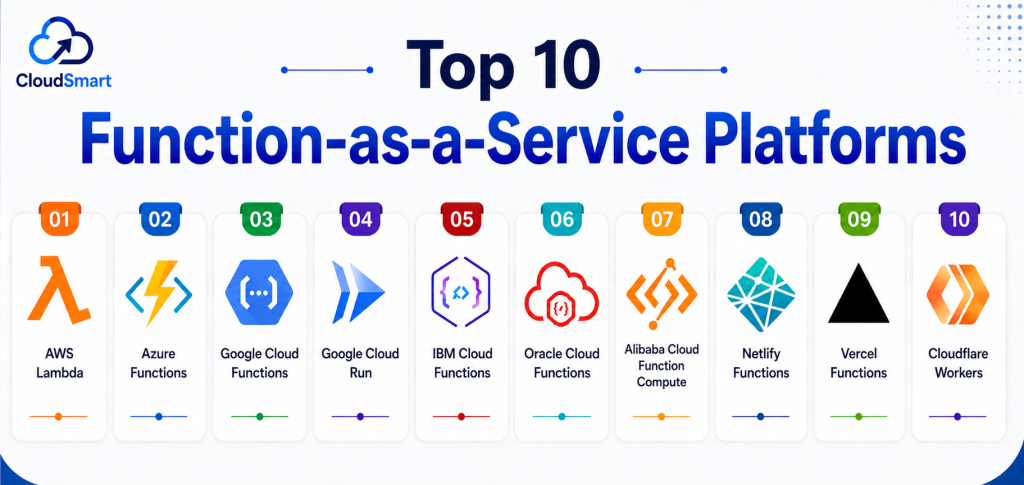
Top 10 Function-as-a-Service Platforms
#1 — AWS Lambda
Short description: A leading FaaS platform that executes code in response to events with automatic scaling and deep cloud integration.
Key Features
- Event-driven execution
- Auto-scaling
- Multi-language support
- Integration with cloud services
- Pay-per-use pricing
Pros
- Highly scalable
- Rich ecosystem
Cons
- Vendor lock-in
- Cold start delays
Platforms / Deployment
Cloud
Cloud-managed
Security & Compliance
IAM, encryption, access control
Not publicly stated certifications
Integrations & Ecosystem
AWS Lambda integrates deeply with cloud services and DevOps workflows.
- API Gateway
- S3
- DynamoDB
- CloudWatch
Support & Community
Extensive documentation and strong enterprise support.
#2 — Azure Functions
Short description: A serverless compute service that enables event-driven applications within the Microsoft ecosystem.
Key Features
- Event triggers
- Auto-scaling
- Multiple languages
- Integration with Azure services
Pros
- Strong enterprise integration
- Flexible development
Cons
- Vendor dependency
- Complexity in setup
Platforms / Deployment
Cloud
Cloud-managed
Security & Compliance
Azure security controls
Not publicly stated certifications
Integrations & Ecosystem
- Azure Storage
- Event Grid
- DevOps tools
Support & Community
Strong enterprise support.
#3 — Google Cloud Functions
Short description: A lightweight FaaS platform for building event-driven applications within Google Cloud.
Key Features
- Event-driven execution
- Auto-scaling
- Multi-language support
- Cloud integration
Pros
- Easy to use
- Good performance
Cons
- Limited customization
- Vendor lock-in
Platforms / Deployment
Cloud
Cloud-managed
Security & Compliance
Cloud security features
Not publicly stated certifications
Integrations & Ecosystem
- Pub/Sub
- Cloud Storage
- Firebase
Support & Community
Strong ecosystem support.
#4 — Google Cloud Run
Short description: A container-based serverless platform allowing flexible deployment of functions and services.
Key Features
- Container support
- Auto-scaling
- HTTP-based execution
- Flexible runtime
Pros
- More flexible than traditional FaaS
- Supports containers
Cons
- Requires container knowledge
- Pricing complexity
Platforms / Deployment
Cloud
Cloud-managed
Security & Compliance
Cloud security controls
Not publicly stated certifications
Integrations & Ecosystem
- Kubernetes
- Google Cloud services
Support & Community
Enterprise-level support.
#5 — IBM Cloud Functions
Short description: An open-source-based FaaS platform built on Apache OpenWhisk.
Key Features
- Event-driven execution
- API integration
- Auto-scaling
- Open-source foundation
Pros
- Flexible and extensible
- Open architecture
Cons
- Smaller ecosystem
- Limited adoption
Platforms / Deployment
Cloud
Cloud-managed
Security & Compliance
Not publicly stated
Integrations & Ecosystem
- IBM Cloud services
Support & Community
Moderate community support.
#6 — Oracle Cloud Functions
Short description: A serverless platform designed for event-driven applications within Oracle Cloud infrastructure.
Key Features
- Event triggers
- Auto-scaling
- Container-based deployment
- Cloud integration
Pros
- Enterprise capabilities
- Container support
Cons
- Limited ecosystem
- Vendor dependency
Platforms / Deployment
Cloud
Cloud-managed
Security & Compliance
Cloud security features
Not publicly stated certifications
Integrations & Ecosystem
- Oracle Cloud services
Support & Community
Enterprise support available.
#7 — Alibaba Cloud Function Compute
Short description: A scalable FaaS platform designed for event-driven workloads in Alibaba Cloud.
Key Features
- Event-driven execution
- Auto-scaling
- Multi-language support
- Cloud integration
Pros
- Scalable
- Strong regional presence
Cons
- Limited global adoption
- Ecosystem limitations
Platforms / Deployment
Cloud
Cloud-managed
Security & Compliance
Not publicly stated
Integrations & Ecosystem
- Alibaba Cloud services
Support & Community
Regional support availability.
#8 — Netlify Functions
Short description: A developer-friendly FaaS platform focused on frontend and JAMstack applications.
Key Features
- Serverless functions
- Git-based deployment
- CDN integration
- Easy setup
Pros
- Simple and fast deployment
- Great for frontend developers
Cons
- Limited backend features
- Scaling constraints
Platforms / Deployment
Cloud
Cloud-managed
Security & Compliance
Not publicly stated
Integrations & Ecosystem
- GitHub
- Frontend frameworks
Support & Community
Strong developer community.
#9 — Vercel Functions
Short description: A serverless platform optimized for modern web applications and frontend frameworks.
Key Features
- API routes
- Edge functions
- Fast deployment
- Framework integration
Pros
- Excellent developer experience
- Fast execution
Cons
- Limited backend depth
- Vendor dependency
Platforms / Deployment
Cloud
Cloud-managed
Security & Compliance
Not publicly stated
Integrations & Ecosystem
- Next.js
- Frontend tools
Support & Community
Strong ecosystem support.
#10 — Cloudflare Workers
Short description: An edge-based FaaS platform that runs code globally for ultra-low latency applications.
Key Features
- Edge execution
- Global distribution
- Fast performance
- Lightweight runtime
Pros
- Very low latency
- Global reach
Cons
- Limited runtime flexibility
- Learning curve
Platforms / Deployment
Cloud
Cloud-managed
Security & Compliance
Edge security features
Not publicly stated certifications
Integrations & Ecosystem
- CDN
- Web applications
Support & Community
Growing developer community.
Comparison Table
| Tool Name | Best For | Platform(s) Supported | Deployment | Standout Feature | Public Rating |
|---|---|---|---|---|---|
| AWS Lambda | Enterprise | Cloud | Cloud | Scalability | N/A |
| Azure Functions | Microsoft users | Cloud | Cloud | Integration | N/A |
| Google Functions | Lightweight apps | Cloud | Cloud | Simplicity | N/A |
| Cloud Run | Containers | Cloud | Cloud | Flexibility | N/A |
| IBM Functions | Open-source | Cloud | Cloud | OpenWhisk | N/A |
| Oracle Functions | Enterprise | Cloud | Cloud | Containers | N/A |
| Alibaba Functions | Regional use | Cloud | Cloud | Scalability | N/A |
| Netlify Functions | Frontend | Cloud | Cloud | Simplicity | N/A |
| Vercel Functions | Web apps | Cloud | Cloud | Developer UX | N/A |
| Cloudflare Workers | Edge apps | Cloud | Cloud | Low latency | N/A |
Evaluation & Scoring of Function-as-a-Service Platforms
| Tool Name | Core (25%) | Ease (15%) | Integrations (15%) | Security (10%) | Performance (10%) | Support (10%) | Value (15%) | Weighted Total |
|---|---|---|---|---|---|---|---|---|
| AWS Lambda | 10 | 8 | 10 | 9 | 9 | 10 | 8 | 9.2 |
| Azure Functions | 9 | 8 | 9 | 9 | 8 | 9 | 8 | 8.8 |
| Google Functions | 9 | 9 | 9 | 8 | 8 | 9 | 8 | 8.7 |
| Cloud Run | 9 | 8 | 9 | 8 | 9 | 9 | 8 | 8.8 |
| IBM Functions | 7 | 7 | 7 | 7 | 7 | 7 | 8 | 7.2 |
| Oracle Functions | 8 | 7 | 8 | 8 | 8 | 8 | 7 | 7.9 |
| Alibaba Functions | 8 | 7 | 7 | 7 | 8 | 7 | 8 | 7.6 |
| Netlify Functions | 7 | 9 | 7 | 7 | 8 | 8 | 9 | 8.0 |
| Vercel Functions | 7 | 9 | 7 | 7 | 8 | 8 | 9 | 8.0 |
| Cloudflare Workers | 9 | 8 | 8 | 8 | 10 | 8 | 8 | 8.7 |
How to interpret the scores:
These scores are comparative and reflect typical use cases across development teams. Higher scores indicate stronger capabilities, but the best platform depends on your specific needs. Enterprise platforms excel in scalability and integration, while developer-focused tools prioritize simplicity and speed. Always test platforms with real workloads before making a final decision.
Which Function-as-a-Service Platform Is Right for You?
Solo / Freelancer
Netlify Functions or Vercel Functions are ideal due to ease of use and fast deployment.
SMB
Google Cloud Functions or Azure Functions offer a balance of scalability and usability.
Mid-Market
AWS Lambda or Cloud Run provide strong integration and flexibility.
Enterprise
AWS Lambda and Azure Functions provide enterprise-grade performance and security.
Budget vs Premium
Simple platforms reduce cost, while enterprise platforms offer advanced capabilities.
Feature Depth vs Ease of Use
Beginner tools focus on simplicity, while advanced platforms offer deeper control.
Integrations & Scalability
Major cloud providers provide the best integration ecosystems.
Security & Compliance Needs
Enterprise tools provide stronger access control and security features.
Frequently Asked Questions (FAQs)
1. What is Function-as-a-Service?
It is a cloud model where functions run in response to events. Developers do not manage servers. The platform handles execution and scaling.
2. How is FaaS different from serverless?
FaaS is a subset of serverless computing. It focuses specifically on running functions. Serverless includes other services as well.
3. What are the benefits of FaaS?
It provides scalability, cost efficiency, and faster development. It reduces infrastructure management.
4. What are cold starts?
Cold starts occur when a function initializes after inactivity. This can cause delays in execution.
5. Is FaaS secure?
Security depends on configuration and platform features. Most platforms offer strong access control and encryption.
6. Can FaaS handle large workloads?
Yes, it scales automatically to handle demand. However, execution limits may apply.
7. What languages are supported?
Most platforms support multiple programming languages. Supported languages vary by provider.
8. Is FaaS cost-effective?
It is cost-effective for variable workloads. Costs increase with higher usage.
9. Can FaaS be used for APIs?
Yes, it is commonly used to build APIs. Many platforms integrate with API gateways.
10. What are common mistakes?
Ignoring cold starts and overusing functions are common issues. Proper design is important.
Conclusion
Function-as-a-Service platforms have become a cornerstone of modern cloud application development by enabling developers to build scalable, event-driven systems without managing infrastructure. Leading platforms such as AWS Lambda, Azure Functions, and Google Cloud Functions offer robust capabilities for enterprise-grade applications, while tools like Netlify and Vercel provide simplicity and speed for frontend-focused development. Edge-based platforms like Cloudflare Workers further enhance performance by reducing latency through global execution. Each platform brings its own strengths, whether it is deep cloud integration, flexibility, or developer experience. The right choice depends on your workload requirements, team expertise, and long-term architecture goals. Smaller teams often benefit from simplicity and rapid deployment, while enterprises prioritize scalability, security, and integrations. Since no single platform fits all use cases, it is important to evaluate options carefully. A practical approach is to shortlist a few platforms, run pilot projects, and assess performance and integration capabilities. This ensures a scalable, efficient, and future-ready FaaS strategy.