Introduction
Infrastructure Monitoring Tools are software platforms used to track the health, performance, and availability of IT infrastructure components such as servers, networks, databases, cloud services, and containers. In simple terms, they act like a real-time visibility system that helps teams detect issues before they impact users.
As modern infrastructure becomes more distributed across cloud, hybrid, and on-prem environments, monitoring is no longer optional—it is essential. These tools help organizations maintain uptime, optimize performance, and ensure systems are running efficiently under changing workloads.
Common use cases include:
- Monitoring server health and uptime
- Tracking application and infrastructure performance
- Detecting outages and anomalies
- Managing cloud and hybrid infrastructure
- Capacity planning and optimization
What buyers should evaluate:
- Metrics, logs, and tracing capabilities
- Real-time alerting and anomaly detection
- Scalability across environments
- Ease of deployment and configuration
- Integration with DevOps tools
- Visualization and dashboards
- Automation and remediation features
- Security and compliance support
Best for: DevOps teams, IT operations, SREs, cloud engineers, and enterprises managing distributed infrastructure.
Not ideal for: Small environments with minimal infrastructure or teams that do not require continuous monitoring.
Key Trends in Infrastructure Monitoring Tools
- Unified observability platforms: Combining metrics, logs, and traces into a single system
- AI-driven monitoring: Automated anomaly detection and predictive insights
- Cloud-native monitoring: Designed for containers and microservices
- Real-time analytics: Faster insights into system performance
- Automation and auto-remediation: Systems that fix issues automatically
- Integration with DevOps pipelines: Continuous monitoring during deployments
- Multi-cloud visibility: Monitoring across multiple cloud providers
- Security monitoring convergence: Integration with security tools
- Cost optimization insights: Tracking resource usage and efficiency
How We Selected These Tools (Methodology)
- Evaluated market adoption and enterprise usage
- Assessed feature completeness across monitoring types
- Reviewed performance and scalability capabilities
- Considered security and compliance features
- Analyzed integration ecosystems
- Included tools for different deployment models
- Balanced open-source and commercial solutions
- Evaluated ease of use and onboarding
- Considered community and vendor support
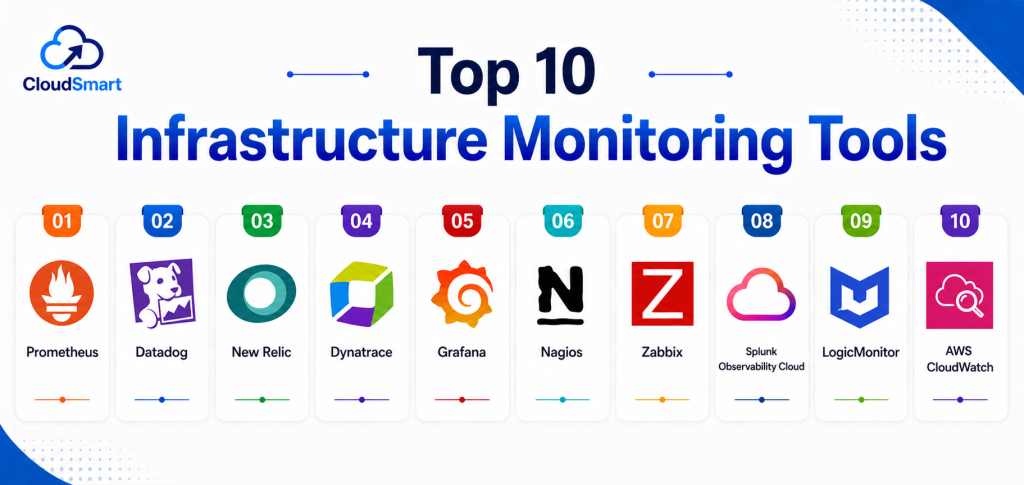
Top 10 Infrastructure Monitoring Tools
#1 — Prometheus
Short description: An open-source monitoring tool designed for cloud-native environments, widely used for metrics collection and alerting.
Key Features
- Time-series database
- Powerful query language
- Alerting system
- Kubernetes integration
- Metrics scraping
Pros
- Highly scalable
- Strong Kubernetes support
Cons
- Requires setup and maintenance
- Limited built-in visualization
Platforms / Deployment
Cross-platform
Self-hosted
Security & Compliance
Not publicly stated
Integrations & Ecosystem
Prometheus integrates with modern cloud-native tools.
- Kubernetes
- Grafana
- Alertmanager
Support & Community
Large open-source community.
#2 — Datadog
Short description: A cloud-based monitoring platform offering unified observability across infrastructure, applications, and logs.
Key Features
- Metrics, logs, and traces
- Real-time dashboards
- AI-based alerts
- Cloud integrations
- Performance monitoring
Pros
- Easy to use
- Strong visualization
Cons
- Expensive at scale
- Complex pricing
Platforms / Deployment
Cloud
Cloud-managed
Security & Compliance
Encryption, RBAC
Not publicly stated certifications
Integrations & Ecosystem
- AWS
- Azure
- Kubernetes
- CI/CD tools
Support & Community
Enterprise-grade support.
#3 — Nagios
Short description: A traditional monitoring tool used for tracking infrastructure health and performance.
Key Features
- Infrastructure monitoring
- Alerting system
- Plugin support
- Reporting
Pros
- Highly customizable
- Proven reliability
Cons
- Outdated interface
- Complex setup
Platforms / Deployment
Linux
Self-hosted
Security & Compliance
Not publicly stated
Integrations & Ecosystem
- Plugins ecosystem
Support & Community
Large community support.
#4 — Zabbix
Short description: An enterprise-grade open-source monitoring solution for networks, servers, and applications.
Key Features
- Real-time monitoring
- Alerting
- Data visualization
- Scalability
- Agent-based monitoring
Pros
- Free and open-source
- Comprehensive features
Cons
- Complex configuration
- Learning curve
Platforms / Deployment
Cross-platform
Self-hosted
Security & Compliance
Encryption support
Not publicly stated certifications
Integrations & Ecosystem
- Cloud platforms
- Network devices
Support & Community
Strong community support.
#5 — New Relic
Short description: A full-stack observability platform offering monitoring for infrastructure, applications, and user experiences.
Key Features
- Unified observability
- Real-time monitoring
- AI insights
- Distributed tracing
- Custom dashboards
Pros
- Comprehensive platform
- Easy setup
Cons
- Cost increases with usage
- Data limits
Platforms / Deployment
Cloud
Cloud-managed
Security & Compliance
Encryption, access control
Not publicly stated certifications
Integrations & Ecosystem
- Cloud providers
- DevOps tools
Support & Community
Strong vendor support.
#6 — Grafana
Short description: A visualization and monitoring platform often used with Prometheus and other data sources.
Key Features
- Dashboard visualization
- Multi-data source support
- Alerting
- Custom plugins
Pros
- Excellent visualization
- Flexible integrations
Cons
- Requires backend data source
- Setup complexity
Platforms / Deployment
Cross-platform
Cloud / Self-hosted
Security & Compliance
RBAC, authentication
Not publicly stated certifications
Integrations & Ecosystem
- Prometheus
- Elasticsearch
- Cloud tools
Support & Community
Large open-source ecosystem.
#7 — SolarWinds
Short description: A comprehensive monitoring platform focused on network and infrastructure performance.
Key Features
- Network monitoring
- Performance tracking
- Alerting
- Reporting
Pros
- Strong network monitoring
- Enterprise features
Cons
- Expensive
- Complex setup
Platforms / Deployment
Windows
Self-hosted
Security & Compliance
Not publicly stated
Integrations & Ecosystem
- Enterprise tools
Support & Community
Enterprise support.
#8 — Dynatrace
Short description: An AI-driven monitoring platform offering full-stack observability and automation.
Key Features
- AI-powered monitoring
- Real-time analytics
- Application performance monitoring
- Automation
Pros
- Advanced AI capabilities
- End-to-end visibility
Cons
- Expensive
- Complex configuration
Platforms / Deployment
Cloud
Cloud-managed
Security & Compliance
Encryption, access control
Not publicly stated certifications
Integrations & Ecosystem
- Cloud platforms
- DevOps tools
Support & Community
Strong enterprise support.
#9 — Splunk Observability
Short description: A monitoring platform offering real-time insights into infrastructure and application performance.
Key Features
- Metrics and logs
- Real-time analytics
- Alerting
- Visualization
Pros
- Powerful analytics
- Scalable
Cons
- High cost
- Complex setup
Platforms / Deployment
Cloud / Hybrid
Security & Compliance
Encryption, RBAC
Not publicly stated certifications
Integrations & Ecosystem
- Cloud providers
- Data tools
Support & Community
Enterprise support.
#10 — LogicMonitor
Short description: A cloud-based infrastructure monitoring platform with automated discovery and alerting.
Key Features
- Automated monitoring
- Cloud integration
- Alerting
- Dashboards
Pros
- Easy deployment
- Scalable
Cons
- Subscription cost
- Limited customization
Platforms / Deployment
Cloud
Security & Compliance
Not publicly stated
Integrations & Ecosystem
- Cloud platforms
- IT tools
Support & Community
Strong vendor support.
Comparison Table
| Tool Name | Best For | Platform(s) Supported | Deployment | Standout Feature | Public Rating |
|---|---|---|---|---|---|
| Prometheus | Cloud-native | Cross-platform | Self-hosted | Metrics engine | N/A |
| Datadog | SaaS monitoring | Cloud | Cloud | Unified platform | N/A |
| Nagios | Traditional infra | Linux | Self-hosted | Plugin system | N/A |
| Zabbix | Enterprise open-source | Cross-platform | Self-hosted | Full monitoring | N/A |
| New Relic | Full-stack | Cloud | Cloud | Observability | N/A |
| Grafana | Visualization | Cross-platform | Hybrid | Dashboards | N/A |
| SolarWinds | Network | Windows | Self-hosted | Network focus | N/A |
| Dynatrace | AI monitoring | Cloud | Cloud | AI insights | N/A |
| Splunk | Analytics | Hybrid | Hybrid | Data analysis | N/A |
| LogicMonitor | SaaS infra | Cloud | Cloud | Automation | N/A |
Evaluation & Scoring of Infrastructure Monitoring Tools
| Tool Name | Core (25%) | Ease (15%) | Integrations (15%) | Security (10%) | Performance (10%) | Support (10%) | Value (15%) | Weighted Total |
|---|---|---|---|---|---|---|---|---|
| Prometheus | 9 | 6 | 9 | 7 | 9 | 8 | 9 | 8.3 |
| Datadog | 9 | 9 | 10 | 8 | 9 | 9 | 7 | 8.8 |
| Nagios | 7 | 5 | 7 | 7 | 8 | 8 | 9 | 7.2 |
| Zabbix | 8 | 6 | 8 | 7 | 8 | 8 | 9 | 7.9 |
| New Relic | 9 | 9 | 9 | 8 | 9 | 9 | 7 | 8.6 |
| Grafana | 8 | 7 | 9 | 7 | 8 | 8 | 9 | 8.1 |
| SolarWinds | 8 | 6 | 8 | 8 | 8 | 9 | 7 | 7.9 |
| Dynatrace | 10 | 8 | 10 | 9 | 10 | 9 | 6 | 9.0 |
| Splunk | 9 | 7 | 10 | 9 | 9 | 9 | 6 | 8.7 |
| LogicMonitor | 8 | 8 | 9 | 8 | 8 | 9 | 7 | 8.2 |
How to interpret the scores:
These scores are comparative and reflect typical usage across different environments. Higher scores indicate stronger capabilities, but the best tool depends on your needs. Open-source tools offer flexibility and cost savings, while commercial tools provide advanced features and ease of use. Always evaluate tools in your environment before making a decision.
Which Infrastructure Monitoring Tool Is Right for You?
Solo / Freelancer
Prometheus with Grafana offers a cost-effective and flexible solution.
SMB
Zabbix or LogicMonitor provide a balance of features and ease of use.
Mid-Market
Datadog and New Relic offer scalability and strong integrations.
Enterprise
Dynatrace and Splunk provide advanced analytics and automation.
Budget vs Premium
Open-source tools reduce cost, while premium tools offer convenience and advanced features.
Feature Depth vs Ease of Use
Datadog and New Relic are easier to use, while Prometheus offers more flexibility.
Integrations & Scalability
Cloud-native tools excel in scalability and integrations.
Security & Compliance Needs
Enterprise tools provide stronger compliance and governance.
Frequently Asked Questions (FAQs)
1. What are infrastructure monitoring tools?
They track system health, performance, and availability. They help detect issues early and ensure systems run smoothly.
2. Why are they important?
They prevent downtime and improve performance. They also provide insights into system behavior.
3. What is observability?
Observability combines metrics, logs, and traces. It provides deeper insights into system performance.
4. Are open-source tools reliable?
Yes, tools like Prometheus are widely used. They require setup but offer flexibility.
5. Do these tools support cloud environments?
Yes, most tools support cloud and hybrid infrastructure.
6. Can monitoring tools detect failures automatically?
Yes, they use alerts and anomaly detection. This helps teams respond quickly.
7. What is real-time monitoring?
It provides instant visibility into system performance. This helps identify issues immediately.
8. Are these tools scalable?
Yes, modern tools are designed for large-scale environments.
9. What are common mistakes?
Not configuring alerts properly and ignoring data are common mistakes.
10. Which tool is best?
There is no single best tool. The right choice depends on your needs.
Conclusion
Infrastructure Monitoring Tools are essential for maintaining the health, performance, and reliability of modern IT systems. As organizations move toward cloud-native and distributed architectures, monitoring becomes critical for ensuring uptime and optimizing resources. Tools like Prometheus and Grafana provide flexibility and cost efficiency, while platforms like Datadog, Dynatrace, and Splunk offer advanced capabilities and ease of use. Open-source solutions are ideal for teams seeking control and customization, whereas managed services simplify deployment and scaling. The best tool depends on your infrastructure complexity, team expertise, and operational goals. Smaller teams may prioritize simplicity and cost, while enterprises require scalability, automation, and advanced analytics. No single tool fits every scenario, so it is important to evaluate multiple options. A practical approach is to shortlist a few tools, test them in your environment, and validate their performance and integration capabilities. This ensures a reliable and future-ready monitoring strategy.