Introduction
Transactional Email APIs are developer-focused services that allow applications to send automated, event-driven emails such as password resets, OTPs, receipts, alerts, and account notifications. Unlike marketing email tools, these APIs are built for reliability, speed, and high deliverability, ensuring critical messages always reach the inbox.
In modern SaaS and cloud applications, transactional emails are mission-critical. A delayed or missing email can directly impact user experience, login access, and revenue flow.
These APIs are widely used in:
- Password reset and authentication emails
- Order confirmations and receipts
- System alerts and notifications
- OTP and verification messages
- API-driven SaaS communications
What buyers should evaluate:
- Deliverability rate and inbox placement
- API simplicity and developer experience
- Sending speed and latency
- Scalability for high-volume workloads
- Pricing model (per email / volume tiers)
- Authentication support (SPF, DKIM, DMARC)
- Analytics and tracking capabilities
- Integration with apps, backend systems, and cloud platforms
Best for: SaaS companies, developers, startups, fintech apps, and enterprise platforms needing reliable system-generated email delivery.
Not ideal for: Personal email use or small-scale manual emailing without automation needs.
Key Trends in Transactional Email APIs
- Deliverability-first design: Focus shifting from features to inbox placement quality
- Developer-first APIs: Simple REST APIs and SDKs dominating adoption
- Separation of marketing and transactional streams: Cleaner email reputation management
- Real-time event tracking: Webhooks for delivery, bounce, and open tracking
- AI-assisted deliverability optimization: Smart routing and reputation scoring
- Stricter email authentication: SPF, DKIM, and DMARC becoming mandatory
- Serverless email sending: Cloud-native, event-triggered architectures
- Cost optimization at scale: Ultra-low-cost providers for high-volume emails
- Hybrid email stacks: Combining multiple providers for redundancy
How We Selected These Tools (Methodology)
- Evaluated real-world deliverability performance
- Assessed API design and developer experience
- Reviewed scalability for transactional workloads
- Considered integration ecosystem and SDK support
- Analyzed pricing transparency and cost efficiency
- Included both enterprise and startup-friendly tools
- Balanced performance-focused and developer-friendly platforms
- Reviewed reputation in SaaS and cloud ecosystems
- Considered security, authentication, and compliance readiness
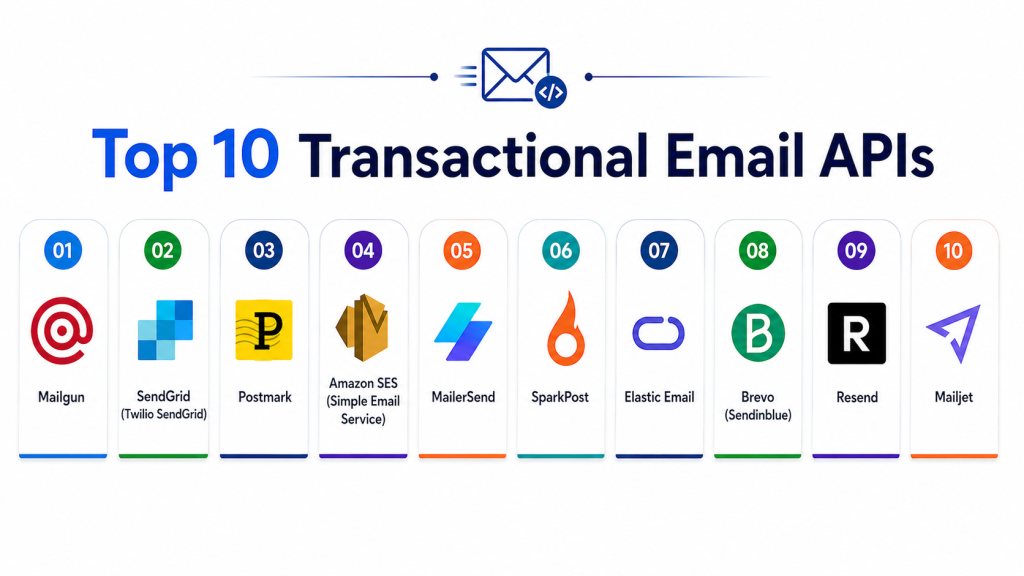
Top 10 Transactional Email APIs
#1 — Mailgun
Short description: A developer-first email API platform offering flexible routing, validation, and scalable transactional email delivery.
Key Features
- RESTful email API
- Email validation service
- Routing and forwarding rules
- Detailed delivery logs
- SMTP relay support
- Analytics and tracking
Pros
- Highly flexible API
- Strong deliverability control
Cons
- Requires technical setup
- Pricing complexity at scale
Platforms / Deployment
Cloud / API-based
Security & Compliance
SPF, DKIM, DMARC support
Not publicly stated certifications
Integrations & Ecosystem
Mailgun integrates deeply into modern SaaS architectures.
- Backend frameworks
- CRM systems
- DevOps pipelines
Support & Community
Strong developer documentation and enterprise support.
#2 — SendGrid
Short description: A widely adopted email API and marketing platform offering scalable transactional email delivery.
Key Features
- Email API and SMTP relay
- Template management
- Deliverability insights
- Event webhooks
- Analytics dashboard
- Marketing + transactional support
Pros
- Easy onboarding
- Scalable infrastructure
Cons
- Complex pricing tiers
- UI can feel heavy
Platforms / Deployment
Cloud
Security & Compliance
Authentication support (SPF, DKIM, DMARC)
Not publicly stated certifications
Integrations & Ecosystem
- CRM tools
- SaaS platforms
- Cloud services
Support & Community
Large enterprise user base and strong support.
#3 — Postmark
Short description: A high-speed transactional email API focused on reliability and inbox delivery performance.
Key Features
- Fast transactional email delivery
- Activity logs
- Bounce handling
- Email templates
- Webhook events
- Delivery analytics
Pros
- Excellent deliverability
- Very fast email delivery
Cons
- Limited marketing features
- Higher per-email cost
Platforms / Deployment
Cloud
Security & Compliance
Strong authentication support
Not publicly stated certifications
Integrations & Ecosystem
- SaaS platforms
- Backend applications
Support & Community
Highly rated support and documentation.
#4 — Amazon SES (Simple Email Service)
Short description: A cost-efficient, scalable email API built on AWS infrastructure for high-volume transactional email sending.
Key Features
- High-volume email sending
- SMTP and API support
- Bounce and complaint handling
- Domain verification
- AWS integration
- Deliverability controls
Pros
- Extremely low cost
- Highly scalable
Cons
- Complex setup
- Requires AWS knowledge
Platforms / Deployment
Cloud (AWS)
Security & Compliance
IAM-based security
Not publicly stated certifications
Integrations & Ecosystem
- AWS Lambda
- EC2
- CloudWatch
- API Gateway
Support & Community
Strong AWS ecosystem support.
#5 — Mailtrap
Short description: A transactional email testing and staging API that helps developers safely test email workflows before production.
Key Features
- Email sandbox testing
- Spam score analysis
- Email debugging tools
- API integration
- Email capture inbox
- Deliverability insights
Pros
- Safe testing environment
- Developer-friendly setup
Cons
- Not a full production sender
- Limited marketing features
Platforms / Deployment
Cloud
Security & Compliance
Secure email testing environment
Not publicly stated certifications
Integrations & Ecosystem
- CI/CD pipelines
- Backend frameworks
Support & Community
Strong developer-focused support.
#6 — MailerSend
Short description: A modern transactional email API designed for simplicity and SaaS integration.
Key Features
- Email API
- Template builder
- SMTP relay
- Real-time analytics
- Webhooks
- Automation workflows
Pros
- Easy setup
- Clean API design
Cons
- Smaller ecosystem
- Limited enterprise depth
Platforms / Deployment
Cloud
Security & Compliance
Encryption support
Not publicly stated certifications
Integrations & Ecosystem
- SaaS tools
- Backend applications
Support & Community
Growing support ecosystem.
#7 — SendForensics
Short description: A deliverability optimization platform focused on spam analysis and inbox placement testing.
Key Features
- Spam testing tools
- Inbox placement analysis
- Email content optimization
- Sender reputation tracking
- Authentication checks
Pros
- Deep deliverability insights
- Actionable recommendations
Cons
- No email sending API
- Learning curve
Platforms / Deployment
Cloud
Security & Compliance
SPF, DKIM, DMARC validation
Not publicly stated certifications
Integrations & Ecosystem
- Email providers
- Marketing platforms
Support & Community
Strong analytics-focused support.
#8 — Amazon Pinpoint
Short description: A customer engagement service for sending transactional and targeted email campaigns.
Key Features
- Multi-channel messaging
- Email analytics
- Segmentation tools
- Event tracking
- AWS integration
Pros
- Strong AWS ecosystem integration
- Scalable messaging
Cons
- Complex setup
- Overkill for simple apps
Platforms / Deployment
Cloud (AWS)
Security & Compliance
AWS security standards
Not publicly stated certifications
Integrations & Ecosystem
- AWS services
- Analytics tools
Support & Community
Enterprise AWS support.
#9 — Resend
Short description: A modern email API focused on developer experience and simplicity for transactional emails.
Key Features
- Simple REST API
- Email templates
- Event tracking
- Webhooks
- Developer SDKs
Pros
- Modern developer experience
- Fast integration
Cons
- Newer ecosystem
- Limited enterprise features
Platforms / Deployment
Cloud
Security & Compliance
Not publicly stated
Integrations & Ecosystem
- SaaS applications
- Developer frameworks
Support & Community
Rapidly growing developer community.
#10 — SparkPost
Short description: A transactional email API platform focused on deliverability analytics and high-volume sending.
Key Features
- Email API
- Deliverability analytics
- Event tracking
- Template management
- SMTP relay
Pros
- Strong analytics
- High-volume capable
Cons
- Complex UI
- Enterprise pricing
Platforms / Deployment
Cloud
Security & Compliance
Authentication support
Not publicly stated certifications
Integrations & Ecosystem
- Enterprise applications
- SaaS platforms
Support & Community
Enterprise-grade support.
Comparison Table
| Tool Name | Best For | Platform(s) Supported | Deployment | Standout Feature | Public Rating |
|---|---|---|---|---|---|
| Mailgun | Developers | Cloud | Cloud | Flexible API | N/A |
| SendGrid | All-in-one | Cloud | Cloud | Marketing + transactional | N/A |
| Postmark | Speed-focused apps | Cloud | Cloud | Deliverability | N/A |
| Amazon SES | High volume | Cloud | Cloud | Low cost | N/A |
| Mailtrap | Testing | Cloud | Cloud | Sandbox environment | N/A |
| MailerSend | SaaS apps | Cloud | Cloud | Simplicity | N/A |
| SendForensics | Optimization | Cloud | Cloud | Spam analysis | N/A |
| Amazon Pinpoint | AWS users | Cloud | Cloud | Multi-channel messaging | N/A |
| Resend | Modern devs | Cloud | Cloud | DX-first API | N/A |
| SparkPost | Enterprises | Cloud | Cloud | Analytics depth | N/A |
Evaluation & Scoring of Transactional Email APIs
| Tool Name | Core (25%) | Ease (15%) | Integrations (15%) | Security (10%) | Performance (10%) | Support (10%) | Value (15%) | Weighted Total |
|---|---|---|---|---|---|---|---|---|
| Mailgun | 9 | 8 | 9 | 8 | 9 | 9 | 8 | 8.6 |
| SendGrid | 9 | 8 | 9 | 8 | 9 | 9 | 8 | 8.6 |
| Postmark | 9 | 9 | 8 | 9 | 9 | 9 | 7 | 8.6 |
| Amazon SES | 9 | 7 | 10 | 9 | 10 | 9 | 10 | 8.9 |
| Mailtrap | 8 | 9 | 8 | 8 | 8 | 8 | 9 | 8.3 |
| MailerSend | 8 | 9 | 8 | 8 | 8 | 8 | 8 | 8.1 |
| SendForensics | 9 | 8 | 8 | 9 | 8 | 8 | 7 | 8.3 |
| Amazon Pinpoint | 9 | 7 | 9 | 9 | 9 | 9 | 8 | 8.5 |
| Resend | 8 | 9 | 8 | 8 | 8 | 8 | 9 | 8.3 |
| SparkPost | 9 | 7 | 9 | 8 | 9 | 9 | 7 | 8.4 |
How to interpret the scores:
These scores reflect comparative performance across developer and enterprise use cases. Higher scores indicate stronger reliability, scalability, and ecosystem maturity. Cost-efficient tools like Amazon SES excel at scale, while platforms like Postmark focus on deliverability. Developer-first tools like Resend prioritize simplicity and speed of integration. The best choice depends on workload type, email volume, and technical complexity.
Which Transactional Email API Is Right for You?
Solo / Developer
Resend or Mailtrap for simplicity and testing workflows.
SMB
MailerSend or SendGrid for balanced features and scalability.
Mid-Market
Postmark or Mailgun for reliability and deliverability control.
Enterprise
Amazon SES, SparkPost, or SendGrid for high-volume operations.
Budget vs Premium
Amazon SES is cost-efficient; Postmark is premium deliverability-focused.
Feature Depth vs Ease of Use
SendGrid offers all-in-one features; Resend focuses on simplicity.
Integrations & Scalability
AWS SES and SendGrid offer the strongest ecosystem support.
Security & Compliance Needs
Enterprise tools provide stronger governance and monitoring capabilities.
Frequently Asked Questions (FAQs)
1. What is a transactional email API?
It is a service that allows applications to send automated emails like OTPs, receipts, and alerts through code.
2. How is it different from marketing email tools?
Transactional emails are event-driven and user-specific, while marketing emails are campaign-based.
3. What is deliverability in email APIs?
It refers to how successfully emails reach the inbox instead of spam folders.
4. Which API is best for startups?
Resend, MailerSend, or Mailgun are popular choices for startups.
5. What is the cheapest transactional email API?
Amazon SES is the most cost-efficient at scale.
6. Why do emails go to spam?
Poor authentication, bad sender reputation, or incorrect configuration can cause spam filtering.
7. Do these APIs support templates?
Yes, most platforms provide email template systems for dynamic content.
8. Can I use multiple email APIs together?
Yes, many companies use multiple providers for redundancy and failover.
9. Are transactional email APIs secure?
Yes, they support encryption and authentication standards like SPF, DKIM, and DMARC.
10. What is the biggest mistake in email APIs?
Not configuring authentication records properly, leading to poor deliverability.
Conclusion
Transactional Email APIs are critical infrastructure components for modern applications, ensuring reliable delivery of system-generated emails such as notifications, receipts, and authentication messages. Platforms like Mailgun and SendGrid provide flexible and scalable APIs, while Postmark focuses on high deliverability and speed. Amazon SES stands out for cost efficiency at large scale, and newer tools like Resend emphasize developer experience and simplicity. Supporting tools such as Mailtrap and SendForensics enhance testing and deliverability optimization, ensuring emails reach users effectively. The right choice depends on your technical needs, email volume, and budget. Smaller teams often prioritize ease of integration and developer experience, while enterprises focus on scalability, analytics, and compliance. Since no single platform fits all use cases, it is important to evaluate options carefully. A practical approach is to combine a primary sending API with testing and deliverability tools for optimal performance. This ensures a reliable, scalable, and future-ready email infrastructure.