Introduction
Algorithmic Trading Platforms are specialized software solutions that allow traders, hedge funds, and quantitative analysts to develop, backtest, optimize, and execute automated trading strategies across various financial markets. These platforms leverage market data, analytics, and execution engines to implement strategies at high speed and scale.
They are essential because algorithmic trading enables precise, data-driven execution, reduces manual errors, and increases efficiency in fast-moving markets. Modern platforms integrate real-time market data, advanced analytics, and risk management tools to optimize performance. Common use cases include high-frequency trading, statistical arbitrage, market-making, trend-following strategies, and portfolio automation.
Buyers should evaluate market connectivity, backtesting capabilities, strategy optimization, latency, API accessibility, multi-asset support, analytics and reporting, automation features, scalability, and vendor support.
Best for: Professional traders, quantitative analysts, hedge funds, proprietary trading firms, and asset managers.
Not ideal for: Small investors or casual traders with limited strategy complexity or low trading volume.
Key Trends in Algorithmic Trading Platforms
- Integration with low-latency market data feeds for high-frequency strategies
- Cloud-based platforms enabling collaboration and scalability
- API-first architecture for strategy automation
- AI and machine learning for predictive analytics and strategy optimization
- Multi-asset and multi-market execution support
- Backtesting and simulation tools for strategy validation
- Real-time risk management and compliance monitoring
- Integration with broker execution systems
- Visualization dashboards for analytics and performance monitoring
- Customizable scripting languages for strategy development
How We Selected These Tools
- Adoption by professional traders, hedge funds, and quantitative teams
- Multi-asset class support and global market connectivity
- Backtesting, simulation, and strategy optimization capabilities
- Integration with broker APIs and execution platforms
- Real-time risk management and compliance features
- Automation and workflow capabilities
- Cloud and on-premise deployment options
- Scalability for high-volume and low-latency execution
- Analytics, reporting, and visualization tools
- Vendor support, reliability, and training resources
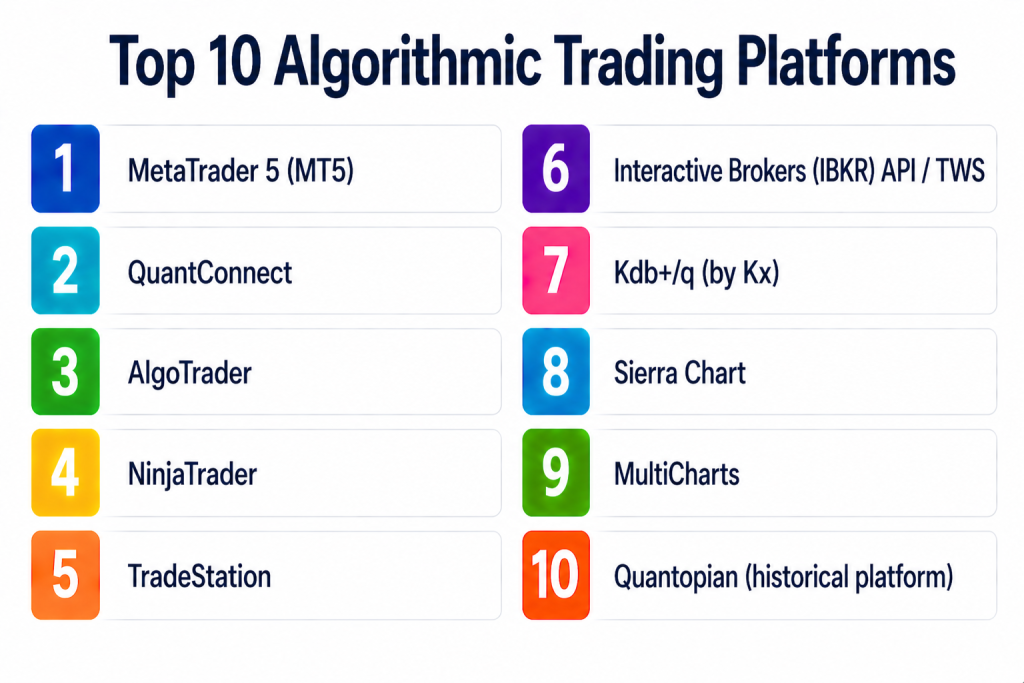
Top 10 Algorithmic Trading Platforms
#1 — MetaTrader 5 (MT5)
Short description: MT5 is a multi-asset trading platform that supports automated trading, technical analysis, and algorithmic strategy development.
Key Features
- Automated strategy execution via Expert Advisors (EAs)
- Multi-asset trading (Forex, stocks, futures)
- Backtesting and optimization tools
- Technical indicators and charting
- Multi-language scripting (MQL5)
Pros
- Popular and widely supported
- Easy to use for retail and professional traders
- Backtesting included
- Supports custom indicators
Cons
- Limited high-frequency trading support
- Retail-focused
- Broker-dependent execution
- Advanced analytics may be limited
Platforms / Deployment
Windows / Web / Mobile
Cloud / On-prem
Security & Compliance
Not publicly stated
Integrations & Ecosystem
- Broker trading accounts
- Market data feeds
- Third-party indicators
Support & Community
Large global user community and extensive documentation.
#2 — QuantConnect
Short description: QuantConnect is a cloud-based algorithmic trading platform for quantitative strategy development and backtesting.
Key Features
- Cloud-based backtesting
- Multi-asset support (equities, crypto, futures)
- Python and C# coding environments
- Algorithm library and community sharing
- Integration with broker APIs
Pros
- Open-source and flexible
- Cloud-based scalability
- Multi-asset strategy support
- Developer-friendly
Cons
- Requires programming knowledge
- Cloud reliance
- Premium features may cost extra
- Learning curve for beginners
Platforms / Deployment
Web / Cloud
Cloud
Security & Compliance
Not publicly stated
Integrations & Ecosystem
- Interactive Brokers
- GDAX/Coinbase Pro
- FXCM
Support & Community
Active developer community and support forums.
#3 — AlgoTrader
Short description: AlgoTrader provides institutional-grade algorithmic trading software for multi-asset class execution and automated strategy management.
Key Features
- Multi-asset algorithmic trading
- Backtesting and simulation tools
- Risk management modules
- API and FIX protocol integration
- Cloud and on-prem deployment
Pros
- Institutional-grade
- Multi-asset support
- High customizability
- Robust risk controls
Cons
- Enterprise-focused
- High cost
- Setup complexity
- Requires technical expertise
Platforms / Deployment
Web / Desktop
Cloud / On-prem
Security & Compliance
Not publicly stated
Integrations & Ecosystem
- Broker APIs
- Market data feeds
- Risk management systems
Support & Community
Enterprise support with professional services.
#4 — NinjaTrader
Short description: NinjaTrader is a trading platform for futures, forex, and equities with advanced charting and algorithmic trading capabilities.
Key Features
- Automated strategy execution
- Advanced charting and analytics
- Multi-broker connectivity
- Backtesting and optimization
- C# strategy development
Pros
- Flexible for professional traders
- Advanced analytics and charting
- Multi-broker support
- Community add-ons
Cons
- Windows-only
- Enterprise features limited
- Programming knowledge required
- Broker dependency
Platforms / Deployment
Windows
Cloud / On-prem
Security & Compliance
Not publicly stated
Integrations & Ecosystem
- Interactive Brokers
- CQG
- Market data providers
Support & Community
Active user community and third-party developers.
#5 — TradeStation
Short description: TradeStation is a multi-asset trading platform with algorithmic trading, backtesting, and advanced market analytics.
Key Features
- Multi-asset trading support
- Automated strategy execution
- Backtesting and simulation
- Technical indicators and charting
- EasyLanguage scripting
Pros
- Advanced analytics
- Supports retail and professional traders
- Backtesting included
- Custom strategy scripting
Cons
- US-focused
- Subscription required
- Learning curve
- Broker dependency
Platforms / Deployment
Windows / Web / Mobile
Cloud / On-prem
Security & Compliance
Not publicly stated
Integrations & Ecosystem
- Broker accounts
- Market data feeds
- Third-party plugins
Support & Community
Community forums and professional support.
#6 — Interactive Brokers (IBKR API / TWS)
Short description: IBKR provides API-driven algorithmic trading and a desktop platform (TWS) for professional and institutional traders.
Key Features
- API for algorithmic trading
- Multi-asset class support
- Real-time market data
- Risk management tools
- Backtesting capabilities
Pros
- Low-latency execution
- Extensive global market access
- Multi-asset coverage
- Trusted broker
Cons
- API complexity
- Learning curve
- Advanced features require programming
- US & global regulations
Platforms / Deployment
Windows / Web / Mobile
Cloud / On-prem
Security & Compliance
Not publicly stated
Integrations & Ecosystem
- Trading APIs
- Market data providers
- Risk management systems
Support & Community
Professional support and developer documentation.
#7 — Kdb+/q (by Kx)
Short description: Kx provides high-performance time-series database and analytics tools for ultra-low latency algorithmic trading.
Key Features
- Real-time and historical data
- Ultra-low latency execution
- q programming for algorithmic strategies
- Backtesting support
- Multi-asset integration
Pros
- High performance
- Low latency
- Enterprise-grade
- Multi-asset coverage
Cons
- Technical complexity
- Enterprise-focused
- High cost
- Requires q programming knowledge
Platforms / Deployment
Windows / Linux
Cloud / On-prem
Security & Compliance
Not publicly stated
Integrations & Ecosystem
- Market data feeds
- Execution venues
- Analytics tools
Support & Community
Enterprise support with professional services.
#8 — Sierra Chart
Short description: Sierra Chart is a professional trading platform with advanced charting, technical analysis, and automated trading capabilities.
Key Features
- Multi-asset support
- Automated trading
- Advanced charting tools
- Backtesting
- API and DLL integration
Pros
- Flexible scripting
- Low-latency support
- Strong charting
- Cost-effective
Cons
- Windows-only
- Learning curve
- Limited enterprise support
- Integration setup required
Platforms / Deployment
Windows
Cloud / On-prem
Security & Compliance
Not publicly stated
Integrations & Ecosystem
- Broker connectivity
- Market data feeds
- Custom plugins
Support & Community
Active user forums and documentation.
#9 — MultiCharts
Short description: MultiCharts is a professional trading platform for algorithmic trading and strategy development.
Key Features
- Automated strategy execution
- Backtesting and simulation
- Multi-broker support
- Technical indicators and charting
- EasyLanguage and .NET scripting
Pros
- Flexible scripting
- Multi-broker support
- Advanced charting
- Backtesting included
Cons
- Windows-only
- Pricing varies
- Setup complexity
- Learning curve
Platforms / Deployment
Windows
Cloud / On-prem
Security & Compliance
Not publicly stated
Integrations & Ecosystem
- Brokers
- Market data feeds
- Analytics tools
Support & Community
Support available with community contributions.
#10 — Quantopian (historical platform)
Short description: Quantopian was a cloud-based platform for developing, backtesting, and deploying quantitative trading strategies.
Key Features
- Python-based algorithmic strategy development
- Backtesting and simulation
- Community sharing of algorithms
- Integration with broker APIs
Pros
- Open-source focus
- Cloud-based
- Developer-friendly
- Accessible for research
Cons
- Platform discontinued for live trading
- Enterprise support limited
- US-focused
- Integration effort
Platforms / Deployment
Web / Cloud
Cloud
Security & Compliance
Not publicly stated
Integrations & Ecosystem
- Broker APIs
- Python ecosystem
- Market data feeds
Support & Community
Developer-focused support.
Comparison Table
| Tool Name | Best For | Platform(s) Supported | Deployment | Standout Feature | Public Rating |
|---|---|---|---|---|---|
| MT5 | Retail & professional traders | Windows/Web/Mobile | Cloud/On-prem | Expert Advisors | N/A |
| QuantConnect | Quant developers | Web | Cloud | Python/C# API | N/A |
| AlgoTrader | Hedge funds | Web/Desktop | Cloud/On-prem | Institutional trading | N/A |
| NinjaTrader | Futures/forex traders | Windows | Cloud/On-prem | Charting & automation | N/A |
| TradeStation | Professional traders | Windows/Web/Mobile | Cloud/On-prem | EasyLanguage scripting | N/A |
| IBKR API/TWS | Institutional & professional | Windows/Web/Mobile | Cloud/On-prem | Global market access | N/A |
| Kdb+/q | High-frequency traders | Windows/Linux | Cloud/On-prem | Ultra-low latency | N/A |
| Sierra Chart | Professional traders | Windows | Cloud/On-prem | Advanced charting | N/A |
| MultiCharts | Professional traders | Windows | Cloud/On-prem | Multi-broker support | N/A |
| Quantopian | Quant researchers | Web | Cloud | Cloud-based Python | N/A |
Evaluation & Scoring of Algorithmic Trading Platforms
| Tool | Core | Ease | Integrations | Security | Performance | Support | Value | Weighted Total |
|---|---|---|---|---|---|---|---|---|
| MT5 | 8.5 | 8 | 8 | 8 | 8 | 8 | 8 | 8.1 |
| QuantConnect | 8.5 | 7.5 | 8.5 | 8 | 8.5 | 8 | 8 | 8.2 |
| AlgoTrader | 9 | 7.5 | 8.5 | 8 | 9 | 8 | 7.5 | 8.3 |
| NinjaTrader | 8.5 | 8 | 8 | 8 | 8 | 8 | 8 | 8.1 |
| TradeStation | 8 | 7.5 | 8 | 8 | 8 | 8 | 7.5 | 7.9 |
| IBKR API/TWS | 9 | 7 | 8.5 | 8 | 9 | 8 | 7 | 8.2 |
| Kdb+/q | 9 | 6.5 | 8 | 8 | 9.5 | 7.5 | 7 | 8.1 |
| Sierra Chart | 8 | 8 | 7.5 | 8 | 8 | 7.5 | 7.5 | 7.8 |
| MultiCharts | 8.5 | 7.5 | 8 | 8 | 8.5 | 8 | 7.5 | 8.0 |
| Quantopian | 8 | 7.5 | 7.5 | 8 | 8 | 7.5 | 7.5 | 7.7 |
Which Algorithmic Trading Platform Is Right for You?
Solo / Freelancer
Use MT5 or Sierra Chart for accessible algorithmic trading and charting.
SMB
Choose TradeStation or NinjaTrader for strategy development with multi-asset support.
Mid-Market
Consider QuantConnect or MultiCharts for quantitative research and algorithmic automation.
Enterprise
Use AlgoTrader, IBKR API/TWS, or Kdb+/q for institutional-grade algorithmic trading with low latency and multi-market support.
Budget vs Premium
Budget platforms provide backtesting and automation; premium platforms deliver low-latency, high-frequency, and multi-market execution.
Feature Depth vs Ease of Use
Enterprise platforms offer advanced analytics and performance; retail platforms focus on usability and accessibility.
Integrations & Scalability
Ensure platform connectivity with brokers, market data providers, and risk management systems.
Security & Compliance Needs
Verify encryption, audit trails, and secure API access.
Frequently Asked Questions
1. What is an algorithmic trading platform?
It is software that allows automated execution of trading strategies based on pre-defined rules.
2. Why is it important?
It increases trading efficiency, reduces manual errors, and allows high-frequency strategies.
3. Who uses these platforms?
Hedge funds, proprietary trading firms, quantitative analysts, and professional traders.
4. What features matter most?
Strategy automation, backtesting, multi-asset support, market connectivity, and risk management.
5. Are these platforms cloud-based?
Many platforms offer cloud-based or hybrid deployment options.
6. Can they handle high-frequency trading?
Enterprise-grade platforms like Kdb+/q and AlgoTrader support ultra-low latency execution.
7. How long does setup take?
It varies from days for retail platforms to weeks or months for institutional platforms.
8. Are they secure?
Enterprise platforms include encryption, secure API access, and compliance monitoring.
9. Do they provide backtesting?
Yes, all major platforms provide backtesting and simulation tools.
10. What are alternatives?
Manual trading, semi-automated trading scripts, or low-cost retail platforms.
Conclusion
Algorithmic Trading Platforms are essential for traders and firms seeking automated, data-driven trading strategies. Enterprise platforms like AlgoTrader, IBKR API/TWS, and Kdb+/q deliver low-latency, institutional-grade performance. Mid-market tools such as QuantConnect and MultiCharts support quantitative strategy development and backtesting. Retail-focused platforms like MT5, TradeStation, and NinjaTrader provide accessibility and multi-asset capabilities. The right choice depends on strategy complexity, market access, and execution needs. Organizations should evaluate latency, scalability, integration, and analytics before adoption. Pilot programs can validate strategy performance and execution reliability. Ultimately, the best platform aligns with trading objectives and operational requirements.