Introduction
OKR & Goal Management Software helps organizations define Objectives and Key Results (OKRs), track progress, and align teams toward strategic goals. Instead of scattered spreadsheets or disconnected tools, these platforms provide a centralized system for goal setting, performance tracking, and accountability.
OKRs are widely used to create alignment, transparency, and measurable outcomes across organizations. They help teams focus on high-impact priorities and continuously track progress through measurable results.
Modern OKR tools go beyond simple tracking—they include dashboards, AI insights, integrations, and continuous feedback loops that improve execution and decision-making.
Common use cases include:
- Company-wide goal alignment
- Team and individual OKR tracking
- Weekly progress updates and check-ins
- Performance and KPI tracking
- Strategic planning and execution
What buyers should evaluate:
- Goal alignment and hierarchy
- Real-time progress tracking
- Reporting and analytics
- Integration with HR, project, and communication tools
- Automation and AI insights
- Ease of use and onboarding
- Scalability across teams
- Security and access control
- Custom workflows and templates
Best for: Startups, SMBs, enterprises, product teams, and leadership teams focused on alignment and execution.
Not ideal for: Very small teams managing goals informally.
Key Trends in OKR & Goal Management Software
- AI-powered goal recommendations and insights
- Real-time OKR tracking with dashboards
- Integration with project management tools (Jira, Asana, Slack)
- Combining OKRs with performance management
- Weekly check-ins replacing static reporting
- Predictive analytics for goal achievement
- Cross-team alignment and visibility
- Mobile-first OKR tracking
- Automated reminders and workflows
- Hybrid OKR + KPI + performance platforms
How We Selected These Tools (Methodology)
- Strong adoption across startups to enterprises
- Comprehensive OKR and goal tracking capabilities
- Proven scalability and performance
- Integration ecosystem (HR, PM, collaboration tools)
- Security features like RBAC and audit logs
- Ease of use and onboarding
- Reporting and analytics depth
- Vendor innovation and AI capabilities
- Flexibility across industries
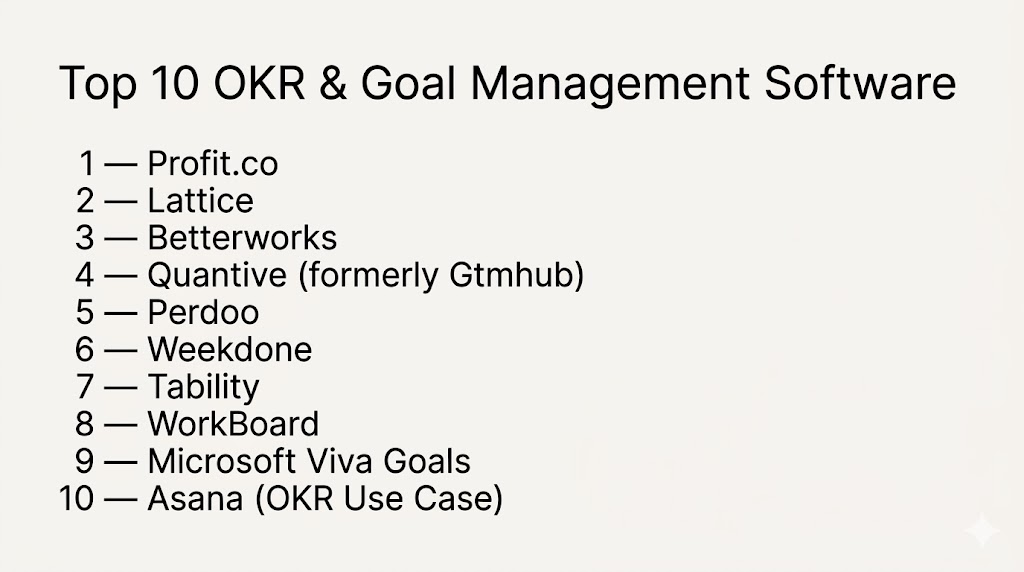
Top 10 OKR & Goal Management Software
#1 — Profit.co
Short description: A comprehensive OKR platform combining goal tracking, KPI management, and performance workflows.
Key Features
- OKR and KPI tracking
- Weighted scoring and progress tracking
- Built-in performance reviews
- Visual dashboards and heatmaps
- Templates and OKR coaching
Pros
- All-in-one platform
- Strong visualization
Cons
- Feature-heavy interface
- Learning curve
Platforms / Deployment
Web / Cloud
Security & Compliance
RBAC, encryption
Integrations & Ecosystem
Supports HR, project, and collaboration tools.
- Slack
- Jira
- APIs
Support & Community
Strong documentation and onboarding.
#2 — Lattice
Short description: A people-focused platform combining OKRs with performance and engagement.
Key Features
- OKR tracking
- Performance reviews
- Continuous feedback
- Analytics dashboards
- Goal alignment
Pros
- Easy integration with HR workflows
- Strong UX
Cons
- Pricing
- Limited deep OKR customization
Platforms / Deployment
Web / Cloud
Security & Compliance
SSO, encryption
Integrations & Ecosystem
- HRIS tools
- Slack
Support & Community
Strong adoption and support.
#3 — Betterworks
Short description: An enterprise-grade OKR platform focused on alignment and continuous performance.
Key Features
- OKR tracking
- Continuous feedback
- Performance reviews
- Analytics
- Goal alignment
Pros
- Enterprise-ready
- Strong alignment features
Cons
- Complex setup
- Pricing
Platforms / Deployment
Web / Cloud
Security & Compliance
SSO, MFA
Integrations & Ecosystem
- HR tools
- APIs
Support & Community
Enterprise support.
#4 — Quantive (formerly Gtmhub)
Short description: A strategy execution platform with strong analytics and AI coaching.
Key Features
- OKR tracking
- AI-powered insights
- Data integrations
- Real-time dashboards
- Strategy alignment
Pros
- Strong analytics
- AI-driven insights
Cons
- Complex setup
- Enterprise pricing
Platforms / Deployment
Web / Cloud
Security & Compliance
SSO, MFA
Integrations & Ecosystem
- Data tools
- HR systems
Support & Community
Enterprise support.
#5 — Perdoo
Short description: A simple and effective OKR platform for SMBs and growing teams.
Key Features
- Goal alignment
- KPI tracking
- Strategy maps
- Progress tracking
- Reporting
Pros
- Easy to use
- Clear visualization
Cons
- Limited advanced features
- Smaller ecosystem
Platforms / Deployment
Web / Cloud
Security & Compliance
Not publicly stated
Integrations & Ecosystem
- HR tools
- APIs
Support & Community
Good SMB support.
#6 — Weekdone
Short description: A lightweight OKR tool focused on weekly planning and progress tracking.
Key Features
- Weekly check-ins
- Goal tracking
- Reporting dashboards
- Progress updates
- Team alignment
Pros
- Simple and intuitive
- Great for small teams
Cons
- Limited enterprise features
- Basic analytics
Platforms / Deployment
Web / Cloud
Security & Compliance
Not publicly stated
Integrations & Ecosystem
- Slack
- APIs
Support & Community
Strong SMB support.
#7 — Tability
Short description: A modern OKR platform with strong AI-assisted goal tracking and check-ins.
Key Features
- Real-time tracking
- Weekly check-ins
- AI goal suggestions
- Templates
- Integrations
Pros
- Clean UI
- Strong AI features
Cons
- Limited enterprise features
- Navigation limitations
Platforms / Deployment
Web / Cloud
Security & Compliance
Not publicly stated
Integrations & Ecosystem
- Jira
- Slack
Support & Community
Growing ecosystem.
#8 — WorkBoard
Short description: An enterprise OKR platform focused on strategy execution and alignment.
Key Features
- OKR tracking
- Strategy execution tools
- AI coaching
- Analytics
- Alignment dashboards
Pros
- Strong enterprise focus
- AI insights
Cons
- Expensive
- Complex
Platforms / Deployment
Web / Cloud
Security & Compliance
SSO, MFA
Integrations & Ecosystem
- Enterprise systems
- APIs
Support & Community
Enterprise support.
#9 — Microsoft Viva Goals
Short description: A goal management platform integrated with Microsoft ecosystem tools.
Key Features
- OKR tracking
- Integration with Microsoft Teams
- Progress dashboards
- Automation
- Reporting
Pros
- Strong Microsoft integration
- Easy adoption for MS users
Cons
- Limited outside ecosystem
- Feature depth
Platforms / Deployment
Web / Cloud
Security & Compliance
Enterprise-grade security
Integrations & Ecosystem
- Microsoft Teams
- Office tools
Support & Community
Strong enterprise support.
#10 — Asana (OKR Use Case)
Short description: A project management tool with OKR tracking capabilities.
Key Features
- Goal tracking
- Task management
- Progress visualization
- Collaboration tools
- Reporting
Pros
- Easy to use
- Strong project integration
Cons
- Not a pure OKR tool
- Limited advanced OKR features
Platforms / Deployment
Web / Mobile / Cloud
Security & Compliance
SSO, encryption
Integrations & Ecosystem
- Hundreds of integrations
- APIs
Support & Community
Large global community.
Comparison Table (Top 10)
| Tool Name | Best For | Platform(s) Supported | Deployment | Standout Feature | Public Rating |
|---|---|---|---|---|---|
| Profit.co | All-in-one OKR | Web | Cloud | OKR + KPI + reviews | N/A |
| Lattice | HR + OKR | Web | Cloud | Performance + goals | N/A |
| Betterworks | Enterprise OKR | Web | Cloud | Alignment automation | N/A |
| Quantive | Strategy execution | Web | Cloud | AI insights | N/A |
| Perdoo | SMB OKR | Web | Cloud | Strategy maps | N/A |
| Weekdone | Small teams | Web | Cloud | Weekly check-ins | N/A |
| Tability | Simple OKRs | Web | Cloud | AI tracking | N/A |
| WorkBoard | Enterprise strategy | Web | Cloud | AI coaching | N/A |
| Viva Goals | Microsoft users | Web | Cloud | MS integration | N/A |
| Asana | Project + OKR | Web, Mobile | Cloud | Task + goals | N/A |
Evaluation & Scoring of OKR & Goal Management Software
| Tool Name | Core | Ease | Integrations | Security | Performance | Support | Value | Weighted Total |
|---|---|---|---|---|---|---|---|---|
| Profit.co | 10 | 7 | 9 | 8 | 9 | 8 | 7 | 8.4 |
| Lattice | 9 | 8 | 8 | 8 | 8 | 8 | 7 | 8.1 |
| Betterworks | 10 | 6 | 9 | 9 | 9 | 8 | 6 | 8.3 |
| Quantive | 10 | 6 | 9 | 9 | 9 | 8 | 6 | 8.3 |
| Perdoo | 8 | 9 | 7 | 6 | 8 | 7 | 9 | 8.0 |
| Weekdone | 8 | 9 | 7 | 6 | 8 | 7 | 9 | 8.0 |
| Tability | 9 | 8 | 8 | 6 | 8 | 7 | 8 | 8.0 |
| WorkBoard | 10 | 6 | 9 | 9 | 9 | 8 | 6 | 8.3 |
| Viva Goals | 9 | 8 | 9 | 9 | 8 | 8 | 7 | 8.3 |
| Asana | 8 | 9 | 9 | 8 | 8 | 8 | 8 | 8.2 |
How to interpret:
These scores are comparative across tools. Enterprise platforms score higher in analytics and scalability, while lightweight tools excel in usability and affordability. Use this as a shortlist guide—not a final decision.
Which OKR & Goal Management Software Is Right for You?
Solo / Freelancer
Use simple tools like Notion or spreadsheets instead.
SMB
Perdoo, Weekdone, and Tability are best for simplicity and cost.
Mid-Market
Lattice, Profit.co, and Asana offer balance and scalability.
Enterprise
WorkBoard, Quantive, and Betterworks are ideal for complex alignment.
Budget vs Premium
Weekdone and Tability are budget-friendly, while Quantive and WorkBoard are premium.
Feature Depth vs Ease of Use
Tability = easiest, Quantive = most advanced.
Integrations & Scalability
Profit.co and Asana excel.
Security & Compliance Needs
Betterworks and WorkBoard are best for strict environments.
Frequently Asked Questions (FAQs)
What is OKR software?
It helps teams set, track, and achieve measurable goals aligned with company strategy.
What is the difference between OKR and KPI?
OKRs define goals and outcomes, while KPIs measure ongoing performance.
Who should use OKR tools?
Startups, SMBs, and enterprises focused on alignment and growth.
Do OKR tools use AI?
Yes, many include AI for insights and recommendations.
Can OKR tools integrate with other systems?
Yes, integration with HR, project, and communication tools is common.
Are OKR tools expensive?
Pricing ranges from affordable SMB tools to enterprise platforms.
Do they improve productivity?
Yes, they improve focus, alignment, and accountability.
Can small teams use OKR tools?
Yes, lightweight tools are designed for startups.
What industries use OKRs?
Tech, finance, healthcare, and startups widely use OKRs.
What mistakes should be avoided?
Setting too many goals or focusing on tasks instead of outcomes.
Conclusion
OKR & Goal Management Software has become essential for organizations aiming to align teams, improve execution, and achieve measurable results. These platforms transform goal-setting from a static process into a dynamic, data-driven system that drives accountability and transparency. While tools like Weekdone and Tability offer simplicity for smaller teams, platforms like Quantive, WorkBoard, and Betterworks deliver enterprise-grade capabilities with advanced analytics and AI insights. The right choice depends on your organization’s size, complexity, and integration needs. Instead of selecting one tool immediately, shortlist a few options, run pilot implementations, and evaluate how effectively they align your teams and drive meaningful outcomes.