Introduction
Customer Data Platforms (CDPs) are systems designed to collect, unify, and manage customer data from multiple sources into a single, consistent profile. They enable businesses to create a 360-degree view of customers, combining data from websites, apps, CRM systems, marketing tools, and offline channels.
In today’s data-driven landscape, CDPs are critical for delivering personalized customer experiences, improving marketing efficiency, and enabling real-time decision-making. Unlike traditional data warehouses or CRMs, CDPs are built specifically to activate data across marketing, product, and customer experience workflows.
Common Use Cases
- Unified customer profiles across channels
- Personalization and targeting
- Marketing automation and campaign orchestration
- Customer journey analytics
- Data activation for ads, email, and product experiences
What Buyers Should Evaluate
- Data ingestion capabilities (batch vs real-time)
- Identity resolution and profile unification
- Integration ecosystem (CRM, analytics, ads platforms)
- Data governance and privacy compliance
- Activation capabilities (segmentation, orchestration)
- Scalability and performance
- Ease of implementation and maintenance
- API and developer support
- Pricing model (events, profiles, usage-based)
Best for: Marketing teams, data teams, product teams, and enterprises managing large volumes of customer data across multiple channels.
Not ideal for: Small businesses with limited data sources or simple marketing needs.
Key Trends in Customer Data Platforms (CDP)
- Real-time CDPs enabling instant personalization and activation
- Composable CDP architectures (warehouse-native models)
- AI-driven customer segmentation and predictions
- Privacy-first data management (first-party data focus)
- Reverse ETL and data warehouse integration
- Customer journey orchestration built into CDPs
- Edge-based data processing for low latency
- Integration with personalization and experimentation tools
- Server-side tracking replacing browser-based tracking
- Unified data layer for marketing + product + analytics
How We Selected These Tools (Methodology)
The tools were selected based on:
- Market adoption and industry recognition
- Depth of data unification and identity resolution
- Real-time vs batch data processing capabilities
- Integration ecosystem (CRM, ads, analytics, cloud platforms)
- Scalability and performance
- Ease of use for marketers and developers
- Deployment flexibility (cloud, hybrid, warehouse-native)
- Security and governance features
- Innovation in AI and predictive analytics
- Suitability across SMB, mid-market, and enterprise
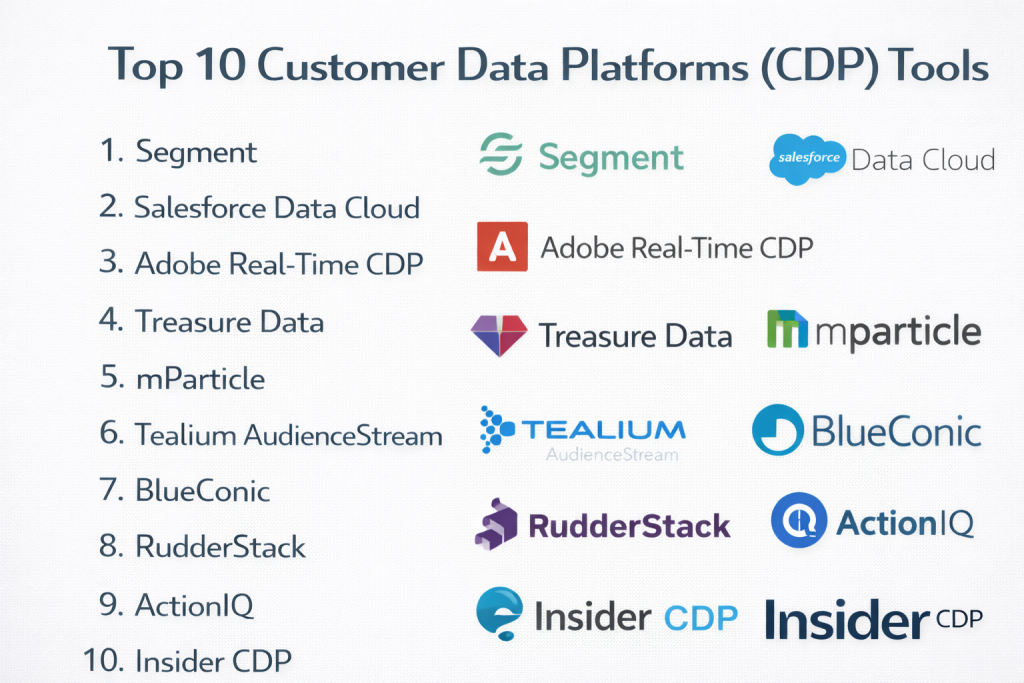
Top 10 Customer Data Platforms (CDP) Tools
#1 — Segment
Short description: A widely used CDP that focuses on collecting, unifying, and routing customer data across tools.
Key Features
- Data collection from multiple sources
- Identity resolution and user profiles
- Data routing to downstream tools
- Real-time event tracking
- API-first architecture
- Data governance controls
Pros
- Strong integration ecosystem
- Developer-friendly
Cons
- Pricing scales quickly
- Requires setup for advanced use
Platforms / Deployment
Web
Cloud
Security & Compliance
- SSO, encryption, access controls
- Additional certifications: Not publicly stated
Integrations & Ecosystem
Extensive integrations across modern stacks.
- CRM tools
- Analytics platforms
- Marketing tools
- APIs
Support & Community
Strong documentation and developer community.
#2 — Salesforce Data Cloud
Short description: A CDP within the Salesforce ecosystem focused on real-time customer data unification and activation.
Key Features
- Real-time data ingestion
- Identity resolution
- Customer profiles
- Journey orchestration
- AI insights
- Deep CRM integration
Pros
- Strong enterprise capabilities
- Native CRM integration
Cons
- Complex setup
- Requires Salesforce ecosystem
Platforms / Deployment
Web
Cloud
Security & Compliance
Not publicly stated
Integrations & Ecosystem
Deep Salesforce ecosystem.
- CRM
- Marketing tools
- APIs
Support & Community
Enterprise-level support.
#3 — Adobe Real-Time CDP
Short description: An enterprise-grade CDP designed for real-time personalization and data activation.
Key Features
- Real-time data processing
- Identity graph
- Audience segmentation
- Omnichannel activation
- AI-driven insights
- Integration with Adobe Experience Cloud
Pros
- Powerful enterprise features
- Real-time capabilities
Cons
- Expensive
- Complex implementation
Platforms / Deployment
Web
Cloud
Security & Compliance
Not publicly stated
Integrations & Ecosystem
Adobe ecosystem integrations.
- Analytics
- Marketing tools
- APIs
Support & Community
Enterprise support.
#4 — Treasure Data
Short description: A CDP focused on data unification, analytics, and customer journey orchestration.
Key Features
- Data ingestion and unification
- Customer segmentation
- Journey orchestration
- AI analytics
- Data governance
- Real-time processing
Pros
- Strong data capabilities
- Scalable platform
Cons
- Learning curve
- Enterprise-focused pricing
Platforms / Deployment
Web
Cloud
Security & Compliance
Not publicly stated
Integrations & Ecosystem
Integrates with enterprise tools.
- CRM
- APIs
- Analytics platforms
Support & Community
Enterprise support.
#5 — mParticle
Short description: A CDP focused on data infrastructure and customer data pipelines.
Key Features
- Data collection and routing
- Identity resolution
- Audience segmentation
- Real-time processing
- Data governance
- API-first design
Pros
- Strong data infrastructure
- Flexible integrations
Cons
- Requires technical expertise
- Complex setup
Platforms / Deployment
Web
Cloud
Security & Compliance
Not publicly stated
Integrations & Ecosystem
Strong integration ecosystem.
- Analytics tools
- APIs
- Marketing platforms
Support & Community
Enterprise support.
#6 — Tealium AudienceStream
Short description: A CDP focused on real-time data collection and audience segmentation.
Key Features
- Real-time data ingestion
- Identity resolution
- Audience segmentation
- Data activation
- Tag management integration
- Event tracking
Pros
- Strong real-time capabilities
- Mature platform
Cons
- Complex setup
- Pricing varies
Platforms / Deployment
Web
Cloud
Security & Compliance
Not publicly stated
Integrations & Ecosystem
Wide integrations.
- Marketing tools
- Analytics
- APIs
Support & Community
Strong enterprise support.
#7 — BlueConic
Short description: A CDP focused on marketing teams for personalization and segmentation.
Key Features
- Unified customer profiles
- Real-time segmentation
- Personalization
- Data activation
- Privacy controls
- Analytics
Pros
- Marketer-friendly
- Easy segmentation
Cons
- Limited developer flexibility
- Smaller ecosystem
Platforms / Deployment
Web
Cloud
Security & Compliance
Not publicly stated
Integrations & Ecosystem
Marketing-focused integrations.
- CRM
- APIs
- Marketing tools
Support & Community
Good documentation.
#8 — RudderStack
Short description: A warehouse-native CDP focused on data pipelines and reverse ETL.
Key Features
- Event tracking
- Data pipelines
- Warehouse integration
- Reverse ETL
- Identity resolution
- Open-source option
Pros
- Warehouse-native architecture
- Developer-friendly
Cons
- Requires data infrastructure
- Setup complexity
Platforms / Deployment
Web
Cloud / Self-hosted
Security & Compliance
Not publicly stated
Integrations & Ecosystem
Strong developer ecosystem.
- Data warehouses
- APIs
- Analytics tools
Support & Community
Growing open-source community.
#9 — ActionIQ
Short description: An enterprise CDP focused on marketing analytics and customer segmentation.
Key Features
- Data unification
- Customer segmentation
- Analytics
- Campaign orchestration
- Data governance
- Reporting
Pros
- Strong analytics capabilities
- Enterprise-ready
Cons
- Complex setup
- High cost
Platforms / Deployment
Web
Cloud
Security & Compliance
Not publicly stated
Integrations & Ecosystem
Enterprise integrations.
- CRM
- APIs
- Marketing tools
Support & Community
Enterprise support.
#10 — Insider CDP
Short description: A CDP integrated into a broader growth and personalization platform.
Key Features
- Customer data unification
- Real-time segmentation
- Personalization
- Journey orchestration
- AI insights
- Cross-channel activation
Pros
- All-in-one platform
- Strong personalization
Cons
- Less flexible as standalone CDP
- Pricing varies
Platforms / Deployment
Web / Mobile
Cloud
Security & Compliance
Not publicly stated
Integrations & Ecosystem
Marketing-focused integrations.
- CRM
- APIs
- Messaging platforms
Support & Community
Enterprise support.
Comparison Table (Top 10)
| Tool Name | Best For | Platform(s) Supported | Deployment | Standout Feature | Public Rating |
|---|---|---|---|---|---|
| Segment | Data pipelines | Web | Cloud | Data routing | N/A |
| Salesforce Data Cloud | CRM integration | Web | Cloud | Real-time profiles | N/A |
| Adobe RT CDP | Enterprise personalization | Web | Cloud | Real-time CDP | N/A |
| Treasure Data | Data orchestration | Web | Cloud | Journey orchestration | N/A |
| mParticle | Data infrastructure | Web | Cloud | API-first CDP | N/A |
| Tealium | Real-time CDP | Web | Cloud | Tag management | N/A |
| BlueConic | Marketing teams | Web | Cloud | Easy segmentation | N/A |
| RudderStack | Warehouse-native | Web | Hybrid | Reverse ETL | N/A |
| ActionIQ | Enterprise analytics | Web | Cloud | Data insights | N/A |
| Insider | Growth teams | Web, Mobile | Cloud | Personalization + CDP | N/A |
Evaluation & Scoring of Customer Data Platforms (CDP)
| Tool Name | Core (25%) | Ease (15%) | Integrations (15%) | Security (10%) | Performance (10%) | Support (10%) | Value (15%) | Weighted Total |
|---|---|---|---|---|---|---|---|---|
| Segment | 9 | 7 | 10 | 8 | 9 | 9 | 7 | 8.6 |
| Salesforce | 10 | 6 | 10 | 8 | 9 | 9 | 6 | 8.5 |
| Adobe | 10 | 6 | 10 | 8 | 9 | 9 | 6 | 8.5 |
| Treasure Data | 9 | 6 | 9 | 7 | 9 | 8 | 7 | 8.1 |
| mParticle | 9 | 6 | 9 | 7 | 9 | 8 | 7 | 8.0 |
| Tealium | 9 | 6 | 9 | 8 | 9 | 8 | 7 | 8.1 |
| BlueConic | 8 | 8 | 7 | 7 | 8 | 8 | 7 | 7.8 |
| RudderStack | 8 | 6 | 9 | 7 | 8 | 7 | 9 | 7.9 |
| ActionIQ | 9 | 6 | 8 | 8 | 9 | 8 | 6 | 8.0 |
| Insider | 8 | 8 | 8 | 7 | 8 | 8 | 7 | 7.9 |
How to interpret scores:
- Higher scores indicate stronger enterprise readiness
- Enterprise CDPs excel in integrations and scalability
- Warehouse-native tools score high in flexibility and value
- Marketer-friendly tools score higher in ease of use
- Choose based on your data architecture and use case
Which Customer Data Platform Is Right for You?
Solo / Freelancer
- Limited need; consider analytics tools instead
SMB
- Best options: BlueConic, Insider
- Focus on ease and quick activation
Mid-Market
- Best options: Segment, RudderStack
- Balance flexibility and scalability
Enterprise
- Best options: Salesforce, Adobe, Treasure Data
- Focus on scale, governance, and AI
Budget vs Premium
- Budget: RudderStack
- Premium: Salesforce, Adobe
Feature Depth vs Ease of Use
- Advanced: Adobe, Salesforce
- Easy: BlueConic
Integrations & Scalability
- Strong integrations: Segment, Salesforce
- Lightweight: Insider
Security & Compliance Needs
- High compliance: Enterprise CDPs
- Basic needs: SMB tools
Frequently Asked Questions (FAQs)
What is a CDP?
A platform that collects and unifies customer data into a single profile.
How is a CDP different from CRM?
CRM stores customer data; CDP unifies and activates data across systems.
Do I need a CDP?
If you have multiple data sources and need personalization, yes.
Are CDPs expensive?
Enterprise CDPs are costly; some SMB options exist.
Can CDPs work in real time?
Yes, many modern CDPs support real-time data processing.
What is identity resolution?
Matching data from different sources to a single user profile.
Can CDPs integrate with analytics tools?
Yes, most CDPs integrate with analytics and marketing platforms.
What are common challenges?
Data quality, integration complexity, and governance.
How long does implementation take?
From weeks to months depending on scale.
Which CDP is best overall?
Depends on your data stack, team, and business needs.
Conclusion
Customer Data Platforms are essential for unifying customer data and enabling personalized, data-driven experiences.