Introduction
Many beginners enter the stock market with excitement but quickly discover that investing is more complicated than choosing a company whose share price appears likely to rise. They hear conflicting advice about value investing, growth stocks, technical analysis, index funds, market timing, diversification, and long-term wealth creation. Social media can make the confusion worse because successful trades are often highlighted while losses, uncertainty, and risk are discussed far less. Reading high-quality investment books can create a more structured foundation. A good book explains why markets behave as they do, how businesses create value, why prices sometimes become disconnected from business fundamentals, and how emotions can damage decision-making. However, simply buying popular books is not enough. Some are written for beginners, others assume accounting knowledge, and some focus on a specific investing philosophy rather than the entire market. The best approach is to build a reading sequence that begins with basic market understanding, moves into business and financial analysis, develops an understanding of valuation and portfolio construction, and finally strengthens investor psychology and risk awareness. This guide examines some of the best books for learning stock market investing while also explaining how to read them practically. It does not treat any author as a source of guaranteed investment results. Instead, the objective is to help beginners build financial literacy, ask better questions, avoid random stock tips, understand investment risk, and gradually develop a decision-making process that can be applied to real companies and portfolios. Readers in India should also remember that many well-known investing books were written using international or US market examples. Their principles may remain useful, but taxation, regulations, brokerage practices, disclosure rules, and financial products can differ between countries. Books therefore work best when combined with current market information, company disclosures, and applicable local regulations.
What is Stock Market Investing Books ?
Stock market investing books are educational resources that explain how shares, businesses, markets, portfolios, valuation, risk, and investor behaviour work. Some books teach the mechanics of investing, while others focus on one particular philosophy.
A beginner may read one book to understand what a stock represents, another to learn how to analyze financial statements, and another to understand why emotions such as fear and greed influence investment decisions.
The important point is that no single book teaches everything.
A useful investing library normally includes several categories:
- Market basics
- Fundamental analysis
- Value investing
- Growth investing
- Index investing
- Portfolio construction
- Risk management
- Behavioural finance
- Investment psychology
- Business quality analysis
For example, suppose a beginner hears that a company’s share price has fallen by 30%. Without proper education, the investor may assume the stock has automatically become cheap.
A good investment book teaches the reader to ask better questions:
- Why has the price fallen?
- Have earnings declined?
- Has debt increased?
- Has the competitive position weakened?
- Is the company still generating cash?
- Is the valuation actually attractive?
The common misunderstanding is that reading investment books provides a list of stocks that will rise. Their real value is different: they teach frameworks for thinking.
Practical takeaway: Use books to improve the quality of your investment decisions, not to search for guaranteed stock recommendations.
Why Learning Stock Market Investing Is Important
Investing affects more than the decision to purchase shares. It influences how people think about savings, inflation, financial goals, business ownership, risk, and long-term wealth management.
Someone who understands investing is more likely to recognize that return and risk are connected. Higher expected returns normally require accepting uncertainty, and even well-researched investments can decline.
Investment education can also improve emotional discipline. A person who has studied market history and investor psychology may be less likely to panic simply because the market experiences a sharp correction.
Knowledge also supports better portfolio planning. Rather than investing all available money in one fashionable company, a knowledgeable investor can consider diversification, asset allocation, financial goals, and liquidity requirements.
Consider a salaried employee who has saved ₹2 lakh. A social-media influencer recommends investing the entire amount in one rapidly rising stock. Without investment knowledge, the employee may focus only on recent returns. After studying basic investing principles, the same person might instead ask about valuation, business quality, risk, diversification, and whether part of the savings needs to remain available for emergencies.
The goal of stock market education is therefore not simply higher returns. It is better financial judgment.
The Real Problem Beginners Face While Learning Investing
The biggest problem facing beginners is rarely a shortage of information. It is an excess of unorganized information.
One person recommends long-term value investing. Another recommends intraday trading. Someone else promotes momentum strategies, options, cryptocurrencies, small-cap stocks, or speculative opportunities.
Without a foundation, beginners struggle to determine which advice is relevant.
Several problems repeatedly appear.
Too much conflicting advice: Different strategies can work under different conditions. Beginners often mix them together without understanding their assumptions.
Unrealistic expectations: Seeing exceptional investment returns online can create the impression that consistently beating the market is easy.
Weak understanding of businesses: Some people buy stocks based only on price charts, recommendations, or recent price movements without understanding what the underlying company does.
Emotional decision-making: Fear causes investors to sell during declines, while greed encourages them to buy after prices have already risen dramatically.
Random learning: Reading advanced valuation material before understanding basic financial statements creates unnecessary confusion.
Dependence on tips: Investors sometimes ask what to buy before learning why they should buy anything.
A structured reading plan solves part of this problem by creating an educational sequence instead of an information overload.
How to Learn Stock Market Investing Through Books Step by Step
Step 1: Learn What a Stock Actually Represents
Begin by understanding that a share represents partial ownership in a business. Learn basic concepts such as stock exchanges, market capitalization, dividends, earnings, and shareholder ownership. This matters because beginners often think of stocks only as moving prices on a screen. When reading, connect every stock symbol with the real company behind it. A common mistake is immediately searching for multibagger opportunities. A better approach is to first understand how businesses earn money and why ownership has value.
Step 2: Understand the Difference Between Investing and Trading
Investing generally focuses on business value and longer holding periods, while trading usually emphasizes shorter-term price movements and specific entry and exit rules. Neither concept should be confused with guaranteed profit. Beginners frequently combine the two—for example, buying a stock as a short-term trade and calling it a long-term investment after the price falls. The better approach is to decide why you are entering a position before committing money.
Step 3: Learn Fundamental Business Analysis
Once the basics are clear, study revenue, profit, cash flow, debt, margins, return on capital, competitive advantages, and management quality. Fundamental analysis helps determine whether an apparently attractive stock represents a healthy business. Beginners often focus on one metric such as the price-to-earnings ratio. Instead, analyze several financial and qualitative factors together.
Step 4: Study Valuation
A good business can still become a poor investment if purchased at an unreasonable price. Valuation teaches investors to compare price with expected business performance, cash flows, assets, and earning power. Beginners sometimes treat every low-priced share as cheap. The better approach is to distinguish between a low share price and an attractive business valuation.
Step 5: Learn Diversification and Portfolio Thinking
Individual stock analysis is only part of investing. You must also decide how much money to place in each investment. Diversification can reduce dependence on a single company, industry, or investment idea. A common mistake is concentrating heavily in the first stock that appears promising. A stronger approach is to consider each investment as one part of an overall portfolio.
Step 6: Study Investor Psychology
Even excellent analysis can become useless if emotions control decisions. Read about fear, greed, overconfidence, confirmation bias, herd behaviour, and loss aversion. Investors frequently sell good companies because prices temporarily fall or chase speculative stocks because everyone appears optimistic. Understanding psychology helps investors create rules before emotions become intense.
Step 7: Apply What You Read Before Increasing Risk
Do not rush from reading one investment book to deploying significant capital. Maintain a watchlist, analyze several companies, write down your investment reasoning, and observe what happens. Compare your original assumptions with actual business results. The common mistake is equating knowledge with experience. A better approach is gradual application, regular review, and continued learning.
Key Factors That Influence Investment Learning
Risk and Return
Every investment involves some form of risk. Books should teach readers to evaluate possible losses before focusing on expected gains. Any resource suggesting that attractive returns can be achieved without meaningful risk should be treated cautiously.
Time Horizon
A person investing for a goal decades away may think differently from someone needing money within a short period. Investment strategies should therefore be understood within the context of time.
Market Volatility
Share prices regularly move. Books that explain volatility help beginners avoid interpreting every decline as permanent loss or every rally as proof of excellent investing ability.
Research Quality
Investment decisions improve when they are based on financial statements, business economics, industry conditions, and credible information rather than rumours.
Diversification
Diversification helps prevent one investment mistake from determining the outcome of an entire portfolio. Books on portfolio construction are therefore important even for stock pickers.
Emotional Control
Markets can produce excitement, anxiety, regret, and overconfidence. Investor psychology is one of the most valuable areas of study because emotions can override good analysis.
Portfolio Review
Investing is not finished after buying a stock. Investors should monitor whether the original business assumptions remain valid.
Long-Term Discipline
Investment knowledge becomes useful only when it influences consistent behaviour. Constantly changing strategy based on recent market performance can damage long-term decision-making.
Detailed Breakdown of the Best Books for Learning Stock Market Investing
There is no universally perfect investment book. Different titles solve different learning problems. The following books are widely regarded as valuable because each teaches a specific aspect of investing.
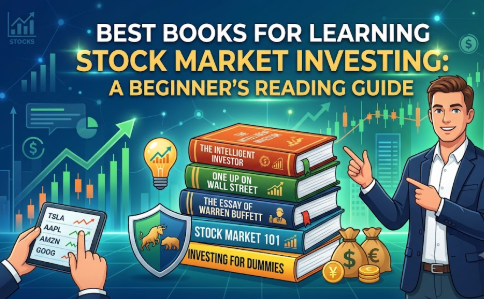
The Intelligent Investor — Benjamin Graham
This book is one of the best-known works on value investing. Its central strength is not a list of stocks but a framework for thinking about investment risk, valuation, discipline, and the difference between investing and speculation.
A particularly important lesson is that market prices can fluctuate much more than underlying business value. Investors should therefore avoid allowing daily market movements to dictate every decision.
For modern beginners, some examples and terminology can feel dated. The better approach is to focus on the underlying principles rather than trying to apply every historical example literally.
Best for: value-investing mindset, margin of safety, emotional discipline.
One Up On Wall Street — Peter Lynch
Peter Lynch explains investing in an accessible way and encourages readers to understand businesses rather than treating the market as an abstract machine.
One useful idea is that ordinary consumers may notice successful products, services, and business trends before they become widely discussed by professional investors. However, noticing a popular company is only the beginning. Research is still necessary.
The common mistake is interpreting “invest in what you know” as permission to buy any familiar brand. The better interpretation is to use familiarity as a starting point for deeper analysis.
Best for: beginner stock research and understanding businesses.
Common Stocks and Uncommon Profits — Philip Fisher
Philip Fisher focuses on identifying high-quality businesses capable of growing over long periods.
The book emphasizes qualitative analysis: management ability, research and development, competitive strength, growth opportunities, profitability, and how companies treat shareholders.
It is useful for investors who want to move beyond simple valuation ratios and understand why some businesses deserve careful long-term attention.
Best for: business quality and growth-oriented investing.
A Random Walk Down Wall Street — Burton G. Malkiel
This book introduces readers to market efficiency, diversification, asset allocation, speculation, bubbles, and the challenges of consistently outperforming broad markets.
It is particularly valuable because it provides a different perspective from stock-picking books.
Reading conflicting investment philosophies is healthy. It prevents beginners from assuming that selecting individual stocks is the only legitimate investing approach.
Best for: market theory, diversification, passive investing concepts.
The Little Book of Common Sense Investing — John C. Bogle
John Bogle makes the case for low-cost, diversified index investing.
The book teaches an important lesson: investment outcomes depend not only on which securities perform well but also on costs, behaviour, diversification, and how consistently an investor follows a sensible plan.
Stock pickers can benefit from reading it even if they ultimately choose individual companies because it provides a benchmark against which active investing should be evaluated.
Best for: index investing and long-term portfolio simplicity.
The Psychology of Money — Morgan Housel
This book focuses less on valuation and more on behaviour.
It explains why financial outcomes are influenced by personal history, expectations, patience, savings habits, risk tolerance, and emotional reactions.
Investors often assume that financial success depends entirely on intelligence. In reality, behaviour can be equally important.
Someone capable of analyzing a company may still make poor decisions if they panic during market declines or become excessively confident after a profitable period.
Best for: investor psychology and financial behaviour.
The Most Important Thing — Howard Marks
Howard Marks discusses risk, market cycles, second-level thinking, valuation, defensive investing, and the difficulty of making superior investment decisions.
The book is particularly useful after beginners have learned basic concepts because it encourages deeper thinking about uncertainty.
Rather than asking only what could go right, investors are encouraged to think carefully about what could go wrong.
Best for: risk awareness and advanced investment thinking.
The Five Rules for Successful Stock Investing — Pat Dorsey
This book provides a practical framework for examining companies, competitive advantages, valuation, and financial performance.
It is useful for readers who understand basic investing but want a more systematic method for analyzing individual businesses.
The important lesson is that company analysis should connect financial numbers with the economic characteristics of the business.
Best for: fundamental analysis and company research.
The Essays of Warren Buffett — Selected and Organized by Lawrence Cunningham
This collection organizes Warren Buffett’s shareholder communications around topics such as corporate governance, investing, mergers, accounting, finance, and business ownership.
Its value comes from understanding how a long-term business owner thinks about capital allocation and corporate quality.
Beginners should not treat Buffett’s investment decisions as a portfolio to copy. The useful part is studying the reasoning framework.
Best for: business ownership mindset and capital allocation.
Security Analysis — Benjamin Graham and David Dodd
This is substantially more advanced than most beginner investing books.
It examines securities, financial statements, valuation, fixed-income investments, and analytical methods in considerable depth.
A beginner does not need to start here. Attempting it too early may create frustration.
The better approach is to study introductory investment and accounting concepts first and return to advanced material later.
Best for: experienced learners seeking deeper security analysis.
Common Mistakes Beginners Make While Reading Investment Books
Reading Without Applying
Finishing many books can create the feeling of progress without improving actual analytical ability.
After each book, apply one or two frameworks to real companies. Examine an annual report, calculate basic ratios, or write a short investment thesis.
Looking for Stock Tips Inside Books
Books are educational tools, not current recommendation services.
A company mentioned positively in an older book may now have completely different fundamentals, management, valuation, or competitive conditions.
Copying Famous Investors Blindly
Warren Buffett, Peter Lynch, Benjamin Graham, and other investors operated under different market conditions, information environments, portfolio sizes, and personal circumstances.
Learn their principles instead of mechanically copying historical investments.
Ignoring Accounting
Business analysis becomes difficult without basic familiarity with financial statements.
Learn how income statements, balance sheets, and cash-flow statements connect.
Reading Only One Investing Philosophy
If you read only value-investing books, every problem may start looking like a valuation problem.
Reading opposing perspectives builds intellectual flexibility.
Ignoring Risk Management
Finding a good company does not automatically tell you how much to invest in it.
Portfolio allocation matters.
Confusing Knowledge With Certainty
Investment research reduces ignorance; it does not eliminate uncertainty.
Future business outcomes can differ from even well-reasoned expectations.
Depending Only on Social Media Summaries
Short summaries can introduce ideas but often remove important context.
Reading the complete reasoning behind an investment framework is more valuable.
Don’t Do This Checklist
- Do not invest solely because a book mentions a company.
- Do not expect any investment method to guarantee profit.
- Do not borrow money merely to test a stock-picking strategy.
- Do not invest emergency funds in volatile shares.
- Do not copy portfolios without understanding the reasoning.
- Do not ignore company financial statements.
- Do not assume a falling stock is automatically undervalued.
- Do not assume a rising stock must be a good business.
- Do not change strategies every few weeks.
- Do not trust anonymous claims of guaranteed returns.
- Do not share brokerage passwords, OTPs, or sensitive financial information.
- Do not ignore tax and regulatory responsibilities.
Practical Real-Life Examples of Learning Stock Market Investing
Example 1: Salaried Beginner
Situation: A salaried employee wants to begin investing after seeing colleagues discuss stocks.
Challenge: He initially plans to buy whichever shares have recently risen the most.
Better action: He first studies market basics, diversification, and company research.
Learning: Investing becomes a planned financial activity rather than a reaction to market excitement.
Example 2: Social-Media Stock Tip
Situation: A beginner receives a message claiming a small company’s stock will rise rapidly.
Challenge: Fear of missing out encourages immediate buying.
Better action: She examines the company’s financial position, valuation, risks, and disclosure history before deciding.
Learning: Research is more reliable than urgency created by anonymous tips.
Example 3: Investor Facing a Market Decline
Situation: An investor sees the portfolio fall significantly during broad market weakness.
Challenge: Panic creates an urge to sell everything.
Better action: The investor reviews whether the underlying business assumptions have changed.
Learning: Price volatility and permanent business deterioration are not always the same.
Example 4: Student Learning Valuation
Situation: A student assumes a ₹40 share is cheaper than a ₹2,000 share.
Challenge: The comparison uses share price instead of business valuation.
Better action: The student learns about market capitalization, earnings, cash flow, and valuation ratios.
Learning: A low share price does not automatically mean an inexpensive investment.
Example 5: Experienced Trader Exploring Investing
Situation: A short-term trader wants to build a long-term portfolio.
Challenge: The trader continues making decisions primarily from short-term price movements.
Better action: He begins studying business economics, management quality, competitive advantages, and valuation.
Learning: Long-term investing requires a different decision framework from short-term trading.
Table 1: Investment Books Compared by Learning Objective
| Book | Best For | Difficulty | Main Learning |
|---|---|---|---|
| The Intelligent Investor | Value investing | Intermediate | Valuation, discipline, margin of safety |
| One Up On Wall Street | Beginner stock research | Beginner | Understanding businesses |
| Common Stocks and Uncommon Profits | Quality investing | Intermediate | Management and business quality |
| A Random Walk Down Wall Street | Market theory | Beginner–Intermediate | Diversification and market efficiency |
| The Little Book of Common Sense Investing | Index investing | Beginner | Low-cost diversified investing |
| The Psychology of Money | Investor behaviour | Beginner | Financial psychology |
| The Most Important Thing | Risk management | Intermediate | Cycles, risk, second-level thinking |
| The Five Rules for Successful Stock Investing | Fundamental research | Intermediate | Company analysis |
| The Essays of Warren Buffett | Business thinking | Intermediate | Capital allocation and ownership |
| Security Analysis | Advanced valuation | Advanced | Detailed security analysis |
Table 2: Suggested Beginner Reading Sequence
| Learning Stage | Reading Focus | Suitable Books | Main Objective |
|---|---|---|---|
| Stage 1 | Behaviour and basics | The Psychology of Money, One Up On Wall Street | Build basic investing awareness |
| Stage 2 | Passive vs active investing | A Random Walk Down Wall Street, Common Sense Investing | Understand portfolio alternatives |
| Stage 3 | Value and quality | The Intelligent Investor, Common Stocks and Uncommon Profits | Learn business and valuation thinking |
| Stage 4 | Fundamental analysis | The Five Rules for Successful Stock Investing | Develop research structure |
| Stage 5 | Risk and judgment | The Most Important Thing | Understand uncertainty and cycles |
| Stage 6 | Deeper study | Buffett Essays, Security Analysis | Develop advanced business analysis |
Tools, Methods, and Frameworks Readers Can Use
Investment Journal
An investment journal records why you are considering or buying a company, your expectations, major risks, valuation assumptions, and conditions that would cause you to reconsider.
It helps reveal whether decisions are based on analysis or emotion.
Stock Watchlist
A watchlist allows beginners to observe businesses without immediately investing.
Track revenue, profit, debt, major developments, valuation, and your reasons for interest.
This reduces the pressure to purchase every company immediately.
Fundamental Analysis Checklist
Create a repeatable checklist covering:
- Business model
- Revenue growth
- Profitability
- Cash flow
- Debt
- Competitive advantages
- Management
- Industry conditions
- Valuation
- Major risks
Using the same framework prevents attractive narratives from replacing analysis.
Portfolio Allocation Rules
Decide in advance how much portfolio exposure you are comfortable placing in one company or sector.
The appropriate allocation varies by investor, but creating limits encourages deliberate risk management.
Annual Report Review
Annual reports help investors understand company strategy, financial statements, risk factors, management commentary, and business performance.
Beginners should gradually become comfortable reading them rather than relying entirely on third-party summaries.
Monthly Learning Review
At the end of each month, ask:
- What did I learn?
- Which assumptions were wrong?
- Which concepts remain unclear?
- Did emotions influence any decisions?
- Am I following my investment process?
Regular reflection converts reading into practical skill.
Expert Tips to Make Better Investment Decisions
1. Read for Frameworks, Not Predictions
A useful book teaches you how to think. Market conditions change, companies change, and valuations change. Extract the decision-making framework instead of treating historical examples as current recommendations.
2. Understand the Business Before the Stock
Before studying charts or price movements, explain in simple words how the company makes money. If the business model is unclear, additional research is necessary.
3. Separate Price From Value
A stock can decline and remain expensive. Another can rise and still offer reasonable value. Learn to compare market price with business economics rather than judging price movement alone.
4. Read Competing Viewpoints
Study both active stock-picking and diversified passive-investing philosophies. Understanding disagreement helps you make a more informed choice about your own strategy.
5. Start With Small Financial Exposure
Education does not remove uncertainty. Beginners can reduce the cost of early mistakes by avoiding unnecessarily large investments while still learning.
6. Keep Emergency Savings Separate
Money needed for rent, healthcare, education, debt payments, or emergencies should not depend on short-term stock-market performance.
7. Write Down Why You Are Investing
Before purchasing a stock, document what you believe about its business quality, valuation, growth, risks, and expected holding period.
Written reasoning makes later evaluation easier.
8. Study Mistakes as Seriously as Successes
A profitable investment can result from luck, while a losing investment can come from a reasonable process affected by an unpredictable event. Review the decision process, not only the outcome.
9. Avoid Information Overload
Reading twenty books simultaneously can create confusion. Finish one, summarize the main principles, apply them, and then move to the next subject.
10. Understand Basic Accounting
You do not need to become an accountant, but investors should understand revenue, expenses, profit, assets, liabilities, cash flow, and shareholder equity.
11. Treat Social Media as a Starting Point
An interesting post may identify a company worth researching, but it should not replace independent analysis.
12. Measure Yourself Against a Sensible Benchmark
If actively selecting stocks requires substantial time and risk but consistently fails to justify the effort, diversified alternatives deserve consideration.
13. Respect Valuation
Even exceptional businesses can become risky when investor expectations are extremely high. Business quality and purchase price should be considered together.
14. Protect Your Investment Accounts
Use strong passwords, secure devices, appropriate authentication, and caution around unsolicited messages requesting financial information.
15. Build Patience Into Your Process
Investment education often produces slow improvements rather than immediate results. Sustainable progress comes from reading, analysis, observation, mistakes, and repeated review.
Case Studies: How Better Understanding Changes Decisions
Case Study 1: From Stock Tips to Business Analysis
Profile: Rahul, a salaried professional beginning stock-market investing.
Situation: Rahul started following several online groups that regularly shared stock recommendations.
Problem: He bought companies without knowing what they did, why they were valued highly, or what risks they faced.
Wrong approach: His decision process was essentially, “Someone sounds confident, so the stock may rise.”
Better approach: Rahul started reading introductory investing books and created a simple fundamental-analysis checklist. Before considering any company, he examined its business model, revenue, profits, debt, cash flow, valuation, and major risks.
Result or learning: He stopped feeling pressure to act on every recommendation and became comfortable saying, “I do not understand this company well enough.”
Key takeaway: Better investing often begins with improving the quality of questions rather than finding more tips.
Case Study 2: Understanding Diversification
Profile: Neha, a young professional building a long-term portfolio.
Situation: Neha became extremely confident in a business operating in a fast-growing industry.
Problem: She considered putting most of her available investment capital into the single company.
Wrong approach: She focused almost entirely on potential return while ignoring the consequences if her analysis was wrong.
Better approach: After studying portfolio construction and investment risk, she began thinking in terms of diversification and position size.
Result or learning: She recognized that even attractive companies can face unexpected competition, regulation, management problems, or industry changes.
Key takeaway: Confidence in an investment thesis should not eliminate risk management.
Case Study 3: Learning to Handle Market Volatility
Profile: Arjun, an investor with several fundamentally researched companies.
Situation: A broad market decline caused many of his holdings to fall.
Problem: He interpreted lower market prices as evidence that every original investment decision had failed.
Wrong approach: His first reaction was to sell simply because his portfolio was showing losses.
Better approach: Investment psychology books encouraged him to separate market price movements from changes in business fundamentals. He reviewed each company individually.
Result or learning: Some investment assumptions remained intact while others required revision. Instead of making one emotional decision for the entire portfolio, he evaluated each holding based on evidence.
Key takeaway: A market decline should trigger review, not automatic panic.
Risk Awareness: What Readers Must Check First
Market Risk
Market risk is the possibility that share prices decline because of economic conditions, investor sentiment, interest rates, geopolitical developments, or broad market weakness.
Risk reduction: Diversify and avoid investing money needed in the near future.
Business Risk
A company can lose customers, face stronger competition, suffer management problems, or experience falling profitability.
Risk reduction: Understand the business and monitor whether the original investment thesis remains valid.
Valuation Risk
An excellent company purchased at an extremely demanding valuation can disappoint if growth falls below investor expectations.
Risk reduction: Consider price and business value together.
Liquidity Risk
Some shares can be difficult to buy or sell at expected prices, particularly in less actively traded securities.
Risk reduction: Understand trading liquidity before building a position.
Emotional Risk
Fear, greed, overconfidence, and herd mentality can lead to poor timing and excessive risk-taking.
Risk reduction: Use written rules, predefined allocation limits, and an investment journal.
Fraud and Misinformation Risk
False recommendations, impersonation scams, pump-and-dump promotions, and misleading investment claims can target beginners.
Risk reduction: Verify information independently and avoid guaranteed-return claims.
Concentration Risk
Holding too much money in one company, industry, or theme increases dependence on a narrow set of outcomes.
Risk reduction: Use diversification appropriate to your goals and risk tolerance.
Tax and Compliance Risk
Investment transactions can have taxation and reporting consequences depending on jurisdiction and transaction type.
Risk reduction: Maintain accurate records and consult qualified professionals when necessary.
Cybersecurity Risk
Compromised brokerage or banking credentials can create serious financial damage.
Risk reduction: Protect passwords, authentication methods, devices, and sensitive information.
Readers should verify current company information, market rules, taxation, brokerage conditions, and regulatory requirements before acting. Books provide education but cannot replace current factual verification or personalized professional advice.
Checklist Before Investing Real Money
Before taking action, check whether you can confidently say:
- I understand what the company does.
- I know why I am considering the investment.
- I have reviewed major financial information.
- I have considered valuation.
- I understand important business risks.
- I have considered how much of my portfolio to allocate.
- I am not investing emergency money.
- I am not acting because of fear of missing out.
- I have independently checked major claims.
- I understand that losses are possible.
- I am not relying on guaranteed-return promises.
- I have considered diversification.
- I understand my investment time horizon.
- I have protected my financial account information.
- I have considered tax or compliance implications.
- I have written down my investment reasoning.
- I know what developments would make me reconsider the investment.
Use this checklist before placing money into an investment rather than after problems appear. Its purpose is not to eliminate risk—something no checklist can do—but to make decisions more deliberate.
Strategic Insights for Better Decision-Making
Position Sizing
Investment analysis answers whether a company may be attractive. Position sizing answers how much risk you should take.
Even a high-conviction investment should be considered within the context of the entire portfolio.
Portfolio Review
Do not review a portfolio simply by checking whether prices are green or red.
Ask whether:
- Business performance matches expectations.
- Debt levels remain manageable.
- Competitive conditions have changed.
- Management behaviour remains acceptable.
- Valuation still makes sense.
- Your original thesis remains valid.
Diversification
Diversification is not simply owning many stocks.
If twenty companies all depend on the same economic factor, the portfolio may still be highly concentrated.
Think about companies, sectors, business models, and underlying risks.
Risk Allocation
Every investment thesis contains uncertainty. Allocate capital according to both expected opportunity and possible downside.
The objective is to remain financially resilient even when some assumptions prove incorrect.
Long-Term Mindset
Long-term investing does not mean permanently holding every stock regardless of evidence.
It means giving sound business theses enough time to develop while remaining willing to change your view when facts change.
Avoiding Herd Mentality
Popular investments often feel psychologically safer because many people agree with them.
Popularity, however, does not guarantee appropriate valuation or future returns.
Independent analysis becomes especially important when market narratives become extremely optimistic or pessimistic.
Investment Discipline
Create rules while calm.
Decide your research requirements, allocation principles, risk limits, review process, and reasons for selling before emotions are intense.
A repeatable process is generally more valuable than constantly searching for a perfect prediction.
Key Stock Market Terms Explained for Beginners
- Stock: A stock represents partial ownership in a company. When you buy shares, you become one of its shareholders.
- Share Price: The share price is the market price at which a stock currently trades. Price alone does not show whether a company is cheap or expensive.
- Market Capitalization: Market capitalization represents the total market value of a company’s outstanding shares and is more informative than comparing share prices alone.
- Fundamental Analysis: Fundamental analysis evaluates a company’s business, financial performance, management, industry, and valuation.
- Valuation: Valuation is the process of estimating what a business or security may reasonably be worth.
- Price-to-Earnings Ratio: The P/E ratio compares a company’s share price with its earnings. It is useful but should not be used in isolation.
- Dividend: A dividend is a distribution that some companies make to shareholders from available profits or reserves according to applicable rules and company policy.
- Diversification: Diversification means spreading investments across multiple holdings or risk sources instead of depending heavily on one outcome.
- Volatility: Volatility describes the degree of price movement in an investment. High volatility means prices can change significantly over relatively short periods.
- Margin of Safety: Margin of safety refers to buying with a reasonable gap between estimated value and market price to help account for uncertainty in analysis.
- Portfolio: A portfolio is the collection of investments owned by an investor.
- Risk Tolerance: Risk tolerance describes how much uncertainty and potential loss an investor is financially and emotionally prepared to accept.
- Bull Market: A bull market generally refers to an extended period of broadly rising asset prices and investor optimism.
- Bear Market: A bear market generally refers to a significant and sustained period of declining market prices.
- Asset Allocation: Asset allocation is the process of deciding how money is distributed among different asset classes according to goals, time horizon, and risk considerations.
Who Should Read This Blog
Beginners
People with little or no investment knowledge can use the reading sequence to avoid jumping directly into advanced material.
Students
Students interested in finance, economics, business, or personal investing can develop a stronger theoretical foundation before taking significant financial risks.
Salaried Employees
Working professionals can use investment books to understand how equities may fit into broader savings and financial planning.
Small Business Owners
Business owners may find investment books especially valuable because many concepts—cash flow, capital allocation, competitive advantage, debt, and return on capital—also apply to operating businesses.
New Investors
Anyone already buying shares but lacking a structured process can use these books to improve research and portfolio discipline.
Traders
Short-term traders interested in long-term investing can learn how business analysis differs from price-based trading decisions.
Loan Seekers
Although this guide is not primarily about borrowing, anyone with significant debt should understand that investing borrowed money can increase financial risk. Investment education can reinforce the importance of separating debt obligations from speculative decisions.
Crypto Learners
Readers familiar with crypto markets may benefit from studying traditional investing concepts such as valuation, diversification, risk, and behavioural finance.
Finance Bloggers and Content Creators
Writers covering financial subjects can improve educational accuracy by understanding established investing frameworks rather than repeating popular market narratives.
People Improving Financial Awareness
You do not need to become an active stock picker to benefit from investment education. Understanding risk, compounding, diversification, businesses, and market behaviour can improve broader financial decision-making.
Frequently Asked Questions
1. What are the best books for learning stock market investing?
Useful starting points include One Up On Wall Street, The Psychology of Money, The Intelligent Investor, A Random Walk Down Wall Street, and The Little Book of Common Sense Investing. The right choice depends on whether you want to learn business analysis, index investing, valuation, risk, or investor psychology.
2. Which stock market book should a complete beginner read first?
A complete beginner may find The Psychology of Money and One Up On Wall Street easier starting points than highly technical valuation books. After learning basic market concepts, the reader can move into fundamental analysis and value-investing material.
3. Is The Intelligent Investor suitable for beginners?
Yes, but some parts can feel dense or dated to a new reader. Beginners should focus on the principles of investment versus speculation, market behaviour, valuation discipline, and margin of safety rather than trying to apply every historical example directly.
4. Can investment books teach me which stocks to buy?
Books can teach analytical methods but should not be treated as sources of current stock recommendations. Companies, valuations, industries, regulations, and market conditions change. Current decisions require current research.
5. How many investing books should a beginner read?
There is no required number. Reading five books carefully and applying their ideas may be more useful than quickly finishing fifty. Focus on covering market basics, business analysis, valuation, portfolio management, and psychology.
6. Are old stock market books still useful?
Many older books contain principles about business ownership, valuation, investor psychology, and risk that remain educational. However, historical examples, regulations, taxes, products, and market structures should be checked against current conditions.
7. What are the best books for learning stock market investing through fundamental analysis?
Books such as The Five Rules for Successful Stock Investing, Common Stocks and Uncommon Profits, and eventually Security Analysis can help readers develop deeper fundamental-analysis skills. Beginners should understand basic accounting first.
8. Should beginners learn investing or trading first?
Someone primarily interested in building long-term financial assets may benefit from learning investing first. Trading requires a different framework involving shorter-term decisions, risk controls, execution, and market behaviour. Neither approach guarantees profit.
9. Can I learn stock investing without a finance degree?
Yes. Many investment concepts can be learned gradually through books, financial statements, company reports, and practice. However, understanding basic accounting and financial terminology significantly improves investment analysis.
10. How should I practice after reading investing books?
Choose several companies for a watchlist, study their businesses and financial statements, write investment theses, estimate major risks, and track how your assumptions develop. You do not need to invest significant money simply to practice analysis.
11. What is the biggest mistake beginners make after reading investment books?
One major mistake is becoming overconfident after learning a few concepts. Understanding terminology does not eliminate market uncertainty. Position sizing, diversification, risk management, and continuous learning remain necessary.
12. Are the best books for learning stock market investing enough to become a successful investor?
Books can create a strong foundation, but investing also requires practical experience, current research, emotional discipline, risk management, and ongoing learning. No book or strategy can guarantee successful investment results.
Conclusion and Next Steps
The best books for learning stock market investing are valuable not because they reveal a hidden formula for identifying stocks that will always rise, but because they help investors develop better judgment. A beginner who studies how businesses work, how financial statements connect, why valuation matters, how portfolios manage risk, and how emotions influence decisions is far better prepared than someone acting solely on tips or recent market movements. Start with accessible books that explain business ownership and investor psychology. Then learn the differences between active stock selection and diversified passive investing. As your understanding grows, move toward fundamental analysis, valuation, competitive advantages, portfolio construction, and advanced risk thinking. Most importantly, apply what you learn. Maintain a stock watchlist, read company disclosures, write down investment theses, compare assumptions with actual results, and review mistakes without allowing either losses or profits to distort your judgment. Remember that even excellent books reflect particular philosophies, historical market environments, and sometimes specific national regulatory systems. They should therefore be combined with current company information, applicable regulations, taxation awareness, and your personal financial circumstances. Investing always involves uncertainty, and careful research cannot guarantee positive outcomes. Keep emergency savings separate, avoid investing under social pressure, reject promises of guaranteed returns, diversify thoughtfully, and consider qualified professional guidance when your financial situation requires personalized advice. The most useful next step is simple: choose one beginner-friendly investment book, read it slowly, summarize the key principles in your own words, and apply those principles to a few companies without feeling pressure to immediately invest. Once the ideas become practical rather than theoretical, move to the next subject. Over time, this disciplined learning process can help transform stock-market investing from a collection of tips and predictions into a structured approach based on businesses, valuation, risk, evidence, and long-term financial thinking.