Introduction
The stability of digital systems is seen as the backbone of modern business. When a system is designed, the focus must be placed on its ability to remain functional under heavy pressure. A Certified Site Reliability Architect is the specialist responsible for creating these resilient structures. In this comprehensive guide, the path to becoming a leader in system reliability is explored. The importance of the certification, the necessary learning steps, and the long-term career impacts are discussed for engineers and technical managers worldwide.
What is Certified Site Reliability Architect
The Certified Site Reliability Architect is defined as a high-level expert who builds and manages the architecture of reliable systems. It is not just about keeping a website running; it is about designing a system that can recover from errors automatically. Engineering practices are used to solve operational challenges, making the entire infrastructure more predictable. This role is considered a bridge between software development and stable system operations, ensuring that growth does not lead to frequent failures.
Why it matters today
In the current global market, even a few seconds of downtime can result in the loss of millions of dollars and customer trust. As more services are moved to the cloud, the complexity of managing these systems increases significantly. A Certified Site Reliability Architect is required to manage this complexity by building self-healing and scalable platforms. Reliability is no longer seen as an afterthought; it is treated as a core feature of every successful digital product.
Why Certified Site Reliability Architect certifications are important
Professional credibility is established through the achievement of a recognized certification. For an individual, it provides a structured way to master the latest industry standards and tools. Global organizations use these certifications to identify talent that can handle high-stakes technical environments. A Certified Site Reliability Architect credential proves that a professional has been tested against real-world scenarios. Career growth is often accelerated, and higher trust is placed in certified individuals during large-scale project planning.
Why choose SRESchool?
A specialized focus on the SRE domain is provided by SRESchool. While many institutions offer general technology courses, this school is dedicated to the science of reliability and architecture. The learning materials are designed by industry experts who have managed massive infrastructures. Practical, hands-on experience is prioritized to ensure that students can apply their knowledge immediately. A global community of reliability professionals is accessible to everyone who chooses this path.
Certification Deep-Dive for Certified Site Reliability Architect
What is this certification?
The Certified Site Reliability Architect is an advanced credential that validates the skills needed to design and oversee stable, scalable digital systems. It focuses on the architectural level of Site Reliability Engineering.
Who should take this certification?
This certification is intended for senior software engineers, system administrators, and cloud architects. It is also highly beneficial for engineering managers who oversee the technical health of large platforms.
Certification Overview Table
| Track | Level | Who it’s for | Prerequisites | Skills Covered | Recommended Order |
| SRE | Architect | Senior Engineers | Basic IT Knowledge | System Design, Resilience | 1 |
| DevOps | Expert | Pipeline Leads | CI/CD Basics | Automation, Delivery | 2 |
| DevSecOps | Specialist | Security Engineers | Security Basics | Automated Defense | 3 |
| AIOps/MLOps | Advanced | Data Scientists | AI Fundas | Model Reliability | 4 |
| DataOps | Specialist | Data Engineers | Database Basics | Data Flow Quality | 5 |
| FinOps | Practitioner | Tech Managers | Cloud Billing | Cost Management | 6 |
Skills you will gain
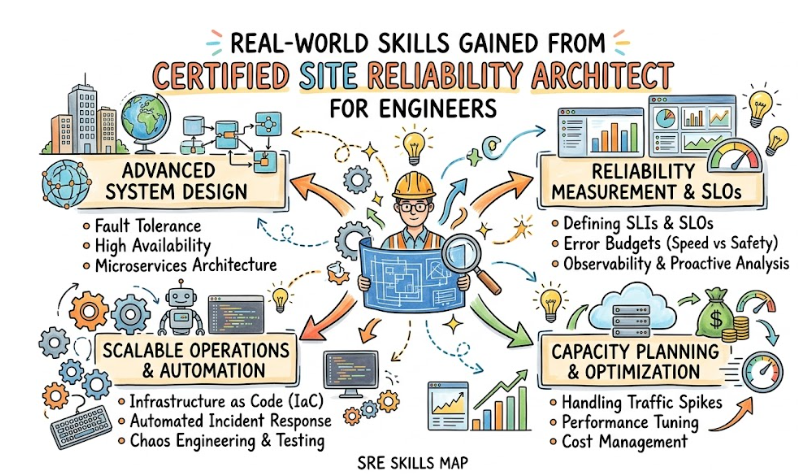
- The ability to design distributed systems with high resilience is gained.
- Mastery over automation tools for infrastructure management is achieved.
- Skills in defining and monitoring Service Level Objectives (SLOs) are developed.
- Knowledge of chaos engineering and resilience testing is acquired.
- Expertise in managing large-scale incident response is built.
- The capacity to balance new feature releases with system stability is refined.
Real-world projects you should be able to do after this certification
- A multi-region failover system for a global application is designed.
- An automated observability dashboard for microservices is implemented.
- A disaster recovery strategy for a mission-critical database is built.
- A capacity planning report for a fast-growing cloud platform is generated.
- A self-healing automation script for common system errors is created.
Preparation plan
7–14 days plan
The core concepts of SRE and architectural patterns are reviewed. The official exam guide is used to identify key study areas. Practice questions are solved to understand the testing format.
30 days plan
In-depth study sessions for each module are conducted. Hands-on labs are used to practice system design scenarios. Weak areas are targeted with additional reading and revision.
60 days plan
Extensive mock exams are taken to build confidence and speed. Real-world case studies are analyzed to learn from industry-standard designs. A final review of the entire syllabus is completed before the exam date.
Common mistakes to avoid
- Practical design principles are ignored in favor of only learning specific tools.
- The importance of the “human” and “cultural” side of SRE is underestimated.
- Monitoring is confused with deep system observability.
- Automation is applied to processes that are fundamentally broken.
Best next certification after this
- Same track: Advanced SRE Specialist.
- Cross-track: Certified DevSecOps Architect.
- Leadership / management: Strategic Engineering Leadership.
Choose Your Learning Path
DevOps Path
This path is best for those who want to automate the software delivery lifecycle. It is suitable for developers who want to take responsibility for how their code is deployed and managed.
DevSecOps Path
This path is chosen by professionals who wish to make security an automated part of the pipeline. It is ideal for those who want to ensure that code is safe and compliant before it reaches production.
Site Reliability Engineering (SRE) Path
This path is designed for engineers who focus on the operational excellence of a system. It is the core path for those aiming to become a Certified Site Reliability Architect.
AIOps / MLOps Path
This path is intended for those working with machine learning and artificial intelligence. It focuses on using data to predict and prevent system failures automatically.
DataOps Path
This path is for individuals who manage the flow of data within an organization. It ensures that data pipelines are reliable, fast, and high-quality.
FinOps Path
This path is chosen by those who want to manage cloud spending. Financial accountability is brought to technical teams to ensure cloud resources are used efficiently.
Role Recommended Certifications Mapping
| Role | Recommended Certification | Key Career Benefit |
| DevOps Engineer | Certified Site Reliability Architect | Move to high-level design roles |
| SRE | Advanced SRE Professional | Master deep technical systems |
| Platform Engineer | Certified Kubernetes Expert | Improve cluster management |
| Cloud Engineer | Multi-Cloud Architect | Handle diverse cloud environments |
| Security Engineer | Certified DevSecOps Specialist | Secure the entire pipeline |
| Data Engineer | Certified DataOps Professional | Streamline data delivery |
| FinOps Practitioner | Cloud Financial Manager | Optimize global cloud spend |
| Engineering Manager | SRE Leadership Professional | Lead high-performing teams |
Next Certifications to Take
One same-track certification
The Advanced SRE Specialist certification is suggested as a next step. This program allows for a deeper exploration of complex system tuning and advanced troubleshooting. It is a natural progression for anyone who has mastered the architect level.
One cross-track certification
The Certified DevSecOps Architect is highly recommended. By combining reliability skills with advanced security knowledge, a professional becomes much more versatile. This dual expertise is extremely valuable for modern, safety-conscious organizations.
One leadership-focused certification
The Technical Leadership Professional credential is offered for those aiming for management roles. The skills needed to lead large teams and make strategic technical decisions are taught. It is the best way to transition into a Director or CTO role.
Training & Certification Support Institutions
DevOpsSchool
Extensive training for a wide range of DevOps and SRE tools is provided here. Practical labs and real-world projects are used to prepare students for the industry. Support is offered for various certification paths.
Cotocus
Professional training and consulting services are delivered by this institution. A focus is maintained on current industry trends and high-level architectural design. Experienced instructors provide guidance throughout the learning journey.
ScmGalaxy
A large community of software professionals is supported through this platform. Information regarding configuration management and reliability is shared through blogs and guides. Training for multiple technical tracks is available.
BestDevOps
Simplified learning paths for complex technical subjects are offered at this school. The goal is to make advanced certifications accessible to a wider audience. Career guidance is a key part of their service.
devsecopsschool.com
The core focus is placed on the integration of security into the development process. Students are taught how to automate security checks and maintain safe pipelines. It is a leading source for DevSecOps education.
sreschool.com
This is the primary institution dedicated to Site Reliability Engineering. Every level of the SRE career path, from foundation to architect, is covered. It is the official provider for the Certified Site Reliability Architect credential.
aiopsschool.com
Training on the application of artificial intelligence in IT operations is provided here. The skills needed to build intelligent and self-monitoring systems are taught. It is suitable for forward-thinking engineers.
dataopsschool.com
The efficient management and delivery of data are the main subjects at this school. Students are taught how to build and maintain reliable data pipelines using automated practices.
finopsschool.com
Financial management and cost optimization in the cloud are taught at this institution. It is a vital resource for anyone responsible for managing cloud budgets and resource efficiency.
FAQs Section
- How is technical debt managed during this course?
The identification and mitigation of technical debt are treated as core architectural responsibilities. - What is the impact on release frequency?
A properly designed reliability framework allows for faster releases by reducing the fear of failure. - Is there a focus on cost versus reliability?
The program teaches how to balance high availability with cost-effective cloud design. - How does it help with legacy systems?
Architectural patterns for modernizing and stabilizing older infrastructures are covered. - Is the certification recognized by startups?
Yes, startups value the ability to scale reliably just as much as large enterprises do. - What is the pass rate for the exam?
The exam is challenging, but with proper preparation at SRESchool, most candidates are successful. - Are there renewal fees for the certification?
Standard renewal fees may apply after the three-year validity period ends. - How is the lab environment accessed?
Students are provided with secure online access to dedicated cloud labs for all practical exercises. - Does it cover cloud-native patterns?
Yes, the architecture of modern containerized and serverless applications is a major focus. - Can a developer with no ops experience take this?
It is recommended that candidates have a basic understanding of operations before attempting the architect level. - How does it compare to a general cloud architect cert?
This certification is specifically focused on the discipline of reliability and SRE, rather than general cloud features. - Is mentorship provided?
Yes, expert guidance is available to students throughout their learning journey at SRESchool.
Additional FAQs for Certified Site Reliability Architect
- Is coding a major part of the exam?
The logic of automation and system design is tested rather than writing complex code from scratch. - Does this certification focus on a specific cloud?
No, the principles are cloud-agnostic and can be applied to AWS, Azure, or Google Cloud. - What is the main focus of the architect level?
High-level design, resilience strategy, and balancing stability with speed are the main focus areas. - Are there group discounts for teams?
Many institutions offer special rates for corporate groups and technical teams. - How quickly are certificates issued?
Digital certificates are usually issued within a few business days of passing the exam. - Is chaos engineering covered in this course?
Yes, the concepts of resilience testing and chaos engineering are part of the curriculum. - Can a manager take this certification?
Yes, it is very beneficial for managers who need to understand technical architecture to make better decisions. - Is there a community for certified architects?
Access to a global network of reliability professionals is provided to all certified individuals.
Testimonials
Anshul
A complete change in professional perspective was experienced through this program. The difference between simple operations and true reliability architecture was understood. Career growth has been very fast since then.
Riya
The focus on real-world projects was very helpful. The concepts of error budgets and SLOs are now being applied in my daily work. I feel much more confident as a technical lead.
Manish
The depth of the study material was very impressive. Complex topics were explained in a simple and clear manner. This certification has given me a competitive edge in the job market.
Sneha
New skills in system design and automation were acquired. The support from the instructors was excellent throughout the preparation. I highly recommend this to every senior engineer.
Vivek
The transition from a senior developer to a reliability architect was made easy by this course. A clear roadmap for the future was provided. I am now leading major infrastructure projects.
Conclusion
The Certified Site Reliability Architect certification is a vital milestone for any software professional. A deep understanding of system resilience and architectural planning is gained. Long-term career benefits include higher salaries and the ability to lead complex technical initiatives. Strategic learning and careful planning are encouraged for everyone in the industry. By choosing a dedicated institution like SRESchool, a successful and stable career in technology is ensured.