Introduction
Imagine buying a house and renting it out. Every month, the tenant sends you rent money. You own the property, but the cash keeps flowing in with very little extra effort on your part.
Investing in the stock market can work the exact same way. Instead of buying real estate, you buy shares of stable, profitable companies. While many people think of stocks only as assets to buy low and sell high, a different group of investors focuses on collecting regular cash payments.
Yet, for many beginners, the stock market feels confusing. Words like “yield,” “payout ratios,” and “preferred shares” can sound like a foreign language. Poor understanding often leads to chasing high-risk stocks that promise huge payouts but crash soon after.
This guide will explain how to build a steady stream of passive income from stocks using simple words, clear examples, and smart risk management.
What Is Passive Income From Stocks?
Passive income from stocks is money you earn from your stock investments that requires little to no ongoing effort to maintain.
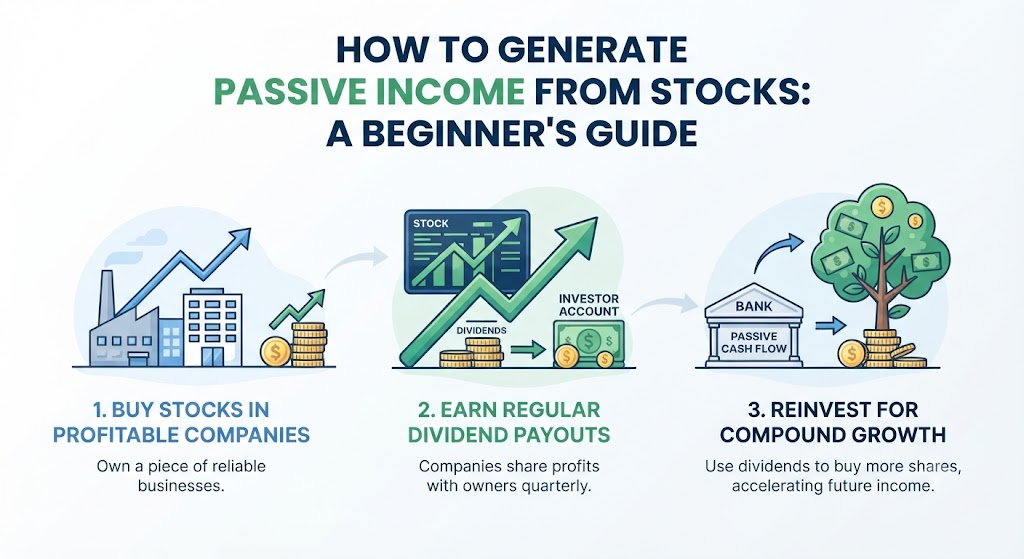
When you buy a stock, you become a part-owner of that company. If the company makes a profit, it can choose to do two things: keep the money to grow the business, or share a portion of those profits directly with its owners. The money shared with owners is called a dividend.
Why Does It Matter?
Relying entirely on a single paycheck is risky. If your job changes, your income stops. Passive income creates an alternate financial stream. It works for you even while you sleep, travel, or focus on other things.
Example
Suppose you buy shares in an established electric utility company. Because millions of people pay their electricity bills every month, the utility makes steady profits. Four times a year, the company sends a portion of those profits directly to your brokerage account as cash. You did not work for that money; your invested capital did.
How Dividend Stocks Work
To earn passive income from stocks, you generally look for dividend-paying stocks. Understanding the basic lifecycle of a dividend helps clarify how the process works.
- Company Profitability: A healthy, stable business generates consistent net earnings.
- Board Decision: The company’s board of directors decides to distribute a portion of those earnings to shareholders.
- Declaration Date: The company announces how much money it will pay per share and sets key dates.
- Ex-Dividend Date: This is a crucial cutoff. To receive the upcoming dividend, you must own the stock before this date. If you buy it on or after this date, the previous owner gets that round of cash.
- Payment Date: The cash lands directly in your brokerage account.
Why Do Some Companies Pay Dividends and Others Do Not?
Young, fast-growing technology companies rarely pay dividends. They prefer to reinvest every penny back into research, marketing, and expansion to grow faster. Mature, stable companies—like consumer goods makers, banks, and utility providers—often have fewer massive growth opportunities. Instead, they attract investors by sharing their steady profits.
Important Factors to Understand
Before you invest your hard-earned money, you need to understand a few core metrics that determine whether a dividend stock is safe and profitable.
1. Dividend Yield
The dividend yield tells you how much cash flow you are getting relative to the stock’s current price. It is expressed as a percentage.
- Simple Meaning: Annual cash payout divided by the stock price.
- Why It Matters: It helps you compare the income-generating power of different stocks.
- Example: If a stock trades at $100 and pays $4 a year in dividends, its dividend yield is 4%.
2. Payout Ratio
The payout ratio shows the percentage of a company’s earnings that is paid out as dividends.
- Simple Meaning: How much profit goes to shareholders versus how much stays in the business.
- Why It Matters: A very high payout ratio (like 90% or more) means the company is paying out almost all its earnings. If business slows down even a little, they might have to cut the dividend. A healthy ratio is typically between 40% and 60%.
3. Dividend Growth Rate
This measures how fast a company increases its dividend payment over time.
- Simple Meaning: Are your cash payments getting bigger each year?
- Why It Matters: Inflation causes everyday goods to become more expensive. If your dividend payments stay flat, your purchasing power drops. Companies that raise their dividends consistently help protect you against inflation.
Detailed Explanation: Different Ways to Earn Passive Income
Not all income-generating investments are standard company stocks. Here are the primary vehicles investors use.
Dividend Aristocrats and Kings
These are elite companies that have increased their dividend payouts every single year for 25 consecutive years (Aristocrats) or 50 years (Kings). They tend to be large, stable businesses with strong brands and reliable customer demand.
- Use Case: Conservative investors looking for long-term safety and predictable income.
Real Estate Investment Trusts (REITs)
A REIT is a company that owns, operates, or finances income-producing real estate—such as apartment buildings, shopping malls, warehouses, or office towers.
- How It Works: By law, REITs must distribute at least 90% of their taxable income to shareholders in the form of dividends. This often results in higher-than-average dividend yields.
- Limitation: REIT dividends are often taxed at ordinary income rates rather than lower capital gains tax rates in many jurisdictions.
Exchange-Traded Funds (ETFs)
Instead of buying individual stocks, a dividend ETF buys a basket of dozens or hundreds of different dividend-paying companies.
- Why It Matters: Diversification spreads your money across many businesses. If one company runs into trouble and cuts its dividend, the other companies help cushion the blow.
Practical Examples
Let us look at how a real-world investor might approach this.
Scenario: Building a Cash Flow Portfolio
Meet Sarah, a 30-year-old professional. She wants to build a portfolio that will eventually pay for her annual vacation using purely passive income.
- Setting a Goal: Sarah wants to generate $2,000 a year in passive dividend income.
- Choosing Assets: She decides against buying single speculative stocks. Instead, she chooses a broad dividend growth ETF with an average dividend yield of 3.5%.
- Doing the Math: To make $2,000 a year at a 3.5% yield, she needs an investment portfolio worth approximately $57,142 ($\$2,000 \div 0.035$).
- Execution: Sarah invests a fixed amount of money every month. She turns on dividend reinvestment (DRIP), meaning her dividend cash automatically buys more shares of the ETF instead of sitting idle. Her share count compounds over time, accelerating her path to her goal.
Common Mistakes Beginners Should Make
1. Chasing Unusually High Yields
- What People Do: Look for stocks paying 10%, 12%, or 15% dividends.
- Why It Happens: High numbers look exciting and promise fast returns.
- Why It Causes Problems: In the stock world, an ultra-high yield is often a warning sign. It usually means the stock price has plummeted because the company is struggling, and a dividend cut is right around the corner.
- What to Do Instead: Stick to moderate, sustainable yields (typically 2% to 5%) backed by financially healthy, profitable businesses.
2. Ignoring Diversification
- What People Do: Put all their money into two or three high-profile dividend stocks from the same industry (like banking).
- Why It Happens: Familiarity bias makes people invest only in brands they know.
- Why It Causes Problems: If an economic downturn hits the banking sector, all your investments take a simultaneous hit, and multiple dividends could be slashed at once.
- What to Do Instead: Spread your money across different sectors like healthcare, utilities, consumer goods, and technology.
3. Forgetting About Taxes and Fees
- What People Do: Calculate gross dividend income without factoring in brokerage fees or taxes.
- Why It Causes Problems: Taxes can significantly reduce your take-home cash flow.
- What to Do Instead: Understand the tax laws in your region regarding dividend income and use tax-advantaged accounts where available.
Risks and Limitations
While passive income from stocks is powerful, it is not risk-free.
- Market Volatility: Stock prices fluctuate daily. Even if a company pays steady dividends, the overall value of your portfolio can drop during a market crash.
- Dividend Cuts: Unlike bank interest, dividends are never guaranteed. If a company faces a financial crisis, the board can reduce or eliminate the dividend overnight.
- Inflation Risk: If your dividend payouts remain flat while the cost of living rises, your purchasing power slowly declines.
Decision-Making Framework
Use this simple step-by-step framework to decide how to start generating passive income from stocks:
- Assess Your Timeline: Are you looking for income today to live on, or are you growing wealth for the future? (If growing, use dividend reinvestment).
- Determine Risk Tolerance: Can you handle seeing your portfolio value drop by 20% during a bad market year in exchange for long-term income?
- Choose Your Investment Vehicle: Decide whether you want the simplicity of diversified ETFs or the hands-on control of picking individual stocks.
- Check the Fundamentals: Review the payout ratios, debt levels, and earnings history of your chosen investments.
- Automate and Monitor: Set up regular contributions and review your portfolio performance once or twice a year—avoid checking it every day.
Checklist Before You Invest
- Have I defined my primary financial goal (growth vs. immediate income)?
- Am I diversified across at least 4 to 5 different economic sectors?
- Have I checked the dividend payout ratio to ensure the payment is sustainable?
- Am I avoiding stocks with unsustainably high yields (>8%) without proper research?
- Have I set up an automated investing routine to remain consistent?
- Am I prepared to hold investments through normal market ups and downs?
Key Terms
- Asset Allocation: Spreading your investments across different categories, such as stocks, bonds, and cash, to manage risk.
- Brokerage Account: An investment account used to buy and sell stocks, ETFs, and other financial assets.
- Compound Interest / Growth: The process where your investment earnings generate their own earnings over time, speeding up wealth accumulation.
- Dividend: A cash payment made by a corporation to its shareholders out of its profits.
- Ex-Dividend Date: The deadline by which you must own a stock to qualify for its upcoming dividend payment.
- Payout Ratio: The proportion of earnings paid out as dividends to shareholders, expressed as a percentage.
- Portfolio: A collection of all your financial investments held across different accounts.
- REIT (Real Estate Investment Trust): A company that owns and operates income-producing real estate and distributes most of its profits to shareholders.
- Yield: The income return on an investment, calculated as annual dividends divided by the current stock price.
FAQs
1. How much money do I need to start earning passive income from stocks?
You can start with very small amounts. Many modern brokerage platforms allow fractional share trading, meaning you can buy a piece of an expensive stock or ETF for as little as $5 or $10.
2. Are stock dividends guaranteed?
No. Unlike a bank certificate of deposit (CD) or government bond, companies are never legally required to pay dividends. A board of directors can reduce or cancel a dividend at any time if business conditions worsen.
3. Should I take the cash payout or reinvest my dividends?
If you are still working and building your wealth, turning on dividend reinvestment (DRIP) is usually best. It automatically buys more shares for you without trading fees, helping your portfolio grow much faster through compounding.
4. How often are dividends paid?
Most U.S. companies pay dividends on a quarterly (every three months) basis. However, some companies pay monthly, and others pay semi-annually or annually.
5. Do I have to pay taxes on dividend income?
Yes. In most countries, dividends are treated as taxable income. The exact tax rate depends on your total income bracket and whether the dividends are classified as “qualified” or “ordinary.”
6. What is the difference between growth stocks and dividend stocks?
Growth stocks (like many tech startups) rarely pay dividends because they reinvest profits to expand rapidly. Dividend stocks are usually mature companies that return a portion of their steady earnings to shareholders as cash.
7. Can I live entirely off dividend income?
Yes, many people do, but it requires a substantial initial investment portfolio. For example, generating $40,000 a year in passive income from a portfolio yielding 4% requires a total investment capital of $1,000,000.
8. Is investing in dividend stocks risky?
Yes, all stock market investing carries risk. While dividend-paying companies tend to be more established and financially stable than non-paying startups, their stock prices can still drop during market recessions.
Conclusion
Generating passive income from stocks is not a get-rich-quick scheme. It is a slow, steady process of buying ownership in reliable, profitable businesses that share their success with you.
By focusing on sustainable dividend yields, keeping your portfolio diversified, and letting compounding work its magic over years, you can turn the stock market into a reliable engine for long-term financial independence. Start small, stay consistent, and let time do the heavy lifting.