Introduction
Investing can feel a bit like cooking a meal. If you put too much salt into a single dish, the whole meal is ruined. Similarly, if you put all your savings into just one company or one type of investment, a single bad turn in the market can wipe out your financial progress.
Many beginners jump into investing by buying whatever stock is popular on the news. They rarely think about how different investments work together. This often leads to panic selling when the market drops, or missing out on stable long-term growth.
Understanding portfolio allocation strategies changes this approach. Instead of guessing, you build a structured financial plan. This guide will walk you through what portfolio allocation means, how different strategies work, common mistakes to avoid, and how to set up a portfolio that fits your personal goals.
What Is Portfolio Allocation?
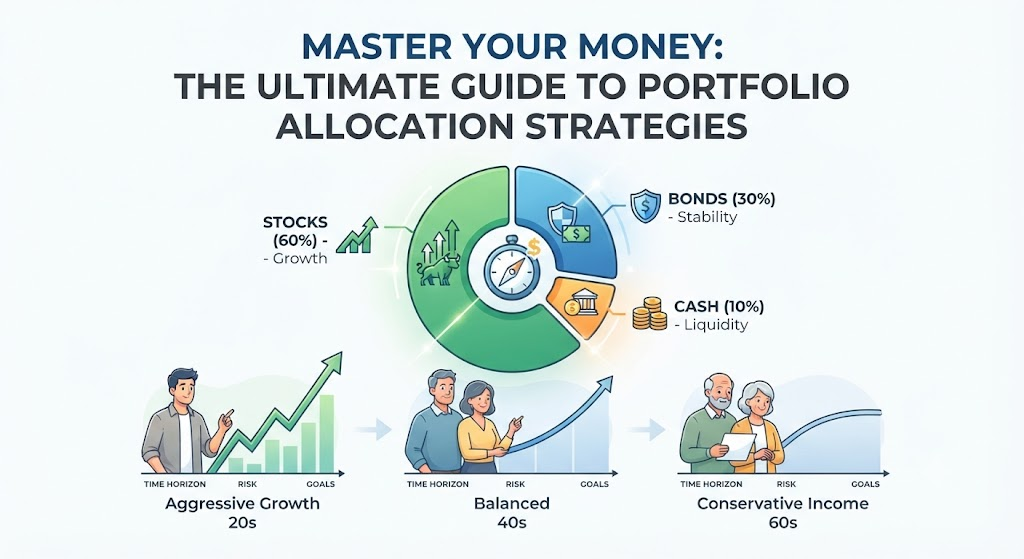
Portfolio allocation means dividing your investment capital across various asset classes. An asset class is a group of similar types of investments. The three main pillars of traditional investing are:
- Stocks (Equities): Shares of ownership in companies. They offer high growth potential but come with high price swings.
- Bonds (Fixed Income): Loans you give to governments or corporations. They pay regular interest and are generally safer than stocks.
- Cash and Cash Equivalents: Safe, liquid assets like savings accounts or short-term certificates of deposit that protect your principal money.
Why Does It Matter?
Different asset classes react differently to economic events. When stocks go down, bonds sometimes go up. By mixing them, you smooth out the wild ups and downs of the market. This makes your financial journey much easier to manage emotionally and financially.
How Portfolio Allocation Works
Allocation is not a one-time choice; it is an ongoing system. It works by setting target percentages for each asset class based on your personal timeline and risk tolerance.
For example, a balanced investor might choose a 60/40 portfolio. This means 60% of their money goes into stocks for growth, and 40% goes into bonds for stability.
Over time, your investments will grow at different rates. If stocks perform exceptionally well, your 60% stock allocation might grow to represent 75% of your total portfolio. At this point, your portfolio becomes riskier than you originally planned. To fix this, you practice rebalancing, which means selling some of your winning stocks and buying bonds to bring your portfolio back to your target 60/40 split.
Core Portfolio Allocation Strategies
Different investors have different needs. Here are the most common strategies used to structure a portfolio:
1. Strategic Asset Allocation
This is a long-term approach where you set your target percentages and stick to them for years. You only adjust your mix when your age changes or your major life goals shift. It relies on the idea that markets recover over time and staying disciplined wins the race.
2. Tactical Asset Allocation
This is a more active strategy. While you keep a core long-term baseline, you temporarily shift money into certain sectors if you spot short-term economic opportunities. This requires more research, market tracking, and emotional control.
3. Constant Weighting Allocation
With this strategy, you constantly monitor your portfolio. Whenever an asset class moves a few percentage points away from its target weight, you buy or sell to restore the original balance. This forces you to automatically buy low and sell high.
4. Life-Cycle (Glide Path) Allocation
This strategy changes automatically as you age. When you are young, your portfolio holds mostly stocks because you have decades to recover from market crashes. As you get closer to retirement, the strategy shifts your money into safer assets like bonds to protect your accumulated wealth.
Important Factors to Understand
Before picking a strategy, you need to look closely at three main factors:
- Time Horizon: How many years until you need the money? A 25-year-old saving for retirement has a long horizon and can handle aggressive stock allocations. Someone saving to buy a house in two years needs a very safe, cash-heavy allocation.
- Risk Tolerance: How do you feel when your account balance drops by 20% in a month? If it keeps you awake at night, your allocation is too aggressive.
- Financial Goals: Are you trying to grow wealth aggressively, generate steady retirement income, or simply beat inflation? Your goal dictates your asset mix.
Practical Examples
Let’s look at how two different people use portfolio allocation in real life.
Example 1: The Young Professional
- Profile: 28 years old, working in tech, investing for retirement 35 years away.
- Strategy: Aggressive Growth Strategy.
- Allocation: 80% Stocks (Global and domestic index funds), 15% Real Estate Investment Trusts (REITs), 5% Bonds.
- Why it works: They have plenty of time to ride out market corrections, allowing compound interest to work its magic on high-growth assets.
Example 2: The Near-Retiree
- Profile: 58 years old, planning to retire in five years.
- Strategy: Conservative Income-focused Strategy.
- Allocation: 50% Bonds, 40% Dividend-paying Stocks, 10% Cash.
- Why it works: Protecting existing wealth is more important than chasing high returns. The high bond and cash allocation ensures steady income and minimizes the risk of a sudden market crash right before retirement.
Common Mistakes to Avoid
Even smart investors fall into behavioral traps. Watch out for these common allocation mistakes:
- Chasing Last Year’s Winner: Moving all your money into the asset class that performed best last year. Markets move in cycles; yesterday’s winner can easily become tomorrow’s loser.
- Set and Completely Forget: Never checking your portfolio for ten years. Your asset mix can drift dangerously out of alignment with your risk tolerance.
- Home Country Bias: Putting 100% of your money into companies based only in your home country. This misses out on global economic growth and exposes you to local economic downturns.
- Panicking During Drops: Selling all your stocks during a market correction out of fear, locking in your losses and missing the market recovery.
Risks and Limitations
Portfolio allocation is powerful, but it is not a magic shield against all losses.
- Systemic Risk: If the entire global economy faces a severe crisis, almost all asset classes can drop in value at the same time.
- Inflation Risk: If your portfolio is too conservative (heavy on cash and low-yield bonds), your returns might not keep up with the rising cost of living, slowly eroding your purchasing power over time.
- Fees and Taxes: Frequent rebalancing or trading can trigger capital gains taxes and transaction fees, which eat into your actual returns.
Decision Framework: How to Choose Your Allocation
Use this simple step-by-step process to figure out your personal allocation strategy:
- Define Your Purpose: Write down exactly what you are investing for (retirement, a home, general wealth).
- Determine Your Timeline: Count the exact number of years until you need to spend this money.
- Assess Your Emotional Tolerance: Honestly ask yourself how you would react if your portfolio lost 25% of its value in a single quarter.
- Pick a Baseline Mix: Choose a standard asset split (such as 80/20, 60/40, or 40/60) that matches your timeline and risk comfort.
- Automate Your Investments: Set up automatic monthly transfers so your allocation stays consistent without requiring daily emotional decisions.
- Schedule a Yearly Review: Check your portfolio once or twice a year to rebalance if your asset weights have drifted significantly.
Checklist for Your Portfolio
Before locking in your investment strategy, run through this quick checklist:
- My asset mix matches my actual timeline, not just my wishes.
- I have included multiple asset classes (not just a single stock or sector).
- I understand my risk tolerance and can sleep well if the market drops.
- I have a plan for how and when I will rebalance my portfolio.
- My investments are diversified globally to protect against local market downturns.
- I am aware of the fees associated with the funds or platforms I use.
Key Terms
- Asset Allocation: The process of dividing investment funds across different types of assets like stocks, bonds, and cash.
- Diversification: Spreading investments across various individual assets within those classes to lower overall risk.
- Rebalancing: The act of selling parts of winning investments and buying underperforming ones to restore your original target asset mix.
- Equities: Another term for stocks; shares representing ownership in a corporation.
- Fixed Income: Investments like bonds that pay a set amount of interest over time.
- Time Horizon: The total length of time you plan to hold an investment before needing to withdraw the money.
- Risk Tolerance: Your emotional and financial ability to handle drops in your portfolio value without panicking.
- Glide Path: A formula that automatically shifts a portfolio’s asset mix from aggressive to conservative as the investor ages.
FAQs
What is the best portfolio allocation percentage for beginners?
A classic starting point for long-term investors is often a balanced approach, such as 70% to 80% in broad-market stock index funds and 20% to 30% in bond funds, adjusted based on your age and comfort with risk.
How often should I rebalance my portfolio?
Most financial professionals recommend checking your portfolio once or twice a year. You only need to rebalance if your asset allocations have drifted more than 5% away from your original target percentages.
Does portfolio allocation guarantee I won’t lose money?
No. Asset allocation helps manage and reduce risk, but all investing involves the risk of losing money. No strategy can completely protect you from broad economic downturns.
Is cash considered part of an asset allocation?
Yes. Cash and short-term safe equivalents are a vital asset class. They provide liquidity for emergencies and give you dry powder to buy investments when market prices drop.
Can I change my allocation strategy as I get older?
Yes, absolutely. As your life circumstances, income needs, and proximity to retirement change, your investment strategy should evolve to become more conservative.
What is the difference between diversification and asset allocation?
Asset allocation is choosing categories of investments (stocks vs. bonds). Diversification is spreading your money among different individual items within those categories (owning shares in 500 different companies instead of just one).
Should I manage my portfolio allocation myself?
You can easily manage it yourself using low-cost index funds or robo-advisors. If your financial situation is complex, or if you feel overwhelmed by market decisions, consulting a fee-only financial planner is a smart option.
Conclusion
Portfolio allocation is the anchor of successful long-term investing. By thoughtfully dividing your money across stocks, bonds, and cash, you protect yourself against unnecessary emotional stress and severe market losses.
Remember that perfection is not the goal. The best strategy is one you understand clearly, can stick with through market storms, and align closely with your personal life timeline. Start simple, stay consistent, and let time work in your favor.