Introduction
Software outages cost businesses money, damage reputation, and frustrate users. When an online banking application freezes or an e-commerce checkout page crashes during a flash sale, the problem usually stems from how systems are built, updated, and monitored.
Traditionally, software developers focused purely on building features quickly, while system administrators focused on keeping servers stable. This created natural friction. Developers wanted rapid change, whereas administrators feared change because new updates often triggered outages.
Site Reliability Engineering solves this problem by treating system operations as a software engineering problem. Instead of performing repetitive maintenance by hand, reliability engineers write code to manage infrastructure, automate recovery, and measure system health.
For developers, systems engineers, and cloud practitioners, entering this discipline can feel overwhelming. Many tutorials introduce complex tools like Kubernetes, Terraform, and distributed tracing without explaining the foundational ideas that govern them. This guide explains how Site Reliability Engineering works, what structured education covers, and how engineers can build the practical skills needed to operate resilient production systems.
What Is Site Reliability Engineering?
Site Reliability Engineering is an engineering discipline that combines software development with infrastructure operations to build highly scalable and reliable distributed systems. The discipline was originally established at Google to run massive web services at global scale.
In everyday terms, if a DevOps philosophy says that development and operations teams should work together, Site Reliability Engineering provides the concrete rulebook for doing so. A site reliability engineer designs systems that can automatically survive hardware failures, network interruptions, and unexpected traffic spikes.
       Development (Speed) ◄─── SRE Balance ───► Operations (Stability)
                                     │
           ┌─────────────────────────┴─────────────────────────┐
           ▼                                                   ▼
Service Level Objectives (SLOs)                     Automated Systems & Tooling
  (Defines acceptable risk)                           (Eliminates repetitive work)
The core assumption is simple: software will eventually break, hardware will fail, and humans will make errors. Therefore, instead of aiming for impossible 100% perfection, teams design resilient architectures and accept controlled, calculated risk.
Core Metrics and Concepts
Reliability engineering relies on objective mathematical boundaries rather than personal opinions about system performance. Three metrics and one management rule form this foundation.
- Service Level Indicator (SLI): A direct, quantifiable measure of service performance at a specific moment. For example, the percentage of HTTP requests that return a successful status code within 200 milliseconds over a five-minute window.
- Service Level Objective (SLO): A target reliability goal agreed upon by engineering and business stakeholders. For example: “The checkout service will maintain a 99.9% successful SLI over any rolling 30-day window.”
- Service Level Agreement (SLA): A business contract with customers that defines financial or contractual penalties if the service fails to meet agreed uptime guarantees. SLAs are almost always less strict than internal SLOs to give engineers a safety cushion.
- Error Budget: The allowable amount of downtime or failure a system can experience without violating its SLO. If a service targets 99.9% availability, its error budget is 0.1%. When the error budget is healthy, teams ship new features quickly. When the budget is exhausted by outages, feature releases freeze and engineering effort redirects entirely to system stability and technical debt.
Key Real-World Use Cases
                        ┌────────────────────────┐
                        │   Incoming Incidents   │
                        └───────────┬────────────┘
                                    │
           ┌────────────────────────┴────────────────────────┐
           ▼                                                 ▼
High-Volume Transactions                            Microservice Failures
- Error budget gating                              - Automated circuit breaking
- Real-time capacity autoscaling                   - Canary rollout rollbacks
High-Volume Financial Transactions
Payment gateways process millions of transactions an hour. A five-minute failure causes direct revenue loss and customer distress. Reliability engineers deploy automated traffic shedding and circuit-breaker patterns. If a database cluster slows down, non-critical background jobs pause immediately, preserving all available server bandwidth for customer payment authorization.
Distributed Microservices Platforms
Modern cloud applications split single applications into hundreds of microservices. When one downstream microservice slows down, it can cause a cascading failure across the entire application. Reliability engineers configure canary deployments—releasing code updates to 2% of live users first—paired with automated rollback scripts that revert changes the moment error rates cross baseline thresholds.
Cloud Migration and Hybrid Operations
Organizations moving legacy systems to public cloud infrastructure face unpredictable networking and storage latency. Reliability engineering practices establish telemetry pipelines before migration begins, ensuring baseline performance metrics can be measured and verified continuously throughout the transition.
What to Look For (Evaluation Criteria)
When selecting Site Reliability Engineering training programs or self-paced courses, evaluate offerings against these operational criteria:
- Practical Production Labs Over Slides: Theoretical knowledge of distributed systems is insufficient. Look for courses that run live fault-injection labs where students must diagnose and repair broken production-like clusters.
- Emphasis on Code and Automation: Reliability engineering requires programming. Strong training programs teach scripting and automation in languages such as Python or Go, alongside infrastructure configuration tools.
- Realistic Incident Response Simulations: The curriculum must cover on-call protocols, alert triage, incident commander roles, and writing actionable postmortems.
- Tool-Agnostic Principles: While familiarity with popular tools is essential, programs should emphasize why architectures work, rather than just which command-line flags to type.
- Architectural Trade-Off Analysis: Effective training explains when distributed complexity is harmful and helps engineers calculate the real cost of operational choices.
Best For and Not Ideal For
Best For
- Software Engineers: Developers wanting to understand how their code behaves at runtime under heavy network and server load.
- System Administrators and DevOps Engineers: Professionals moving away from manual server patching toward automated, code-driven infrastructure management.
- Engineering Leads and Architects: Technical leaders needing to align feature delivery speed with product stability goals.
Not Ideal For
- Complete Computer Science Beginners: Reliability engineering assumes foundational knowledge of operating systems, networking, and basic programming.
- Teams Seeking Quick Certifications Without Labs: Passing a multiple-choice exam without hands-on system troubleshooting will not prepare an engineer for live on-call responsibilities.
- Environments Opposed to Automation: Organizations that rely on rigid, manual change-approval boards without engineering investment in automation cannot effectively run an SRE model.
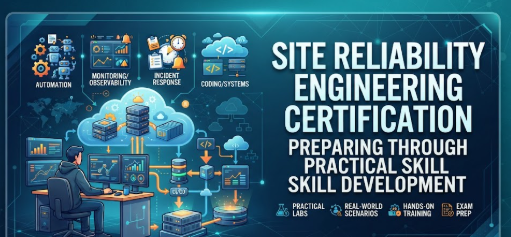
Core Focus Areas in Site Reliability Engineering
Structured reliability education divides operational expertise into distinct, interconnected technical areas:
┌─────────────────────────────────────────────────────────────┐
│                 Site Reliability Engineering                │
├──────────────────────────────┬──────────────────────────────┤
│ 1. Observability & Telemetry │ 2. Infrastructure Automation │
│    - Metrics, Logs, Tracing  │    - Declarative IaC, State  │
├──────────────────────────────┼──────────────────────────────┤
│ 3. Incident Lifecycle Mgmt   │ 4. Toil Reduction & Scripting│
│    - Severity, Blameless RCA │    - Automation, Code Limits │
└──────────────────────────────┴──────────────────────────────┘
1. Observability and Telemetry
Observability is the ability to infer the internal health of a system using only its external outputs. Unlike traditional monitoring—which simply checks whether a server is online or offline—observability tracks:
- Metrics: Numerical data points measured over time, such as CPU utilization, request throughput, and memory consumption.
- Logs: Timestamped records of discrete events containing rich debugging context.
- Distributed Traces: Records tracking a single end-user request through dozens of interconnected microservices, pinpointing exact execution bottlenecks.
2. Infrastructure as Code and Orchestration
Reliability engineers do not configure servers by clicking through cloud web consoles. All servers, network gateways, and security groups are defined in human-readable configuration files. This ensures that infrastructure environments can be version-controlled, tested, reproduced, and torn down cleanly across different cloud regions.
3. Incident Lifecycle and Blameless Postmortems
When a system fails, the priority is rapid service restoration, not root-cause investigations. Once normal operation resumes, teams conduct blameless postmortems. This practice assumes that system failures stem from poor tooling, bad defaults, or brittle architectures—not malicious or incompetent employees. The output is a clear list of concrete software tickets designed to prevent that exact class of failure from reoccurring.
4. Toil Reduction
Google defines “toil” as operational work tied to running a production service that tends to be manual, repetitive, automatable, tactical, and devoid of enduring engineering value. Site Reliability Engineering targets keeping toil below 50% of an engineer’s time, dedicating the remaining 50% purely to software engineering projects that permanently eliminate recurring operational work.
Essential SRE Tools and Ecosystem
Understanding the tools used in reliability engineering helps professionals translate principles into daily workflows.
| Category | Primary Tools | Operational Function | Key Limitation to Remember |
| Observability | Prometheus, Grafana, OpenTelemetry | Collects system performance metrics, aggregates traces, and renders status dashboards. | High data volume can cause steep cloud storage costs and metric lag. |
| Container Orchestration | Kubernetes | Manages lifecycle, scheduling, health checks, and autoscaling for containerized services. | High operational complexity; introduces steep debugging curves. |
| Infrastructure as Code | Terraform, OpenTofu | Declaratively defines cloud infrastructure state across multiple service providers. | State file drift and locking issues can block deployment pipelines. |
| Incident Management | PagerDuty, Opsgenie | Routes automated urgent alerts to on-call engineers based on shift schedules. | Misconfigured alert thresholds lead to engineer alert fatigue and burnout. |
| Chaos Engineering | Chaos Mesh, Gremlin | Injects controlled latency, server crashes, and network drops to verify resilience. | Must never be run in production without mature observability already active. |
Common Mistakes
Treating SRE as a New Label for Traditional Operations
- What happens: An organization renames its system administration team to the “SRE Team” without changing budgets, responsibilities, or tooling.
- Why it happens: Leadership wants modern buzzwords without investing the time and budget required for engineering cultural change.
- The consequence: Engineers remain trapped in manual server updates, alert fatigue worsens, and code reliability fails to improve.
- The solution: Ensure reliability engineers have software development authority and can write production code to remove operational bottlenecks.
Alerting on Everything (Alert Fatigue)
- What happens: Teams configure alerts for every server CPU spike, memory jump, or minor transient error code.
- Why it happens: A fear of missing small bugs leads teams to configure overprotective monitoring alerts.
- The consequence: Engineers receive hundreds of low-priority alerts weekly, begin ignoring notifications, and eventually sleep through critical outages.
- The solution: Alert strictly on user-facing symptoms (such as SLO degradation or high customer latency). Never page an on-call human for an issue that self-heals or can wait until normal business hours.
Setting 100% Availability as the Goal
- What happens: Product managers demand four-nines (99.99%) or absolute zero-downtime guarantees for non-critical internal software.
- Why it happens: Misunderstanding the exponential cost of reliability.
- The consequence: Product release cycles stall completely because every minor code change requires excessive safety checks.
- The solution: Calculate uptime targets based on user perception. If a user connects via an unstable mobile connection with 98% reliability, a background service offering 99.999% availability provides no added benefit while multiplying operating costs.
Comparison and Decision Framework
Selecting the right professional development route depends on your current technical background, time constraints, and career objectives.
| Learning Format | Primary Advantage | Main Limitation | Best Fit For |
| Interactive Online Labs | Real-world troubleshooting practice with live cloud consoles. | Can be disorganized if not structured into an end-to-end curriculum. | Engineers who learn fastest by breaking and fixing systems. |
| Cohort-Based Training | Direct mentorship, code reviews, and mock incident simulations. | Higher financial investment and strict calendar schedules. | Career switchers moving from pure operations into enterprise SRE roles. |
| Vendor Certifications | Demonstrates specific command-line and platform knowledge on resumes. | Focuses on vendor-specific tooling rather than broad reliability design patterns. | Professionals validating platform proficiency for consulting or contract roles. |
| Self-Directed Reading | Minimal financial cost; deep coverage of theoretical system design. | Lacks feedback on live operational errors and software architecture bugs. | Senior developers wanting to adopt specific SRE practices within current teams. |
Practical Implementation Checklist
Use this operational checklist to evaluate whether a team or individual is successfully applying reliability principles:
- SLOs are clearly defined: Every production service has measurable targets backed by customer-focused SLIs.
- Error budgets control releases: Product managers and engineers agree in writing on what happens when error budgets are exhausted.
- Alerts are actionable: Every on-call page links directly to an up-to-date runbook detailing clear triage steps.
- Infrastructure is automated: No human manually modifies production servers via remote command-line sessions.
- Postmortems are blameless: Incident reviews analyze organizational, process, and architectural gaps rather than individual human blame.
- Toil is measured: Teams track recurring manual operational hours and prioritize engineering projects to eliminate them.
Key Terms
- Toil: Repetitive, manual, automatable operational work that scales linearly with service growth and delivers no permanent engineering improvement.
- Error Budget: The mathematically allowed room for failure a system can experience over a set period without violating its Service Level Objective.
- Blameless Postmortem: A formal incident review process that identifies architectural and procedural root causes without punishing individual engineers.
- Circuit Breaker: A software design pattern that halts requests to a failing downstream dependency before that dependency causes the caller application to crash.
- Chaos Engineering: The practice of intentionally introducing controlled failures into a system to identify hidden weaknesses before they cause real-world outages.
- Runbook: A structured guide that documents the precise steps required to diagnose and resolve an operational issue or alert.
- Canary Deployment: A deployment strategy where code updates are initially routed to a tiny percentage of users to verify safety before a full fleet rollout.
- High Availability: A system architecture design that eliminates single points of failure, ensuring services remain accessible even during hardware breakdowns.
Frequently Asked Questions
What is the difference between DevOps and SRE?
DevOps is an organizational culture and philosophy centered on breaking down silos between developers and operations teams to ship code faster. Site Reliability Engineering is a specific implementation of DevOps principles that uses software engineering practices, defined metrics (SLIs and SLOs), and error budgets to balance development speed with system uptime.
Do I need to know how to code to become an SRE?
Yes. Unlike traditional systems administration, reliability engineering requires writing software. You do not need to build complex web applications, but you must be comfortable writing scripts, consuming APIs, automating infrastructure deployments, and reading backend application code to diagnose production bugs. Python, Go, and Bash are the most common languages in this space.
Why is 100% uptime not an ideal goal?
Targeting 100% uptime is economically wasteful and stalls product development. Achieving an extra “nine” of availability (for example, moving from 99.9% to 99.99%) requires massive investments in redundant hardware, complex multi-region networking, and conservative deployment cycles. If users cannot perceive that difference, the extra cost harms the business without helping customers.
How do SREs manage on-call stress?
Effective engineering organizations protect their teams by establishing strict alert routing, requiring automated runbooks for every alert, and limiting on-call shifts. If a system triggers repeated pages throughout the night, the on-call engineer has the authority to declare an operational issue and assign engineering tasks the following day to fix the underlying defect.
What is the role of Kubernetes in Site Reliability Engineering?
Kubernetes is a container orchestration platform that automates container deployment, health checking, horizontal scaling, and self-healing restarts. It handles many routine operational duties automatically, making it a foundational tool in modern cloud reliability engineering.
What makes an incident postmortem successful?
A successful postmortem avoids blaming any single person for making a mistake. It focuses on why the system allowed that mistake to cause widespread damage, what monitoring gaps delayed incident detection, and what automated tests or architectural safeguards must be built to eliminate that failure mode permanently.
How does capacity planning fit into SRE responsibilities?
Capacity planning involves forecasting organic user growth, seasonal traffic spikes, and resource consumption trends. Reliability engineers analyze telemetry data to ensure server clusters, database storage, and network allocations can scale up smoothly without surprising the business with sudden budget spikes or unexpected resource shortages.
Which tools should a beginner learn first?
Beginners should start with foundational technologies: Linux operating system fundamentals, basic computer networking (DNS, TCP/IP, HTTP status codes), and a scripting language like Python or Go. Once comfortable with system basics, move to containerization with Docker, infrastructure automation using Terraform, and metrics collection with Prometheus.
Conclusion
Site Reliability Engineering bridges the traditional divide between building software features and maintaining infrastructure stability. By defining precise service level targets, using error budgets to guide release cycles, and writing software to automate routine administrative tasks, reliability engineers create systems that can scale securely under heavy real-world demands.
Whether you are preparing for formal training, studying for platform certifications, or improving operations inside your current organization, keep your focus on durable engineering habits. Master foundational networking and operating system concepts, learn to measure user happiness through actionable metrics, and always prioritize long-term automation over repetitive manual fixes.