Introduction
HPC Job Schedulers help organizations manage, prioritize, allocate, and optimize compute resources across high-performance computing environments. These platforms are essential for scientific computing, AI model training, engineering simulations, research clusters, rendering farms, financial modeling, genomics, weather forecasting, and other compute-intensive workloads running across distributed infrastructure.
In modern HPC environments, organizations often operate thousands of CPU and GPU nodes shared across multiple teams, departments, or research groups. HPC Job Schedulers automate workload distribution, queue management, resource allocation, workload prioritization, policy enforcement, and cluster utilization optimization to maximize infrastructure efficiency and reduce idle compute resources.
Real-world use cases include:
- Scheduling AI and machine learning training jobs
- Managing scientific simulations across compute clusters
- Orchestrating distributed rendering workloads
- Allocating GPU resources for research teams
- Optimizing compute usage across hybrid HPC environments
Buyers evaluating HPC Job Schedulers should consider:
- Scalability across large compute clusters
- CPU and GPU workload management
- Queue and policy management flexibility
- Multi-tenant workload isolation
- Hybrid and cloud burst support
- Monitoring and observability capabilities
- Integration with HPC and AI ecosystems
- Security and access controls
- Container and Kubernetes compatibility
- Reliability under high job volumes
Best for: Research organizations, AI infrastructure teams, universities, engineering firms, pharmaceutical companies, financial modeling teams, national laboratories, cloud HPC providers, and enterprises operating distributed compute infrastructure.
Not ideal for: Small environments with only a few standalone servers or organizations without large-scale distributed compute requirements.
Key Trends in HPC Job Schedulers
- GPU-aware scheduling is becoming standard for AI and ML workloads.
- Hybrid cloud bursting is improving compute scalability.
- Kubernetes integration with HPC environments is increasing rapidly.
- AI-driven workload optimization is improving cluster utilization.
- Containerized HPC workloads are becoming more common.
- Multi-cluster federation support is expanding across enterprises.
- HPC observability and telemetry analytics are improving.
- Energy-efficient scheduling is becoming more important for sustainability goals.
- Cloud-native orchestration models are influencing HPC environments.
- Fractional GPU allocation and dynamic resource sharing are evolving quickly.
How We Selected These Tools
The tools in this list were selected based on scalability, scheduling flexibility, GPU support, ecosystem maturity, operational reliability, and adoption across HPC and AI environments.
Selection criteria included:
- Cluster scheduling capabilities
- CPU and GPU workload optimization
- Scalability across distributed environments
- Queue management flexibility
- Integration with HPC ecosystems
- Security and workload isolation
- Cloud and hybrid deployment support
- Observability and monitoring features
- Enterprise and research adoption
- Suitability for AI and scientific computing workloads
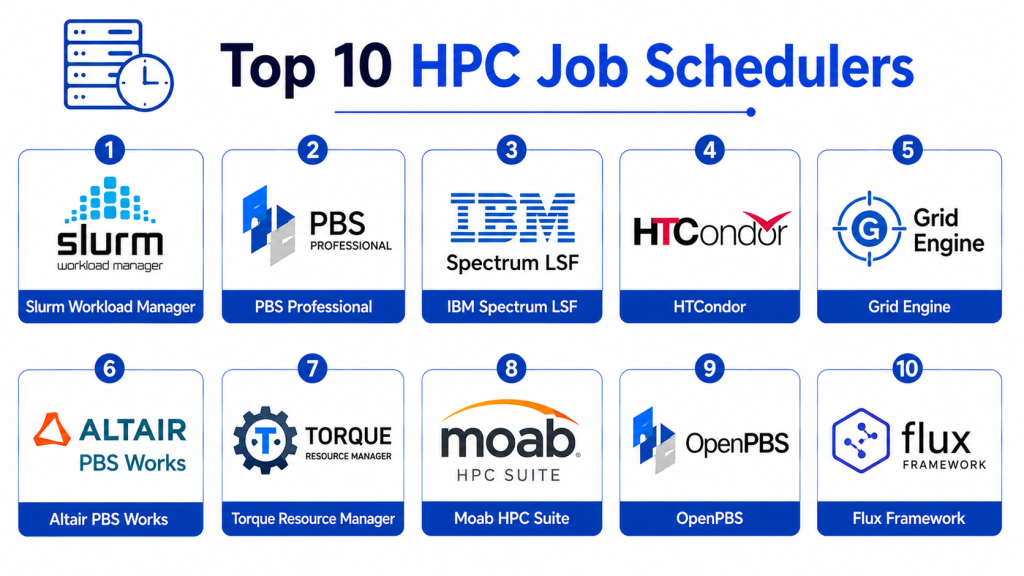
Top 10 HPC Job Schedulers
1- Slurm Workload Manager
Short description: Slurm is one of the most widely used open-source HPC job schedulers for scientific computing, AI training, distributed simulations, and large-scale compute cluster orchestration.
Key Features
- Distributed job scheduling
- GPU-aware workload management
- Multi-user queue management
- Resource reservation controls
- Scalable cluster orchestration
- Job dependency handling
- Advanced workload prioritization
Pros
- Excellent scalability for large HPC clusters
- Strong GPU scheduling support
- Large open-source community adoption
Cons
- Requires operational expertise
- Advanced configurations can become complex
- Less cloud-native than Kubernetes-first platforms
Platforms / Deployment
- Linux / HPC clusters / GPU infrastructure
- Self-hosted / Hybrid
Security & Compliance
- User isolation
- RBAC support
- Audit logging
- Authentication integration
- Workload isolation
Integrations & Ecosystem
Slurm integrates with HPC environments, AI infrastructure, and scientific computing systems.
- NVIDIA GPUs
- MPI frameworks
- AI frameworks
- Monitoring systems
- HPC storage platforms
- Research computing tools
Support & Community
Large HPC ecosystem adoption, extensive documentation, and commercial support providers are available.
2- IBM Spectrum LSF
Short description: IBM Spectrum LSF is an enterprise HPC scheduler optimized for AI, distributed compute, scientific workloads, and hybrid infrastructure orchestration.
Key Features
- Distributed workload scheduling
- AI and GPU workload optimization
- Multi-cluster federation
- Resource utilization analytics
- Policy-based scheduling
- Hybrid cloud bursting
- Advanced queue management
Pros
- Strong enterprise scalability
- Mature workload orchestration capabilities
- Good hybrid infrastructure support
Cons
- Enterprise licensing complexity
- Requires operational expertise
- Premium infrastructure model
Platforms / Deployment
- Linux / HPC clusters / GPU infrastructure
- Self-hosted / Hybrid
Security & Compliance
- RBAC
- Authentication integration
- Audit logging
- Secure workload controls
- Cluster isolation
Integrations & Ecosystem
IBM Spectrum LSF integrates with enterprise HPC and AI infrastructure ecosystems.
- NVIDIA GPUs
- Hybrid cloud infrastructure
- AI frameworks
- HPC storage systems
- Monitoring tools
- Enterprise compute environments
Support & Community
Enterprise support, HPC consulting services, and large-scale operational expertise are available.
3- PBS Professional
Short description: PBS Professional is an HPC job scheduler designed for scientific computing, engineering simulations, AI workloads, and distributed compute management.
Key Features
- Queue-based workload scheduling
- Resource allocation management
- GPU scheduling support
- Job dependency handling
- Policy-driven workload controls
- Cluster monitoring
- Multi-user workload orchestration
Pros
- Strong HPC scheduling capabilities
- Good policy-based workload management
- Mature scheduling ecosystem
Cons
- Requires HPC administration expertise
- Enterprise deployments can become complex
- Cloud-native capabilities are more limited
Platforms / Deployment
- Linux / HPC clusters / Compute infrastructure
- Self-hosted / Hybrid
Security & Compliance
- User isolation
- Authentication integration
- Audit logging
- Queue-level workload controls
Integrations & Ecosystem
PBS Professional integrates with scientific computing and distributed infrastructure environments.
- HPC systems
- AI frameworks
- GPU clusters
- Monitoring tools
- Research computing platforms
- MPI environments
Support & Community
Strong research and enterprise HPC community adoption with operational support availability.
4- HTCondor
Short description: HTCondor is a specialized workload management system optimized for high-throughput computing and distributed scientific workloads.
Key Features
- High-throughput workload scheduling
- Distributed compute orchestration
- Opportunistic resource usage
- Workflow automation
- Multi-site compute support
- Fault-tolerant scheduling
- Policy-driven workload execution
Pros
- Excellent for distributed scientific workloads
- Strong fault-tolerant execution support
- Good resource scavenging capabilities
Cons
- Less optimized for GPU-heavy AI clusters
- Requires distributed computing expertise
- Complex operational tuning
Platforms / Deployment
- Linux / Distributed compute clusters
- Self-hosted / Hybrid
Security & Compliance
- Authentication integration
- User isolation
- Secure workload execution
- Audit logging support
Integrations & Ecosystem
HTCondor integrates with research computing and distributed workload environments.
- Scientific computing systems
- Research clusters
- Monitoring platforms
- Workflow systems
- Distributed compute environments
Support & Community
Strong academic and scientific computing community support with extensive documentation.
5- Altair Grid Engine
Short description: Altair Grid Engine provides distributed workload scheduling and resource management for HPC, AI, rendering, and enterprise compute environments.
Key Features
- Distributed job scheduling
- GPU workload management
- Resource quota controls
- Workload prioritization
- Queue management
- Hybrid infrastructure support
- Multi-user orchestration
Pros
- Strong enterprise workload management
- Good resource optimization capabilities
- Useful hybrid compute support
Cons
- Enterprise operational complexity
- Smaller ecosystem compared to Slurm
- Advanced customization may require expertise
Platforms / Deployment
- Linux / HPC infrastructure / Compute clusters
- Self-hosted / Hybrid
Security & Compliance
- RBAC
- Audit logging
- User isolation
- Authentication integration
- Secure workload controls
Integrations & Ecosystem
Grid Engine integrates with enterprise compute and distributed workload environments.
- GPU systems
- AI frameworks
- Rendering environments
- HPC storage
- Monitoring platforms
- Hybrid infrastructure
Support & Community
Enterprise support, operational consulting, and technical documentation are available.
6- Kubernetes with Volcano Scheduler
Short description: Kubernetes combined with Volcano Scheduler enables batch scheduling and HPC workload orchestration for containerized compute environments.
Key Features
- Kubernetes-native scheduling
- Batch workload orchestration
- GPU-aware scheduling
- Queue-based resource management
- Elastic compute scaling
- Containerized workload support
- Cloud-native orchestration
Pros
- Strong Kubernetes integration
- Good cloud-native scalability
- Useful AI and batch workload support
Cons
- Requires Kubernetes expertise
- HPC-specific tuning may require customization
- Enterprise monitoring may require integrations
Platforms / Deployment
- Linux / Kubernetes / GPU clusters
- Cloud / Self-hosted / Hybrid
Security & Compliance
- Kubernetes RBAC
- Namespace isolation
- Audit logging
- Container isolation
- Identity integration
Integrations & Ecosystem
Volcano integrates with Kubernetes and cloud-native HPC environments.
- Kubernetes
- AI frameworks
- Monitoring platforms
- GPU infrastructure
- DevOps pipelines
- Cloud providers
Support & Community
Growing CNCF ecosystem support and active cloud-native community adoption.
7- Univa Grid Engine
Short description: Univa Grid Engine provides enterprise-grade workload orchestration for AI, HPC, rendering, and large-scale distributed compute environments.
Key Features
- Distributed workload scheduling
- GPU and CPU resource management
- Resource quota policies
- Multi-cluster orchestration
- Hybrid cloud bursting
- Queue prioritization
- Utilization analytics
Pros
- Strong enterprise workload scalability
- Good AI infrastructure support
- Mature scheduling capabilities
Cons
- Enterprise licensing model
- Operational expertise required
- Smaller open-source ecosystem
Platforms / Deployment
- Linux / HPC clusters / Hybrid infrastructure
- Self-hosted / Hybrid
Security & Compliance
- RBAC
- Authentication integration
- Audit logging
- Secure workload scheduling
- Multi-user isolation
Integrations & Ecosystem
Univa integrates with enterprise AI and HPC ecosystems.
- GPU clusters
- Hybrid cloud infrastructure
- AI frameworks
- HPC storage systems
- Monitoring tools
- Enterprise compute environments
Support & Community
Enterprise support and operational consulting services are available.
8- Flux Framework
Short description: Flux Framework is a next-generation HPC workload manager focused on scalable distributed scheduling and modern scientific computing workflows.
Key Features
- Hierarchical scheduling
- Distributed workload orchestration
- Scalable job management
- HPC workflow optimization
- Dynamic resource allocation
- Advanced scheduling policies
- Multi-level resource management
Pros
- Modern HPC scheduling architecture
- Strong scalability potential
- Good distributed workflow flexibility
Cons
- Smaller production adoption footprint
- Requires advanced HPC expertise
- Ecosystem still maturing
Platforms / Deployment
- Linux / HPC infrastructure / Compute clusters
- Self-hosted
Security & Compliance
- User isolation
- Authentication integration
- Secure workload controls
- Audit visibility varies by deployment
Integrations & Ecosystem
Flux integrates with scientific computing and distributed scheduling environments.
- HPC systems
- Scientific workflows
- GPU infrastructure
- Research computing tools
- Monitoring environments
Support & Community
Growing research computing ecosystem and active HPC development community support.
9- Nomad by HashiCorp
Short description: Nomad is a lightweight workload orchestrator supporting distributed compute, GPU scheduling, batch workloads, and hybrid infrastructure orchestration.
Key Features
- Lightweight workload scheduling
- GPU-aware orchestration
- Multi-region deployment support
- Hybrid infrastructure management
- Batch workload scheduling
- Resource allocation controls
- Container orchestration
Pros
- Simpler operational model than Kubernetes
- Good hybrid infrastructure flexibility
- Lightweight deployment architecture
Cons
- Smaller HPC ecosystem
- Less specialized for scientific computing
- Advanced AI workflows may require integrations
Platforms / Deployment
- Linux / GPU clusters / Cloud infrastructure
- Cloud / Self-hosted / Hybrid
Security & Compliance
- ACL controls
- Encryption
- Audit logging
- Workload isolation
- Secure service communication
Integrations & Ecosystem
Nomad integrates with distributed infrastructure and cloud-native compute environments.
- Docker
- GPU infrastructure
- Consul
- Vault
- Monitoring systems
- Hybrid cloud environments
Support & Community
Strong HashiCorp ecosystem support and growing infrastructure automation adoption.
10- Oracle Grid Engine
Short description: Oracle Grid Engine helps organizations manage distributed compute workloads, HPC scheduling, and enterprise batch processing across large compute environments.
Key Features
- Distributed job scheduling
- Resource allocation controls
- Queue management
- Multi-user workload orchestration
- HPC workload support
- Resource prioritization
- Enterprise compute scheduling
Pros
- Mature distributed scheduling capabilities
- Good enterprise workload support
- Useful policy-driven orchestration
Cons
- Enterprise operational complexity
- Smaller modern ecosystem adoption
- Less cloud-native flexibility
Platforms / Deployment
- Linux / Compute clusters / HPC infrastructure
- Self-hosted / Hybrid
Security & Compliance
- RBAC
- Audit logging
- User isolation
- Authentication integration
- Secure workload controls
Integrations & Ecosystem
Oracle Grid Engine integrates with enterprise distributed compute environments.
- HPC infrastructure
- Enterprise systems
- GPU environments
- Monitoring platforms
- Storage systems
- Batch compute workflows
Support & Community
Enterprise support and distributed compute operational guidance are available.
Comparison Table
| Tool Name | Best For | Platforms Supported | Deployment | Standout Feature | Public Rating |
|---|---|---|---|---|---|
| Slurm Workload Manager | Large HPC and AI clusters | Linux / HPC clusters | Self-hosted / Hybrid | Large-scale HPC scheduling | N/A |
| IBM Spectrum LSF | Enterprise AI and HPC | Linux / GPU infrastructure | Self-hosted / Hybrid | Hybrid workload optimization | N/A |
| PBS Professional | Scientific compute orchestration | Linux / Compute clusters | Self-hosted / Hybrid | Policy-driven scheduling | N/A |
| HTCondor | High-throughput distributed workloads | Linux / Distributed clusters | Self-hosted / Hybrid | Opportunistic workload execution | N/A |
| Altair Grid Engine | Enterprise distributed compute | Linux / HPC infrastructure | Self-hosted / Hybrid | Resource optimization controls | N/A |
| Kubernetes with Volcano Scheduler | Cloud-native HPC orchestration | Kubernetes / GPU clusters | Cloud / Self-hosted / Hybrid | Containerized HPC scheduling | N/A |
| Univa Grid Engine | AI and hybrid scheduling | Linux / Hybrid infrastructure | Self-hosted / Hybrid | Multi-cluster orchestration | N/A |
| Flux Framework | Next-generation HPC scheduling | Linux / HPC clusters | Self-hosted | Hierarchical scheduling | N/A |
| Nomad by HashiCorp | Lightweight hybrid orchestration | Linux / Cloud infrastructure | Cloud / Self-hosted / Hybrid | Lightweight distributed orchestration | N/A |
| Oracle Grid Engine | Enterprise batch scheduling | Linux / HPC infrastructure | Self-hosted / Hybrid | Enterprise workload orchestration | N/A |
Evaluation & Scoring of HPC Job Schedulers
| Tool Name | Core 25% | Ease 15% | Integrations 15% | Security 10% | Performance 10% | Support 10% | Value 15% | Weighted Total |
|---|---|---|---|---|---|---|---|---|
| Slurm Workload Manager | 9.5 | 7.4 | 8.9 | 8.9 | 9.5 | 9.0 | 9.2 | 9.06 |
| IBM Spectrum LSF | 9.3 | 7.2 | 8.8 | 9.1 | 9.4 | 8.9 | 7.9 | 8.81 |
| PBS Professional | 9.0 | 7.1 | 8.5 | 8.8 | 9.1 | 8.7 | 8.4 | 8.59 |
| HTCondor | 8.7 | 7.0 | 8.3 | 8.5 | 8.9 | 8.6 | 9.0 | 8.47 |
| Altair Grid Engine | 8.8 | 7.3 | 8.4 | 8.8 | 8.9 | 8.5 | 8.2 | 8.46 |
| Kubernetes with Volcano Scheduler | 8.9 | 7.5 | 9.1 | 8.9 | 9.0 | 8.6 | 8.7 | 8.74 |
| Univa Grid Engine | 8.9 | 7.2 | 8.5 | 8.8 | 9.0 | 8.5 | 8.1 | 8.49 |
| Flux Framework | 8.5 | 6.9 | 8.2 | 8.4 | 8.9 | 8.1 | 8.8 | 8.27 |
| Nomad by HashiCorp | 8.4 | 8.0 | 8.3 | 8.8 | 8.5 | 8.4 | 8.9 | 8.43 |
| Oracle Grid Engine | 8.5 | 7.1 | 8.2 | 8.6 | 8.7 | 8.3 | 8.0 | 8.19 |
These scores are comparative and intended to help organizations evaluate operational fit rather than identify a universal winner. Traditional HPC schedulers score highly for scientific computing scalability and mature workload controls, while cloud-native schedulers provide stronger container and hybrid infrastructure integration. Buyers should align scheduler selection with workload type, infrastructure architecture, AI adoption, and operational expertise.
Which HPC Job Scheduler Is Right for You?
Solo / Freelancer
Independent researchers and small compute teams often prioritize open-source flexibility and manageable infrastructure complexity. Slurm and Nomad are practical choices for smaller clusters and experimental environments.
SMB
SMBs usually need scalable workload orchestration and manageable operational overhead without enterprise-level complexity. Kubernetes with Volcano Scheduler and PBS Professional provide strong scheduling capabilities for growing compute environments.
Mid-Market
Mid-sized organizations often require stronger GPU orchestration, hybrid cloud support, and multi-user scheduling controls. Slurm, Kubernetes with Volcano Scheduler, and Univa Grid Engine are strong options for expanding HPC operations.
Enterprise
Large enterprises and national-scale research organizations typically require high-scale distributed scheduling, advanced workload policies, multi-cluster federation, and hybrid compute orchestration. Slurm, IBM Spectrum LSF, PBS Professional, and Altair Grid Engine are strong enterprise-focused solutions.
Budget vs Premium
Open-source platforms such as Slurm, HTCondor, Flux, and Volcano Scheduler reduce licensing costs while requiring operational expertise. Enterprise schedulers such as IBM Spectrum LSF and Altair Grid Engine provide stronger support and governance capabilities with higher infrastructure investment.
Feature Depth vs Ease of Use
Traditional HPC schedulers provide mature workload controls and scientific computing optimization, while cloud-native schedulers simplify container orchestration and hybrid infrastructure integration.
Integrations & Scalability
Organizations already invested in Kubernetes, NVIDIA GPU clusters, enterprise HPC infrastructure, or hybrid cloud environments should prioritize schedulers aligned with existing infrastructure ecosystems.
Security & Compliance Needs
Security-focused compute environments should prioritize workload isolation, RBAC, audit logging, secure authentication integration, and policy-based resource controls. Enterprise schedulers and Kubernetes-native orchestration environments provide stronger governance capabilities.
Frequently Asked Questions
1. What is an HPC Job Scheduler?
An HPC Job Scheduler manages the execution, prioritization, allocation, and orchestration of workloads across distributed high-performance computing environments.
2. Why are HPC schedulers important?
They improve compute utilization, automate workload management, optimize resource allocation, reduce idle infrastructure, and simplify distributed workload orchestration.
3. What workloads commonly use HPC schedulers?
Scientific simulations, AI model training, rendering, genomics, financial modeling, engineering analysis, weather forecasting, and large-scale data analytics commonly rely on HPC schedulers.
4. What is queue-based scheduling?
Queue-based scheduling prioritizes workloads using policies, resource availability, user quotas, and job priorities to optimize compute cluster efficiency.
5. What is cloud bursting in HPC?
Cloud bursting allows HPC workloads to expand into cloud infrastructure when on-premises resources become insufficient or overloaded.
6. What are common implementation mistakes?
Common mistakes include weak queue policies, poor observability, inefficient resource quotas, lack of GPU scheduling optimization, and inadequate workload isolation.
7. Can HPC schedulers support AI workloads?
Yes. Modern HPC schedulers increasingly support GPU scheduling, AI training orchestration, distributed inference, and machine learning workflows.
8. What integrations are most important?
Important integrations include GPU management systems, Kubernetes, AI frameworks, monitoring platforms, HPC storage systems, authentication services, and distributed compute environments.
9. Should organizations choose traditional HPC schedulers or cloud-native schedulers?
Traditional schedulers are better for scientific computing and mature HPC operations, while cloud-native schedulers are stronger for containerized AI and hybrid infrastructure environments.
10. What should buyers evaluate before selecting an HPC scheduler?
Buyers should evaluate scalability, workload flexibility, GPU support, security controls, hybrid infrastructure compatibility, observability, operational complexity, and long-term infrastructure strategy.
Conclusion
HPC Job Schedulers are essential for organizations operating distributed compute infrastructure, scientific research environments, AI training platforms, and large-scale engineering workloads. The right scheduler can improve infrastructure utilization, optimize GPU and CPU resource allocation, simplify workload orchestration, and strengthen operational efficiency across complex compute environments. Slurm Workload Manager remains a leading choice for large-scale HPC and AI clusters, while IBM Spectrum LSF and PBS Professional provide mature enterprise scheduling capabilities. HTCondor excels in high-throughput scientific workloads, Kubernetes with Volcano Scheduler strengthens cloud-native orchestration, and Nomad offers lightweight hybrid infrastructure flexibility. Altair Grid Engine, Univa Grid Engine, Oracle Grid Engine, and Flux Framework further expand enterprise and next-generation HPC scheduling options. The best choice depends on infrastructure architecture, AI adoption strategy, operational expertise, cloud integration requirements, and workload complexity. Shortlist two or three schedulers, validate queue management and workload orchestration performance in real environments, test observability and resource policies carefully, and ensure the chosen solution can scale effectively with long-term compute infrastructure growth.
I like how different schedulers are compared clearly, making evaluation easier for enterprise and research computing environments today.